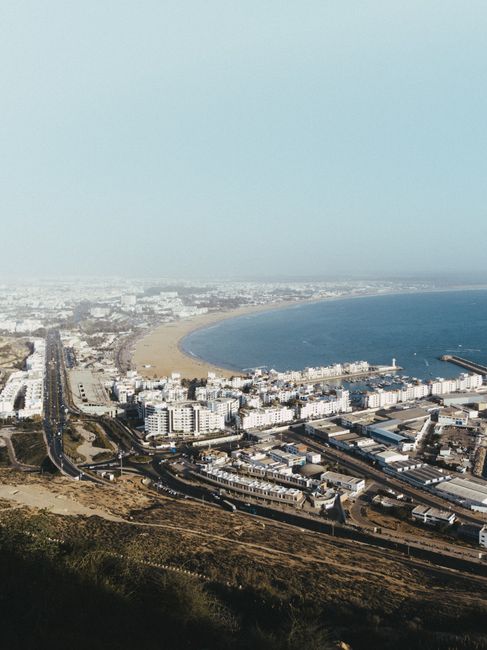
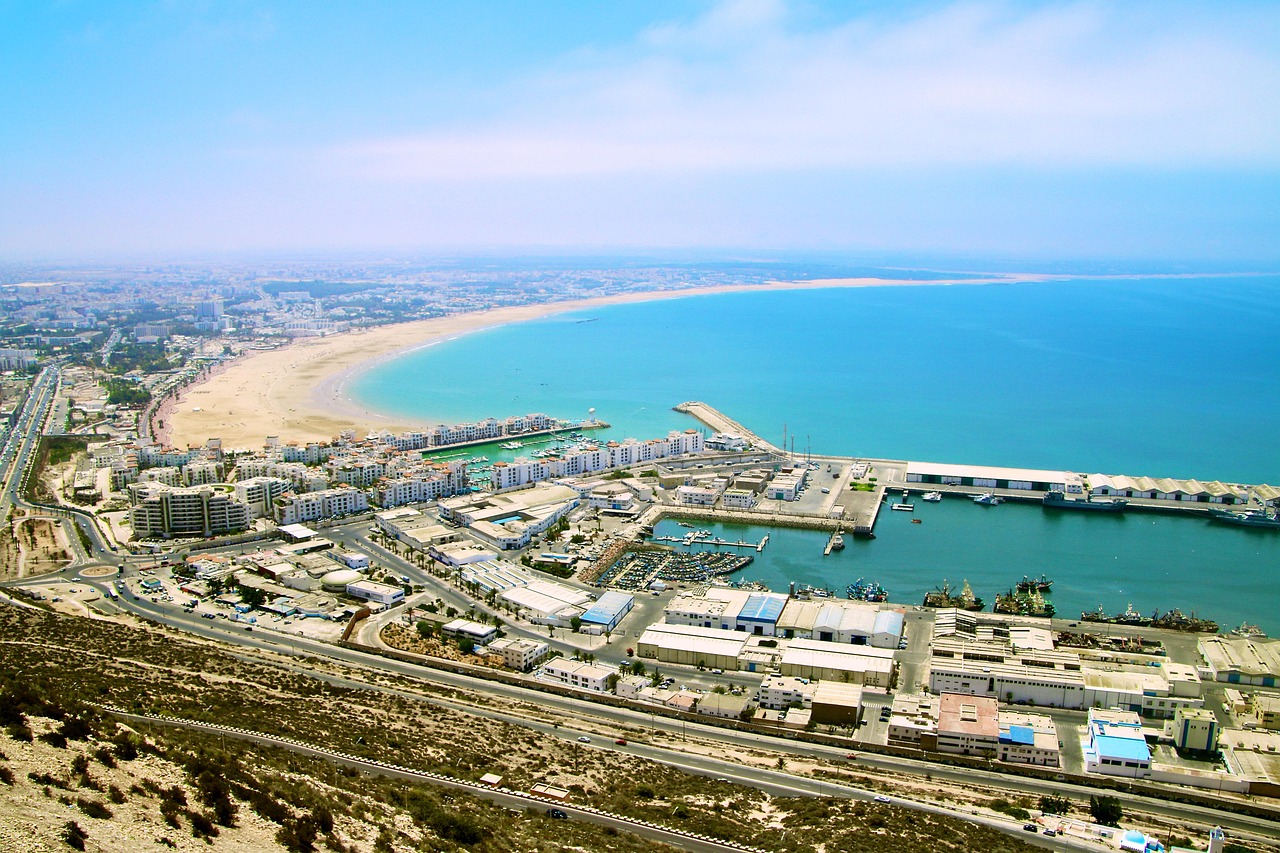
Agadir is Morocco’s biggest beach resort and, after Marrakech, its busiest destination for hotel stays. Spread around a wide, sheltered bay on the Atlantic coast of the Souss-Massa region, it has a long sandy beach backed by a promenade, more sunshine than almost anywhere in Europe in winter, and a climate that rarely gets too hot or too cold. The city looks modern because it is: a devastating earthquake in 1960 destroyed old Agadir, and the city was rebuilt a little to the south. On the hill above, the ruined walls of the Kasbah of Agadir Oufella mark the old town, with sweeping views over the bay and the port. Agadir is a base for surfing at Taghazout and the coast to the north, for the palm-filled gorges of Paradise Valley, for the walled town of Taroudant, for bird-watching in Souss-Massa National Park, and for visiting the women’s cooperatives that make argan oil from the trees that grow only in this part of the world. It’s a relaxed, family-friendly place to unwind at the end of a Moroccan tour, or for a winter sun break. Swimming is best from June to October.
Right now in Agadir
- Wed 20–28°C 68–82°F Mostly clear
- Thu 19–25°C 66–78°F Clear
- Fri 19–24°C 66–75°F Mostly clear
Weather: MET Norway (CC BY 4.0) · Sea temperature: NOAA CoastWatch
Top tours in Agadir
See all tours for Agadir →
From local operators, with prices and reviews; you check availability and book on Viator, our partner. We may earn a commission at no extra cost to you. How we earn money
Agadir at a glance
- Best for: beach holidays, winter sun, surfing nearby, golf, argan cooperatives and easy trips into the Souss valley and the Anti-Atlas.
- How long: 4–7 days for a beach stay; 2–3 days at the end of a tour.
- Best time: all year for sunshine; June to October for warmer sea; winter for mild, sunny days.
- Getting there: fly into Agadir Al Massira (AGA), or take a bus from Marrakech (about 3–3.5 hours) or Essaouira.
- Getting around: walk the seafront; petit taxis, ride-hailing apps and grand taxis for Taghazout and further.
- Good to know: there is no train to Agadir; ONCF’s Supratours buses connect with trains in Marrakech.
- Before you go: visas, money and general safety are in our Morocco travel guide.
Agadir’s areas and where to stay
Agadir is easy to understand: the beach and the hotel zone run along the bay, the modern city center lies just inland, and the port, the marina and the Kasbah hill are at the northern end. Resort areas and surf villages continue up the coast.
The beachfront and hotel zone
Most visitors stay in the hotel zone (secteur touristique) along the promenade, where large resorts, all-inclusive hotels and apartment hotels face the beach. It’s flat, walkable and lively in the evening, with cafés and restaurants on the seafront.
The marina and the city center
The marina, at the northern end of the beach below the Kasbah, has modern apartments, restaurants and yachts. The city center, around Avenue Hassan II and Place Al Amal, has shops, cafés and local restaurants, and the Souk El Had market is a short taxi ride inland.
Founty and the south
South of the center, Founty and the newer resort areas toward the Souss river mouth have quieter, upscale hotels, golf courses and wide beaches.
Taghazout and the surf coast
About 20 km (12 miles) north, the former fishing village of Taghazout and neighboring Tamraght have surf camps, guesthouses and yoga retreats, and Taghazout Bay is a newer resort with large hotels and a golf course.
Where to stay in Agadir
- Hotel zone on the beach: resort and all-inclusive hotels, walkable to everything.
- Marina: apartments and restaurants with harbor views.
- Founty: quieter, upscale hotels and golf.
- Taghazout or Tamraght: surf camps and guesthouses for surfers and yoga lovers.
- Taroudant or the Souss countryside: riads and kasbah hotels inland.
Top things to see in Agadir
The beach and the promenade
Agadir’s main beach curves for several kilometers around the bay, with fine sand, beach clubs, camel and horse rides, and a long paved promenade that is the place to be at sunset. The bay is more sheltered than most of Morocco’s Atlantic coast, so the water is calmer, but there are still waves and currents, and lifeguards are on duty only in season. Sunbeds and umbrellas can be rented from beach clubs, and many hotels have private sections of beach. Early mornings are the time for joggers, walkers and fishermen, while families fill the sand in the late afternoon.
The Kasbah of Agadir Oufella
The walls of the 16th-century Kasbah of Agadir Oufella, on a hill about 230 m (750 ft) above the port, are almost all that survived the earthquake. The views over the bay, the port and the city are superb, especially at sunset, and the words “God, Country, King” are written in Arabic on the hillside below. You can drive or take a taxi up, or ride the cable car from the city.
Museum of the Reconstruction of Agadir
This small museum tells the story of the earthquake of 29 February 1960, which destroyed the old town in seconds, and of the rebuilding of the city, with photographs and plans. According to the National Museums Foundation, entry costs MAD 50 (about US$5) for foreign visitors, and it opens daily except Tuesday, from 10 a.m. to 6 p.m.
Souk El Had
Souk El Had, one of the largest markets in Morocco, fills a walled enclosure with thousands of stalls selling fruit and vegetables, spices, olives, argan oil, clothes, leather, carpets and crafts. It’s a real local market rather than a tourist souk, and prices are fair; it is usually closed on Mondays.
Agadir Art Museum and the Amazigh heritage
The Agadir Art Museum, run by the National Museums Foundation, shows modern and contemporary Moroccan art (MAD 40 for foreign visitors; Tuesday to Sunday, 10 a.m. to 6 p.m.). The region is a heartland of Amazigh (Berber) culture, and you’ll see the Tifinagh alphabet on public signs.
The port and the fish market
At the working fishing port, blue boats unload sardines and other catch, and a row of simple grill restaurants serves fresh fish by weight at lunchtime.
Crocoparc and the gardens
Families enjoy Crocoparc, a crocodile park and botanical garden on the road toward the airport, and the Olhão Garden in the center, which commemorates the friendship with the Portuguese town of Olhão.
Other things to do in Agadir
Surfing
The coast north of Agadir is one of the best surf areas in Africa. Taghazout has famous right-hand point breaks such as Anchor Point for experienced surfers, while beaches such as Panorama and Banana Point suit beginners with lessons. The best waves arrive from October to April. See our surfing guide and our wetsuits guide.
Food and drink
Agadir’s food is fresh and simple: grilled sardines and fish at the port, tagines with argan oil, amlou (a spread of argan oil, almonds and honey) at breakfast, and seafood in the marina’s restaurants. Alcohol is widely available in hotels, bars and restaurants in the tourist zone.
Argan cooperatives
The argan tree grows almost only in southwest Morocco, and UNESCO lists the knowledge and practices related to it as Intangible Cultural Heritage. Women’s cooperatives on the roads to Essaouira and Taroudant show how the nuts are cracked and pressed by hand into cooking and cosmetic oil; buy directly from a cooperative to support local women. You may see goats climbing argan trees along the road; many of these scenes are staged for photos and tips.
Hammams, spas and thalasso
Many resort hotels have spas with a traditional hammam scrub and argan-oil massage, and Agadir has several thalassotherapy centers using seawater treatments. Local public hammams in the city center are cheaper and more traditional, separated by gender.
Golf, quad bikes and boat trips
Agadir has several golf courses, and operators offer quad and buggy rides in the dunes south of the city, horseback rides on the beach, and boat trips and fishing from the marina. See our boat trips guide.
Day trips from Agadir
- Paradise Valley: palm-lined gorges and rock pools in the foothills of the High Atlas, about 30 km (19 miles) northeast; best after spring rains.
- Taroudant: a walled market town with complete ocher ramparts, often called “little Marrakech,” about 80 km (50 miles) east.
- Souss-Massa National Park: coastal dunes and estuaries south of the city, with flamingos and the rare northern bald ibis.
- Tiznit and Legzira: the silver jewelry souks of Tiznit and the red cliffs of Legzira beach, about 1.5–2 hours south.
- Imsouane: a fishing village with one of Morocco’s longest surf waves, about 1.5 hours north.
- Essaouira: about 3 hours north along the coast; see our Essaouira guide.
Nearby destinations
- Essaouira123 km
- Marrakech203 km
- Ouarzazate261 km
Getting there and getting around
By air
Agadir Al Massira Airport (AGA), about 25 km (16 miles) southeast of the center, has flights from many European cities, often seasonal, and domestic links with Casablanca. Taxis and hotel transfers take about 30 minutes to the hotel zone.
By bus and road
Agadir has no train station. Supratours, ONCF’s coach company, runs buses from Marrakech station, timed with trains, and CTM and other companies link Agadir with Marrakech, Essaouira, Casablanca and the south. The motorway to Marrakech takes about 3–3.5 hours by car.
Getting around
The hotel zone and seafront are walkable, and petit taxis run within the city; insist on the meter. City buses serve the center and the suburbs, ride-hailing apps work, and shared grand taxis run to Taghazout, Inezgane and further.
When to go and how long to stay
Agadir has one of the mildest climates in Morocco, with sunshine most of the year. Daytime highs stay between about 21 °C (70 °F) in January and 27 °C (81 °F) in August, thanks to the cool Atlantic current, though hot desert winds can push temperatures much higher for a few days. Nights in winter drop to about 8 °C (47 °F), so bring a warm layer. Rain is rare and falls mostly between November and March. The sea is coolest in winter and warmest in September and October. The table uses the 1991–2020 climate normals for the Agadir-Inezgane station of Morocco’s General Directorate of Meteorology (DGM), as published by the World Meteorological Organization (WMO): average daily highs and lows, total precipitation, and days with at least 1 mm of rain.
| Month | Average high / low | Rain (days with 1 mm or more) | What to expect |
|---|---|---|---|
| January | 21 °C (70 °F) / 8 °C (47 °F) | 32 mm (1.3 in), 3 days | Sunny, mild days; cool nights; winter sun season |
| February | 22 °C (72 °F) / 10 °C (50 °F) | 29 mm (1.1 in), 3 days | Sunny and mild; good surf |
| March | 23 °C (74 °F) / 12 °C (54 °F) | 31 mm (1.2 in), 3 days | Pleasant; a few showers |
| April | 23 °C (74 °F) / 14 °C (57 °F) | 14 mm (0.5 in), 2 days | Pleasant; spring flowers inland |
| May | 24 °C (76 °F) / 16 °C (61 °F) | 6 mm (0.2 in), 1 day | Warm and dry |
| June | 26 °C (78 °F) / 18 °C (65 °F) | 1 mm (under 0.1 in), 0 days | Warm; morning cloud possible |
| July | 27 °C (80 °F) / 19 °C (67 °F) | under 1 mm, 0 days | Warm and dry; busy with summer visitors |
| August | 27 °C (81 °F) / 20 °C (67 °F) | 3 mm (0.1 in), 0 days | Warmest month; busiest beaches |
| September | 26 °C (79 °F) / 19 °C (65 °F) | 4 mm (0.1 in), 0 days | Warm sea; excellent |
| October | 26 °C (79 °F) / 17 °C (62 °F) | 21 mm (0.8 in), 2 days | Warm sea and dry days; surf season starts |
| November | 24 °C (75 °F) / 13 °C (55 °F) | 42 mm (1.7 in), 3 days | Mild; occasional rain |
| December | 22 °C (72 °F) / 10 °C (50 °F) | 49 mm (1.9 in), 4 days | Mild days; the wettest month |
Agadir receives about 230 mm (9 in) of rain a year, falling on about 21 days.
Events worth planning around
Summer and the school holidays bring Moroccan families to the beach, and European winter holidays bring sun-seekers from November to March. During Ramadan, expected to begin in early February 2027, resort hotels operate normally, but local restaurants may open only after sunset.
A week in Agadir
Spend most days on the beach and the promenade, with a sunset at the Kasbah, a morning at Souk El Had and the reconstruction museum, a surf lesson in Taghazout, a day in Paradise Valley, and a trip to Taroudant or Souss-Massa National Park.
Three days at the end of a tour
Day one, the beach and promenade, with lunch at the port and sunset from the Kasbah. Day two, Souk El Had in the morning, the reconstruction museum, and an afternoon surf lesson or yoga class in Taghazout. Day three, Paradise Valley or Taroudant, back in time for dinner at the marina.
What a trip to Agadir costs
Prices are approximate, for October 2026, converted at about MAD 9.85 to the US dollar (Bank Al-Maghrib reference rate).
| Item | Typical cost |
|---|---|
| Museum of the Reconstruction (foreign visitor) | MAD 50 (about US$5) |
| Grilled fish lunch at the port | MAD 60–150 (about US$6–15) |
| Mid-range restaurant dinner | MAD 150–350 (about US$15–36) |
| Surf lesson with board and wetsuit, half day | MAD 250–450 (about US$25–46) |
| Petit taxi in town | MAD 10–30 (about US$1–3) |
| Grand taxi seat to Taghazout | MAD 10–20 (about US$1–2) |
| Mid-range hotel double, per night | MAD 700–1,600 (about US$70–160) |
Practical tips for Agadir
- Swim at lifeguarded beaches: and follow the flags.
- Visit Souk El Had early: and avoid Mondays, when it’s usually closed.
- Buy argan oil from cooperatives: check that the bottle is labeled and sealed.
- Plan onward travel by bus: Supratours links with trains in Marrakech.
- Pack a warm layer: evenings are cool in winter.
Safety in Agadir
Agadir is one of Morocco’s most relaxed and safe destinations. Take normal care against pickpockets on the beach and in the souk, and don’t leave valuables unattended on the sand. The main risks are in the water: the Atlantic has waves, rip currents and cold water even in the bay, so swim only where lifeguards are present, usually in summer, and follow their flags. At Taghazout and other surf spots, waves break over rock and reef; beginners should surf only with a qualified school on sandy beaches, wear a leash and booties where needed, and respect other surfers. Quad bike and buggy accidents are common, so wear a helmet and use reputable operators. Strong sun is a risk even when the breeze feels cool. Inland, the 2023 Al Haouz earthquake also damaged villages in Taroudant province in the High Atlas, where reconstruction continues; the main roads and towns are open. In an emergency, call 190 for the police and 150 for an ambulance or fire.
What to pack for Agadir
Swimwear, high-factor sunscreen, a sun hat and sunglasses, light clothes, a cover-up for town, a sweater or light jacket for evenings, water shoes for rocky beaches, and a wetsuit if you plan to surf in winter. Morocco uses 220 V with two-pin European sockets. See our water shoes and travel adapters guides.
Agadir travel FAQ
Is Agadir good for a beach holiday?
Yes. It has a long, sandy, relatively sheltered beach, a seafront promenade, many resort hotels and mild, sunny weather all year.
When is the sea warm enough to swim in Agadir?
From about June to October; the Atlantic is cool in winter, though many hotels have heated pools.
Is there a train to Agadir?
No. Take the train to Marrakech and a Supratours bus to Agadir, about 3–3.5 hours, or fly into Agadir Al Massira.
How far is Taghazout from Agadir?
About 20 km (12 miles) north, around 30 minutes by taxi.
Is Agadir good for surfing?
The surf is north of the city, at Taghazout, Tamraght and Imsouane, with waves for all levels and the best season from October to April.
What happened to old Agadir?
The earthquake of 29 February 1960 destroyed the old town and the Kasbah; the city was rebuilt to the south, and the Museum of the Reconstruction tells its story.
How do I get from Agadir to Marrakech?
By bus or car in about 3–3.5 hours on the motorway.
Is Agadir safe?
Yes, it’s one of Morocco’s most relaxed destinations. The main risks are strong currents in the sea and quad-bike accidents.
How many days do I need in Agadir?
Four to seven days for a beach stay with a few excursions, or two to three days at the end of a tour.
Is Agadir a 2030 World Cup host city?
Yes. Morocco co-hosts the 2030 World Cup with Spain and Portugal, and Agadir’s Grand Stadium is one of the planned venues.
Sources and last review
Researched and last reviewed on 5 October 2026. Museum prices and hours: the National Museums Foundation; earthquake reconstruction in Taroudant province: the Moroccan government portal; the 2030 World Cup: the Moroccan government portals; Supratours and the absence of a rail line to Agadir: the Moroccan National Tourist Office; emergency numbers and water and quad-bike safety: the UK government’s factual safety pages, used for practical facts only; the exchange rate: Bank Al-Maghrib; climate normals: Morocco’s General Directorate of Meteorology via the World Meteorological Organization’s 1991–2020 normals (Agadir-Inezgane station). The 1960 earthquake, the Kasbah, the cable car, Souk El Had, argan and the UNESCO listing, surf seasons, distances, travel times and typical prices are general references or estimates, flagged for checking. Prices and rules change, so check locally before you go. For visas, money and general safety, see our Morocco travel guide.
Plan your trip
Partner links: TravelerCenter may earn a commission if you book, at no extra cost to you.
🇪🇬 Useful Arabic phrases for Agadir
All 38 Arabic phrases: restaurant, hotel, emergencies, romance (printable) →