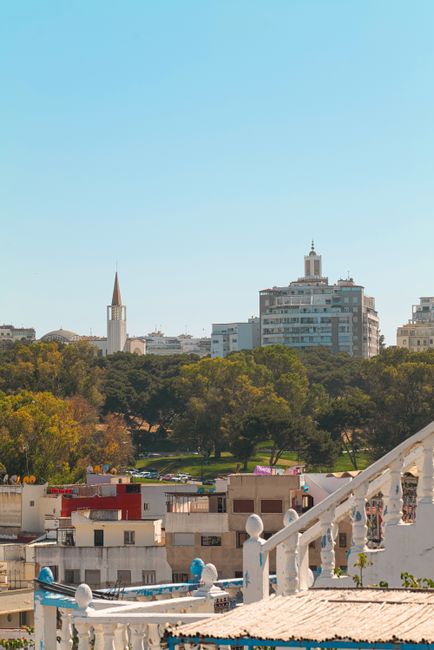
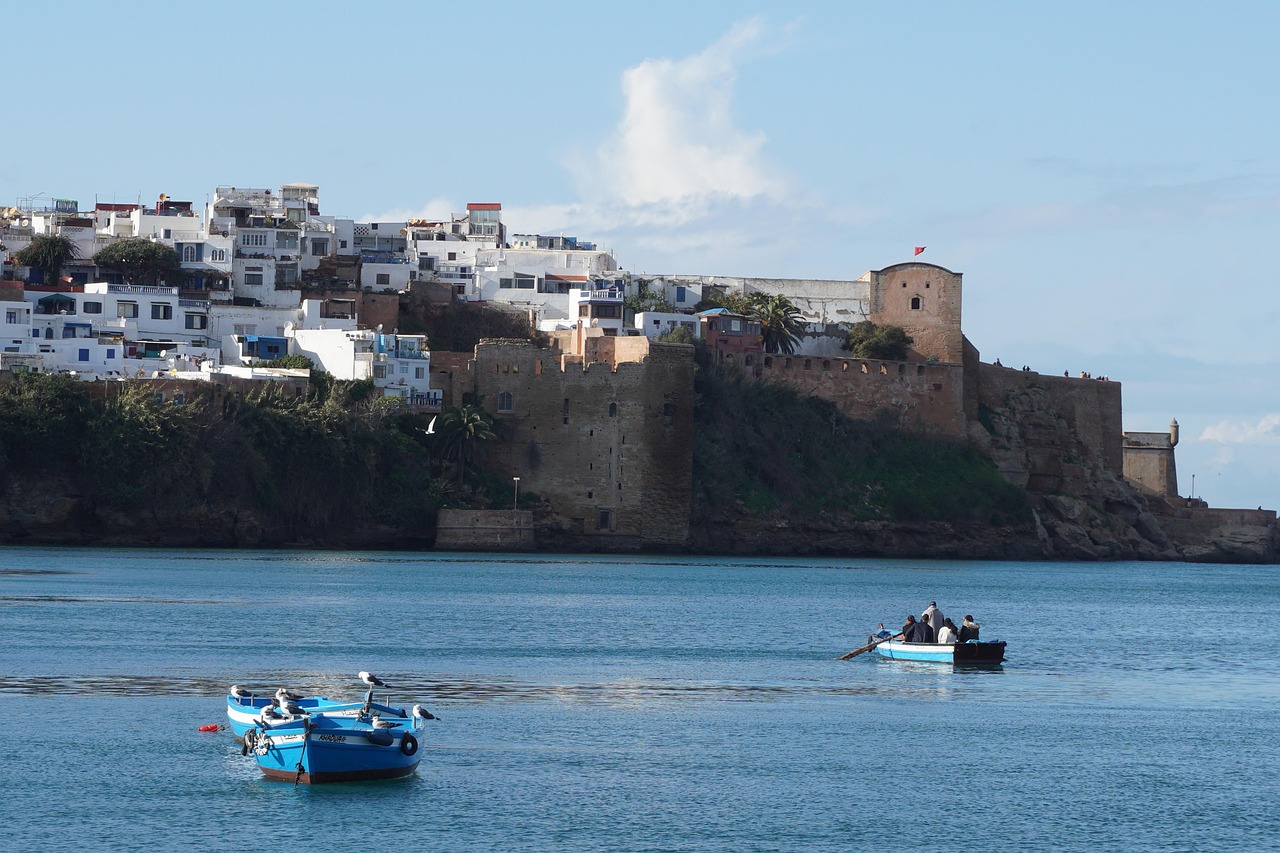
Rabat, Morocco’s capital, is the country’s most relaxed big city: clean, green and walkable, with a whitewashed kasbah above the Atlantic, a calm medina and some of the best museums in North Africa. It sits at the mouth of the Bou Regreg river, facing its twin city of Salé across the water, and its mix of 12th-century Almohad monuments, Marinid ruins and early 20th-century boulevards is listed by UNESCO as “Rabat, Modern Capital and Historic City: a Shared Heritage” (2012). Highlights include the blue-and-white lanes and Andalusian garden of the Kasbah of the Udayas, the unfinished Hassan Tower and the royal Mausoleum of Mohammed V, the overgrown Roman and Marinid ruins of the Chellah, and the modern art of the Mohammed VI Museum. Rabat has far fewer touts than Marrakech or Fez, which makes it a gentle introduction to Morocco, and it’s on the Al Boraq high-speed line between Casablanca and Tangier. Rabat is also a host city for the 2030 World Cup, and its rebuilt Prince Moulay Abdellah Stadium hosted matches of the 2025 Africa Cup of Nations. The climate is mild all year.
Right now in Rabat
- Wed 19–24°C 67–76°F Clear
- Thu 18–24°C 64–75°F 1 mm Partly cloudy
- Fri 17–23°C 62–73°F 1 mm Mostly clear
Weather: MET Norway (CC BY 4.0) · Sea temperature: NOAA CoastWatch
Top tours in Rabat
See all tours for Rabat →
From local operators, with prices and reviews; you check availability and book on Viator, our partner. We may earn a commission at no extra cost to you. How we earn money
Rabat at a glance
- Best for: the Kasbah of the Udayas, Almohad and Marinid monuments, museums, a relaxed medina, the riverfront and the beach.
- How long: 1–2 full days; 3 with Salé and a day trip.
- Best time: April to June and September to October; mild all year.
- Getting there: Al Boraq from Tangier or Casablanca to Rabat Agdal, conventional trains to Rabat Ville, or fly into Rabat-Salé (RBA).
- Getting around: on foot, by tram (Rabat–Salé), petit taxi or ride-hailing app.
- Good to know: many museums close on Tuesdays; the Mausoleum of Mohammed V is free.
- Before you go: visas, money and general safety are in our Morocco travel guide.
Rabat’s areas and where to stay
Rabat is easy to understand: the old medina and the Kasbah of the Udayas sit on the coast at the river mouth; the Ville Nouvelle spreads south with government buildings, avenues and the Rabat Ville station; and the residential districts of Agdal and Hassan lie beyond, with Salé across the bridge.
The medina and the Kasbah
The small medina has riads and guesthouses, lively streets such as Rue Souika and the Rue des Consuls with its carpet and craft shops, and food stalls. Staying in the Kasbah of the Udayas itself, in one of a handful of guesthouses, is a special experience with ocean views.
Ville Nouvelle and Hassan
The Ville Nouvelle, laid out under the French protectorate around Avenue Mohammed V, has Art Deco and Neo-Moorish buildings, mid-range hotels, cafés and the Rabat Ville station. The Hassan district, near the Hassan Tower, has business hotels and is walkable to the main sights.
Agdal and the Bou Regreg
Agdal, around the Rabat Agdal high-speed station, is a modern neighborhood with apartments, restaurants and shopping. Along the river, the Bou Regreg marina and new cultural buildings have hotels with views of Salé.
Where to stay in Rabat
- Medina or Kasbah: riads with character, close to the sea and the old city.
- Ville Nouvelle: central hotels near Rabat Ville station and the museums.
- Hassan: business hotels near the Hassan Tower and the mausoleum.
- Agdal: modern hotels near the Al Boraq station.
- Souissi: green, upscale area with large hotels and golf.
Top things to see in Rabat
The Kasbah of the Udayas
Built by the Almohads in the 12th century on the cliff above the river mouth, the Kasbah of the Udayas is entered through the monumental carved gate of Bab Oudaya. Inside, lanes painted blue and white lead to a terrace with views over the Atlantic and Salé, and a café serves mint tea and pastries. The Andalusian Garden below the walls is a peaceful place of orange trees and flowers. Entry to the kasbah is free. The 17th-century palace inside houses the Oudayas National Museum of Jewelry, which according to the National Museums Foundation costs MAD 60 (about US$6) for foreign visitors and opens daily except Tuesday, from 10 a.m. to 6 p.m.
The Hassan Tower and the Mausoleum of Mohammed V
The Almohad sultan Yaqub al-Mansur began a vast mosque here in the 1190s; work stopped when he died, leaving the Hassan Tower, an unfinished minaret about 44 m (144 ft) high, and a forest of column stumps. On the same esplanade, the white Mausoleum of Mohammed V, with its green-tiled roof, holds the tombs of King Mohammed V and his sons King Hassan II and Prince Moulay Abdellah. Entry is free, mounted royal guards stand at the gates, and visitors can look down into the richly decorated tomb chamber. Dress modestly.
The Chellah
South of the city walls, the Chellah is a walled garden of ruins: the remains of the Roman town of Sala Colonia and a 14th-century Marinid necropolis with a mosque, a minaret covered in zellige and tombs, all overgrown with fig trees and banana plants, and home to hundreds of nesting storks. There is a small entry fee. It’s especially beautiful in the late afternoon.
The medina
Rabat’s medina is compact, flat and relaxed, with markets for spices, olives, clothes and household goods, and the Rue des Consuls, where foreign consuls once lived, now lined with carpet, leather and craft shops. Bargaining is gentle here compared with Marrakech.
Museums
- Mohammed VI Museum of Modern and Contemporary Art: Moroccan and international art in a 21st-century building on Avenue Moulay Hassan (MAD 60 for foreign visitors; closed Tuesdays).
- Museum of History and Civilizations: Roman bronzes from Volubilis, including the famous head of Juba II, and prehistoric finds (MAD 20; closed Tuesdays).
- National Museum of Photography: in Fort Rottembourg on the cliffs (MAD 20; closed Tuesdays).
- Oudayas National Museum of Jewelry: in the Kasbah of the Udayas (MAD 60 for foreign visitors).
Salé
Across the Bou Regreg, Salé has a traditional medina and the beautiful Marinid Madrasa of Abu al-Hassan, completed in 1341, with carved stucco and cedar around a small courtyard. According to the Ministry of Youth, Culture and Communication, entry costs MAD 80 (about US$8) for foreign adults. Get there on the tram across the bridge, or by small rowing boat across the river from below the kasbah.
From pirate republic to capital
Rabat began as a fortified camp, or ribat, from which the Almohads launched campaigns into Spain in the 12th century, and Yaqub al-Mansur planned it as an imperial capital. After centuries of decline it revived in the 17th century, when Muslim refugees expelled from Spain settled here and in Salé and formed the corsair “Republic of Bou Regreg,” whose pirates raided shipping as far as Iceland. In 1912 the French made Rabat the seat of the protectorate, building the Ville Nouvelle beside the medina, and after independence in 1956 it remained the capital. UNESCO’s listing recognizes this layering of medieval and 20th-century city planning.
Other things to do in Rabat
Food and drink
Rabat has excellent mid-range restaurants serving fish, tagines, couscous on Fridays and pastilla, and simple places in the medina for sandwiches, harira and grilled sardines. The cafés of the Ville Nouvelle and the Kasbah’s Café Maure, with its terrace over the river, are classic stops, and the fish restaurants by the port of Salé and along the marina serve the day’s catch. On Fridays, many families eat couscous at lunchtime, and some restaurants offer it only that day. Alcohol is served in licensed hotels, bars and restaurants, mostly in the Ville Nouvelle and Agdal.
Beaches and surfing
Rabat’s city beach below the kasbah has a surf school and consistent waves, and larger beaches lie south toward Temara and north beyond Salé at the Plage des Nations. The Atlantic is cool and powerful: swim only where lifeguards are present. See our surfing and beaches guides.
The riverfront and the gardens
Walk along the Bou Regreg promenade, take the tram or a boat across to Salé, and relax in the Jardin d’Essais Botaniques, a 1920s botanical garden in the Ville Nouvelle. The city’s new Grand Theater on the riverfront is a landmark of contemporary architecture.
Hammams and crafts
Neighborhood hammams in the medina and Salé are inexpensive and separated by gender; hotels and spas offer private versions with massages. For crafts, the Oulja pottery complex on the Salé side of the river has workshops making ceramics, basketry and zellige, with fixed-price shops that make a relaxed alternative to bargaining in the souks.
Day trips from Rabat
- Casablanca: the Hassan II Mosque and the Art Deco downtown, less than an hour by train; see our Casablanca guide.
- Meknes and Volubilis: about 2 hours by train to Meknes, then a taxi to the Roman ruins; see our Meknes guide.
- Lake Sidi Boughaba and Mehdia: a bird reserve and a surf beach near Kenitra, about 40 km (25 miles) north.
- Fez: about 2.5–3 hours by train; better as an overnight stay; see our Fez guide.
- Tangier: about 1 hour 20 minutes on Al Boraq; see our Tangier guide.
Nearby destinations
- Casablanca86 km
- Meknes120 km
- Fez169 km
- Chefchaouen192 km
- Tangier216 km
- Tarifa249 km
- Cádiz284 km
- Marrakech286 km
Getting there and getting around
By train
Rabat has two main stations. Rabat Agdal is the stop for the Al Boraq high-speed train, which runs between Casablanca (Casa Voyageurs), Rabat Agdal, Kenitra and Tangier; according to the Moroccan National Tourist Office, Rabat to Tangier takes about 1 hour 20 minutes. Conventional ONCF trains stop at Rabat Ville, in the center, and at Rabat Agdal, with frequent services to Casablanca, Kenitra, Meknes, Fez and Marrakech. The new Rabat Riad station near the Prince Moulay Abdellah Stadium served match days during the 2025 Africa Cup of Nations.
By air
Rabat-Salé Airport (RBA), about 10 km (6 miles) northeast of the center, has flights to European cities and some domestic routes. Taxis take about 20 minutes to the center. Casablanca’s much larger airport is about 1.5 hours away by train.
Getting around
Central Rabat is walkable, and the tram links Rabat with Salé across the river, stopping near the medina, the Ville Nouvelle and Agdal. Blue petit taxis are cheap and usually use the meter. Ride-hailing apps work, but drivers may not be licensed.
When to go and how long to stay
Rabat has a mild Atlantic climate. Summer highs are about 27–28 °C (81–82 °F), cooled by sea breezes; winter days are around 17–18 °C (63–64 °F), with nights near 7 °C (45 °F) and rain on six to eight days a month from November to February. Spring and autumn are ideal for walking. The table uses the 1991–2020 climate normals for the Rabat-Salé station of Morocco’s General Directorate of Meteorology (DGM), as published by the World Meteorological Organization (WMO): average daily highs and lows, total precipitation, and days with at least 1 mm of rain.
| Month | Average high / low | Rain (days with 1 mm or more) | What to expect |
|---|---|---|---|
| January | 17 °C (63 °F) / 7 °C (45 °F) | 81 mm (3.2 in), 8 days | Mild and showery; the wettest months begin |
| February | 18 °C (65 °F) / 8 °C (46 °F) | 60 mm (2.4 in), 6 days | Mild with rain |
| March | 20 °C (68 °F) / 10 °C (49 °F) | 63 mm (2.5 in), 6 days | Pleasant; spring flowers |
| April | 21 °C (70 °F) / 11 °C (52 °F) | 42 mm (1.7 in), 5 days | Pleasant; good for walking |
| May | 24 °C (74 °F) / 13 °C (56 °F) | 18 mm (0.7 in), 3 days | Warm and sunny |
| June | 26 °C (78 °F) / 16 °C (61 °F) | 4 mm (0.1 in), 1 day | Warm; sea mist possible |
| July | 27 °C (81 °F) / 18 °C (64 °F) | under 1 mm, 0 days | Warm and breezy; busy beaches |
| August | 28 °C (82 °F) / 18 °C (65 °F) | 1 mm (under 0.1 in), 0 days | Warmest month |
| September | 27 °C (80 °F) / 17 °C (62 °F) | 14 mm (0.5 in), 2 days | Warm; quieter |
| October | 25 °C (77 °F) / 14 °C (58 °F) | 55 mm (2.2 in), 5 days | Pleasant; first rains |
| November | 21 °C (70 °F) / 11 °C (51 °F) | 94 mm (3.7 in), 7 days | Mild and wet |
| December | 19 °C (65 °F) / 9 °C (48 °F) | 90 mm (3.6 in), 8 days | Mild and wet; short days |
Rabat receives about 520 mm (21 in) of rain a year, almost none from June to August.
Events worth planning around
Mawazine, one of Africa’s biggest music festivals, fills stages across Rabat and Salé with Moroccan, Arab and international stars, usually in June. During Ramadan, expected to begin in early February 2027, museums and shops keep shorter hours, and the medina is busiest after the evening meal. The national holidays of Throne Day (July 30) and Independence Day (November 18) bring celebrations and some closures.
One day in Rabat
Start at the Kasbah of the Udayas and the Andalusian Garden, walk through the medina and the Rue des Consuls, then on to the Hassan Tower and the Mausoleum of Mohammed V; after lunch, visit the Mohammed VI Museum, and end at the Chellah in the late afternoon light.
Two to three days
Add Salé and its Marinid Madrasa, the Museum of History and Civilizations, a surf lesson or a walk on the beach, and a day trip to Casablanca or Meknes.
What a trip to Rabat costs
Prices are approximate, for October 2026, converted at about MAD 9.85 to the US dollar (Bank Al-Maghrib reference rate).
| Item | Typical cost |
|---|---|
| Oudayas Museum or Mohammed VI Museum (foreign visitor) | MAD 60 (about US$6) |
| Museum of History and Civilizations | MAD 20 (about US$2) |
| Marinid Madrasa, Salé (foreign adult) | MAD 80 (about US$8) |
| Tram ride | MAD 6–8 (about US$0.60–0.80) |
| Al Boraq, Rabat to Tangier, second class | from about MAD 150 (about US$15), depending on the fare |
| Mid-range restaurant dinner | MAD 150–350 (about US$15–36) |
| Mid-range hotel double, per night | MAD 700–1,600 (about US$70–160) |
Practical tips for Rabat
- Mind Tuesday closures: most National Museums Foundation museums close on Tuesdays.
- Use the right station: Al Boraq stops at Rabat Agdal, not Rabat Ville.
- Dress respectfully: at the mausoleum and in the medina, cover shoulders and knees.
- Respect security zones: don’t photograph police, the royal palace guards up close, or government buildings.
- Carry small notes: for the boats to Salé, taxis and cafés.
Safety in Rabat
Rabat is one of Morocco’s calmest cities, with fewer touts and a strong police presence around ministries, embassies and the royal sites. Usual precautions apply: watch for pickpockets in the medina, markets and trams, and keep phones out of reach at café tables near the street. There are many government buildings, so avoid photographing guards, police and official sites. Demonstrations occasionally take place in front of parliament; avoid gatherings. The Atlantic beaches have strong currents and waves, especially in winter, so swim only where lifeguards are on duty and follow the flags. In an emergency, call 190 for the police and 150 for an ambulance or fire.
What to pack for Rabat
Comfortable walking shoes, layers for cool evenings, a light rain jacket from November to March, clothes that cover shoulders and knees, sunscreen and a hat in summer, and swimwear for the beach. Morocco uses 220 V with two-pin European sockets. See our rain jackets and travel adapters guides.
Rabat travel FAQ
Is Rabat worth visiting?
Yes. It’s relaxed and walkable, with the Kasbah of the Udayas, the Hassan Tower, the Chellah and top museums, and far less hassle than the larger tourist cities.
How many days do I need in Rabat?
One full day covers the main sights; two or three let you add Salé, the museums and the beach.
How do I get from Rabat to Tangier?
Take Al Boraq from Rabat Agdal; the trip takes about 1 hour 20 minutes, according to the Moroccan National Tourist Office.
How far is Rabat from Casablanca?
About 90 km (56 miles); trains take less than an hour.
Is the Kasbah of the Udayas free?
Yes, the kasbah and the Andalusian Garden are free. The Oudayas jewelry museum inside costs MAD 60 for foreign visitors.
Can I visit the Mausoleum of Mohammed V?
Yes, it’s free and open daily. Dress modestly and follow the guards’ instructions.
Which museums in Rabat are worth seeing?
The Mohammed VI Museum of Modern and Contemporary Art and the Museum of History and Civilizations, with its Roman bronzes from Volubilis. Both close on Tuesdays.
Is Rabat safe?
Yes, it’s one of Morocco’s calmest cities. Take normal care with valuables, and swim only at supervised beaches.
What is the best time to visit Rabat?
April to June and September to October, but its mild climate makes it pleasant all year.
Is Rabat a 2030 World Cup host city?
Yes. Morocco co-hosts the 2030 World Cup with Spain and Portugal, and Rabat’s Prince Moulay Abdellah Stadium is one of the planned venues.
Sources and last review
Researched and last reviewed on 5 October 2026. The UNESCO listing: the UNESCO World Heritage Center; museum prices and hours: the National Museums Foundation; the Marinid Madrasa in Salé: the Ministry of Youth, Culture and Communication’s official ticket site; Al Boraq stops and times: ONCF and the Moroccan National Tourist Office; Rabat Riad station and the Africa Cup of Nations: ONCF; the 2030 World Cup: the Moroccan government portal; emergency numbers: the UK government’s factual safety pages, used for practical facts only; the exchange rate: Bank Al-Maghrib; climate normals: Morocco’s General Directorate of Meteorology via the World Meteorological Organization’s 1991–2020 normals (Rabat-Salé station). The Hassan Tower’s height, the Chellah fee, the Grand Theater, Al Boraq fares, airport and train times and typical prices are general references or estimates, flagged for checking. Prices and rules change, so check locally before you go. For visas, money and general safety, see our Morocco travel guide.
Plan your trip
Partner links: TravelerCenter may earn a commission if you book, at no extra cost to you.
🇪🇬 Useful Arabic phrases for Rabat
All 38 Arabic phrases: restaurant, hotel, emergencies, romance (printable) →