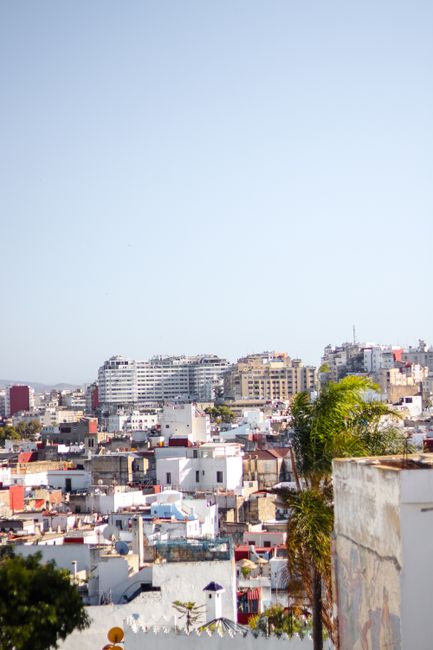
Tangier (Tanger) sits on the northwestern tip of Africa, where the Atlantic meets the Mediterranean and Spain is only about 14 km (9 miles) away across the Strait of Gibraltar. For centuries it was a crossroads of empires and, from 1923 to 1956, an “International Zone” run by foreign powers, which drew diplomats, spies, bankers, painters and writers such as Paul Bowles, William Burroughs and Henri Matisse. Today it’s a fast-growing port city with a renovated waterfront and marina, but its whitewashed medina and hilltop Kasbah, the cafés of the Grand Socco and Petit Socco, and the clifftop terraces of Café Hafa still have the old atmosphere. Beyond the city are the Caves of Hercules and the lighthouse at Cap Spartel, Atlantic beaches, and easy trips to the painted town of Asilah, the blue town of Chefchaouen and the UNESCO-listed medina of Tetouan. Tangier is the northern terminus of the Al Boraq high-speed train, just over two hours from Casablanca, and the arrival point for ferries from Spain, so it makes a natural first or last stop. It’s also a 2030 World Cup host city. Summers are warm and breezy, winters mild and wet.
Right now in Tangier
- Wed 19–24°C 66–74°F 2 mm Mostly clear
- Thu 17–25°C 62–78°F Mostly clear
- Fri 19–25°C 66–76°F 2 mm Rain
Weather: MET Norway (CC BY 4.0) · Sea temperature: NOAA CoastWatch
Top tours in Tangier
See all tours for Tangier →
From local operators, with prices and reviews; you check availability and book on Viator, our partner. We may earn a commission at no extra cost to you. How we earn money
Tangier at a glance
- Best for: the medina and Kasbah, literary and artistic history, sea views, cafés, beaches and trips to Asilah, Chefchaouen and Tetouan.
- How long: 2 full days; 3–4 with day trips.
- Best time: May to June and September to October; July and August are busy with summer visitors.
- Getting there: Al Boraq from Casablanca, Rabat and Kenitra; ferries from Tarifa and Algeciras in Spain; or fly into Tangier Ibn Battouta (TNG).
- Getting around: on foot in the medina; petit taxis and ride-hailing apps elsewhere.
- Good to know: many national museums close on Tuesdays, and the wind across the Strait can be strong.
- Before you go: visas, money and general safety are in our Morocco travel guide.
Tangier’s areas and where to stay
Tangier climbs up from the bay. The medina and the Kasbah cover the hill above the port, the Ville Nouvelle spreads south and west from the Grand Socco, and the beachfront Corniche curves east along the bay toward Malabata.
The Kasbah and the medina
The Kasbah, the fortified upper town, has some of Tangier’s most charming riads and boutique guesthouses, with terraces looking across the Strait to Spain. Below, the medina’s lanes lead down to the Petit Socco, the little square of cafés that was the heart of the International Zone. Staying here means steep lanes and steps, so pack light or ask for help with luggage.
The Ville Nouvelle
The European-style new town around Boulevard Pasteur and the Terrasse des Paresseux viewpoint has 1920s–1950s buildings, the Grand Café de Paris, shops, bars and mid-range hotels. It’s central and practical, with taxis everywhere.
The Corniche, the marina and Malabata
The waterfront Corniche and the new Tanja Marina Bay have modern hotels, apartments and restaurants facing the city beach. Further east, Malabata has large resort hotels and views back over the bay to the medina.
Where to stay in Tangier
- Kasbah riad: views across the Strait and the most atmosphere.
- Medina near the Petit Socco: central and lively, with simpler guesthouses.
- Ville Nouvelle: classic hotels near Boulevard Pasteur, cafés and nightlife.
- Corniche and marina: modern hotels with sea views, walkable to the medina.
- Malabata or Cap Spartel: resort hotels and villas outside the center.
Top things to see in Tangier
The Kasbah and the Kasbah Museum
Climb through the medina to the Kasbah, the old citadel, with its whitewashed walls, the Bab el-Bahr sea gate and terraces over the port. The former sultan’s palace, Dar el-Makhzen, now houses the Kasbah Museum of Mediterranean Cultures, with archaeological and ethnographic collections and a lovely Andalusian garden. According to the National Museums Foundation, entry costs MAD 30 (about US$3) for adults, and it opens daily except Tuesday, from 10 a.m. to 6 p.m. Nearby, the old Kasbah prison now hosts the Kasbah Museum of Contemporary Art (MAD 30).
The Grand Socco and the Petit Socco
The Grand Socco (officially Place du 9 Avril 1947) is the busy square at the gate of the medina, with the Mendoubia gardens and their ancient dragon tree, the art deco Cinema Rif, now a film-library café, and the green-tiled Sidi Bou Abid mosque. Walk down the Rue es-Siaghine, the old silversmiths’ street, to the Petit Socco, where writers and travelers once sat for hours in the cafés.
The American Legation and Dar Niaba
The Tangier American Legation, in the medina, was the first property owned by the United States abroad, given by the sultan in 1821, and it’s now a museum and cultural center with paintings, maps and a room dedicated to Paul Bowles. On the same street, Dar Niaba, the former residence of the sultan’s representative, houses the Museum of Traveling Artists (MAD 20; closed Tuesdays), which shows works by foreign artists inspired by Morocco.
Café Hafa and the Marshan
Founded in 1921, Café Hafa is a series of terraces stepping down the cliff in the Marshan district, where you drink mint tea looking across the Strait, as the Rolling Stones and the Beat writers did. Nearby are the Phoenician tombs cut into the cliff edge and the residential streets of the Marshan plateau.
The Caves of Hercules and Cap Spartel
About 14 km (9 miles) west of the city, the Caves of Hercules are limestone caves on the Atlantic coast whose sea opening is said to look like a map of Africa; according to legend, Hercules rested here after separating Europe and Africa. The Ministry of Youth, Culture and Communication lists entry at MAD 80 (about US$8) for foreign adults. On the way, the Cap Spartel lighthouse marks the point where the Atlantic meets the Strait, and the long Achakar beach stretches south.
The Perdicaris Palace
Built in 1878 by the Greek American Ion Perdicaris on a hill in the Rmilat forest, about 6 km (4 miles) from the center, the Perdicaris Palace overlooks the Strait. Restored and opened in April 2022, it houses a heritage interpretation center on Perdicaris and the forest’s biodiversity. The ministry lists entry at MAD 60 (about US$6) for foreign adults.
St Andrew’s Church and the Grand Mosque
The Anglican St Andrew’s Church, built in the 1890s in a Moorish style with the Lord’s Prayer in Arabic over the altar, has a peaceful garden cemetery. The medina’s Grand Mosque is closed to non-Muslims.
Other things to do in Tangier
Food and drink
Tangier’s food mixes Moroccan and Andalusian influences: grilled sardines and fried fish by the port, bocadillos and churros, harira and bissara in medina cafés, and tagines and couscous in riad restaurants. Try the kalinti, a chickpea flan sold by street vendors, and mint tea at the old cafés. The Ville Nouvelle has bars, wine bars and restaurants that serve alcohol.
Beaches
The city beach along the Corniche is busy in summer; for cleaner water and more space, head west to Achakar on the Atlantic or east to the coves toward Ksar es-Seghir on the Mediterranean. The Atlantic beaches can have strong currents. See our beaches guide.
Cinema, art and literary Tangier
Catch a film or a coffee at the Cinémathèque in the Cinema Rif, browse the Librairie des Colonnes bookshop on Boulevard Pasteur, and look for galleries in the Kasbah. Literary walking tours follow the haunts of Bowles, Burroughs and Tennessee Williams.
Day trips from Tangier
- Asilah: a small walled seaside town with white and blue houses and murals, about 45 km (28 miles) south, under an hour by train or road.
- Tetouan: the UNESCO-listed, Andalusian-style medina, about an hour southeast by road.
- Chefchaouen: the blue town of the Rif, about 2.5–3 hours by road; better overnight; see our Chefchaouen guide.
- Larache and Lixus: the Atlantic port of Larache and the Phoenician and Roman ruins of Lixus, about 90 km (56 miles) south.
- Tarifa, Spain: by fast ferry across the Strait in about an hour; see our Tarifa and Spain guides.
Nearby destinations
- Tarifa33 km
- Chefchaouen83 km
- Cádiz96 km
- Marbella117 km
- Costa del Sol117 km
- Ronda122 km
- Málaga163 km
- Seville181 km
Getting there and getting around
By train
Tanger Ville station, east of the center near the Corniche, is the northern terminus of the Al Boraq high-speed train, which stops at Kenitra, Rabat Agdal and Casa Voyageurs. According to the Moroccan National Tourist Office, the journey takes about 50 minutes to Kenitra, 1 hour 20 minutes to Rabat and 2 hours 10 minutes to Casablanca. At Kenitra, connect to conventional trains for Meknes and Fez; at Casablanca, change for Marrakech. ONCF is extending the high-speed line from Kenitra to Marrakech, which will bring Tangier within about 2 hours 40 minutes of Marrakech when it opens; it was not open in October 2026.
By ferry
Fast ferries cross from Tarifa in Spain to the Tanger Ville port, near the medina, in about an hour; larger car ferries sail from Algeciras and other Spanish and European ports to Tanger Med, a huge port about 40 km (25 miles) east of the city. Summer, especially July and August, brings very heavy traffic as Moroccans abroad return home.
By air and road
Tangier Ibn Battouta Airport (TNG), about 15 km (9 miles) southwest of the center, has flights from many European cities and domestic routes. Taxis take about 25 minutes to the center. Motorways run south to Rabat and east to Tanger Med and Tetouan.
Getting around
The medina and Kasbah are walkable but steep. Blue petit taxis run within the city, and larger grand taxis go to Cap Spartel, Asilah and Tetouan. Ride-hailing apps work, but drivers may not be licensed. A sightseeing bus links the main viewpoints in season.
When to go and how long to stay
Tangier has a mild Mediterranean climate, moderated by the sea and often windy. Summer is warm and dry, with highs around 28–30 °C (82–86 °F), and the east wind (the levante) can blow for days. Winter is mild and wet, with days around 17 °C (63 °F), nights about 9 °C (48 °F) and rain on seven to nine days a month. Spring and autumn are the most pleasant. Tangier has no 1991–2020 station file in the WMO set, so the table uses the normals for Tetouan, the nearest station of Morocco’s General Directorate of Meteorology (DGM) on the same coast, about 60 km (37 miles) east, as published by the World Meteorological Organization (WMO); Tangier itself is a little cooler in summer and windier. The table shows average daily highs and lows, total precipitation, and days with at least 1 mm of rain.
| Month | Average high / low | Rain (days with 1 mm or more) | What to expect |
|---|---|---|---|
| January | 17 °C (63 °F) / 9 °C (49 °F) | 93 mm (3.7 in), 8 days | Mild and wet; the rainiest season |
| February | 18 °C (64 °F) / 10 °C (50 °F) | 87 mm (3.4 in), 7 days | Mild and showery |
| March | 19 °C (66 °F) / 12 °C (53 °F) | 73 mm (2.9 in), 7 days | Mild; spring begins |
| April | 21 °C (69 °F) / 13 °C (55 °F) | 62 mm (2.5 in), 7 days | Pleasant, some showers |
| May | 23 °C (74 °F) / 15 °C (59 °F) | 30 mm (1.2 in), 4 days | Warm and sunny; excellent |
| June | 27 °C (81 °F) / 18 °C (65 °F) | 8 mm (0.3 in), 1 day | Warm; beach season starts |
| July | 30 °C (86 °F) / 21 °C (69 °F) | 1 mm (under 0.1 in), 0 days | Hot and dry; busy with summer visitors |
| August | 30 °C (87 °F) / 21 °C (71 °F) | 5 mm (0.2 in), 1 day | Warmest month; ferries very busy |
| September | 28 °C (82 °F) / 20 °C (67 °F) | 29 mm (1.1 in), 3 days | Warm; sea at its warmest |
| October | 24 °C (76 °F) / 16 °C (62 °F) | 75 mm (2.9 in), 7 days | Pleasant; first autumn rains |
| November | 20 °C (69 °F) / 13 °C (55 °F) | 92 mm (3.6 in), 8 days | Mild and wet |
| December | 18 °C (65 °F) / 10 °C (51 °F) | 100 mm (4.0 in), 9 days | Mild and wet; quiet |
The Tetouan station receives about 650 mm (26 in) of rain a year, almost all between October and May.
Events worth planning around
In July and August, the ports and the Al Boraq are at their busiest as Moroccans living abroad come home for the summer. During Ramadan, expected to begin in early February 2027, cafés and restaurants in the medina open mostly after sunset.
Two days in Tangier
Day one: the Grand Socco, the American Legation, the Petit Socco and the medina, lunch, then the Kasbah and its museum, and sunset at Café Hafa. Day two: the Caves of Hercules and Cap Spartel in the morning, a beach lunch at Achakar, the Perdicaris Palace, and an evening on Boulevard Pasteur and the Corniche.
Three to four days
Add Asilah and its murals, a day in Tetouan, or an overnight trip to Chefchaouen.
What a trip to Tangier costs
Prices are approximate, for October 2026, converted at about MAD 9.85 to the US dollar (Bank Al-Maghrib reference rate).
| Item | Typical cost |
|---|---|
| Kasbah Museum (adult) | MAD 30 (about US$3) |
| Caves of Hercules (foreign adult) | MAD 80 (about US$8) |
| Perdicaris Palace (foreign adult) | MAD 60 (about US$6) |
| Al Boraq to Casablanca, second class | from about MAD 200 (about US$20), depending on the fare |
| Mint tea at Café Hafa | MAD 10–20 (about US$1–2) |
| Seafood dinner | MAD 150–350 (about US$15–36) |
| Mid-range hotel double, per night | MAD 700–1,600 (about US$70–160) |
Practical tips for Tangier
- Book Al Boraq early: cheaper fares sell out, especially in summer and on weekends.
- Use the right port: Tarifa ferries use Tanger Ville; most Algeciras ferries use Tanger Med, 40 km (25 miles) away.
- Mind Tuesday closures: the Kasbah Museum and other national museums close on Tuesdays.
- Expect hills: comfortable shoes help in the Kasbah and medina.
- Carry small notes: for taxis, cafés and tips.
Safety in Tangier
Tangier is generally safe and much calmer than its old reputation suggests. Around the ferry port, the station and the Grand Socco, touts may offer hotels, taxis or tours, and unofficial guides may follow you in the medina; decline politely and use official taxis or a licensed guide. Watch for pickpockets in the medina and on crowded beaches. You may be offered hashish: possession and use of drugs are serious offenses in Morocco with long prison sentences, so refuse. The Atlantic beaches west of the city have strong currents, and lifeguards are on duty only in summer at the main beaches. Strong winds across the Strait can cancel ferries, so build in a spare day if you have a flight to catch on the other side. In an emergency, call 190 for the police and 150 for an ambulance or fire.
What to pack for Tangier
Comfortable shoes for steep lanes, a windproof jacket, a light rain jacket from November to April, swimwear and sunscreen in summer, clothes that cover shoulders and knees, and small notes. Morocco uses 220 V with two-pin European sockets. See our rain jackets and travel adapters guides.
Tangier travel FAQ
How do I get from Spain to Tangier?
Take a fast ferry from Tarifa to Tanger Ville port in about an hour, or a ferry from Algeciras to Tanger Med, east of the city. Flights also connect Spanish cities with Tangier.
How long is the train from Tangier to Casablanca?
About 2 hours 10 minutes on Al Boraq, according to the Moroccan National Tourist Office, with stops at Kenitra and Rabat Agdal.
Is Tangier worth visiting?
Yes, for its medina and Kasbah, its history as an international city, its sea views and cafés, and as a base for Asilah, Tetouan and Chefchaouen.
How many days do I need in Tangier?
Two full days for the city and Cap Spartel; three or four with day trips.
How much are the Caves of Hercules?
MAD 80 (about US$8) for foreign adults and MAD 40 for children aged 7 to 13, according to the Ministry of Youth, Culture and Communication.
How do I get from Tangier to Chefchaouen?
By CTM bus or grand taxi in about 2.5–3 hours, or by private transfer; there’s no train.
Can I take a day trip to Tarifa from Tangier?
Yes, the fast ferry takes about an hour each way. Take your passport and allow time for border checks.
Is Tangier safe?
Yes, for most visitors. Expect touts near the port and station, keep valuables close, and refuse drug offers.
What is the best time to visit Tangier?
May to June and September to October, when it’s warm and less crowded than in midsummer.
Is Tangier a 2030 World Cup host city?
Yes. Morocco co-hosts the 2030 World Cup with Spain and Portugal, and the Grand Stade de Tanger, being renovated and expanded, is one of the planned venues.
Sources and last review
Researched and last reviewed on 5 October 2026. Kasbah Museum, Kasbah contemporary art and Dar Niaba prices and hours: the National Museums Foundation; Caves of Hercules and Perdicaris Palace prices and history: the Ministry of Youth, Culture and Communication’s official ticket site; Al Boraq stops and times: ONCF and the Moroccan National Tourist Office; the Kenitra–Marrakech line: ONCF and the Moroccan government portal; the 2030 World Cup and the Tangier stadium: the Moroccan government portals; the UNESCO listing of Tetouan: the UNESCO World Heritage Center; drug penalties and emergency numbers: the UK government’s factual safety pages, used for practical facts only; the exchange rate: Bank Al-Maghrib; climate normals: Morocco’s General Directorate of Meteorology via the World Meteorological Organization’s 1991–2020 normals (Tetouan station, used as the nearest proxy). The International Zone dates, the American Legation, Café Hafa, ferry times, distances, Al Boraq fares and typical prices are general references or estimates, flagged for checking. Prices and rules change, so check locally before you go. For visas, money and general safety, see our Morocco travel guide.
Plan your trip
Partner links: TravelerCenter may earn a commission if you book, at no extra cost to you.
🇪🇬 Useful Arabic phrases for Tangier
All 38 Arabic phrases: restaurant, hotel, emergencies, romance (printable) →