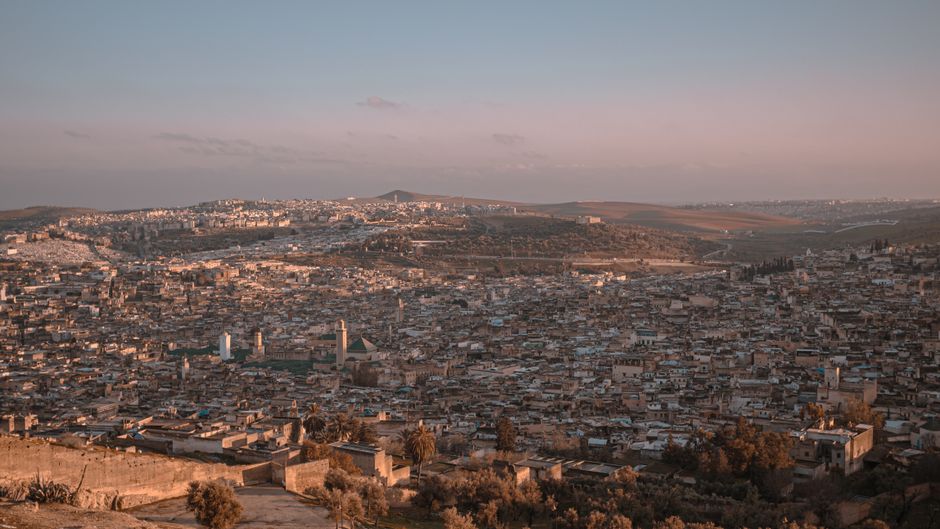
Meknes is the quietest of Morocco’s four imperial cities, and for many visitors that’s its charm. In the late 17th century, Sultan Moulay Ismail, one of the most powerful rulers in Moroccan history, made it his capital and surrounded it with some 40 km (25 miles) of walls, monumental gates, palaces, granaries and stables built for 12,000 horses. Much of that grandeur survives, and the Historic City of Meknes has been a UNESCO World Heritage Site since 1996. Today you can walk through the giant Bab Mansour gate onto the lively Place el-Hedim, explore a small, easygoing medina with very little hassle, visit the restored Mausoleum of Moulay Ismail, and wander through the vast vaults of the Heri es-Souani granaries. Meknes is also the base for Volubilis, Morocco’s best-preserved Roman city, and the hilltop holy town of Moulay Idriss Zerhoun, both about 30 km (19 miles) north, and for the vineyards of the Saïss plain, the heart of Moroccan winemaking. It’s an easy train ride from Fez and Rabat. The best months are March to May and October to November.
Right now in Meknes
- Wed 16–25°C 61–78°F 5 mm Heavy showers
- Thu 15–27°C 59–80°F 1 mm Light showers
- Fri 15–21°C 58–70°F 12 mm Heavy rain
Weather: MET Norway (CC BY 4.0)
Top tours in Meknes
See all tours for Meknes →
From local operators, with prices and reviews; you check availability and book on Viator, our partner. We may earn a commission at no extra cost to you. How we earn money
Meknes at a glance
- Best for: imperial monuments, a relaxed medina, the Roman ruins of Volubilis, Moulay Idriss and wine estates.
- How long: 1 full day for the city; 2–3 days with Volubilis, Moulay Idriss and a winery.
- Best time: March to May and October to November; July and August average about 34 °C (93 °F) in the afternoon.
- Getting there: by train from Fez (under an hour), Rabat, Casablanca or Tangier (changing at Kenitra for Al Boraq).
- Getting around: on foot in the medina and imperial city; petit taxis and grand taxis for Volubilis.
- Good to know: Volubilis is hot and shadeless, so go early, and many museums close on Tuesdays.
- Before you go: visas, money and general safety are in our Morocco travel guide.
Meknes’s areas and where to stay
Meknes is split by the valley of the Oued Boufekrane. On the east bank are the medina and the imperial city (the Kasbah of Moulay Ismail), and on the west bank the French-built Ville Nouvelle (Hamria), with the main station and modern hotels.
The medina and Place el-Hedim
Riads and guesthouses in the medina, close to Place el-Hedim and Bab Mansour, put you at the heart of things, with rooftop views over the green-tiled roofs and minarets. The medina is small and easy to navigate compared with Fez.
The imperial city
South of Place el-Hedim, the imperial city is a quiet district of high walls, palaces and gardens, with a few guesthouses in old houses. It’s a pleasant area to walk in the evening.
The Ville Nouvelle
The Ville Nouvelle has larger hotels, cafés, bars and restaurants that serve alcohol, plus both train stations. It’s practical for short stays, about 15–20 minutes on foot or a short taxi ride from the medina.
Where to stay in Meknes
- Medina riad near Place el-Hedim: atmosphere, rooftop terraces and walkability.
- Imperial city guesthouse: quiet and close to the monuments.
- Ville Nouvelle hotel: pools, parking and the stations.
- Moulay Idriss or near Volubilis: guesthouses with views of the ruins and the Zerhoun hills.
- Wine estate: a country stay on the Saïss plain.
Top things to see in Meknes
Bab Mansour and Place el-Hedim
Bab Mansour, completed in the early 18th century and named after its architect, is one of the grandest gates in North Africa, covered in green and black zellige and carved inscriptions, with marble columns said to come from Volubilis. It faces Place el-Hedim, the city’s main square, which fills in the evening with families, storytellers, snail sellers and food stalls; the covered food market on its edge sells olives, spices and dates.
The Mausoleum of Moulay Ismail
The tomb of Moulay Ismail, who died in 1727, is one of the few active Islamic shrines in Morocco that non-Muslims may enter, as far as the courtyards and a room overlooking the tomb chamber. Its decoration of zellige, carved stucco and painted cedar has been restored. Entry is free, but dress modestly and expect it to close at prayer times.
Heri es-Souani and the Agdal Basin
Moulay Ismail’s royal granaries and storehouses, the Heri es-Souani, are a series of huge vaulted halls with thick walls that kept grain and fodder cool, used as a film set; beyond them are the roofless ruins of the royal stables. Next door, the Agdal Basin, a 4-hectare (10-acre) reservoir, supplied the palace gardens and is now a pleasant place to walk. There’s a small entry fee for the granaries.
Dar Jamaï, the National Museum of Music
Housed in a 19th-century vizier’s palace on Place el-Hedim, Dar Jamaï displays Moroccan musical instruments, Andalusian and Amazigh music traditions and fine painted ceilings, around a beautiful Andalusian garden. According to the National Museums Foundation, entry costs MAD 30 (about US$3) for adults, and it opens daily except Tuesday, from 10 a.m. to 6 p.m.
The medina and the Bou Inania Madrasa
The medina’s souks sell carpets, embroidery, ironwork and damascene, the local craft of inlaying silver thread into black steel. The 14th-century Bou Inania Madrasa of Meknes, completed under the Marinids, has a beautiful courtyard and a rooftop view of the Grand Mosque’s green tiles; there is a small fee.
Volubilis
About 30 km (19 miles) north of Meknes, Volubilis spreads across a plateau below the Zerhoun hills. According to the Ministry of Youth, Culture and Communication, the city was founded in the 2nd century BC, became the capital of the kingdom of Mauretania and an outpost of the Roman Empire, and later briefly served as the capital of Idris I, founder of the Idrisid dynasty. You can walk the main street, the Decumanus Maximus, to the Triumphal Arch of Caracalla, see the Capitol and the Basilica, and admire superb floor mosaics in the houses of Orpheus, the Labors of Hercules and Venus. The ministry lists entry at MAD 100 (about US$10) for foreign adults and MAD 50 for children aged 7 to 13, with tickets available online. Volubilis has been a UNESCO World Heritage Site since 1997. There’s almost no shade, so go early in the morning or late in the afternoon, and bring water and a hat. Licensed guides wait at the entrance.
Moulay Idriss Zerhoun
Clinging to two hills about 3 km (2 miles) from Volubilis, Moulay Idriss Zerhoun is one of Morocco’s holiest towns, built around the shrine of Idris I, who arrived in 789 and founded the first Moroccan Islamic dynasty. The shrine is closed to non-Muslims, but you can climb through the whitewashed lanes to viewpoints over the town and the cylindrical minaret covered in green tiles. It’s a lively pilgrimage center, especially during the annual moussem in late summer.
Moulay Ismail’s capital
Moulay Ismail ruled for 55 years, from 1672 to 1727, the longest reign in Moroccan history. He built his capital with forced labor and materials taken from older sites, including Volubilis and the Badi Palace in Marrakech, raised a standing army of tens of thousands, and exchanged ambassadors with Louis XIV of France. After his death the capital moved on, and an earthquake in 1755 damaged many buildings, which is why parts of the imperial city are now romantic ruins. Walking between its high walls, gates and gardens gives a sense of the scale of his ambitions.
Other things to do in Meknes
Food and drink
Meknes is surrounded by olive groves, orchards and vineyards. Eat grilled kefta and merguez in the stalls around Place el-Hedim, try the local olives and preserved lemons in the covered market, and look for tagines with prunes and almonds and seasonal couscous. The Ville Nouvelle has restaurants and bars that serve Moroccan wine.
Wine tasting
The Saïss plain around Meknes, at about 500–600 m (1,600–2,000 ft), is Morocco’s best-known wine region, producing reds, rosés and the pale “gris” rosé. Several estates on the plain offer tastings and lunch by reservation. See our wine tasting guide.
Cycling and walking
The countryside between Meknes, Volubilis and Moulay Idriss is good for walks and cycling in spring, through olive groves and wheat fields. See our cycling and hiking guides.
Day trips from Meknes
- Volubilis and Moulay Idriss: the main day trip, about 30–40 minutes by grand taxi or car each way.
- Fez: under an hour by train, with its vast medina and madrasas; see our Fez guide.
- Ifrane and Azrou: the Middle Atlas resort of Ifrane and the cedar forests near Azrou, about 1–1.5 hours southeast.
- Rabat: about 2 hours by train; see our Rabat guide.
- Chefchaouen: about 3.5–4 hours by road; see our Chefchaouen guide.
Nearby destinations
- Fez53 km
- Rabat120 km
- Chefchaouen145 km
- Casablanca194 km
- Tangier211 km
- Tarifa237 km
- Marbella298 km
- Costa del Sol299 km
Getting there and getting around
By train
Meknes has two stations in the Ville Nouvelle, Meknes Amir Abdelkader and Meknes (the main station). ONCF trains run frequently to Fez in under an hour and west to Kenitra, Rabat and Casablanca. For Tangier, change at Kenitra to the Al Boraq high-speed train, which ONCF connects with trains from Meknes and Fez.
By air and road
The nearest airport is Fes–Saïss (FEZ), about 60 km (37 miles) east. The A2 motorway links Meknes with Fez and Rabat, and CTM buses serve the main cities.
Getting around
The medina and imperial city are walkable, though the imperial city’s walls stretch for kilometers, so a taxi or a calèche ride helps for Heri es-Souani. Petit taxis run within the city. For Volubilis and Moulay Idriss, take a shared grand taxi from near the Institut Français or the stations to Moulay Idriss and walk or take a taxi on to the ruins, or hire a taxi for a half day.
When to go and how long to stay
Meknes is inland at about 550 m (1,800 ft), with hot, dry summers and cool, wet winters. Spring and autumn are the most pleasant, with highs of about 20–26 °C (68–79 °F) and green countryside in spring. Summer afternoons average about 34 °C (93 °F), and Volubilis gets hotter. Winter days are mild, around 16–17 °C (61–63 °F), but nights drop to about 5 °C (41 °F), and it rains on about seven days a month. The table uses the 1991–2020 climate normals for the Meknes station of Morocco’s General Directorate of Meteorology (DGM), as published by the World Meteorological Organization (WMO): average daily highs and lows, total precipitation, and days with at least 1 mm of rain.
| Month | Average high / low | Rain (days with 1 mm or more) | What to expect |
|---|---|---|---|
| January | 16 °C (60 °F) / 5 °C (41 °F) | 62 mm (2.4 in), 7 days | Cool and damp; cold nights |
| February | 17 °C (63 °F) / 6 °C (42 °F) | 55 mm (2.2 in), 7 days | Cool; almond blossom |
| March | 20 °C (67 °F) / 8 °C (46 °F) | 57 mm (2.3 in), 7 days | Mild, showery; green fields |
| April | 22 °C (71 °F) / 9 °C (49 °F) | 46 mm (1.8 in), 6 days | Pleasant; wildflowers at Volubilis |
| May | 26 °C (79 °F) / 12 °C (54 °F) | 29 mm (1.1 in), 4 days | Warm and sunny; very good |
| June | 30 °C (87 °F) / 15 °C (60 °F) | 8 mm (0.3 in), 1 day | Hot afternoons; harvest time |
| July | 34 °C (93 °F) / 18 °C (65 °F) | 1 mm (under 0.1 in), 0 days | Very hot; visit Volubilis early |
| August | 34 °C (93 °F) / 19 °C (66 °F) | 3 mm (0.1 in), 1 day | Very hot |
| September | 30 °C (85 °F) / 16 °C (61 °F) | 22 mm (0.9 in), 2 days | Hot early, then pleasant; grape harvest |
| October | 26 °C (78 °F) / 14 °C (56 °F) | 49 mm (1.9 in), 5 days | Warm days; excellent |
| November | 20 °C (68 °F) / 9 °C (49 °F) | 63 mm (2.5 in), 6 days | Mild with rain; olive harvest |
| December | 17 °C (62 °F) / 6 °C (44 °F) | 66 mm (2.6 in), 7 days | Cool and damp |
Meknes receives about 460 mm (18 in) of rain a year, almost all between October and May.
Events worth planning around
The moussem of Moulay Idriss, a major pilgrimage with fantasia horse displays, takes place in late summer. Meknes hosts SIAM, a large international agriculture show, in spring. During Ramadan, expected to begin in early February 2027, sites keep shorter hours and Place el-Hedim comes alive after sunset.
One day in Meknes
Start at Bab Mansour and Place el-Hedim, visit Dar Jamaï, explore the medina and the Bou Inania Madrasa, then walk through the imperial city to the Mausoleum of Moulay Ismail and Heri es-Souani; return to Place el-Hedim for dinner at the stalls.
Two to three days
Spend a morning at Volubilis and lunch in Moulay Idriss, then visit a wine estate on the Saïss plain, or continue to Fez.
What a trip to Meknes costs
Prices are approximate, for October 2026, converted at about MAD 9.85 to the US dollar (Bank Al-Maghrib reference rate).
| Item | Typical cost |
|---|---|
| Volubilis (foreign adult) | MAD 100 (about US$10) |
| Dar Jamaï museum (adult) | MAD 30 (about US$3) |
| Grand taxi to Moulay Idriss (shared seat) | MAD 15–25 (about US$1.50–2.50) |
| Half-day taxi to Volubilis and Moulay Idriss | MAD 300–500 (about US$30–50) |
| Licensed guide at Volubilis | MAD 150–300 (about US$15–30) |
| Dinner at Place el-Hedim | MAD 50–120 (about US$5–12) |
| Mid-range riad double, per night | MAD 600–1,300 (about US$60–130) |
Practical tips for Meknes
- Start Volubilis early: the site opens in the morning and is shadeless.
- Buy Volubilis tickets online if you like: the ministry’s official site sells them; avoid other resellers.
- Mind Tuesday closures: Dar Jamaï and other national museums close on Tuesdays.
- Combine with Fez: trains are frequent, so Meknes works as a day trip or an overnight stop.
- Carry small notes: for taxis, guides and stalls.
Safety in Meknes
Meknes is calm and friendly, with far less hassle than Fez or Marrakech. Some unofficial guides wait near Bab Mansour and at Volubilis; agree any price in advance or use a licensed guide with an official badge. Keep valuables close in the medina and on Place el-Hedim at night. Heat is the main risk at Volubilis from June to September, when afternoon temperatures can pass 40 °C (104 °F): go early, carry water and wear a hat. Grand taxis can be crowded and fast; sit in the back and ask the driver to slow down if needed. In winter, roads into the Middle Atlas toward Ifrane and Azrou can be icy or closed by snow. In an emergency, call 190 for the police and 150 for an ambulance or fire.
What to pack for Meknes
Comfortable walking shoes, a sun hat, sunglasses and sunscreen for Volubilis, a refillable water bottle, light clothes that cover shoulders and knees, a warm layer for winter evenings, a light rain jacket from November to March, and small notes. Morocco uses 220 V with two-pin European sockets. See our hiking shoes and travel adapters guides.
Meknes travel FAQ
Is Meknes worth visiting?
Yes. It has some of Morocco’s grandest imperial monuments, a relaxed medina, and it’s the base for Volubilis and Moulay Idriss.
How much is the Volubilis ticket?
According to the Ministry of Youth, Culture and Communication, MAD 100 (about US$10) for foreign adults and MAD 50 for children aged 7 to 13; tickets are sold online and at the site.
How do I get from Meknes to Volubilis?
Take a shared grand taxi to Moulay Idriss and walk or taxi the last 3 km (2 miles), or hire a taxi for a half day. The drive takes about 30–40 minutes.
Can I visit Volubilis as a day trip from Fez?
Yes, about 1.5 hours by road each way; many trips combine Volubilis, Moulay Idriss and Meknes in one day.
Can non-Muslims visit the Mausoleum of Moulay Ismail?
Yes, the courtyards and a room overlooking the tomb are open to non-Muslims. Dress modestly and avoid prayer times.
How many days do I need in Meknes?
One full day for the city, plus half a day for Volubilis and Moulay Idriss.
How do I get from Meknes to Fez?
By train in under an hour; trains run frequently through the day.
Is there wine in Meknes?
Yes, the Saïss plain around Meknes is Morocco’s main wine region, and several estates offer tastings by reservation.
What is the best time to visit Meknes?
March to May and October to November. Summers are hot, especially at Volubilis.
Is Meknes safe?
Yes, it’s one of the most relaxed cities in Morocco. Take normal care with valuables and the heat.
Sources and last review
Researched and last reviewed on 5 October 2026. Volubilis ticket prices, history and online sales: the Ministry of Youth, Culture and Communication’s official ticket site; Dar Jamaï price and hours: the National Museums Foundation; the UNESCO listings of Meknes and Volubilis: the UNESCO World Heritage Center; Al Boraq connections at Kenitra: ONCF; emergency numbers: the UK government’s factual safety pages, used for practical facts only; the exchange rate: Bank Al-Maghrib; climate normals: Morocco’s General Directorate of Meteorology via the World Meteorological Organization’s 1991–2020 normals (Meknes station). Moulay Ismail’s dates, the length of the walls, the Heri es-Souani and Bou Inania fees, the mausoleum’s access rules, the moussem, train times and typical prices are general references or estimates, flagged for checking. Prices and rules change, so check locally before you go. For visas, money and general safety, see our Morocco travel guide.
Plan your trip
Partner links: TravelerCenter may earn a commission if you book, at no extra cost to you.
🇪🇬 Useful Arabic phrases for Meknes
All 38 Arabic phrases: restaurant, hotel, emergencies, romance (printable) →