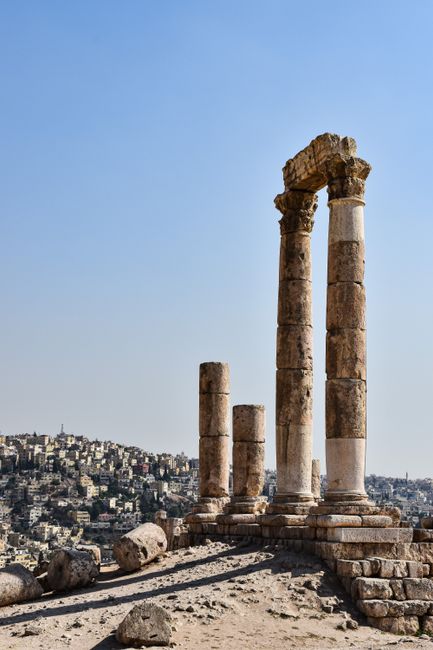
Jordan, a small kingdom between the Jordan Valley and the Arabian Desert, packs an extraordinary range of sights into a country you can cross by car in a day. The rose-red Nabataean city of Petra, carved into sandstone cliffs more than 2,000 years ago, is the reason most visitors come, and it deserves at least two full days. Around it lie the red dunes and towering rock walls of Wadi Rum, where you can sleep in a Bedouin camp under some of the clearest night skies in the region; the Dead Sea, the lowest point on Earth at about 427 m (1,400 feet) below sea level, where the salty water lets you float without effort; the coral reefs of Aqaba on the Red Sea; the colonnaded Roman streets of Jerash; the Byzantine mosaics of Madaba; and the hillside capital, Amman, with its Citadel, Roman Theatre and excellent restaurants. Jordanians are famous for their hospitality, English is widely spoken in tourism, and roads link the main sights along the Desert Highway and the slower, scenic King’s Highway. Most nationalities can get a visa on arrival, and the Jordan Pass, bought before you travel, covers the visa fee and entry to Petra and more than 40 other sites. Plan around the seasons: spring and autumn are ideal, summer is hot in the south and the valleys, and winter can bring rain, cold and even snow on the high plateau.
Right now in Jordan
- Wed 14–25°C 57–77°F Mostly clear
- Thu 17–28°C 62–83°F Clear
- Fri 18–29°C 65–84°F Clear
Weather: MET Norway (CC BY 4.0)
Multi-day tours of Jordan
Multi-day tours from local operators. You check dates and book on Viator, our partner; we may earn a commission at no extra cost to you. How we earn money
Jordan at a glance: governorates and regions
Jordan covers about 89,300 km² (34,500 square miles), roughly the size of Portugal or the state of Indiana, and has a population of about 11 million. Arabic is the official language, and English is widely understood in cities and tourist areas. The country is a kingdom divided into 12 governorates. Its landscapes change quickly: the fertile Jordan Valley and the Dead Sea lie far below sea level in the west, a high plateau with Amman, Madaba and Karak runs north to south above it, and desert covers most of the east and south down to the Gulf of Aqaba, Jordan’s only coastline.
Time and the weekend: Jordan uses Arabia Standard Time (UTC+3) all year, with no daylight saving. The weekend is Friday and Saturday, and some sites and offices keep shorter hours on Friday.
The main regions for visitors
- Amman and the north: the capital, plus the Roman city of Jerash, Ajloun Castle, Umm Qais above the Jordan Valley and the basalt town of Umm al-Jimal.
- The Dead Sea and the Jordan Valley: resort hotels and public beaches on the Dead Sea, the Baptism Site (Al-Maghtas), Wadi Mujib and the hot springs of Hammamat Ma’in.
- Madaba and the King’s Highway: mosaic churches in Madaba, Mount Nebo, the crusader-era castles of Karak and Shobak and the Dana Biosphere Reserve.
- Petra and Wadi Musa: the Nabataean city, Little Petra and the town of Wadi Musa that serves them.
- Wadi Rum and Aqaba: the desert protected area and its Bedouin camps, and Jordan’s Red Sea resort with its marine reserve.
- The eastern desert: the Umayyad-era “desert castles” of Qusayr Amra, Kharana and Azraq, and the Azraq and Shaumari reserves.
Where to go: the capital, Petra, the desert, the Dead Sea and the Red Sea
For a first trip of a week to ten days, most visitors land in Amman, see the city and Jerash, drive south along the King’s Highway via Madaba, Mount Nebo and Karak to Petra, continue to Wadi Rum for a night in the desert, and end in Aqaba or back at the Dead Sea.
Amman
The capital spreads over a series of hills, with the Citadel and its Temple of Hercules and Umayyad Palace above downtown, a large Roman Theatre, busy souqs, the Jordan Museum and the cafes of Rainbow Street and Jabal al-Weibdeh. It is the best base for day trips to Jerash, the Dead Sea and Madaba. See our Amman guide.
Petra and Wadi Musa
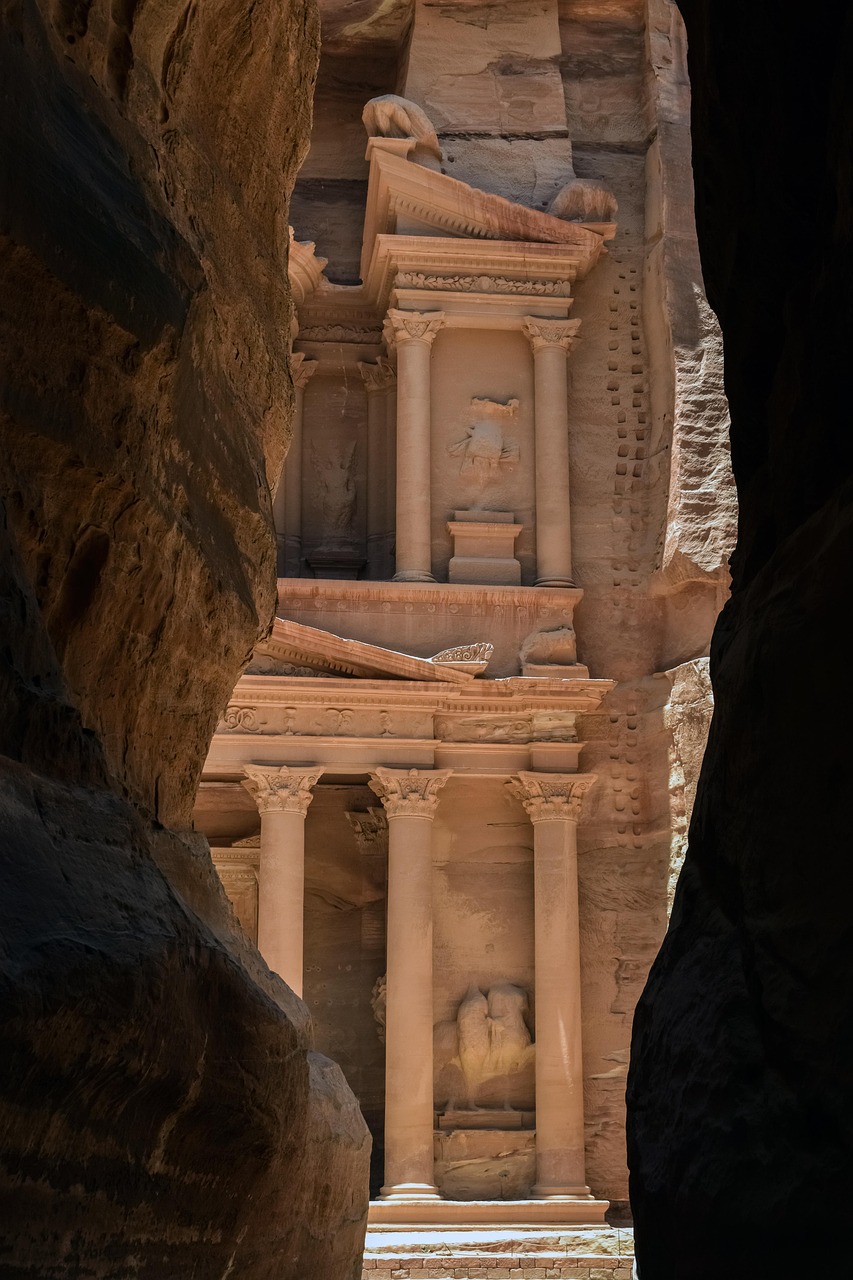
Petra, a UNESCO World Heritage Site since 1985, was the capital of the Nabataeans, a trading people who carved tombs, temples and a theatre into the rock. The walk through the Siq, a narrow gorge more than a kilometer long, ends at the Treasury (Al-Khazneh); beyond it lie the Royal Tombs, the Colonnaded Street, Qasr al-Bint and the long climb of about 800 steps to the Monastery (Ad-Deir). The town of Wadi Musa, at the entrance, has all the hotels. See our Petra and Wadi Musa guide.
Wadi Rum
A protected area of sandstone and granite mountains, red sand and narrow canyons, inscribed by UNESCO in 2011 for both its natural and cultural value, with rock art and inscriptions left over thousands of years. Visitors explore by jeep, camel or on foot with local Bedouin guides and sleep in desert camps. See our Wadi Rum guide.
Aqaba
Jordan’s only port and Red Sea resort, run as a special economic zone, with coral reefs and wrecks in the Aqaba Marine Reserve, beaches, a Mamluk-era castle and easy access to Wadi Rum and Petra. See our Aqaba guide.
The Dead Sea
About an hour from Amman, the Dead Sea’s eastern shore has resort hotels with private beaches and spas, plus public beaches for day visitors. The water is roughly ten times saltier than the ocean, so you float on the surface, and the black mud is used for skin treatments. Nearby are the Baptism Site “Bethany Beyond the Jordan” (Al-Maghtas), a UNESCO World Heritage Site since 2015, and the water-filled canyons of Wadi Mujib.
Jerash, Ajloun and Umm Qais
North of Amman, Jerash is one of the best-preserved Roman provincial cities anywhere, with an oval forum, colonnaded street, temples and theatres. Ajloun’s 12th-century castle overlooks wooded hills, and Umm Qais (ancient Gadara) has views over the Jordan Valley.
Madaba, Mount Nebo and the King’s Highway
Madaba is known for its Byzantine mosaics, including the mosaic map of the Holy Land in St. George’s Church. Mount Nebo, nearby, overlooks the Jordan Valley. The King’s Highway continues south through dramatic wadis to Karak Castle, Dana and Shobak Castle before reaching Petra.
Dana and the nature reserves
The Dana Biosphere Reserve has trails from the stone village of Dana down toward the Wadi Araba desert, with eco-lodges run by the Royal Society for the Conservation of Nature. Other reserves include Ajloun Forest, the Azraq Wetland and the Mujib Biosphere Reserve.
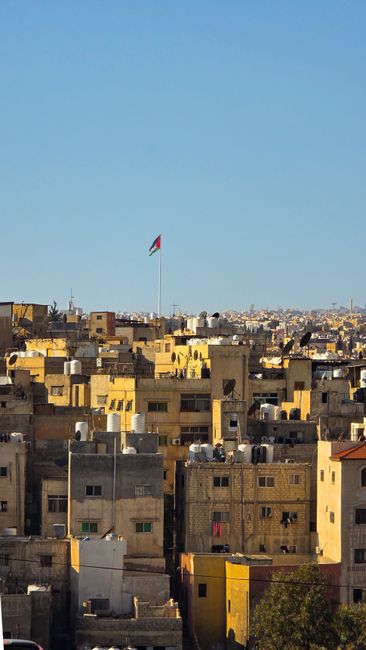
Amman Travel Guide
Plan a trip to Amman: the Citadel and Roman Theatre with ticket prices, the Jordan Museum, downtown souqs, Rainbow Street and Jabal al-Weibdeh, where…
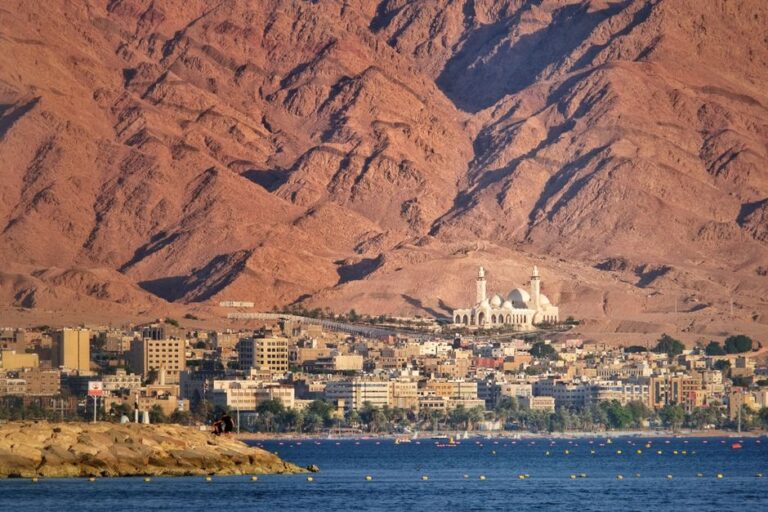
Aqaba Travel Guide
Plan a trip to Aqaba, Jordan's Red Sea resort: the free ASEZA visa and the special economic zone, the UNESCO-listed Aqaba Marine Reserve, the…
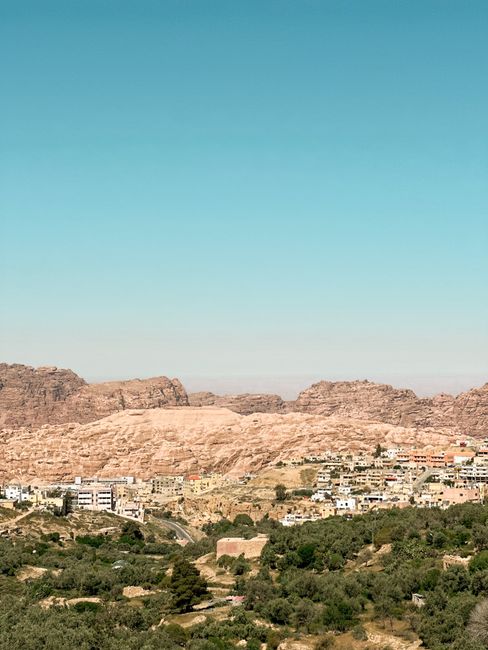
Petra Travel Guide
Plan a trip to Petra and Wadi Musa: ticket prices and the Jordan Pass, opening hours, the Siq and the Treasury, the Monastery steps,…
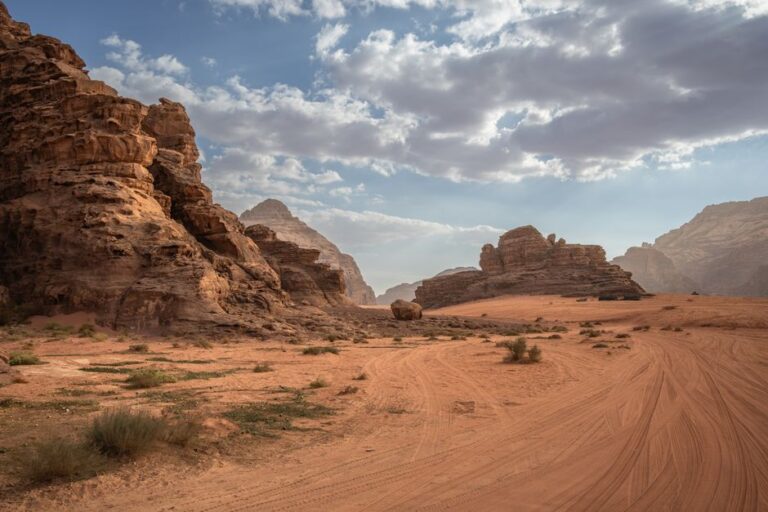
Wadi Rum Travel Guide
Plan a trip to Wadi Rum, Jordan's UNESCO-listed desert: the protected area fee and the Jordan Pass, jeep tours, Khazali Canyon, the rock bridges…
Best time to visit Jordan
Spring (March to May) and autumn (September to November) are the best seasons for most of Jordan, and the Petra Development and Tourism Region Authority recommends them for visiting Petra. Days are warm and dry, wildflowers bloom in spring, and the desert nights are pleasant. Summer (June to August) is hot but dry: Amman’s average highs are about 32 °C (90 °F), while Aqaba and the Dead Sea are much hotter, with average highs near 39 °C (102 °F) in Aqaba. Winter (December to February) is cool and sometimes wet on the plateau, with average lows of about 4 °C (39 °F) in Amman; snow occasionally falls on the high ground around Amman, Petra and the King’s Highway and can close roads. Aqaba and the Dead Sea stay mild in winter, making them good winter escapes. Rain falls mainly from November to March, and flash floods are a risk in wadis during that season.
| Month | Amman: high / low | Aqaba: high / low | Amman rain |
|---|---|---|---|
| January | 12 °C (54 °F) / 4 °C (38 °F) | 20 °C (69 °F) / 9 °C (48 °F) | 63 mm (2.5 in) |
| February | 14 °C (57 °F) / 4 °C (40 °F) | 22 °C (72 °F) / 10 °C (50 °F) | 62 mm (2.4 in) |
| March | 17 °C (63 °F) / 6 °C (43 °F) | 26 °C (78 °F) / 13 °C (55 °F) | 43 mm (1.7 in) |
| April | 23 °C (73 °F) / 10 °C (49 °F) | 31 °C (87 °F) / 17 °C (63 °F) | 14 mm (0.5 in) |
| May | 28 °C (82 °F) / 14 °C (56 °F) | 35 °C (95 °F) / 21 °C (69 °F) | 3 mm (0.1 in) |
| June | 31 °C (87 °F) / 17 °C (62 °F) | 38 °C (101 °F) / 24 °C (74 °F) | under 1 mm |
| July | 32 °C (90 °F) / 18 °C (65 °F) | 39 °C (103 °F) / 25 °C (77 °F) | under 1 mm |
| August | 32 °C (90 °F) / 19 °C (65 °F) | 39 °C (102 °F) / 25 °C (78 °F) | under 1 mm |
| September | 31 °C (87 °F) / 17 °C (62 °F) | 36 °C (98 °F) / 23 °C (74 °F) | under 1 mm |
| October | 27 °C (81 °F) / 14 °C (57 °F) | 33 °C (91 °F) / 20 °C (68 °F) | 7 mm (0.3 in) |
| November | 20 °C (69 °F) / 9 °C (49 °F) | 27 °C (81 °F) / 15 °C (59 °F) | 28 mm (1.1 in) |
| December | 14 °C (58 °F) / 5 °C (41 °F) | 22 °C (71 °F) / 10 °C (51 °F) | 49 mm (1.9 in) |
| Year | 23 °C (74 °F) / 11 °C (52 °F) | 31 °C (87 °F) / 18 °C (64 °F) | 269 mm (10.6 in) |
The figures are the average daily highs and lows and average monthly rainfall that the Jordan Meteorological Department publishes through the World Meteorological Organization’s World Weather Information Service for Amman and Aqaba. Petra and Wadi Rum, at about 1,000 m (3,300 feet) or more, have temperatures closer to Amman’s than Aqaba’s, with cold winter nights in the desert.
Crowds and prices through the year
- Peak (March to May and September to November): the best weather and the most tour groups at Petra; book hotels in Wadi Musa and desert camps in Wadi Rum early.
- Winter (December to February): fewer visitors and lower prices on the plateau; Aqaba and the Dead Sea are busier with regional visitors and European winter flights.
- Summer (June to August): quieter at Petra, where you should start at dawn; Aqaba and the Dead Sea fill with Jordanian and Gulf families, especially at weekends and Eid.
Festivals and events
- Jerash Festival of Culture and Arts (usually summer): concerts and performances in the Roman theatres of Jerash; dates are set each year.
- Petra by Night: a candlelit walk through the Siq to the Treasury, held from Sunday to Thursday evenings all year.
- Dead Sea Ultra Marathon (April): a charity run from Amman down to the Dead Sea.
- Ramadan (in 2027 expected from about 8 February to 9 March): quiet days and lively evenings; opening hours change.
Public holidays
Holidays include New Year’s Day, Labour Day (1 May), Independence Day (25 May), Christmas Day and the Islamic holidays: Eid al-Fitr at the end of Ramadan (about 10 March 2027), Eid al-Adha (about 16 May 2027), the Islamic New Year and the Prophet’s Birthday. Islamic dates follow the lunar calendar and are confirmed shortly before. Government offices close, while most tourist sites, hotels and restaurants stay open, though some sites have shorter hours.
How long to stay: sample itineraries
4 to 5 days: Amman, Petra and the Dead Sea
A day in Amman with the Citadel and Roman Theatre, a morning trip to Jerash, two days at Petra including the Monastery and Petra by Night, and a final afternoon floating in the Dead Sea before your flight.
7 to 8 days: the classic loop
Amman and Jerash, then south along the King’s Highway via Madaba, Mount Nebo and Karak Castle; two nights in Wadi Musa for Petra and Little Petra; a night in a Wadi Rum desert camp; a day or two of snorkeling in Aqaba; and back north along the Desert Highway or by air to the Dead Sea and Amman.
10 to 14 days: deeper and slower
Add the desert castles east of Amman, Ajloun and Umm Qais in the north, hiking in Dana or Wadi Mujib, an extra day at Petra for the High Place of Sacrifice and Little Petra’s back trail, and two nights in Wadi Rum.
Combining Jordan with other countries
Jordan has land borders with five neighbors, and ferries cross the Gulf of Aqaba to Egypt’s Sinai coast. Many travelers combine Jordan with Egypt by ferry or by air; see our Egypt, Dahab and Sharm El Sheikh guides. The Al-Durra crossing near Aqaba and the Umari crossing link Jordan with Saudi Arabia; see our Saudi Arabia guide. Border crossings to the west are covered in our Israel and Eilat guides; check their status before you plan a combined trip.
Entry, money and costs
Entry: visas and the Jordan Pass (last reviewed October 2026)
Your passport must be valid for at least six months from the date you arrive. Most visitors need a visa, but nationals of many countries, including the US, Canada, the UK, Australia and EU countries, can buy one on arrival.
- Visa on arrival: a single-entry tourist visa costs JOD 40 (about US$56) at Queen Alia International Airport, other airports and most land borders. The Jordan Tourism Board lists a multiple-entry visa for JOD 120 (about US$170). Nationalities on the Ministry of Interior’s “restricted” list need prior approval before travel.
- The Jordan Pass: sold online by the Ministry of Tourism and Antiquities, it includes entry to Petra and more than 40 other attractions, from Jerash and Wadi Rum to the Amman Citadel and Karak Castle, and waives the single-entry visa fee if you buy it before you arrive and stay at least two consecutive nights (three days) in Jordan. It comes in three versions: Jordan Wanderer (one day at Petra) for JOD 70, Jordan Explorer (two consecutive days) for JOD 75 and Jordan Expert (three consecutive days) for JOD 80. Show it printed at passport control. It doesn’t include Petra by Night or the Baptism Site, which you can add for JOD 8 when buying the pass instead of JOD 12 on site. It must be used within three months of purchase and expires one month after its first scan. Children under 12 enter the sites free with their parents.
- Aqaba: visitors arriving at Aqaba’s airport or seaport can receive a free visa from the Aqaba Special Economic Zone Authority (ASEZA), valid if you leave within a month, and others can claim it by declaring Aqaba as their destination and registering with the ASEZA office in Aqaba within 48 hours. See our Aqaba guide.
- King Hussein Bridge: visas are not issued at this crossing from the west, so you must arrange one in advance from the Ministry of Interior if you plan to enter Jordan there.
If you have a Jordan Pass but leave before two nights are up, you’ll be asked to pay the visa fee when you depart. Visas are valid for one month and can be extended at police stations. A departure tax of JOD 10 is charged at land borders (it’s included in air tickets). Check the latest rules with Jordan’s Ministry of Interior or your airline before you travel.
Customs, medicines and drones
Declare goods that may be prohibited or dutiable. Drones need an approval applied for at least 10 working days before you travel, or they will be held at the airport until you leave. Keep medicines in their original packaging with a copy of your prescription.
Money and cards
The currency is the Jordanian dinar (JOD, often written JD), divided into 1,000 fils and pegged to the US dollar at about US$1.41 per dinar; the Central Bank of Jordan quoted 708–710 fils to the dollar in October 2026. Credit cards are accepted in hotels, restaurants and larger shops, and Petra’s ticket office takes dinars or Visa cards, but carry cash for souqs, taxis, small shops and rural areas. ATMs are widely available only in Amman and the larger towns. Sales tax is 16%, and many restaurants and hotels add a service charge.
Tipping
A service charge is often added in hotels and restaurants. Elsewhere, about 10% in restaurants, small tips for porters and housekeeping, and a tip for guides and drivers at the end of a tour are customary. Taxi drivers don’t expect tips, but rounding up is common.
Typical travel costs
| Item (as of October 2026) | Jordanian dinars | About US dollars |
|---|---|---|
| Jordan Pass (Wanderer / Explorer / Expert) | JOD 70 / 75 / 80 | $99 / $106 / $113 |
| Single-entry visa without the Jordan Pass | JOD 40 | $56 |
| Petra, one / two / three days (staying in Jordan) | JOD 50 / 55 / 60 | $71 / $78 / $85 |
| Petra, one day for visitors not staying overnight in Jordan | JOD 90 | $127 |
| Petra by Night | JOD 30 | $42 |
| Wadi Rum Protected Area entry | JOD 5 | $7 |
| Jerash | JOD 10 | $14 |
| Baptism Site (Al-Maghtas), with shuttle and guide | JOD 12 | $17 |
| Airport bus from Queen Alia to Amman | JOD 3 | $4.20 |
| Casual restaurant meal | about JOD 4–10 | about $6–14 |
| Mid-range hotel room, per night | about JOD 50–110 | about $70–155 |
Visa, Jordan Pass and Petra prices come from the Ministry of Tourism and Antiquities’ Jordan Pass site and the Petra Development and Tourism Region Authority; the other site fees and the airport bus fare from the Jordan Tourism Board. Meals and hotels are typical ranges.
Getting there and getting around
Arrival airports
Queen Alia International Airport (AMM), about 35 km (22 miles) south of Amman, is the main gateway and the hub of Royal Jordanian, with flights across the Middle East, Europe and beyond. Taxis to the city take about 30–45 minutes, and an airport bus runs to Amman’s southern bus station for JOD 3. King Hussein International Airport (AQJ) in Aqaba has flights from Amman, seasonal European routes and some regional services. Amman Civil Airport (Marka) handles a few regional flights.
Flight disruptions
Since early 2026, regional tensions have led to periodic airspace closures across the Middle East, and European aviation authorities have issued a safety bulletin covering Jordan’s airspace that runs to mid-October 2026. Flights can be delayed, rerouted or canceled at short notice, so check your flight with the airline and the airport’s status before you travel.
Land borders and ferries
- Sheikh Hussein (Jordan River) crossing: in the north near Lake Tiberias; visas on arrival are available for most nationalities.
- Wadi Araba (Yitzhak Rabin) crossing: in the south between Aqaba and Eilat; Jordan Pass holders of non-restricted nationalities can get a visa on arrival here, others need a visa in advance.
- King Hussein Bridge (Allenby): in the Jordan Valley, about 57 km (35 miles) from Amman; you need a visa arranged in advance to enter Jordan here, and private cars and tour buses can’t cross.
- Saudi Arabia: the Umari, Mudawara and Al-Durra crossings are open 24 hours.
- Ferries to Egypt: boats link Aqaba with Nuweiba and Taba Heights in Sinai; check schedules directly with the operators.
The crossings to the west are open most days from about 8 or 8:30 a.m., but they can close at short notice, including at weekends and on some holidays. Check their status with the Jordanian authorities before you travel, allow plenty of time and don’t take photographs at border posts.
Buses
The JETT company runs comfortable air-conditioned buses from Amman (Abdali station) to Petra, Aqaba, the Dead Sea and other cities; the Petra service leaves Amman at about 6:30 a.m. and returns at about 5 p.m. Public minibuses from Amman’s southern bus station are cheaper but leave only when full. Buses also link Aqaba with Petra (about two hours) and Wadi Rum. Services to remote sites such as the desert castles, Dana and Wadi Rum are limited, so many visitors hire a car or a driver.
Taxis and ride-hailing
Yellow taxis are inexpensive and have meters; agree a fare beforehand late at night. White “service” taxis are shared and follow fixed routes. Licensed ride-hailing apps such as Careem, Uber, Jeeny and Petra Ride operate in Amman and other cities. Women traveling alone usually sit in the back.
Driving
Driving is a good way to explore, especially the King’s Highway, the Dead Sea road and the desert castles. Traffic drives on the right. You need your home license and an International Driving Permit, cars must carry a fire extinguisher and warning triangle, seatbelts are compulsory and using a phone while driving is illegal. Speed limits range from 40 km/h in towns to 120 km/h on some highways, with radar checks and on-the-spot fines. Watch for stray animals, broken-down vehicles and unmarked roadworks, take care on the Desert Highway, which has heavy truck traffic, and avoid driving on unlit roads at night. Police checkpoints are common: slow down and carry your passport and license. In winter, snow can block roads on the plateau around Petra and Karak.
Culture, food and everyday etiquette
Hospitality and local customs
Jordan is a predominantly Muslim country with a Christian minority and a strong tradition of welcoming guests. You may be offered Arabic coffee or tea as a greeting; accepting at least one cup is polite. Greet with “marhaba” or “as-salaam alaykum,” use your right hand to eat and pass things, and let a woman offer her hand first. Dress modestly in towns and villages, covering shoulders and knees; swimwear is fine at hotel pools, resort beaches and the Dead Sea hotels. Ask before photographing people, especially women.
Food and drink
Jordan’s national dish is mansaf, lamb cooked in a sauce of fermented dried yogurt (jameed) and served over rice and flatbread for celebrations. Other favorites include maqluba (an upside-down dish of rice, vegetables and meat), zarb (Bedouin barbecue cooked in an underground oven, often served in Wadi Rum camps), mezze with hummus, falafel and mutabbal, and the sweet cheese pastry knafeh. Amman’s downtown is famous for its hummus-and-falafel breakfasts. Alcohol is legal and served in licensed hotels, bars and restaurants, especially in Amman, Aqaba and the Dead Sea resorts, but drinking on the street is illegal.
Ramadan etiquette
During Ramadan, Muslims fast from dawn to sunset. Visitors should avoid eating, drinking and smoking in public during daylight, dress more conservatively and expect shorter opening hours for offices and some shops. Hotels serve non-fasting guests, and the evenings after iftar are lively.
Where to stay
Amman has international hotels in Abdali and Shmeisani, boutique hotels in Jabal Amman and Jabal al-Weibdeh, and budget hotels downtown. Wadi Musa has everything from hostels to five-star hotels within walking distance of the Petra Visitor Center. Wadi Rum has desert camps, from simple tents to domed “bubble” camps. The Dead Sea has resort hotels on its eastern shore, and Aqaba has beach resorts, the Ayla and Tala Bay developments and city hotels. Book ahead for spring, autumn and Eid holidays.
Laws visitors need to know
- ID: carry your passport or a copy; police run random checks and checkpoints.
- Alcohol: legal in licensed venues; drinking on the street is illegal.
- Drugs: possession, use and trafficking carry long prison sentences and heavy fines.
- Relationships: same-sex relations aren’t illegal, but public affection between any couple may cause offence, and it’s socially unacceptable for unmarried couples to live together.
- Religion: it’s illegal to encourage someone to convert to another religion.
- Petra hours: being inside the Petra Archaeological Park outside its opening hours can lead to arrest.
- Photography and drones: don’t photograph military sites, border crossings or police, and get approval before bringing a drone.
Safety, health, accessibility and connectivity
Safety
Jordan has low crime, and violent crime against visitors is rare. The main risks come from the heat, the desert, flash floods, the roads and the regional situation.
- Heat: summer temperatures in Aqaba, the Dead Sea and the Jordan Valley regularly pass 38 °C (100 °F). At Petra and in Wadi Rum, start early, carry plenty of water, wear a hat and rest in the shade at midday.
- Desert and flash floods: from November to March, heavy rain can send flash floods through wadis, including the Siq at Petra and the canyons of Wadi Mujib, and the government sometimes issues flood alerts. Check the forecast, avoid wadis during and for at least a day after heavy rain, and if caught in a flood, climb to high ground and call Civil Defence on 911. In the desert, travel with a licensed guide.
- Dead Sea floating: float on your back, don’t swim face down or splash, and keep the water out of your eyes and mouth; it stings badly and is dangerous if swallowed. Don’t shave beforehand, limit time in the water to about 15–20 minutes, rinse off in fresh water afterward, drink plenty of water, and swim only at hotel or public beaches with lifeguards.
- Red Sea: in Aqaba, dive and snorkel with accredited operators, never alone, and watch for boats and currents.
- Dress codes: cover shoulders and knees away from beaches and pools, and dress more conservatively in rural areas and religious sites.
- Border areas and crossings: the land crossings to the west can close at short notice; check their status before you travel. Border areas in the north and east are military zones that are closed to visitors; stay away from them.
- Flight disruptions: since early 2026, regional tensions have led to periodic airspace closures across the Middle East; check your flight with the airline before you travel and follow instructions from the local authorities, including official emergency alerts.
- Taxis and personal safety: use licensed taxis or ride-hailing apps and sit in the back; avoid demonstrations and large crowds.
- Emergencies: call 911 for police, ambulance and fire. The tourist police can be reached on 117777.
Health and insurance
Medical facilities are good in Amman and Aqaba but basic elsewhere; for serious treatment, go to Amman or Aqaba. Buy travel insurance that covers treatment and evacuation. Hotels of three stars and up filter their water; elsewhere, bottled water is cheap. Visitors staying more than 30 days need an HIV test.
Accessibility
Major hotels and the Jordan Museum are accessible, and at Petra golf carts run from the Visitor Center to the Treasury and between the theatre and Qasr al-Bint for a fee, with carts also available for elderly and disabled visitors during Petra by Night. Most archaeological sites, souqs and desert areas have uneven ground and steps.
Connectivity and power
Mobile coverage is good in cities and along main roads but patchy in Wadi Rum, deep wadis and the eastern desert. Prepaid SIM cards and eSIMs are sold at the airport. The Jordan Tourism Board lists power at 220 V, 50 Hz, with round two-pin sockets (types C and F); British three-pin (type G) sockets are also common.
Things to do: ruins, desert, sea and nature
Jordan’s highlights combine archaeology, landscapes and adventure: walking the Siq to Petra’s Treasury and climbing to the Monastery; a jeep tour and night in a Bedouin camp in Wadi Rum; floating in the Dead Sea; snorkeling the coral reefs of Aqaba; exploring Roman Jerash and the Amman Citadel; seeing the mosaics of Madaba; and hiking in Dana, Wadi Mujib and Ajloun. Jordan has eight places on the UNESCO World Heritage List: Petra, Quseir Amra, Um er-Rasas, Wadi Rum Protected Area, the Baptism Site “Bethany Beyond the Jordan” (Al-Maghtas), As-Salt, Umm Al-Jimāl and, since 2026, the Aqaba Marine Reserve.
- Hiking: Petra’s marked trails, from the easy Main Trail to the High Place of Sacrifice and Jabal Harun; the Jordan Trail, which crosses the country from north to south; and the reserves of Dana and Ajloun.
- Canyoning: Wadi Mujib’s Siq Trail, a wade and scramble up a narrow canyon, open in the warmer months; check with the reserve before you go.
- Desert adventures: jeep tours, camel treks, hot-air balloon flights and stargazing in Wadi Rum.
- Diving and snorkeling: coral reefs, a sunken cargo ship and a scuttled aircraft in the Aqaba Marine Reserve.
- Wellness: Dead Sea mud and spa treatments and the thermal waterfalls of Hammamat Ma’in.
- Food and culture: cooking classes in Amman and Petra, the downtown souqs and the art galleries of Jabal al-Weibdeh.
What to pack
Pack light, breathable clothes that cover shoulders and knees, a scarf for women visiting mosques, sturdy walking shoes with good grip for Petra’s steps and sandstone, a hat, sunglasses and high-SPF sunscreen. Add warm layers for desert nights and winter on the plateau, a rain jacket from November to March, swimwear and water shoes for the Dead Sea and Aqaba, a refillable water bottle and a plug adapter. Print your Jordan Pass, and bring cash in small dinar notes for taxis and tips.
Jordan travel FAQ
Do I need a visa for Jordan?
Most visitors need a visa, but many nationalities, including US, UK, Canadian, Australian and EU citizens, can get one on arrival for JOD 40. The fee is waived if you buy a Jordan Pass before you arrive and stay at least two nights.
What is the Jordan Pass and is it worth it?
It’s an online pass from the Ministry of Tourism and Antiquities that covers the visa fee and entry to Petra and more than 40 other sites. It costs JOD 70 to 80, depending on how many days you spend at Petra, so it pays for itself for most visitors who stay at least two nights.
How much does it cost to visit Petra?
JOD 50 for one day, JOD 55 for two consecutive days and JOD 60 for three if you’re staying overnight in Jordan, or JOD 90 for a one-day visit without an overnight stay. Children under 12 enter free during the day.
Is Petra by Night included in the Jordan Pass?
No. Petra by Night runs from Sunday to Thursday, 8:30 to about 10:30 p.m., and costs JOD 30; you also need a daytime ticket or a Jordan Pass.
How many days do I need in Jordan?
A week covers Amman, Jerash, Petra, Wadi Rum and the Dead Sea or Aqaba. Five days is enough for Amman, Petra and the Dead Sea at a faster pace.
When is the best time to visit Jordan?
March to May and September to November, when days are warm and dry. Summer is very hot in Aqaba and the valleys, and winter can be cold and wet on the plateau.
Can I visit Aqaba without a visa fee?
Visitors arriving at Aqaba’s airport or port can receive a free visa from the Aqaba Special Economic Zone Authority if they leave within a month; check the current rules for your nationality.
Can I cross from Jordan to Israel or Egypt?
There are land crossings to the west at Sheikh Hussein, Wadi Araba and the King Hussein Bridge, and ferries from Aqaba to Sinai. The western crossings can close at short notice, so check their status before you travel.
How do I get from Amman to Petra?
By car in about three hours on the Desert Highway or four hours on the King’s Highway, or on the JETT bus, which leaves Amman’s Abdali station at about 6:30 a.m.
Is it safe to float in the Dead Sea?
Yes, at lifeguarded beaches, if you float on your back, keep the water out of your eyes and mouth, stay in for no more than about 15–20 minutes and rinse off afterward.
Can tourists drink alcohol in Jordan?
Yes, in licensed hotels, bars and restaurants. Drinking alcohol on the street is illegal.
What currency is used in Jordan?
The Jordanian dinar (JOD), divided into 1,000 fils and worth about US$1.41.
Are flights to Jordan ever disrupted?
Sometimes. Since early 2026, regional tensions have led to periodic airspace closures across the Middle East; check your flight with the airline before you travel.
Sources and last review
Researched and last reviewed on 5 October 2026. The Jordan Pass versions, prices, visa-fee waiver, validity and conditions come from the Ministry of Tourism and Antiquities’ Jordan Pass website; Petra’s ticket prices, opening hours, trails, golf carts, payment methods and Petra by Night from the Petra Development and Tourism Region Authority (visitpetra.jo) and the Petra by Night operator; visa fees, border-crossing hours and visa rules, other site fees, airports, the airport bus, taxis, ride-hailing apps, electricity and Dead Sea facts from the Jordan Tourism Board; the restricted nationalities list from the Ministry of Interior; Aqaba’s free visa and marine reserve from the Aqaba Special Economic Zone Authority and its Visit Aqaba website; World Heritage listings from UNESCO; the airspace bulletin from the European Union Aviation Safety Agency; border status, departure tax, drones, laws, driving rules, flash floods, healthcare and emergency numbers from GOV.UK’s Jordan travel information (updated 10 September 2026); the exchange rate from the Central Bank of Jordan; climate averages from the Jordan Meteorological Department via the World Meteorological Organization; area, population and capital from Wikidata. The weekend, sales tax, holidays and Ramadan dates for 2027, festival details, tipping, Dead Sea floating advice, foods and typical prices are general references and flagged for checking. Entry rules can change at short notice, so check official sources before you travel.
Plugs and power in Jordan
Jordan uses 230 V, 50 Hz and these plugs (left) and wall sockets (right):
Mixed sockets; a universal adapter is the safe bet.
All plug types and voltages by country → · Check what you need to pack →
Plan your trip
Partner links: TravelerCenter may earn a commission if you book, at no extra cost to you.
🇪🇬 Useful Arabic phrases for Jordan
All 38 Arabic phrases: restaurant, hotel, emergencies, romance (printable) →