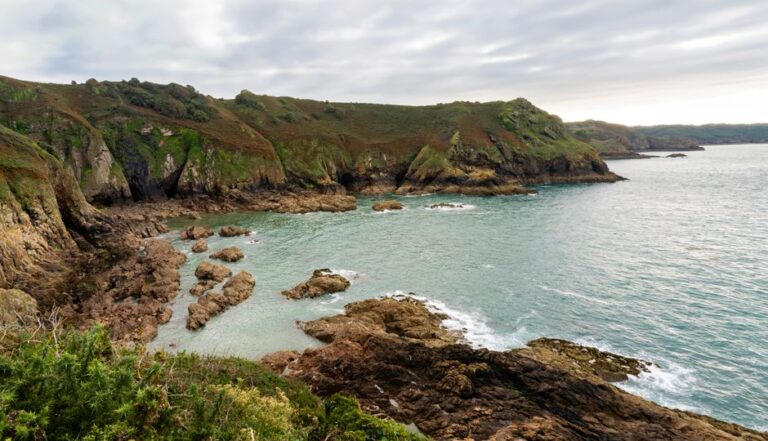
Jersey is the largest of the Channel Islands: a self-governing island of about 118 km² (46 square miles) in the Bay of St Malo, around 22 km (14 miles) off the coast of Normandy and about 135 km (85 miles) south of the English coast. It packs a lot into a space you can drive across in half an hour: two great castles, a 6,000-year-old passage grave, the tunnels dug during the German Occupation, Gerald Durrell’s famous wildlife park, long sandy bays on the south and west coasts, granite cliffs and coves in the north, and one of the biggest tidal ranges in the world, which almost doubles the island’s size at low water. The capital, St Helier, is a compact harbor town with a Victorian market, museums and Elizabeth Castle out in the bay. Jersey feels British, with English spoken and sterling in use, but its Norman roots show in its place names, its food and its laws. Come from May to September for beaches and long evenings, in spring for wildflowers and quieter cliff paths, and allow three to five days; since April 2026 most non-British, non-Irish visitors need an ETA before they travel.
Right now in Jersey
- Wed15–17°C60–63°F10 mm rain
- Thu14–15°C58–59°FPartly cloudy
- Fri16–17°C60–62°F5 mm rain
Multi-day tours of Jersey
Multi-day tours from local operators. You check dates and book on Viator, our partner; we may earn a commission at no extra cost to you. How we earn money
Jersey at a glance: overview and geography
Jersey is a British Crown Dependency, not part of the United Kingdom and not part of the European Union. It has its own parliament (the States Assembly), its own laws, taxes and courts, and its own banknotes and coins, while the UK is responsible for its defense and international relations. The island, together with the uninhabited reefs of Les Écréhous and Les Minquiers, forms the Bailiwick of Jersey. The 2021 census counted 103,267 residents, about a third of them in the parish of St Helier.
The island tilts from north to south. The north coast is a wall of high granite cliffs, cut by small bays and coves; the land slopes gently down to the long, sunny south coast, with St Aubin’s Bay, St Helier and the low reef-strewn shore toward Gorey. The west coast is one long, Atlantic-facing beach, St Ouen’s Bay, about 8 km (5 miles) of sand backed by dunes and wetlands. Inland are small fields (the source of Jersey Royal potatoes), narrow lanes, granite farmhouses and wooded valleys.
The tides shape everything. On the biggest spring tides, the sea rises and falls by up to about 12 m (40 ft), according to Visit Jersey; at low water, vast areas of rock, sand and gullies appear off the south and east coasts, making the island almost twice its high-tide size. Guided low-tide walks to Seymour Tower and over the reefs are one of Jersey’s most memorable experiences, but the tide comes in fast, so never go out alone without knowing the times.
Jersey was part of the Duchy of Normandy, and when King John lost mainland Normandy to France in 1204, the islands stayed loyal to the English Crown. That history explains Mont Orgueil Castle, built to face France, and the island’s Norman-French heritage: Jèrriais, the old Norman language, still appears on signs and place names, although English is the everyday language. From 1 July 1940 to 9 May 1945, Jersey was occupied by German forces, and Liberation Day, 9 May, is the island’s national holiday.
Time zone: Jersey uses the same time as the UK, Greenwich Mean Time (UTC+0) in winter and British Summer Time (UTC+1) from late March to late October.
Jersey’s parishes and coasts
- St Helier and the south coast: the capital and its harbor, St Aubin’s Bay with Elizabeth Castle, and the seafront promenade toward the old harbor village of St Aubin.
- The east (Grouville, St Martin, Gorey): Mont Orgueil Castle above Gorey Harbour, the long sandy sweep of Grouville Bay, La Hougue Bie and the low-tide reefs around Seymour Tower.
- The southwest (St Brelade): St Brelade’s Bay, the island’s favorite family beach, Portelet and Ouaisné bays, and La Corbière lighthouse on its tidal causeway.
- The west (St Ouen, St Peter): St Ouen’s Bay for surfing and sunsets, the dunes of Les Blanches Banques, the airport and the clifftop ruin of Grosnez Castle.
- The north (Trinity, St John, St Mary, St Lawrence): the cliff path, Devil’s Hole, Bonne Nuit and Bouley Bay, Jersey Zoo at Trinity and the Jersey War Tunnels in St Lawrence.
Where to go in Jersey: town, castles, bays and cliffs
You can stay in one place and see the whole island: nowhere is more than about 30 minutes’ drive from anywhere else, and buses fan out from St Helier to every coast. Most visitors base themselves in St Helier, St Brelade’s Bay, St Aubin or Gorey.
St Helier
The capital is the island’s transport hub and its liveliest place to stay, with the Victorian Central Market, Royal Square, the Jersey Museum and the Maritime Museum, shops (with no VAT, only 5% GST) and the widest choice of restaurants. Elizabeth Castle sits on a tidal islet in the bay, reached by an amphibious “castle ferry” or on foot across the causeway at low tide. See our St Helier travel guide for sights, neighborhoods and where to stay.
Gorey and Mont Orgueil Castle
On the east coast, the pretty harbor village of Gorey sits beneath Mont Orgueil Castle, a medieval fortress that has guarded the coast facing France for about 800 years. Its maze of towers, stairs and rooms has imaginative displays, and the views reach the French coast on a clear day. As of 2026, the castle opens daily from 10:00 to 17:30 from 1 March to 24 October and 10:00 to 16:00 from 25 October to 31 December (last entry an hour before closing), and an adult ticket costs £19.50 (seniors £18.50, children and students £11.45, under-6s free, family £55.95), according to Jersey Heritage. Grouville Bay, south of Gorey, is a long, safe sandy beach.
St Aubin and St Brelade’s Bay
West of St Helier, the old fishing harbor of St Aubin has steep lanes, pubs and seafood restaurants, and the promenade around St Aubin’s Bay is a flat 6 km (4 mile) walk or bike ride back to town. Over the headland, St Brelade’s Bay is Jersey’s best-known beach, sheltered and sandy, with hotels and cafés along the back and the little Fishermen’s Chapel with its medieval wall paintings beside the parish church.
La Corbière and St Ouen’s Bay
At the island’s southwest tip, the white lighthouse of La Corbière stands on a rock reached by a causeway that disappears at high tide; a siren warns walkers when the tide turns. North of it, St Ouen’s Bay is wild, wide and windswept, Jersey’s surf beach, with the dunes and nature reserve of Les Blanches Banques, the wetlands of St Ouen’s Pond and World War II fortifications along the seawall. It faces west, so it is the place to watch the sunset.
The north coast
The north is for walkers. A cliff path runs most of the length of the coast, from Grosnez Castle’s ruined gateway past Plémont, Grève de Lecq, Devil’s Hole, Bonne Nuit and Bouley Bay to Rozel, with small cafés in the bays. The cliffs are best in spring, when they are covered in gorse and wildflowers.
Inland: the zoo, the tunnels and La Hougue Bie
Three of Jersey’s best-known sights are inland. Jersey Zoo, founded by the naturalist and author Gerald Durrell in 1959 and run by the Durrell Wildlife Conservation Trust, focuses on endangered species, from gorillas and orangutans to lemurs and island birds. The Jersey War Tunnels, in St Lawrence, are an unfinished German underground hospital complex dug by forced laborers during the Occupation, now a museum of island life from 1940 to 1945. La Hougue Bie, in Grouville, is a Neolithic passage grave about 6,000 years old, under a mound crowned by two medieval chapels, with a German bunker beside it.
Beyond Jersey: Guernsey, Sark and France
Jersey makes an easy base for the other Channel Islands: seasonal fast ferries and short flights link it with Guernsey, and from there to Sark and Herm. France is closer still: the DFDS fast ferry reaches Saint-Malo in under two hours, and in summer Manche Îles Express sails to Granville and Carteret on the Normandy coast. A day in Saint-Malo or a longer trip on to Mont-Saint-Michel, Brittany or Normandy pairs well with a Jersey holiday.
St Helier Travel Guide
Plan a visit to St Helier, Jersey's capital: Elizabeth Castle by amphibious ferry or the low-tide causeway with 2026 hours and prices, the Jersey…
Best time to visit Jersey
Jersey has a mild maritime climate, a little warmer and sunnier than southern England. Winters are mild and damp rather than cold, and summers warm rather than hot. The table below uses the Government of Jersey’s official 1991–2020 averages from the Maison St Louis Observatory in St Helier (temperature and rainfall) and the Fort Regent signal station (sunshine). The temperatures are daily means, so afternoons are a few degrees warmer and nights a few degrees cooler.
| Season (Jersey, 1991–2020) | Mean daily temperature | Sunshine a day | Rainfall a month | What it’s like |
|---|---|---|---|---|
| Spring (Mar–May) | 8.8–13.7 °C (48–57 °F) | 5.0–8.3 hours | 54–68 mm | Bright, breezy and green; cliff paths full of flowers; the sea is still cold. |
| Summer (Jun–Aug) | 16.3–18.4 °C (61–65 °F) | 8.0–8.8 hours | 45–62 mm | The sunniest and driest months; beach weather, long evenings and the busiest time. |
| Autumn (Sep–Nov) | 16.6 °C falling to 10.2 °C (62–50 °F) | 6.9 falling to 2.9 hours | 60–116 mm | September is often lovely and the sea is at its warmest; October and November turn wet and windy. |
| Winter (Dec–Feb) | 7.0–7.7 °C (45–46 °F) | 2.3–3.6 hours | 78–126 mm | Mild, gray and wet, with gales; quiet and cheaper, with most sights still open. |
Over the year, Jersey averages a mean temperature of 12.4 °C (54 °F), 918 mm of rain and 5.7 hours of sunshine a day. The best months for a beach holiday are June to September; May and September are the sweet spot for walking, with fewer people and lower prices than July and August. The sea is coolest in late winter and warmest in late summer; the official mean sea temperature over the year is about 12.7 °C (55 °F), so most people swim from June to September, often in a wetsuit.
Jersey’s events calendar for 2027
- Liberation Day: 9 May, a public holiday marking the end of the Occupation in 1945, with a ceremony and celebrations in Liberation Square in St Helier.
- Battle of Flowers: 13–14 August 2027, the 125th anniversary year of Jersey’s carnival of floral floats along Victoria Avenue in St Helier, with a daytime grand parade and a Moonlight Parade, according to the Jersey Battle of Flowers Association.
- Jersey International Air Display: the free display over St Aubin’s Bay is listed for Thursday 9 September 2027, 13:00–17:00, by its organizers (the 2026 display was on 10 September). Elizabeth Castle closes on display days.
How long to stay: sample itineraries
A long weekend (three days)
Day one: St Helier, with the Central Market, the Jersey Museum or the Maritime Museum and the Occupation Tapestry, then Elizabeth Castle in the afternoon. Day two: east to Gorey, Mont Orgueil Castle and Grouville Bay, then La Hougue Bie or the Jersey War Tunnels on the way back. Day three: the west, with St Aubin, St Brelade’s Bay, La Corbière lighthouse and sunset at St Ouen’s Bay.
Five days
Add a day for Jersey Zoo and the north coast (Bouley Bay or Bonne Nuit, then a cliff walk to Devil’s Hole), and a day for the sea: a guided low-tide walk to Seymour Tower or a boat trip around the reefs, then a lazy afternoon on the beach. With a Heritage Pass, you can fit in Hamptonne Country Life Museum too.
A week or more
Spend a day in Guernsey or Sark, or take the ferry to Saint-Malo for a day in Brittany. Walk the whole north coast in sections, learn to surf at St Ouen’s, and rent bikes for the quieter “green lanes” inland, where cyclists and walkers have priority.
Entry rules, money and costs
Entry and the ETA
Jersey is part of the Common Travel Area with the United Kingdom, Ireland, Guernsey and the Isle of Man, and follows UK immigration rules. It is not part of the Schengen area. According to the Government of Jersey:
- British and Irish citizens do not need a passport to travel within the Common Travel Area, but must carry photo ID; airlines and ferry companies ask for it.
- ETA: from 23 April 2026, most other visitors who do not need a visa, including citizens of EU countries, the USA, Canada and Australia, need an Electronic Travel Authorisation (ETA) to visit Jersey. It costs £20, is applied for on GOV.UK with the UK ETA app or online form, usually takes up to three working days, and lasts two years or until the passport expires, whichever is sooner, for any number of visits of up to six months. Every traveler needs one, including babies and children. A UK, Guernsey or Isle of Man ETA also covers Jersey, so if you are already traveling via the UK on a UK ETA, you do not need a separate one.
- No ETA needed: British and Irish citizens, people with EU Settlement Scheme status or permission to live in Jersey, and French citizens on a day trip with a valid national ID card on a commercial ferry operator that is part of the island’s scheme.
- EU, EEA and Swiss citizens arriving from outside the Common Travel Area need a passport, not a national ID card, apart from the exceptions above.
- Visa nationals must get a UK visa valid for Jersey before traveling.
If you take the ferry to or from Saint-Malo or Normandy, remember that France is in the Schengen area, so non-EU travelers go through Schengen border checks there, including registration in the EU’s Entry/Exit System (EES).
Money
Jersey uses the pound sterling. The Government of Jersey issues its own Jersey pound notes and coins, worth exactly the same as British pounds, and Bank of England notes are accepted everywhere. Jersey money is not legal tender in the UK, so spend it or change it before you leave. Cards and contactless payments are widely accepted, and there are cash machines in St Helier and the larger villages. There is no VAT: instead, Jersey’s Goods and Services Tax is 5% on most goods and services.
Healthcare
Jersey’s health service is not part of the NHS, so travel insurance matters. Jersey has reciprocal health agreements with the UK, Guernsey and Alderney, France, Austria, Portugal, Sweden, Norway, Iceland, Australia and New Zealand, which cover emergency treatment only, not GP visits or prescriptions. Since 13 April 2026, visitors from countries without an agreement, including the USA and Canada, pay for care, for example £325 for treatment in the Emergency Department and £475 for an ambulance, according to the Government of Jersey.
How expensive is Jersey?
Jersey costs about the same as a holiday in the south of England, with hotels pricier in July and August. Many of the best things, the beaches, the cliff path, the views and the low-tide shore, are free. The figures below are our estimates for one person per day, sharing a double room, as of October 2026.
| Style | Estimated cost per day | What that looks like |
|---|---|---|
| Budget | about £70–110 | A campsite or simple guesthouse, buses, picnic lunches, one paid sight |
| Mid-range | about £150–250 | A three- or four-star hotel, a rental car or bus pass, castles and restaurant dinners |
| High-end | about £350+ | A boutique or luxury hotel, fine dining, private tours and boat trips |
As of 2026, a Jersey Heritage Pass, which gives seven days’ unlimited entry to Elizabeth Castle, Mont Orgueil, the Jersey Museum, the Maritime Museum and Occupation Tapestry Gallery, La Hougue Bie and Hamptonne, costs £52 for adults, £42 for seniors, £30 for children and students and £136 for a family, and halves the Elizabeth Castle ferry fare. It pays for itself after three sites.
Getting there and getting around
By air
Jersey Airport (JER) is in St Peter, in the west of the island, about 15–20 minutes from St Helier by bus or taxi. According to Visit Jersey, British Airways flies year-round from London Gatwick and Heathrow (from about 40 minutes), and easyJet from ten UK airports, including London Gatwick, Luton and Southend, Manchester, Birmingham, Bristol, Liverpool, Glasgow, Edinburgh and Belfast. Jet2 flies from several UK airports, Loganair from Southampton, Exeter, Bristol, East Midlands, Norwich, Bordeaux and Paris Charles de Gaulle, Aer Lingus (operated by Emerald Airlines) from Dublin, and Lufthansa from Munich; many of these routes are seasonal. Bus routes 15, 12, 9 and 22 serve the airport, and there is a taxi rank outside arrivals.
By sea
DFDS runs Jersey’s ferries from the Elizabeth Terminal in St Helier: a conventional ferry from Portsmouth (about 9 hours), a fast ferry from Poole (about 4 hours 30 minutes, depending on tides and weather) and a fast ferry from Saint-Malo in France (under 2 hours). You can take a car on all three routes; one-way fares for a car and two people started at about £145 from Saint-Malo, £171 from Portsmouth and £220 from Poole when we checked. From April to September, Manche Îles Express sails from Granville (about 1 hour 25 minutes) and Carteret (about 1 hour 15 minutes) in Normandy, mainly for foot passengers and day trips.
Getting around
- Bus: LibertyBus runs an island-wide network from Liberation Station in St Helier, with routes to the airport, Gorey (1, 1A, 2), Jersey Zoo (3, 13, 23), the Jersey War Tunnels (8, 28) and St Brelade’s Bay (14). As of March 2026, an adult fare paid by contactless card was £2.75 and a child fare £1.40, according to local press reports; pay on board or with the LibertyBus app. A Discover Jersey visitor pass gives unlimited travel for 1, 2, 3 or 7 days.
- Car: rental cars are easy to find at the airport and harbor, and they make reaching the north coast and quieter bays easy. Drive on the left. The island’s speed limit is 40 mph, with 20–30 mph in built-up areas and 15 mph in green lanes, where walkers, cyclists and horses have priority. At junctions marked “filter in turn,” cars take turns, and a yellow line across a road means give way. Visitors may drive on their home license for up to 12 months.
- Bike and on foot: Jersey has signed cycle routes and a network of green lanes, and the promenade from St Helier to St Aubin is flat and traffic-free. The coastal footpath is the best way to see the north coast.
- Taxis: ranks at the airport, the harbor and in St Helier; book ahead at busy times.
Outdoors: beaches, tides, walking and the sea
Jersey’s beaches are the main reason many people come. On the south coast, St Brelade’s Bay is sheltered and family-friendly, with lifeguards in summer; Portelet and Ouaisné are quieter coves nearby; and Grouville Bay in the east is wide and calm, with Mont Orgueil at one end. The west coast’s St Ouen’s Bay has Atlantic surf, surf schools and the best sunsets, and in the north, Plémont, Grève de Lecq and Bouley Bay are small bays under the cliffs. Many beaches change completely with the tide: at high water, some disappear entirely, so check the tide tables before you lay out a towel. See our beaches guide and our surfing guide.
At low tide, the south and east coasts reveal Europe’s largest rocky intertidal zone, a world of pools, sandbanks and gullies. Go with a guide: the tide comes in quickly and can cut you off, especially on the walk to Seymour Tower or near La Corbière. Guided walks, kayaking, coasteering and boat trips to the reefs of Les Écréhous run from spring to autumn; see our boat trips guide.
On land, the north coast path is one of the finest coastal walks in the British Isles, and the island’s network of green lanes and cycle routes makes inland Jersey ideal for gentle cycling. See our hiking guide and our cycling guide.
Safety, health and staying connected
Jersey is a calm, low-crime island, and the main risks for visitors are natural ones: fast tides, strong currents off St Ouen’s Bay, cliff edges and narrow lanes without pavements. Swim at lifeguarded beaches in summer, check the tide tables, and never walk out onto the low-tide reefs alone. The emergency number for police, ambulance, fire and coastguard is 999. The police non-emergency number is 01534 612612, and the Emergency Department is at Jersey General Hospital in St Helier.
Plugs are the UK three-pin type (G), and Visit Jersey gives the voltage as 240 V, so visitors from Europe and North America need an adapter. Jersey’s phone numbers start with +44 1534, but it has its own mobile networks, and most UK plans treat Jersey as international roaming, so check your plan before you go; local eSIMs are available from about £5.
Food and culture
Jersey’s food is about the sea and the soil. Try fresh Jersey oysters from Grouville Bay, local lobster and crab, and the island’s famous Jersey Royal new potatoes, in season from spring to early summer. Jersey cream, butter and ice cream come from the island’s own breed of cow, and you will find traditional Jersey wonders (twisted doughnuts), bean crock (a slow-cooked bean and pork stew) and black butter (a spiced apple preserve) at markets and farm shops. Beach cafés, harbor pubs and seafood restaurants make eating out a highlight.
Island culture blends British and Norman. Each of the 12 parishes has its own ancient church and its own elected head, the Connétable; many roads and houses have Jèrriais names; and the island’s history from the Neolithic to the Occupation is told in its museums. The Occupation is still within living memory for some families: be respectful at memorials and in the War Tunnels.
Things to do in Jersey
- Explore Mont Orgueil Castle and have lunch on Gorey Harbour.
- Take the amphibious ferry, or walk the causeway at low tide, to Elizabeth Castle.
- Learn about the Occupation at the Jersey War Tunnels and the Occupation Tapestry.
- Meet endangered animals at Jersey Zoo.
- Step inside the 6,000-year-old passage grave at La Hougue Bie.
- Spend a beach day at St Brelade’s Bay or Grouville Bay.
- Watch the sunset over St Ouen’s Bay, or take a surf lesson there.
- Walk out to La Corbière lighthouse when the causeway is uncovered.
- Hike a section of the north coast path, from Grève de Lecq to Devil’s Hole or from Bonne Nuit to Bouley Bay.
- Join a guided low-tide walk to Seymour Tower.
- Cycle the green lanes and the promenade from St Helier to St Aubin.
- Shop for local produce in St Helier’s Central Market.
- See the floral floats at the Battle of Flowers in August.
- Take a day trip to Saint-Malo or Guernsey.
Jersey travel FAQ
Is Jersey part of the UK?
No. Jersey is a self-governing British Crown Dependency with its own parliament, laws and taxes. The UK is responsible for its defense and international relations, and Jersey is part of the Common Travel Area, but it is not part of the United Kingdom or the European Union.
Do I need a passport to go to Jersey?
British and Irish citizens traveling from the UK, Ireland, Guernsey or the Isle of Man need photo ID rather than a passport. Most other visitors need a passport, and since 23 April 2026, most visa-free nationalities, including Americans, Canadians, Australians and EU citizens, also need an ETA (£20).
Do Americans need an ETA for Jersey?
Yes. US citizens need an ETA to visit Jersey from 23 April 2026, unless they already hold a UK, Guernsey or Isle of Man ETA, which also covers Jersey. It is applied for on GOV.UK and lasts two years or until the passport expires.
How do I get to Jersey?
By air, with direct flights from many UK airports (about 40 minutes to an hour), Dublin and seasonal flights from Europe; or by DFDS ferry from Portsmouth, Poole or Saint-Malo. In summer, Manche Îles Express also sails from Granville and Carteret in Normandy.
What currency is used in Jersey?
The pound sterling. Jersey issues its own notes and coins, worth the same as British pounds, and UK notes and coins are accepted everywhere. Jersey notes are not accepted in the UK, so spend or change them before you leave.
What is the best time to visit Jersey?
June to September for beaches and the sunniest weather; May and September for walking, lower prices and fewer crowds. Winter is mild but wet and windy.
How many days do you need in Jersey?
Three days covers St Helier, the two castles and the main bays. Five days gives time for the zoo, the north coast, a low-tide walk and a beach day, and a week lets you add Guernsey or Saint-Malo.
Do I need a car in Jersey?
No. LibertyBus covers the whole island from St Helier, and many visitors manage with buses, bikes and walking. A car makes the north coast and quiet bays easier, but remember the 40 mph limit and narrow lanes.
Is healthcare free for visitors to Jersey?
Only partly. Visitors from countries with a reciprocal agreement, such as the UK and France, get emergency treatment, but not GP visits or prescriptions. Since 13 April 2026, visitors from other countries pay, for example £325 for the Emergency Department. Bring travel insurance.
Can you walk to Elizabeth Castle?
Yes, across the causeway from West Park at low tide only. At other times, take the amphibious castle ferry. Check the tide times and the castle’s opening hours before you set out.
Is Jersey good for a beach holiday?
Yes, from June to September. St Brelade’s Bay and Grouville Bay are sheltered and sandy, and St Ouen’s Bay is great for surfing. The sea is cool, around the low 60s °F (16–18 °C) at best in late summer, so many swimmers use wetsuits.
What language is spoken in Jersey?
English. French was once the official language, and Jèrriais, the island’s Norman language, still appears on signs and place names.
Plugs and power in Jersey
Jersey uses 230 V, 50 Hz and these plugs (left) and wall sockets (right):
UK-style three-pin sockets; Visit Jersey quotes 240 V, within the UK 230 V tolerance.
All plug types and voltages by country → · Check what you need to pack →
Plan your trip
Partner links: TravelerCenter may earn a commission if you book, at no extra cost to you.
Sources · last reviewed 5 October 2026
Researched and last reviewed on 5 October 2026. Entry and ETA rules come from the Government of Jersey’s visitor pages; healthcare agreements and charges from Health and Care Jersey (gov.je); the 2021 population from the Jersey census; climate averages from the Government of Jersey (Jersey Met, 1991–2020); castle, museum and Heritage Pass prices and hours from Jersey Heritage; Jersey Zoo prices from Durrell; Jersey War Tunnels prices from the attraction; flights, currency, plugs, mobile roaming, tides and bus routes from Visit Jersey; ferries from DFDS and Manche Îles Express; driving rules from Jersey Road Safety; emergency numbers from the States of Jersey Police; and event dates from the Jersey Battle of Flowers Association and the Jersey International Air Display. The 2026 bus fare comes from local press and is flagged for checking; daily costs are our estimates. Prices, timetables and rules change, so check the official sites before you travel.
Data: Weather: MET Norway (CC BY 4.0) · Rates: ECB · Wikidata (CC0)