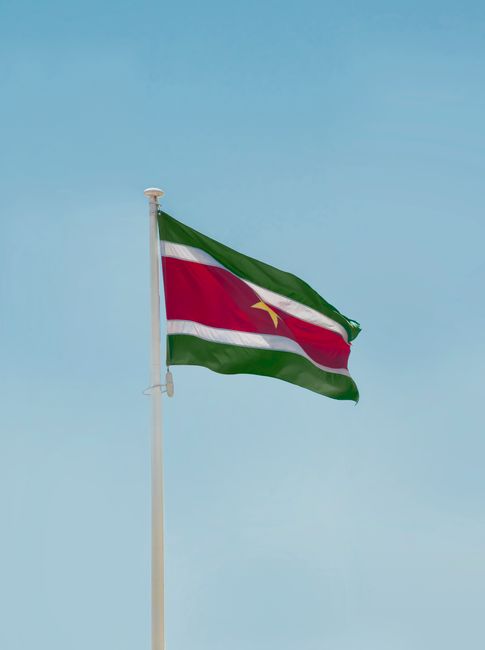
Paramaribo, the capital of Suriname, lies on the west bank of the broad Suriname River, about 15 km (9 miles) from the Atlantic. Its historic center, a grid of streets lined with white-painted wooden houses with green shutters, steep roofs and red-brick foundations, laid out by the Dutch from the 17th century onward, was inscribed on the UNESCO World Heritage List in 2002 as a rare example of a colonial town that blends Dutch architecture with local materials and building traditions. On the waterfront stands Fort Zeelandia, now the Suriname Museum, next to the green expanse of Independence Square, the Presidential Palace and the royal palms of the Palmentuin; a few blocks inland, the huge wooden Cathedral Basilica of Saints Peter and Paul rises over the rooftops, and on Keizerstraat a mosque and a synagogue share the same block. The city’s mix of peoples, from Creole, Hindustani, Javanese, Maroon and Chinese to Indigenous, Lebanese and Dutch, shows in its markets, temples and food, from roti and saoto soup to pom. Paramaribo is also the base for trips to the old plantations of Commewijne, the river dolphins, Jodensavanne and the rainforest of Brownsberg. The long dry season, from about August to November, is the best time to visit.
Right now in Paramaribo
- Sat25–31°C76–88°F6 mm rain
- Sun24–31°C76–88°F6 mm rain
- Mon25–29°C77–85°F2 mm rain
- Wed 25 Nov Independence Day
Paramaribo: quick answers
- Things to do in Paramaribo
- Fort Zeelandia and the Suriname Museum, Independence Square and the Palmentuin, The Cathedral Basilica of Saints Peter and Paul, The mosque and synagogue on Keizerstraat, The Waterkant and the Central Market. More
- Best time to visit Paramaribo
- The long dry season, from about August to November; October is the driest and hottest month, and May the wettest, according to the WMO normals for the city. More
- Where to stay in Paramaribo
- The historic center and the Waterkant, Zeelandia and the river, Uptown and the districts. More
Paramaribo at a glance
- Best for: UNESCO-listed wooden architecture, religious and cultural diversity, food markets and street food, and day trips to plantations, rivers and rainforest.
- How long: two or three days for the city and day trips; more if you continue to the interior.
- Best time: August to November, the long dry season; February and March are also drier.
- Getting there: Johan Adolf Pengel International Airport, at Zanderij, is about 45 km (28 miles) south; Zorg en Hoop airport, in the city, handles domestic and some regional flights.
- Getting around: the historic center is compact and walkable; taxis, minibuses and rented bicycles cover the rest.
- Money: Surinamese dollars; bring US dollars or euros to exchange, and carry cash.
- Before you go: the entry fee, the ICF form, money and general tips are in our Suriname travel guide.
Explore Paramaribo in videos
Hand-picked travel videos from YouTube creators to help you picture the trip. They play from YouTube; the facts in this guide come from our own research.
Paramaribo’s areas
The city spreads along the river and inland across flat land; most visitors stay in or near the historic center.
The historic center and the Waterkant
The UNESCO-listed core, between Fort Zeelandia and the Central Market, takes in Independence Square, the Palmentuin, the Waterkant riverfront with its row of 18th- and 19th-century merchants’ houses, Kerkplein with the Reformed Church, and streets such as Heerenstraat, Gravenstraat and Keizerstraat. Hotels, guesthouses, cafés and the main museums are here.
Zeelandia and the river
Along the river north of the fort, the area around the large riverside hotels has restaurants, casinos and the jetties from which boat tours leave for Commewijne and the dolphins.
Uptown and the districts
North of the center, the neighborhoods along Kristalstraat and Van Roseveltkade are known for their restaurants, bars and nightlife, while Blauwgrond, on the northern edge, is famous for its Javanese warungs. To the west and south, the city fades into the suburbs of Wanica, with Hindu temples, markets and the town of Lelydorp on the road to the airport.
Top things to see in Paramaribo
Fort Zeelandia and the Suriname Museum
The five-sided brick fort on the riverbank grew from a wooden English stronghold that the Dutch captured in 1667 and rebuilt in stone. Its ramparts, barracks and inner courtyard now house the Suriname Museum, with displays on the country’s colonial history, Indigenous and Maroon cultures, and old shop interiors, and there are fine views over the river from the walls. Next to the fort, the whitewashed former officers’ houses and the small park make a pleasant stroll.
Independence Square and the Palmentuin
Independence Square (Onafhankelijkheidsplein), a wide lawn in front of the white wooden Presidential Palace, is the ceremonial heart of the city, flanked by the Ministry of Finance with its clock tower and the National Assembly. Behind the palace, the Palmentuin (Palm Garden) is a grove of very tall royal palms, planted in colonial times, where you may see monkeys and parrots in the treetops; it is a cool place to rest in the heat of the day.
The Cathedral Basilica of Saints Peter and Paul
On Henck Arronstraat, the Roman Catholic cathedral is one of the largest wooden buildings in the Americas, completed in the late 19th century, with twin towers, a cream and gray exterior and a soaring interior of unpainted cedar with carved columns and arches. It was restored in the 2000s and reopened for worship and visits; dress modestly and check visiting hours locally.
The mosque and synagogue on Keizerstraat
On Keizerstraat, the Keizerstraat Mosque, with its slender minarets and green and white decoration, stands right next to the wooden Neveh Shalom Synagogue, whose congregation dates back to the early Jewish settlers of the colony. The two buildings share a parking lot, and they are often photographed together as a symbol of the city’s religious harmony. Ask about visits at each, and dress modestly.
The Waterkant and the Central Market
The riverfront road, the Waterkant, is lined with some of the city’s grandest old wooden merchants’ houses and, in the evening, with food stalls selling grilled meat, bakabana and fresh juices, as people gather to watch the sunset over the river. A short walk west, the busy Central Market (Centrale Markt) sells tropical fruit and vegetables, fish, spices and household goods on its ground floor, and clothes and herbal remedies upstairs; the nearby Maroon market area sells medicinal plants and crafts.
More sights
- The Reformed Church on Kerkplein: a stately church on the square at the heart of the old town.
- Arya Dewaker temple: a modern Hindu temple, open to respectful visitors, on Johan Adolf Pengelstraat.
- Numismatic Museum: the Central Bank of Suriname’s museum of coins, banknotes and the history of money in the colony.
- Jules Wijdenbosch Bridge: the long, high bridge across the Suriname River to Meerzorg and Commewijne, with views of the city.
- Wooden houses of Heerenstraat and Gravenstraat: some of the best-preserved streets of colonial architecture in the center.
Other things to do in Paramaribo
Food and drink
Eating is one of the joys of Paramaribo. Try Hindustani roti with curried chicken and long beans at a roti shop; Creole pom, a baked dish of pomtajer root and chicken, in a sandwich (broodje pom); moksi alesi and heri heri; and the Javanese warungs of Blauwgrond for saoto soup, bami and nasi. Chinese restaurants, Lebanese bakeries, sandwich shops and the Waterkant’s evening stalls add to the choice. Drink fresh juices, a cold Parbo beer or a local rum.
Festivals in the city
The biggest party of the year is Owru Yari, New Year’s Eve, when long strings of firecrackers (pagara) are set off in the center and along the Waterkant, with music and dancing well into the night. Keti Koti, on July 1, celebrates emancipation with traditional Creole dress and food; Holi Phagwa, in spring, brings colored powder to the streets; and Independence Day, November 25, is marked with parades and events.
Cycling and walking tours
The flat streets are easy to explore by bicycle, and several shops rent bikes and run guided rides; walking tours of the historic center explain the architecture and the city’s history. See our city sightseeing and cycling guides.
Day trips from Paramaribo
- Commewijne plantations: cross the river by boat or the Jules Wijdenbosch Bridge to cycle between old estates such as Peperpot, Frederiksdorp and Marienburg, and visit Fort Nieuw Amsterdam, an 18th-century fortress turned open-air museum.
- Dolphins at sunset: boat tours from the city’s jetties head to the meeting of the Suriname and Commewijne rivers to watch Guiana dolphins. See our boat trips guide.
- Jodensavanne: the ruins of the 17th-century Jewish settlement on the Suriname River, a UNESCO World Heritage Site since 2023, about an hour and a half south.
- Brownsberg Nature Park: two to three hours south, for rainforest trails, waterfalls, monkeys and views over the Brokopondo Reservoir. See our hiking guide.
- Blackwater creeks and resorts: south of the airport, simple resorts on tea-colored creeks for swimming and relaxing.
- Into the interior: by road to Atjoni and dugout canoe to the Upper Suriname River lodges, or by small plane from Zorg en Hoop to Raleighvallen and other remote lodges, for stays of two nights or more.
Getting there and getting around
By air
Johan Adolf Pengel International Airport (PBM), at Zanderij, about 45 km (28 miles) south of the city, has flights from Amsterdam with KLM and Surinam Airways, and from the Caribbean, Brazil and Guyana; the drive into Paramaribo takes about an hour. Taxis and hotel transfers meet arrivals; arrange yours in advance if you land late. Zorg en Hoop, the small airport in the city, handles domestic flights to the interior and some flights to Guyana. Before you fly, pay the entry fee online if you need it and fill in the ICF form at icf.sr, and keep both ready for check-in and immigration.
By road
The East–West road links Paramaribo with Nieuw Nickerie and the Canawaima ferry to Guyana at South Drain, about four hours west, and with Albina, two to three hours east, for boats across the Marowijne River to Saint-Laurent-du-Maroni in French Guiana. Minibuses for both leave from stops in the center.
Getting around
The historic center is compact and best explored on foot or by bicycle. Taxis are not metered, so agree on the fare before you set off or ask your hotel or restaurant to call one; ride-hailing apps also operate. Private minibuses, with the route shown on the front, run along fixed routes from the center and around the Central Market and are cheap, though they leave when full. Driving is on the left, and visitors who want to drive should carry an International Driving Permit with their license.
When to go and how long to stay
Paramaribo is hot and humid all year. Suriname’s year is usually divided into four seasons, as described by the Royal Netherlands Meteorological Institute (KNMI): a short dry season in February and March, a long rainy season from April to July, a long dry season from August to November and a short rainy season in December and January. The table shows averages from the World Meteorological Organization’s (WMO) 1991–2020 normals for Zorg en Hoop, in the city, rounded.
| Month | Average high / low | Rain | What to expect |
|---|---|---|---|
| January | 29 °C (85 °F) / 24 °C (75 °F) | 173 mm (6.8 in) | Short rainy season |
| February | 29 °C (85 °F) / 23 °C (74 °F) | 146 mm (5.8 in) | Short dry season begins |
| March | 29 °C (84 °F) / 24 °C (74 °F) | 130 mm (5.1 in) | Short dry season; Holi Phagwa in most years |
| April | 30 °C (86 °F) / 24 °C (76 °F) | 216 mm (8.5 in) | Long rains begin |
| May | 30 °C (86 °F) / 24 °C (75 °F) | 307 mm (12.1 in) | Wettest month |
| June | 30 °C (86 °F) / 24 °C (76 °F) | 296 mm (11.6 in) | Very wet |
| July | 31 °C (87 °F) / 24 °C (76 °F) | 234 mm (9.2 in) | Rains easing; Keti Koti on July 1 |
| August | 32 °C (89 °F) / 25 °C (76 °F) | 148 mm (5.8 in) | Long dry season begins |
| September | 32 °C (90 °F) / 25 °C (77 °F) | 90 mm (3.6 in) | Dry, sunny and hot |
| October | 32 °C (90 °F) / 25 °C (77 °F) | 86 mm (3.4 in) | Driest and hottest month |
| November | 31 °C (88 °F) / 25 °C (77 °F) | 126 mm (4.9 in) | Dry; Independence Day, November 25 |
| December | 30 °C (86 °F) / 24 °C (76 °F) | 184 mm (7.2 in) | Short rains; New Year’s Eve pagara |
One or two days in Paramaribo
Start at Fort Zeelandia and the Suriname Museum in the cool of the morning, walk across Independence Square and through the Palmentuin, then on to the wooden cathedral and the mosque and synagogue on Keizerstraat; have lunch at a roti shop, browse the Central Market, and end on the Waterkant at sunset with grilled food and a cold drink. On a second day, cycle the Commewijne plantations and Fort Nieuw Amsterdam, and take a late-afternoon dolphin boat trip back to the city.
Three days or more
Add a day trip to Brownsberg or to Jodensavanne and the creeks, then continue to the Upper Suriname River or Raleighvallen for a few nights in the rainforest.
Where to stay in Paramaribo
- The historic center: guesthouses and boutique hotels in restored wooden buildings, within walking distance of the sights and the Waterkant.
- The riverside north of the fort: the larger international hotels, with pools and river views, and the jetties for boat tours.
- Uptown: smaller hotels and apartments near the restaurants and bars of the northern neighborhoods.
- Commewijne: plantation lodges and riverside resorts across the river, for a quieter stay.
What a visit to Paramaribo costs
Prices are approximate, for November 2026, given in US dollars because the Surinamese dollar’s rate changes often:
| Item | Typical cost |
|---|---|
| Roti with chicken at a roti shop | US$4–8 |
| Saoto soup at a Javanese warung | US$3–6 |
| Local beer in a bar | US$2–4 |
| Minibus ride in the city | under US$1 |
| Taxi within the city | US$4–10 |
| Taxi, J.A. Pengel Airport to the city | US$35–50 |
| Bicycle rental, per day | US$8–15 |
| Plantation or dolphin boat tour | US$40–90 |
| Dinner for two at a mid-range restaurant | US$35–70 |
| Guesthouse double, per night | US$40–80 |
| Riverside hotel double, per night | US$120–220 |
These figures are our estimates, not official prices.
Practical tips for Paramaribo
- Sort out your paperwork before you fly: the entry fee voucher, if you need one, and the ICF QR code.
- Bring US dollars or euros: change them at banks or cambios, and carry cash for markets, minibuses and small restaurants.
- Agree taxi fares first: or have your hotel call a taxi.
- Beat the heat: sightsee early and late, rest in the Palmentuin at midday, and carry water.
- Dress for places of worship: cover shoulders and knees for the cathedral, mosque, synagogue and temples.
Safety
Take ordinary city precautions: keep your passport and cards secure, with photocopies in a separate place, avoid displaying expensive jewelry or large amounts of cash, take a taxi at night rather than walking through quiet streets, and ask your hotel about the area you are staying in. Use insect repellent, drink plenty of water and protect yourself from the sun. For emergencies, call 115 for the police, fire service and ambulance (also 113 for an ambulance and 110 for the fire service).
What to pack for Paramaribo
Light, breathable clothes, with long sleeves and trousers for the evenings and boat trips; a sun hat, sunglasses and sunscreen; comfortable walking shoes; a light rain jacket or umbrella in the rainy seasons; insect repellent; modest clothes for places of worship; and something smarter for dinner. Electricity is supplied at 115 V and 230 V with different socket types, so bring a universal adapter; see our travel adapters guide.
Paramaribo travel FAQ
Is Paramaribo a UNESCO World Heritage Site?
Yes. The Historic Inner City of Paramaribo was inscribed on the World Heritage List in 2002 for its Dutch colonial street plan and wooden architecture.
How far is the airport from Paramaribo?
Johan Adolf Pengel International Airport, at Zanderij, is about 45 km (28 miles) south, roughly an hour by road. The small Zorg en Hoop airport for domestic flights is in the city.
Where are the mosque and synagogue side by side?
On Keizerstraat, in the center: the Keizerstraat Mosque and the Neveh Shalom Synagogue stand next to each other and share a parking lot.
Can I see dolphins from Paramaribo?
Yes. Boat tours leave in the late afternoon for the meeting of the Suriname and Commewijne rivers, where Guiana dolphins are often seen, usually returning at sunset.
What is the best time to visit Paramaribo?
The long dry season, from about August to November; October is the driest and hottest month, and May the wettest, according to the WMO normals for the city.
What should I eat in Paramaribo?
Roti with curried chicken, broodje pom, saoto soup and bami at a Javanese warung, moksi alesi, and grilled food and bakabana on the Waterkant, with a Parbo beer or fresh juice.
Do people speak English in Paramaribo?
Many do, especially in hotels, restaurants and tourism, although Dutch is the official language and Sranan Tongo the everyday one.
Plan your trip
Partner links: TravelerCenter may earn a commission if you book, at no extra cost to you.
🇳🇱 Useful Dutch phrases for Paramaribo
All 38 Dutch phrases: restaurant, hotel, emergencies, romance (printable) →
Before you go: guidebooks and travel gear
Affiliate links: we may earn a commission at no extra cost to you. As an Amazon Associate we earn from qualifying purchases. We pick items for the place, not for the commission. How we earn money
Sources · last reviewed 10 November 2026
Researched and last reviewed on 10 November 2026. The entry fee, the ICF form and the overland payment points: the Government of Suriname and its Ministry of Foreign Affairs (gov.sr) and icf.sr; currencies to bring and emergency numbers: GOV.UK; electricity and the driving permit: Belgium’s Federal Public Service Foreign Affairs; the seasons: the Royal Netherlands Meteorological Institute (KNMI); climate averages: the WMO 1991–2020 normals for Zorg en Hoop, Paramaribo (NOAA archive); the World Heritage listings: Wikidata. Building dates and descriptions, neighborhoods, museums, festivals, food, flights, travel times and all prices are general references or our estimates, flagged for checking. For entry rules, money and general tips, see our Suriname travel guide.
Data: Weather: MET Norway (CC BY 4.0) · Sea temperature: NOAA CoastWatch · Rates: ECB · Holidays: Nager.Date · Wikidata (CC0)