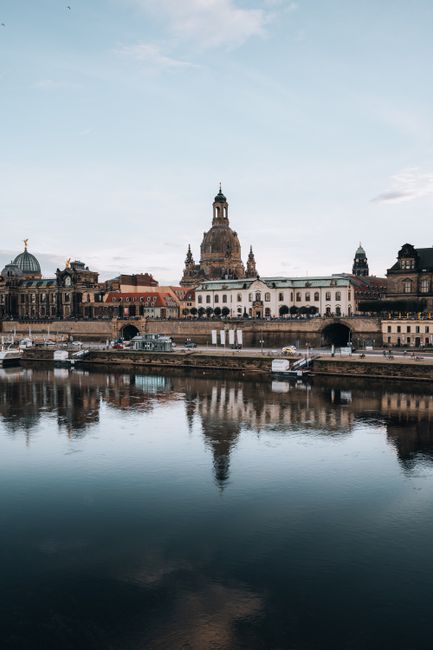
Dresden is the baroque capital of Saxony, a city of domes, palaces and river terraces on the Elbe that was almost erased in February 1945 and has spent the decades since rebuilding itself stone by stone. You come to stand under the dome of the Frauenkirche, walk through the pavilions of the Zwinger, see the jewels of the Green Vault in the Royal Palace, take a tour of the Semperoper, ride a paddle steamer along the river and cross to the lively Neustadt for dinner. It is two hours from Berlin and Prague by train, and the sandstone towers of Saxon Switzerland are less than an hour away. Give it two days for the Old Town and its museums, three or four to add the Neustadt, Pillnitz, Meissen and a hike to the Bastei Bridge.
Right now in Dresden
- Wed 9–20°C 48–68°F Clear
- Thu 11–20°C 52–68°F 3 mm Rain
- Fri 8–13°C 46–55°F Cloudy
Weather: MET Norway (CC BY 4.0) · Air quality: OpenAQ · Rates: ECB
Top tours in Dresden
See all tours for Dresden →
From local operators, with prices and reviews; you check availability and book on Viator, our partner. We may earn a commission at no extra cost to you. How we earn money
Dresden at a glance
- Best for: baroque architecture, world-class art and treasure collections, opera and concerts, river trips, Christmas markets and hiking day trips.
- How long: 2 days for the Old Town, the Frauenkirche, the Zwinger and the Green Vault; 3–4 days to add the Neustadt, Pillnitz, Meissen and Saxon Switzerland.
- Best time: May to September for the river and the hills; late November to Christmas for the Striezelmarkt, Germany’s oldest Christmas market.
- Getting in: direct trains from Berlin take about 1 hour 40 minutes to 2 hours; EuroCity trains from Prague about 2 hours 20 minutes. Dresden Airport is linked to the city by S-Bahn.
- Getting around: on foot in the Old Town, by tram across the river. As of October 2026, entry to the Frauenkirche was free, and a Historic Green Vault timed ticket cost €18.
- Before you go: entry rules, money and general safety are in our Germany travel guide.
Dresden, area by area
The Elbe divides the city. On the south bank, the Altstadt (Old Town) holds almost all the famous sights within a 15-minute walk of each other, rebuilt after the war on the old plan. On the north bank, the Innere Neustadt has baroque streets and the Golden Rider statue, and beyond it the Äußere Neustadt is the city’s bohemian quarter. Upstream, the river curves past villas, vineyards and palaces.
The Altstadt and the Neumarkt
The heart of the city: the Frauenkirche and the rebuilt baroque houses of the Neumarkt, the Royal Palace (Residenzschloss) with the Green Vault, the Catholic Court Church, the Semperoper and the Zwinger on Theaterplatz, and Brühl’s Terrace above the river, once called the “Balcony of Europe”. Best for: first visits, sightseeing on foot and concerts.
Prager Straße and the Altmarkt
South of the Old Town, the broad Prager Straße shopping street leads from the main station to the Altmarkt, the square that hosts the Striezelmarkt, with the Kulturpalast concert hall and the Kreuzkirche, home of the famous boys’ choir. Best for: shopping, arrivals by train and good-value hotels.
The Innere Neustadt
Cross the Augustus Bridge to the gilded Golden Rider statue of Augustus the Strong, the tree-lined Hauptstraße, the Japanese Palace and the Königstraße with its galleries and cafés. Best for: quieter stays with views back across the river to the Old Town skyline.
The Äußere Neustadt
North of Albertplatz, the “outer” Neustadt is a grid of late-19th-century streets full of bars, street art, independent shops and restaurants from every corner of the world. The Kunsthofpassage, a set of courtyards with whimsical façades, including a wall of drainpipes that plays music when it rains, is its best-known sight, and Pfunds Molkerei, a dairy shop covered in hand-painted tiles, is nearby. Best for: nightlife, food and a younger crowd.
Along the Elbe: Loschwitz and Blasewitz
Upstream, the blue steel Loschwitz Bridge, known as the Blue Wonder, links two elegant villa districts. From Loschwitz, historic hill railways climb to viewpoints over the valley, and the riverside path continues to Pillnitz Palace. Best for: cycling, beer gardens and slower stays.
Top things to see in Dresden
Prices and hours below were checked on the official sites in October 2026. They change, so check before you go.
The Frauenkirche
The Church of Our Lady, with its great stone dome, was the symbol of baroque Dresden until it collapsed two days after the bombing of February 1945. For almost 50 years it stayed a heap of rubble as a war memorial. Rebuilding began in 1994, using as many of the original blackened stones as possible, and the church was consecrated again in 2005, with a new golden cross made in Britain on its dome. Inside, pastel galleries rise in tiers around the altar.
Visiting. As of October 2026, entry to the church is free. The church is open for visitors on weekdays from 10:00 to 11:30 and 13:00 to 17:30, with changing times at weekends, around services, short prayers at noon and frequent concerts; check the calendar on the Frauenkirche website. A bilingual audio guide is available, and guided gallery tours in English can be booked online.
The dome climb. The dome ascent leads up stairs and a spiral ramp between the inner and outer domes to a viewing platform 67 m above the Neumarkt, with views over the Old Town and the Elbe; the final section is a steep staircase. As of October 2026 it cost €12 for adults, €7 reduced (including children aged 6 to 16, students and pensioners) and €24 for families. It is open Monday to Saturday 10:00–18:00 and Sunday 13:00–18:00, closing at 16:00 from November to February. Buy tickets online or at the ticket desk.
The Zwinger
Built between 1710 and 1728 for Augustus the Strong by the architect Matthäus Daniel Pöppelmann and the sculptor Balthasar Permoser, the Zwinger is a courtyard of baroque pavilions and galleries, with the Crown Gate, the Nymphs’ Bath fountain and a carillon of Meissen porcelain bells. The courtyard and the Nymphs’ Bath are free to walk through from early morning until late evening.
Inside, the Old Masters Picture Gallery (Gemäldegalerie Alte Meister) shows Raphael’s Sistine Madonna, with its two famous little angels, alongside Titian, Rembrandt, Vermeer and Canaletto’s views of Dresden. The Zwinger also holds the Porcelain Collection, one of the largest in the world, the Sculpture Collection up to 1800 and the Mathematical-Physical Salon of clocks and scientific instruments. As of October 2026, a Zwinger ticket covering these museums cost €18 for adults and €13.50 reduced; the picture gallery opens 10:00–17:00, the other Zwinger collections 11:00–17:00, and all are closed on Mondays.
The Green Vault and the Royal Palace
Augustus the Strong’s treasure chamber in the Residenzschloss is one of the richest in Europe, and it comes in two parts. The Historic Green Vault recreates the king’s original baroque rooms, with mirrored walls, gilding and some 3,000 objects in gold, silver, amber, ivory and precious stones displayed without glass cases. Visitor numbers are limited for conservation, so entry is by a timed ticket: as of October 2026 it cost €18 for adults, €13.50 reduced and €2 for school students, with young children free. Book it online, as slots sell out at busy times; coats and bags of any kind must go in the cloakroom or lockers (bring €1 or €2 coins).
The New Green Vault, on the floor above, shows individual masterpieces in modern cases, such as the 41-carat Dresden Green diamond and the miniature court of the Grand Mogul with its gold and enamel figures. It is covered by the Residenzschloss ticket (€18 for adults as of October 2026), which also includes the Armoury, the Turkish Chamber, the royal state apartments and the Coin Cabinet. The palace museums open 10:00–17:00, to 19:00 for the Green Vault on Fridays, and are closed on Tuesdays. An SKD day ticket for €28 covers all the state museums except the Historic Green Vault, and a combined ticket for the palace and the Historic Green Vault cost €28.
The Semperoper
Gottfried Semper’s opera house on Theaterplatz, rebuilt for a second time and reopened in 1985, is one of the finest in Europe, home of the Saxon State Opera and the Staatskapelle orchestra; Richard Strauss premiered nine of his operas here. To see the auditorium without a ticket for a performance, join a guided tour: tours of about 45 minutes run on most days, depending on rehearsals and performances, and as of October 2026 cost €16 for adults and €11 reduced. Tours start at the entrance beside the main door and should be booked in advance.
The Fürstenzug and Brühl’s Terrace
On the outer wall of the palace stables in Augustusstraße, the Procession of Princes is a mural more than 100 m long, made of around 23,000 Meissen porcelain tiles, showing the rulers of Saxony on horseback. Walk on to Brühl’s Terrace, the raised promenade above the Elbe, for the classic view of the paddle steamers and the river meadows, especially at sunset.
More museums
The Albertinum shows painting and sculpture from Romanticism to the present, with Caspar David Friedrich, the German Expressionists and Gerhard Richter (as of October 2026, €14 for adults). The Military History Museum, with its arrow-shaped extension by Daniel Libeskind, is excellent on a rainy day.
Churches and cathedrals
- Dresden Cathedral
- Frauenkirche Dresden
Museums
- Albertinum
- Green Vault
Other sights
- Brühl's Terrace
- Semperoper
- Zwinger
Elbe steamers and the river
The Sächsische Dampfschiffahrt runs the oldest and largest fleet of historic paddle steamers in the world, and 2026 marks its 190th anniversary. From the landing stages below Brühl’s Terrace, boats sail upstream past the Blue Wonder bridge and the riverside palaces to Pillnitz, and on into Saxon Switzerland, and downstream to Meissen. Short city cruises, evening trips and themed sailings run through the season, which is mainly from spring to autumn, with some winter and Christmas trips.
The Elbe is shallow, and in dry spells low water stops some sailings at short notice: on 2 October 2026, the lines into Saxon Switzerland were cancelled because of low water. Check the operator’s website on the morning you sail. Walkers and cyclists can follow the Elbe Cycle Route along the river meadows in both directions; see our boat trips guide and our cycling guide.
Day trip to Saxon Switzerland and the Bastei
Saxon Switzerland National Park, south-east of Dresden, is a landscape of sandstone towers, gorges and table mountains above the Elbe. Its most famous view is the Bastei, a rock ridge 194 m above the river, crossed by the stone Bastei Bridge of 1851; the bridge is free and always open.
Getting there by train. Take the S1 S-Bahn from Dresden main station towards Schöna; it runs about every 30 minutes and reaches Kurort Rathen in about 40 minutes. A small rope ferry crosses the river to Rathen village, and from there a steep footpath with steps climbs to the Bastei in about 30 to 45 minutes. A ride on the ferry costs a couple of euros.
What’s open, as of October 2026. The path from Kurort Rathen over the Bastei Bridge is open. The Neurathen rock castle beside the bridge, with its walkways between the rocks, has been closed since 2023 after measurements found the rocks moving, and stays closed until further notice. A storm in late July 2026 caused heavy damage around Kurort Rathen: helicopters are clearing fallen trees, some car parks on the Rathen side are closed and several trails and stages of the Malerweg (Painters’ Way) are diverted. The regional tourist board lists current closures, so check it before you set off. See our hiking guide.
On the way, you can stop at the medieval town of Pirna, or take the train on to Königstein for the vast hilltop fortress, or to Bad Schandau, a base for longer hikes. Allow a full day, start early to beat the crowds at the bridge, and wear proper shoes.
Things to do in Dresden
Pillnitz Palace and the river villas
Augustus the Strong’s summer palace at Pillnitz, with its Chinese-style roofs, gardens and a camellia over 200 years old, sits on the riverbank upstream. Arrive by paddle steamer for the full effect, or by tram and the little ferry across the Elbe.
Meissen and the wine villages
Meissen, 25 km down the Elbe, has a Gothic cathedral, a castle above the old town and the porcelain manufactory that made Europe’s first true porcelain in 1710. It is about 35 minutes away by S-Bahn. On the way, Radebeul’s vineyards and wine taverns belong to the Saxon Wine Route, one of Germany’s smallest and most northerly wine regions. See our wine tasting guide.
Eat and drink like a local
Try Dresdner Eierschecke, a layered cheesecake with custard, Christstollen at Christmas, Sauerbraten with red cabbage, Saxon potato soup and a glass of local Müller-Thurgau or Riesling from the Elbe valley. The Neustadt has the city’s best range of bars and international food.
Christmas in Dresden: the Striezelmarkt
The Striezelmarkt on the Altmarkt, first held in 1434, is Germany’s oldest documented Christmas market, named after the “Striezel”, the original name for Dresden’s Christmas stollen. The 592nd market runs from 25 November to 24 December 2026: on the opening day from 16:00 to 21:00, then daily from 10:00 to 21:00, and on 24 December from 10:00 to 14:00. Look for the giant Erzgebirge Christmas pyramid, the huge nutcracker-style figures and the wooden toys from the Ore Mountains. The Stollen Festival, when a giant stollen of several tonnes is paraded through the Old Town and cut on the Altmarkt, takes place on Saturday 5 December 2026. Smaller markets fill the Neumarkt by the Frauenkirche, the Stallhof in the palace and the Neustadt’s Hauptstraße.
Activities and best months
- Boat tripsThe Saxon Steamship company (Weisse Flotte Sachsen) runs nine historic paddle steamers, calling itself the oldest and largest paddle-steamer fleet in the world. They sail the Elbe from Dresden to Pillnitz, Meissen and Saxon Switzerland. The oldest is the Stadt Wehlen of 1879, and the Diesbar is still fired with coal. · source
- City sightseeingDresden's Frauenkirche is a baroque domed church destroyed in the Second World War and rebuilt after reunification as a symbol of peace; entry is free and you can climb the dome. Dresden Marketing also names the Zwinger (1709-1728, home of the Old Masters Picture Gallery and porcelain collection) and the Semperoper among its world-class sights, and lists Christmas markets with wooden huts on the Neumarkt in Advent. · source
Getting to Dresden
By train. Dresden Hauptbahnhof is on the line from Berlin to Prague. Direct trains from Berlin take about 1 hour 40 minutes to 2 hours, and EuroCity trains from Prague about 2 hours 20 minutes; there are frequent trains from Leipzig (about 1 hour 10 minutes) too. Book on bahn.de for advance fares.
By air. Dresden Airport has a limited range of flights; the S2 S-Bahn reaches the main station in about 20 minutes. Berlin Brandenburg, Leipzig/Halle and Prague airports have far more connections and good rail links.
By car. The city is on the A4 and A13 motorways and the A17 to Prague. Parking in the centre is expensive, and the Old Town is best explored on foot.
Getting around Dresden
Walk in the Old Town; trams and buses run by DVB cover the rest of the city, and day tickets are good value. The Carola Bridge, which partly collapsed in September 2024, has been demolished, and a replacement is not due to start construction until 2028, so tram routes across the river have changed: use the Augustus and Albert bridges.
When to go and how long to stay
Dresden has a mild continental climate: warm summers, cold winters and rain spread through the year, with the heaviest falls in summer thunderstorms. The table uses the Deutscher Wetterdienst (DWD) 1991–2020 averages for the Dresden-Klotzsche weather station near the airport: average temperature over day and night, rainfall and hours of sunshine per month.
| Season | Average temperature | Rain per month | Sunshine per month | What it’s like |
|---|---|---|---|---|
| Winter (Dec–Feb) | 0.5–1.7 °C | 33–44 mm | 60–82 hours | Cold and often grey, frost and occasional snow; Christmas markets and concerts |
| Spring (Mar–May) | 4.7 °C rising to 13.9 °C | 36–63 mm | 127–222 hours | Blossom along the Elbe meadows, cool evenings, quieter museums |
| Summer (Jun–Aug) | 17.2–19.4 °C | 63–85 mm | 221–234 hours | Warm, with heatwaves and thunderstorms; beer gardens and open-air films on the river |
| Autumn (Sep–Nov) | 14.6 °C falling to 4.9 °C | 48–52 mm | 164 falling to 68 hours | Golden vineyards and wine festivals in September, foggy November |
Dresden averages about 640 mm of rain a year and 1,770 hours of sunshine. July is the warmest and wettest month; on hot days, afternoons in the Old Town can top 30 °C, so plan museums for the middle of the day. Winter nights are often below freezing.
Dresden in 2 days
Day 1: the Frauenkirche and its dome in the morning, the Fürstenzug, Brühl’s Terrace and a timed slot in the Historic Green Vault in the afternoon, then the New Green Vault, and a concert or opera in the evening. Day 2: the Zwinger and the Old Masters, a Semperoper tour, a short steamer cruise and dinner in the Neustadt.
Dresden in 4 days
Add a day hiking to the Bastei in Saxon Switzerland, and a day for Pillnitz by paddle steamer, the Blue Wonder and Loschwitz, or for Meissen and the vineyards of Radebeul.
Weather month by month
Averages from DWD normals 1991–2020, Dresden-Klotzsche (airport) · Last reviewed 4 Oct 2026
Where to stay in Dresden
- Altstadt and Neumarkt: the most central base, beside the Frauenkirche and the museums; prices peak during the Christmas market.
- Prager Straße and the main station: big modern hotels, good value and handy for day trips by train.
- Innere Neustadt: quiet, elegant and a short walk across the river, often with views of the skyline.
- Äußere Neustadt: guesthouses, hostels and apartments in the nightlife quarter.
- Loschwitz and Blasewitz: villas and small hotels by the river, for slower stays.
Dresden charges a city tax on overnight stays, added to the hotel bill. Book early for Advent weekends, when visitors arrive by the coachload for the markets.
Practical tips for Dresden
- Book the Historic Green Vault: timed tickets are limited; reserve a slot online before you travel.
- Know the closing days: the palace museums close on Tuesdays and the Zwinger museums on Mondays.
- Check the river: low water can cancel steamer sailings at short notice in dry spells.
- Check the trails: look at the Saxon Switzerland tourist board’s list of closures before hiking to the Bastei.
- Go early: the Frauenkirche, the Zwinger courtyard and the Bastei Bridge are calmest early in the morning.
- Bring coins: lockers in the museums take €1 or €2 coins.
What to pack for Dresden
Comfortable shoes for cobbles and the dome climb, a light waterproof, layers for cool evenings by the river, and proper walking shoes if you hike in Saxon Switzerland, where paths have steep steps and ladders. In winter, bring a warm coat, hat and gloves for the markets. Leave big bags at the hotel: museum cloakrooms take them, but the dome stairs are narrow.
What to pack
- City walking shoesLisbon and Porto are steep, with polished limestone cobbles that get slippery, so grippy soles matter.
- Day packs and anti-theft bagsA small zipped or anti-theft bag makes crowded trams and viewpoints less stressful.
- Dry bags and phone pouchesSpray soaks phones and cameras on open boats to the Algarve caves and on whale-watching trips.
- Fleeces and warm layersIt is cooler at sea than on land, especially on morning whale-watching trips.
- Rain jacketsA windproof, waterproof shell keeps you warm on open boats, where wind and spray cool you quickly.
- Reef-friendly sunscreenSun reflects off the water on cruises and cave tours.
- Travel adapters and convertersPortugal uses Type C and F sockets at 230 V, so most visitors from outside Europe need an adapter.
- Water shoesKayak and small-boat trips to the Algarve grottoes land on rock and wet sand.
Dresden travel FAQ
Is the Frauenkirche in Dresden free to visit?
Yes. As of October 2026, entry to the church is free; it is open on weekdays from 10:00 to 11:30 and 13:00 to 17:30, with changing times at weekends and around services and concerts. Only the dome climb is paid.
How much does it cost to climb the Frauenkirche dome?
As of October 2026, €12 for adults, €7 reduced and €24 for families. The climb leads to a platform 67 m up and is open Monday to Saturday 10:00–18:00 and Sunday 13:00–18:00, closing at 16:00 from November to February.
Do I need to book the Historic Green Vault?
Yes, it is strongly recommended. Visitor numbers are limited, so entry is by a timed ticket (€18 for adults as of October 2026). The New Green Vault upstairs is covered by the Residenzschloss ticket.
Can you tour the Semperoper?
Yes. Guided tours of about 45 minutes run on most days, depending on rehearsals, and cost €16 for adults and €11 reduced as of October 2026. Book ahead.
When is the Dresden Striezelmarkt in 2026?
From 25 November to 24 December 2026 on the Altmarkt, open daily 10:00–21:00 (16:00–21:00 on the opening day and 10:00–14:00 on 24 December). The Stollen Festival is on Saturday 5 December 2026.
How do I get from Dresden to the Bastei Bridge?
Take the S1 S-Bahn to Kurort Rathen (about 40 minutes), cross the Elbe on the small ferry and walk up to the bridge in about 30 to 45 minutes. The bridge is free and always open, but the Neurathen rock castle beside it is closed.
Is the Zwinger free?
The courtyard and the Nymphs’ Bath are free to walk through. The museums inside, including the Old Masters Picture Gallery, need a ticket (€18 for adults as of October 2026) and are closed on Mondays.
How many days do you need in Dresden?
Two days cover the Old Town, the Frauenkirche, the Zwinger and the Green Vault. Three or four let you add the Neustadt, a paddle steamer trip, Meissen or Pillnitz and a day in Saxon Switzerland.
When is the best time to visit Dresden?
May to September for the river, the vineyards and hiking, or late November and December for the Striezelmarkt and Advent concerts.
Nearby destinations
- Saxon Switzerland41 km
- Bohemian Switzerland43 km
- Leipzig100 km
- Karlovy Vary110 km
- Prague117 km
- Berlin165 km
- Wrocław230 km
- Český Krumlov252 km
Sources
- © OpenStreetMap contributors · ODbL · fetched 4 Oct 2026
- Wikidata · CC0 · fetched 4 Oct 2026
Sources and last review
Researched and last reviewed on 4 October 2026. Frauenkirche hours, entry and dome prices: the Frauenkirche Dresden foundation; Zwinger, Green Vault and Residenzschloss prices and hours: Staatliche Kunstsammlungen Dresden (SKD); Striezelmarkt dates and hours: the City of Dresden; Saxon Switzerland closures and low-water cancellations: the Saxon Switzerland tourist board (Tourismusverband Sächsische Schweiz); paddle steamers: Sächsische Dampfschiffahrt; Carola Bridge: the City of Dresden; climate: Deutscher Wetterdienst 1991–2020 averages for Dresden-Klotzsche. Semperoper tour prices, the Stollen Festival date, the ferry fare and train times come partly from secondary sources and are flagged for checking. Prices, timetables and rules change, so check the official links before you go. For entry rules, money and general safety, see our Germany travel guide; for the capital, our Berlin guide; and for more of eastern and southern Germany, our Nuremberg guide.
Plan your trip
Partner links: TravelerCenter may earn a commission if you book, at no extra cost to you.
🇩🇪 Useful German phrases for Dresden
All 38 German phrases: restaurant, hotel, emergencies, romance (printable) →