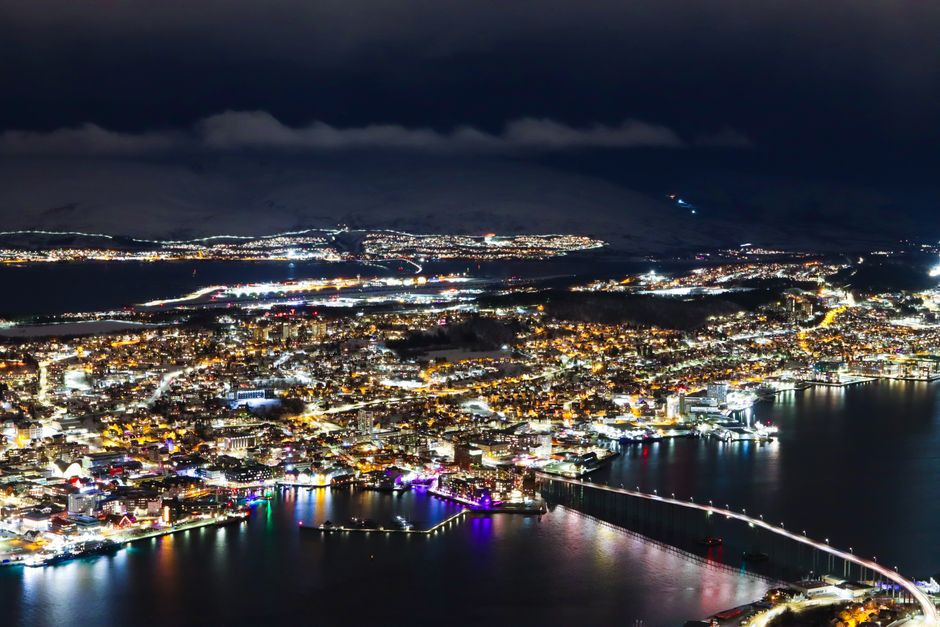
Tromsø is a lively little city 350 km north of the Arctic Circle, built on an island between snowy peaks and the sea. It is Norway’s best-known base for the Northern Lights, which dance overhead on clear, dark nights from late August to early April, and for the strange seasons of the far north: around two months of polar night in winter, when the sun never rises, and two months of midnight sun in summer, when it never sets. You come to ride the cable car up Mount Storsteinen, visit the Arctic Cathedral and the polar museums, go dog sledding, meet reindeer herders, chase the aurora on a clear night and drive out to the wild fjords of Kvaløya and the Lyngen Alps. Give it three or four nights in winter to give the Northern Lights a fair chance, two or three in summer.
Right now in Tromsø
- Wed5–7°C42–45°F26 mm rain
- Thu2–6°C36–42°F9 mm rain
- Fri1–3°C33–37°F2 mm rain
Top tours in Tromsø
See all tours for Tromsø →
From local operators, with prices and reviews; you check availability and book on Viator, our partner. We may earn a commission at no extra cost to you. How we earn money
Tromsø at a glance
- Best for: the Northern Lights, polar night and midnight sun, dog sledding, reindeer and Sami culture, Arctic museums, fjord drives, hiking and ski touring.
- How long: 3–4 nights in the aurora season (late August to early April), so that one or two clear nights are likely; 2–3 nights in summer; a week to add the Lyngen Alps or Senja.
- Best time: late September to March for the Northern Lights; January to March for snow activities with some daylight; 20 May to 22 July for the midnight sun.
- Getting in: flights from Oslo take about 1 hour 50 minutes; the airport is 15–20 minutes from the centre by the Flybuss airport coach or a local bus. The Hurtigruten and Havila coastal ships call every day.
- Getting around: the centre is walkable; Svipper buses cover the island and the mainland. As of October 2026, a single ticket costs NOK 50 and a 24-hour ticket NOK 140.
- Before you go: Norway uses the Norwegian krone (NOK), cards are accepted almost everywhere, and Norway is in the Schengen area. Winter here is cold, dark and slippery, so pack properly (see below).
Tromsø, area by area
Tromsø municipality has about 79,000 people, and the city spreads over the island of Tromsøya and the mainland across the Tromsøysund strait, linked by the Tromsø Bridge and an undersea tunnel. Kvaløya, a much bigger island to the west, is joined by another bridge.
The city centre
The compact centre on the east side of Tromsøya has Storgata, the main shopping street, painted wooden houses from the 1800s, Tromsø Cathedral (one of Norway’s largest wooden churches), the harbour where the coastal ships tie up, Polaria and the Polar Museum. Most hotels, restaurants and tour pick-up points are here, all within a 15-minute walk.
Tromsdalen, across the bridge
On the mainland side, Tromsdalen is home to the Arctic Cathedral and the lower station of the Fjellheisen cable car. It is a 30-minute walk from the centre over the Tromsø Bridge, with fine views back to the island, or a short bus ride.
The rest of the island and Telegrafbukta
The south of Tromsøya has the small Telegrafbukta beach, the botanical garden and the Arctic University Museum; the middle of the island is a long wooded ridge with walking and ski tracks around Prestvannet lake, which locals use for quick aurora watching away from the streetlights. The airport is on the west side.
Kvaløya and the outer coast
West of the city, Kvaløya and its neighbouring islands have steep peaks, white beaches and fishing villages such as Sommarøy, an hour’s drive away. This is where many aurora tours and self-drivers go to find dark, open skies facing north.
Northern Lights, polar night and midnight sun
Seeing the Northern Lights
Tromsø sits under the auroral oval, the ring around the magnetic pole where the Northern Lights appear most often, so on a clear, dark night you have a good chance of seeing them even from the city. Visit Tromsø gives the season as late August to early April; outside that window, the nights are simply too light. Two things matter much more than the “aurora forecast”: darkness and clear skies. The coast is often cloudy, so the best plan is to stay several nights and to be ready to travel. Guided “aurora chase” tours by minibus drive to wherever the sky is clearest, sometimes as far as the Finnish border in the inland valleys, and usually run from about 18:00 to after midnight. Most include warm suits, a fire and photos.
- Best months: late September to October and February to March, when nights are long but the weather is often more settled than in midwinter, and you also get daylight for activities. December and January have the longest dark hours but more cloud and snow.
- Best hours: often between about 21:00 and 01:00, but the lights can appear any time it is dark.
- Forecasts: check cloud cover first (the Norwegian Meteorological Institute’s yr.no app), then an aurora activity forecast. A low activity number can still give a good show this far north.
- Driving yourself: only if you are used to icy, dark roads. Never stop on the road or in passing places to watch the sky; use proper car parks, and switch off your lights.
Polar night
From about 27 November to 15 January, the sun stays below the horizon in Tromsø. It is not pitch black: for a few hours around midday the sky glows blue, pink and orange, which Norwegians call the “blue time”. The surrounding mountains keep the sun hidden from the centre until about 21 January, the city’s Sun Day, celebrated with sun buns (solboller). The dark time is cosy rather than gloomy, with candles everywhere, the Christmas season and, in late January, the Northern Lights Festival of music and the Tromsø International Film Festival (check 2027 dates on their websites).
Midnight sun
From about 20 May to 22 July, according to Visit Tromsø, the sun never sets. Locals hike, kayak and barbecue through the night, the Arctic Cathedral holds late-evening concerts, and the light in late May and June, with snow still on the peaks, is wonderful for photographs. Bring a sleep mask; most hotels have blackout curtains.
Top things to see in Tromsø
Prices below are as of October 2026 and in Norwegian kroner; museums are free for under-18s in several cases, so check before you pay.
Fjellheisen cable car and Storsteinen
The Fjellheisen cable car climbs from Tromsdalen to the Storsteinen ledge, about 420 m up, in four minutes, for the classic view over the island city, the bridge, the fjords and the peaks of Kvaløya. On a clear winter evening it is one of the most comfortable places in town to watch the Northern Lights, with a café at the top. It runs daily from 09:00 to midnight, every half hour. As of October 2026, a return ticket costs NOK 645 for adults and NOK 310 for children aged 3–15 (one way NOK 415 and NOK 195; family return NOK 1,360). Building work for a new station is under way, the car park at the bottom has gone, and the cable car is not wheelchair accessible during the works. Take bus 26 from Torgsenteret in the centre to the “Fjellheisen” stop; in winter (15 November to 31 March) an electric shuttle also runs from the centre. Fit walkers can climb up the Sherpa steps, a stone staircase of about 1,200 steps, in summer and early autumn, and ride down.
The Arctic Cathedral
Tromsø’s landmark, the Arctic Cathedral (Ishavskatedralen), is actually a parish church: a white triangle of 11 aluminium-clad concrete panels designed by Jan Inge Hovig and consecrated in 1965, with a huge glass mosaic by Victor Sparre added in 1972 above the altar. Entry costs from NOK 90 for adults, and children aged 12 and under go free. Opening hours change through the season and around services and concerts, so check ishavskatedralen.no before you go. Concerts include Northern Lights concerts in winter and the midnight-sun concerts in summer; drones are forbidden on the site.
Polaria
The Arctic experience centre, in a building shaped like ice floes pushed up onto land, has a panoramic cinema, exhibitions made with polar researchers, an Arctic aquarium and a seal pool that has been rebuilt three times bigger, with bearded, harbour and ringed seals. Feeding and training sessions are at 10:30, 12:30 and 15:30. Polaria is open daily from 10:00 to 17:00. As of October 2026, tickets cost NOK 395 for adults, NOK 220 for children aged 3–15 and NOK 925 for a family. It is a good choice with children or on a stormy day.
The Polar Museum
In an old customs warehouse by the harbour, the Polar Museum tells the story of Tromsø as the “gateway to the Arctic”: trapping and sealing in Svalbard, and the expeditions of Roald Amundsen and Fridtjof Nansen that set out from or passed through the city. It is small, old-fashioned and fascinating. It is run by the Arctic University Museum; as of October 2026, adults pay NOK 130 and under-18s go free (check opening hours on the museum’s website).
The Arctic University Museum of Norway
The university’s museum, still often called Tromsø Museum, covers the geology, wildlife and people of the north, with a good section on Sami culture and history, and a Northern Lights exhibition that explains what you are (hopefully) seeing at night. As of October 2026, adult tickets cost NOK 130, and under-18s go free. From 16 August to 14 June it opens Monday to Friday 10:00–16:30 and at weekends 11:00–16:00, with longer hours in summer; it is closed on some public holidays. Take a bus to the south of the island.
The old town and the harbour
Walk Storgata and the streets around the wooden Tromsø Cathedral, the harbour and the old Mack brewery, with its classic beer hall (Ølhallen). The modern library and the Perspektivet and Nordnorsk Kunstmuseum (the Northern Norway Art Museum) are close by, and the harbour front is a good place to watch the coastal ships come in.
Churches and cathedrals
- Arctic Cathedral
- Tromsø Cathedral
Museums
- MS Polstjerna
- Tromsø University Museum
Zoos and aquariums
- Polaria
Viewpoints
- Fjellheisen
Peaks and mountains
- Tromsdalstinden
Winter adventures: dogs, reindeer and whales
- Dog sledding: kennels on Kvaløya and in the valleys around Tromsø run trips from roughly late November to April, when there is enough snow; you can ride in the sled or drive your own team. Shorter visits to meet the huskies run all year.
- Reindeer and Sami culture: Sami-run camps near the city offer reindeer feeding, sledding, a meal in a lavvo (tent) and stories and joik songs. Choose one owned by Sami families.
- Whale watching: humpback whales and orcas follow the herring into the fjords in winter, usually from late October or November into January. The herring has moved in recent years, so most trips now go north to the Skjervøy area, a long day out. Choose an operator that follows the whale-watching guidelines and keeps a distance.
- Snowshoeing and skiing: easy snowshoe walks start near Fjellheisen and on Kvaløya; the Lyngen Alps are one of Europe’s great ski-touring areas from February to May, always with a guide unless you are trained in avalanche safety.
- Fjord cruises and saunas: silent electric boats sail the fjords by day and on aurora trips, and floating saunas in the harbour let you dip in the Arctic sea.
In summer, swap snow for hiking on the peaks of Tromsøya and Kvaløya (Fløya, Rødtinden, Store Blåmann), sea kayaking and midnight-sun boat trips. Book popular winter tours a few weeks ahead for Christmas, New Year and February half-term.
Day trips from Tromsø
- Kvaløya and Sommarøy: a round trip of a few hours by car past fjords, beaches and the fishing village of Sommarøy (about one hour each way), with white sand and turquoise water in summer.
- The Lyngen Alps: sharp, glaciated peaks rising straight from the fjord, about 1.5–2 hours away with a ferry crossing; good for scenic drives, hiking in summer and ski touring in spring.
- Senja: Norway’s second-largest island, with dramatic peaks and the Bergsbotn and Tungeneset viewpoints, about 3 hours away; better as an overnight trip.
Activities and best months
- Boat tripsBoat tours from Tromsø range from fjord cruises and sailing trips to fishing trips (cod, haddock, mackerel, wolffish) and fast RIB tours; some run under the midnight sun in summer, others on winter evenings.
- City sightseeingGuided sightseeing in Tromsø runs on foot, by bus, car or bike, with themes such as polar history, coastal culture and local food.
- HikingJunJulAugSepOctThe Tromsø region has hikes from easy walks near the city to demanding mountain routes; the main season usually lasts from June to October, depending on snow, and snow can stay on the higher mountains all summer. Check conditions and follow the Norwegian Mountain Code.
Getting to Tromsø
By air. Tromsø Airport (TOS) is the main hub of northern Norway, with frequent flights from Oslo (about 1 hour 50 minutes) and connections to Bergen, Trondheim and the rest of the north, plus seasonal direct flights from some European cities in winter. There is no railway to Tromsø.
From the airport. The red Flybuss airport coach takes about 20 minutes to the centre, stopping at the main hotels. As of October 2026, it costs NOK 125 one way or NOK 200 return for adults (children 4–15 NOK 80/130); pay online or by card on board, as cash is not accepted. Local Svipper buses 40 and 42 also run to the centre for the normal NOK 50 fare. Taxis take about 10 minutes.
By sea. The Hurtigruten and Havila coastal ships between Bergen and Kirkenes call at Tromsø every day in both directions, with a stop of several hours northbound in the afternoon, long enough for the Arctic Cathedral or the cable car. Port times vary by season, so check the operator’s timetable.
By road. Tromsø is about 250 km from Narvik and 1,700 km from Oslo by road. In winter, the roads are snowy and icy and short of daylight; drive only with winter tyres and experience of these conditions.
Getting around Tromsø
Walk in the centre; buses run by Svipper cover the island, Tromsdalen and Kvaløya. Buy tickets in the Svipper app. As of October 2026 (prices from 1 February 2026), a single adult ticket costs NOK 50 (children 6–17 NOK 25), with a cheaper off-peak fare of NOK 30 on weekdays from 09:00 to 14:00 and from 17:00; a 24-hour ticket costs NOK 140 and a 7-day ticket NOK 327. Most winter tours pick you up in the centre, so you rarely need a car.
The Tromsø Bridge is under repair until 1 November 2026. Cars must use the tunnel, buses use the bridge at set times on weekdays, and pedestrians and cyclists can cross at any time. Check traffic updates if you are driving to the Arctic Cathedral or Fjellheisen before then.
Nearby destinations
- Lofoten225 km
When to go and how long to stay
Thanks to the Gulf Stream, Tromsø is much milder than its latitude suggests: winters are long and snowy rather than bitterly cold, and summers are cool and changeable. The table uses MET Norway’s 1991–2020 climate normals for the Tromsø weather station (100 m above sea level, on the island), as submitted to the World Meteorological Organization: average daily highs, rain or snow per month and days with at least 1 mm.
| Season | Average daily high | Rain or snow per month | Wet days per month | What it’s like |
|---|---|---|---|---|
| Winter (Dec–Feb) | -1.1 to 0.3 °C (nights about -4 to -6 °C) | 97–110 mm | 13–15 | Snow on the ground, polar night until mid-January, Northern Lights and winter activities |
| Spring (Mar–May) | 0.6 °C rising to 8.8 °C | 97 falling to 57 mm | 11–14 | Snowy and bright in March and April, best for skiing; snow melts in May; midnight sun from 20 May |
| Summer (Jun–Aug) | 13.0–16.3 °C | 58–88 mm | 11–13 | Cool, fresh, 24-hour daylight until 22 July; hiking and kayaking |
| Autumn (Sep–Nov) | 10.9 °C falling to 2.1 °C | 94–127 mm | 13–16 | Autumn colours in September, dark evenings and the aurora season, first snow in October or November |
Tromsø gets about 1,090 mm of rain and snow a year, on about 160 days; October is the wettest month and May the driest. The average temperature for the year is just 3.4 °C, and in July it is 12.3 °C. Snow usually covers the ground from November to April. Weather changes fast, so build spare nights into an aurora trip.
Tromsø in 3 days (winter)
Day 1: the centre, Polaria and the Polar Museum, then the cable car at dusk and the Northern Lights from Storsteinen if the sky is clear. Day 2: dog sledding or a Sami reindeer camp, and an aurora chase in the evening. Day 3: the Arctic Cathedral and the Arctic University Museum, a fjord sauna, and a second aurora night if the first was cloudy.
Tromsø in 5 days
Add a whale-watching trip in November to January, or a snowshoe hike, and a day on Kvaløya and Sommarøy or in the Lyngen Alps. In summer, use the extra days to hike Fløya at midnight and drive to Senja.
Weather month by month
Where to stay in Tromsø
- City centre: most hotels are here, close to the harbour, restaurants and tour pick-up points; the best base without a car.
- Tromsdalen: apartments and guesthouses near the Arctic Cathedral and Fjellheisen, a bus ride or a walk over the bridge from the centre.
- Kvaløya and the fjords: cabins and lodges with dark skies, where you can watch the Northern Lights from the doorstep; you need a car and winter driving experience.
- Glass igloos and wilderness camps: outside the city, often with transfers included; expensive, so book early for December and February.
Hotels are busiest and most expensive from mid-November to March, especially at Christmas, New Year and in February. Book three to six months ahead for those dates.
Practical tips for Tromsø
- Watch your step: pavements are icy for months; buy or bring slip-on ice grips (brodder) for your shoes. Many hotels lend them.
- Respect the aurora watchers: don’t park on roads or private land, keep car lights off, and don’t fly drones near the airport or the Arctic Cathedral.
- Book tours that cancel fairly: choose operators that offer a free cancellation or a new date if a trip is called off for weather.
- Pay by card: almost everywhere takes cards and phone payments, including buses and the airport coach.
- Plan for prices: Norway is expensive; the beer hall, bakeries and supermarket hot food are the budget options, and tap water is excellent.
- Check the mountains: before any winter hike, look at the avalanche warning on varsom.no, and never go off-piste or onto steep slopes without a guide.
What to pack for Tromsø
For winter, think layers rather than one huge coat: thermal base layers (wool is best), a fleece or wool sweater, a windproof and waterproof outer shell, warm trousers, a hat that covers your ears, a buff, thin gloves under thick mittens, wool socks and waterproof winter boots with good grip, plus ice grips. Aurora tours stand still in the cold for hours, often at -10 °C or below inland, so most lend thermal suits. Bring a head torch, spare batteries for your camera and phone (the cold drains them fast) and a tripod for Northern Lights photos. In summer, pack a rain jacket, a warm layer, hiking shoes and a sleep mask. Norway uses type C and F plugs, so check our travel adapters guide.
What to pack
- City walking shoesLisbon and Porto are steep, with polished limestone cobbles that get slippery, so grippy soles matter.
- Day packs and anti-theft bagsA small zipped or anti-theft bag makes crowded trams and viewpoints less stressful.
- Dry bags and phone pouchesSpray soaks phones and cameras on open boats to the Algarve caves and on whale-watching trips.
- Fleeces and warm layersIt is cooler at sea than on land, especially on morning whale-watching trips.
- HeadlampsLevada routes such as PR1 and PR9 pass through long, dark, wet tunnels.
- Hiking shoes and bootsMadeira's levadas and the Azores' crater rims are wet, rocky and slippery, so grippy shoes matter more than anywhere else in Portugal.
- Rain jacketsA windproof, waterproof shell keeps you warm on open boats, where wind and spray cool you quickly.
- Reef-friendly sunscreenSun reflects off the water on cruises and cave tours.
- Travel adapters and convertersPortugal uses Type C and F sockets at 230 V, so most visitors from outside Europe need an adapter.
- Trekking polesLong stone staircases and steep descents on Madeira's peaks and the Azores' crater rims are easier on the knees with poles.
- Water bottles and hydration packsAlgarve and Alentejo trails are hot and exposed with few refill points.
- Water shoesKayak and small-boat trips to the Algarve grottoes land on rock and wet sand.
Tromsø travel FAQ
When is the best time to see the Northern Lights in Tromsø?
The season runs from late August to early April, when it is dark enough. Late September to March is the most reliable period, and many locals prefer late September to October and February to March, when the weather is often more settled. Stay at least three or four nights, because clouds are the main problem.
Can you see the Northern Lights from Tromsø city centre?
Yes, strong displays are visible over the city, but the streetlights wash out weaker ones. Walk to Telegrafbukta or Prestvannet on the island, ride the cable car up to Storsteinen, or join a tour that drives to dark, clear skies.
When is the polar night in Tromsø?
From about 27 November to 15 January the sun does not rise above the horizon. Because of the mountains, it reappears in the city only around 21 January, celebrated as Sun Day. There are still a few hours of blue twilight around midday.
When is the midnight sun in Tromsø?
From about 20 May to 22 July, the sun stays above the horizon all night. Clouds can hide it, but it never gets dark.
How much is the Fjellheisen cable car in Tromsø?
As of October 2026, a return ticket costs NOK 645 for adults and NOK 310 for children aged 3–15, and a family return NOK 1,360. It runs daily from 09:00 to midnight. During the current building works there is no car park at the bottom and no wheelchair access, so take bus 26 or the winter shuttle.
Is the Arctic Cathedral worth visiting?
Yes, for its striking 1965 architecture and the huge glass mosaic, and especially for a concert. Entry costs from NOK 90, and children aged 12 and under go free; check the opening hours, as they change with services and events.
Can you go whale watching from Tromsø?
Yes, roughly from late October or November to January, when orcas and humpback whales follow the herring. Most trips now head north to the waters around Skjervøy, which makes for a long day. Sightings are likely but never guaranteed.
How do I get from Tromsø Airport to the city?
Take the Flybuss airport coach (about 20 minutes; NOK 125 one way for adults as of October 2026, card only) or local Svipper buses 40 and 42 (NOK 50, buy in the app). A taxi takes about 10 minutes.
How cold is Tromsø in winter?
Milder than most people expect: in the city, average daytime highs are around -1 to 0 °C from December to February, with nights around -4 to -6 °C. Inland valleys, where aurora tours often go, can be much colder, below -20 °C on clear nights. Wind and wet snow make it feel colder.
Do I need to rent a car in Tromsø?
No. The centre is walkable, buses cover the city, and most tours include hotel or central pick-up. A car is useful in summer for Kvaløya, Sommarøy and the Lyngen Alps; in winter, drive only if you have experience of dark, icy roads.
How many days do you need in Tromsø?
Three to four nights in winter gives you time for the city, one or two activities and several chances at the Northern Lights. Two or three nights is enough in summer, a week if you add the Lyngen Alps or Senja.
Plan your trip
Partner links: TravelerCenter may earn a commission if you book, at no extra cost to you.
🇳🇴 Useful Norwegian phrases for Tromsø
All 38 Norwegian phrases: restaurant, hotel, emergencies, romance (printable) →
Sources · last reviewed 4 October 2026
Researched and last reviewed on 4 October 2026. Northern Lights season and midnight sun dates: Visit Tromsø (visittromso.no); polar night and Sun Day: Visit Tromsø and the Northern Norway tourist board; cable car prices, hours, works and buses: Fjellheisen (fjellheisen.no); the Arctic Cathedral: ishavskatedralen.no and Visit Tromsø; Polaria: Visit Tromsø’s official listing; the Arctic University Museum and the Polar Museum: UiT The Arctic University of Norway; bus fares: Svipper; the airport coach: its operator; the Tromsø Bridge works: Troms County and local press; climate: MET Norway 1991–2020 normals for the Tromsø station (WMO collection). Whale-watching seasons, coastal-ship port times and flight times come partly from secondary sources and are flagged for checking. Prices, timetables and rules change, so check the official links before you go.
Also: visittromso.no · MET Norway normals 1991–2020, Tromsø (climate)
Data: Weather: MET Norway (CC BY 4.0) · Sea temperature: NOAA CoastWatch · Rates: ECB · Costs: World Bank ICP and price levels · © OpenStreetMap contributors (ODBL) · Wikidata (CC0)