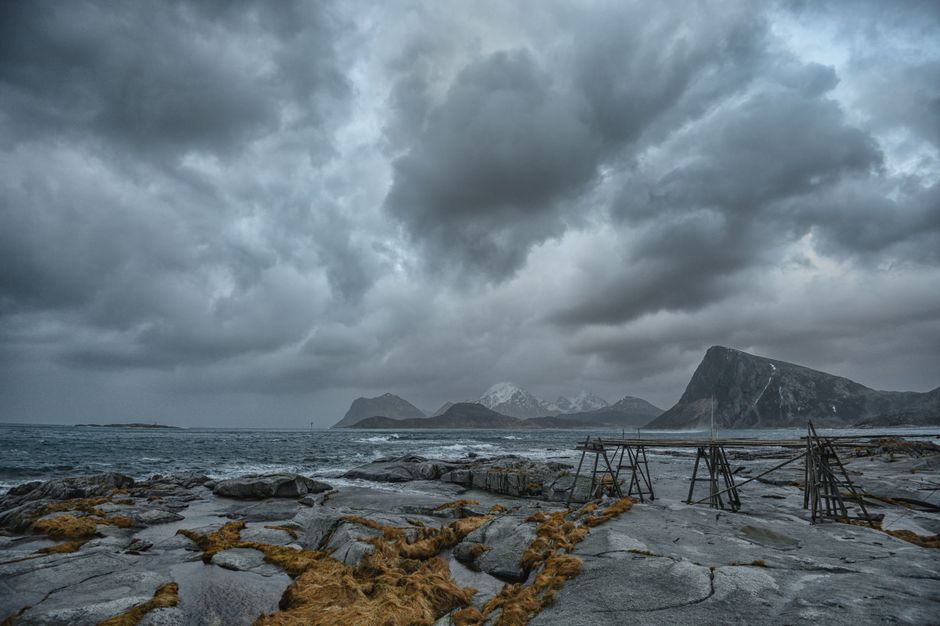
The Lofoten Islands are a chain of jagged granite peaks rising straight out of the Norwegian Sea, 100 to 300 km north of the Arctic Circle. Red and yellow fishermen’s cabins (rorbuer) stand on stilts in sheltered harbours, wooden racks of drying cod line the roads in spring, and white-sand beaches with turquoise water hide between the mountains. The single main road, the E10, threads the islands together with bridges and tunnels from the mainland to the village of Å at the southern tip. You come for the view of Reine and Hamnøy, the beaches of Haukland and Kvalvika, mountain hikes, Arctic surfing at Unstad, the Viking museum at Borg, fresh fish and, depending on the season, the midnight sun or the Northern Lights. Give it at least four days; a week lets you slow down and wait out the weather.
Right now in Lofoten (Svolvær)
- Wed 5–7°C 42–45°F 2 mm Light rain
- Thu 4–6°C 38–43°F 3 mm Partly cloudy
- Fri 2–5°C 35–40°F Mostly clear
Weather: MET Norway (CC BY 4.0) · Sea temperature: NOAA CoastWatch · Rates: ECB
Top tours in Lofoten
See all tours for Lofoten →
From local operators, with prices and reviews; you check availability and book on Viator, our partner. We may earn a commission at no extra cost to you. How we earn money
Lofoten at a glance
- Best months: June to August for hiking, beaches and the midnight sun (about 28 May to 14 July); late August to September for autumn colours, fewer people and the first Northern Lights; February and March for snowy peaks, the cod season and the aurora with some daylight.
- Time needed: 4–5 days to drive the islands from Svolvær to Å with a couple of hikes; 7–10 days to add Vesterålen, more hikes or a slow cabin stay.
- Getting there: by car ferry from Bodø to Moskenes (about 3–3.5 hours), by the Hurtigruten and Havila coastal ships to Stamsund and Svolvær, by short flights from Bodø to Leknes or Svolvær, or by road on the E10 from Evenes airport or Narvik.
- Getting around: a car (or campervan) gives you the most freedom; local buses run along the E10 but are infrequent outside summer.
- Rules: tent camping is banned in summer at Reine, Reinebringen and several other busy spots, and all year at Haukland; campervans may not stay overnight in many lay-bys. Use campsites and toilets, and don’t fly drones near villages and people.
Lofoten, island by island
Lofoten is made up of six municipalities: Vågan, Vestvågøy, Flakstad and Moskenes along the E10, and the small, remote outer islands of Værøy and Røst, reached by ferry or helicopter. From north-east to south-west:
- Austvågøy (Svolvær, Kabelvåg, Henningsvær): the main town of Svolvær, with the airport, hotels, the coastal-ship quay and the Svolværgeita pinnacle; Kabelvåg, the oldest fishing village, with the big wooden Vågan Church (the “Lofoten Cathedral”) and the Lofoten Museum; and Henningsvær, a fishing village spread over small islands, famous for its football pitch on the rocks.
- Gimsøya: a flat island of marshes and beaches, with a golf course that is playable under the midnight sun.
- Vestvågøy (Leknes, Borg, Stamsund, Unstad, Haukland): the farming heart of Lofoten, with the Lofotr Viking Museum at Borg, the main shopping town of Leknes, the surf beach at Unstad, the beaches of Haukland and Uttakleiv, and the coastal-ship port of Stamsund.
- Flakstadøya (Ramberg, Flakstad, Nusfjord, Fredvang): long sandy beaches at Ramberg and Flakstad, the preserved fishing village of Nusfjord, and Fredvang, the starting point for Kvalvika beach and Ryten.
- Moskenesøya (Hamnøy, Sakrisøy, Reine, Moskenes, Å): the most dramatic peaks and the most photographed villages, the ferry port of Moskenes, and Å, where the E10 ends.
Top things to see in Lofoten
Reine, Hamnøy and Sakrisøy
The view everyone comes for: red cabins on tiny islands linked by bridges, with the sheer peaks of Olstinden and Reinebringen behind. The best viewpoints are from the bridges at Hamnøy and from the roadside above Reine, early in the morning or in the evening light. Sakrisøy, between them, has yellow cabins and a well-known fish shop. Park only in marked car parks: the road is narrow, and stopping on the bridges is dangerous.
Reinebringen
A stone staircase of 1,974 steps (as of January 2024), built by Nepalese Sherpas, climbs steeply to the 484 m summit above Reine, with the famous bird’s-eye view over the village and the fjords. Visit Lofoten describes it as a 2 km round trip of 1–2 hours, medium to demanding, very steep and exposed in places, and not suitable for small children or dogs. The season is May to September; in winter, ice, snow and avalanche risk make it dangerous, and the trail is sometimes closed for maintenance or rockfall, so check its status before you go. Park at the Reinebringen car park in Reine’s outer harbour and walk about 30 minutes to the trailhead along the old road beside the E10 tunnel.
Å and the stockfish villages
At the end of the road, Å is a museum village of red cabins, cod-liver-oil works and a stockfish museum, with a bakery famous for its cinnamon buns. On the way, Moskenes and Sørvågen have more racks and harbours. From late winter to early summer, the racks (hjell) are hung with thousands of drying cod.
Nusfjord
One of Norway’s best-preserved fishing villages, at the end of a narrow road in a tight rocky harbour, with a general store, cod-liver-oil factory and sawmill. It is privately run as a resort, and day visitors pay an entrance fee at the gate, about NOK 100 (check on arrival); guests and restaurant diners do not pay.
The beaches: Haukland, Uttakleiv, Kvalvika, Ramberg and Flakstad
Lofoten’s beaches look tropical and feel Arctic: the water rarely gets above about 12–14 °C. Haukland and Uttakleiv, on Vestvågøy, are easy to reach by car and great for midnight-sun evenings. Kvalvika, between two mountains on the north side of Moskenesøya, can only be reached on foot, about an hour each way from the car park near Fredvang. Ramberg and Flakstad have long white beaches right by the E10.
Lofotr Viking Museum
At Borg, archaeologists found the remains of a Viking chieftain’s longhouse, the longest found in Scandinavia, about 83 m. The museum has rebuilt it full size, with costumed guides, a smithy, a Viking ship you can row in summer and Viking feasts in the evening. From 16 September to 31 October 2026 it opens Tuesday to Saturday 11:00–17:00, and from 1 November to 31 December on Wednesdays and Saturdays only. Autumn and winter tickets cost NOK 210 for adults and NOK 160 for children aged 6–15, with a family ticket for NOK 620; summer prices are higher, about NOK 265 for adults.
Henningsvær, Kabelvåg and Svolvær
Henningsvær is the liveliest of the fishing villages, with galleries, cafés and the much-photographed football pitch. Kabelvåg has Vågan Church, built in 1898 and one of the largest wooden churches in Norway, and the Lofoten Museum and aquarium nearby. Svolvær, the islands’ main town, is the base for boat and RIB trips into the narrow Trollfjord, with sea eagles overhead, and for climbing the Svolværgeita pinnacle with a guide.
Churches and cathedrals
- Vågan Church
Peaks and mountains
- Hermannsdalstinden
- Vågakallen
Other sights
- Henningsvær
- Reine
Museums
- Lofotr Viking Museum
Historic centres
- Nusfjord
Hiking, surfing and boat trips
Lofoten’s mountains are low, from 400 to just over 1,100 m, but they rise from sea level and the paths are steep, rocky and often wet, with sudden fog and wind. Popular hikes include Reinebringen, Ryten above Kvalvika beach (about 543 m, with a classic view of the beach below), Offersøykammen and Mannen near Haukland, Festvågtind above Henningsvær and Fløya above Svolvær. Use proper hiking shoes, go in good weather and turn back in fog.
Unstad, on the north coast of Vestvågøy, is one of the world’s best-known Arctic surf spots, with surf schools and board and wetsuit rental; the best waves come from autumn to spring, and you need a thick wetsuit, boots and gloves. Boat trips include the Trollfjord from Svolvær, sea-eagle safaris, fishing trips and, from Reine, boats across the fjord to Vinstad and the Bunes beach walk.
Activities and best months
- Beaches and swimmingVisit Norway lists summer days on beaches such as Hauklandstranden and Rambergstranden among Lofoten's midnight-sun activities.
- HikingVisit Lofoten calls the islands one of Norway's best hiking destinations: day hikes from easy shore walks (the Svinøya breakwater in Svolvær, the gravel road from Uttakleiv to Haukland) to demanding peaks such as Hermannsdalstind and Vågakallen.
- SurfingJanFebMarAprSepOctNovDecLofoten has a cold-water surf scene with surf accommodation, shops and certified coaches. The biggest swells from the Norwegian Sea arrive from September to April and draw experienced surfers; summer brings smaller waves, warmer water and midnight-sun sessions, the best time for beginners. Unstad Arctic Surf is the best-known spot.
Midnight sun, Northern Lights and the cod season
- Midnight sun: according to Visit Lofoten, from about 28 May to 14 July, with slight differences from place to place (Uttakleiv, for example, from 25 May to 18 July). Svolvær is shaded by mountains to the north, so drive 20–30 minutes to the outer coast to see the sun at midnight.
- Northern Lights: Lofoten lies under the auroral oval; the season runs from late August to early April, when the nights are dark. Clear skies are the hard part, so give it several nights.
- Polar night: from about 7 December to 5 January the sun does not rise, though there are a few hours of twilight around midday. By March there are more than ten hours of daylight.
- Cod season: from January to April, Arctic cod (skrei) come to spawn, the harbours fill with fishing boats and the cod is hung to dry on the racks to make stockfish. The World Cod Fishing Championship is held in Svolvær in mid-March.
Getting there and getting around
By ferry from Bodø
The Bodø–Moskenes car ferry, run by Torghatten Nord, crosses the open sea to the south end of the islands in about 3 to 3.5 hours (longer on sailings via Værøy and Røst). Vehicles can be booked in advance on torghatten.no, and from May to September you should: queues of cars that don’t fit on the boat are common. A reservation costs NOK 250 on top of the fare, which is about NOK 605 for a car under 6 m and NOK 185 for an adult passenger (less with an AutoPASS ferry agreement or an electric car). Passengers travelling in a booked car must be registered too. The crossing can be rough in autumn and winter.
By coastal ship, plane or road
The Hurtigruten and Havila coastal ships between Bergen and Kirkenes stop every day at Stamsund and Svolvær, northbound in the evening and southbound in the late afternoon or evening; you can travel just one leg from Bodø, with or without a car on some ships. Widerøe flies small planes from Bodø to Leknes and Svolvær in about 30 minutes. Harstad/Narvik Airport (Evenes) has flights from Oslo and is about 2.5–3 hours’ drive from Svolvær along the E10, which links the islands to the mainland by bridge and tunnel. The drive from Svolvær to Å takes about 2.5–3 hours without stops.
On the islands
A hire car is the easiest way to explore; book months ahead for summer, when cars and campervans sell out. The E10 is narrow in places, with single-lane bridges, tunnels, sheep and cyclists, and many drivers stop suddenly for photos. In winter, hire cars have winter tyres, often studded, but conditions change by the hour; check the road and avalanche forecasts. Local buses run along the E10 between Svolvær, Leknes and Å, with fewer services at weekends and outside summer.
Nearby destinations
- Tromsø225 km
- Swedish Lapland282 km
Camping, campervans and the visitor contribution
Norway’s right to roam lets you pitch a tent on uncultivated land at least 150 m from houses, for up to two nights. In Lofoten, a local regulation adds stricter rules because of crowding: from 1 May to 1 October tent camping is banned at several busy spots in Moskenes (including Reine and Reinebringen) and Vågan, and all year at Haukland beach, and campervans may not park overnight (midnight to 06:00) at designated car parks. Many rest areas along the E10 now have time limits of a few hours. Use campsites, take all rubbish with you and use toilets, which are provided at the main car parks and beaches.
Norway has passed a law that lets busy municipalities charge a visitor contribution (a tourist tax) of 3% on paid accommodation. The Lofoten municipalities have been among the first to apply, but as of October 2026 their scheme is expected to start in 2027 and is not yet in force; check before you book.
When to go and how long to stay
Weather for your datesSunrise and sunset
The Gulf Stream keeps Lofoten mild for its latitude: winters hover around freezing and summers are cool. It is also wet and windy, and the weather changes fast. The table uses MET Norway’s 1991–2020 climate normals as submitted to the World Meteorological Organization: average temperature (over day and night) at Leknes airport, and rain or snow at the Leknes station.
| Season | Average temperature | Rain or snow per month | Wet days per month | What it’s like |
|---|---|---|---|---|
| Winter (Dec–Feb) | -0.5 to 1.1 °C | 136–170 mm | 20–24 | Stormy and dark, polar night until early January, Northern Lights, snow on the peaks |
| Spring (Mar–May) | 0.1 °C rising to 6.5 °C | 127 falling to 61 mm | 14–20 | Cod season and stockfish racks in March and April; snow on the mountains until May |
| Summer (Jun–Aug) | 9.7–12.7 °C | 51–67 mm | 12–15 | The driest time, midnight sun, hiking and beach evenings; busiest and most expensive |
| Autumn (Sep–Nov) | 9.4 °C falling to 2.8 °C | 123–154 mm | 19–23 | Autumn colours and the first Northern Lights in September; stormy from October |
Leknes gets about 1,330 mm of rain and snow a year, falling on about 220 days, but June and July are the driest months, with only about 50 mm each. The average temperature in July is 12.7 °C; on warm summer days it can reach the low 20s. Build spare days into any hiking or aurora plans.
Lofoten in 4 days
Day 1: arrive in Svolvær, visit Henningsvær and Kabelvåg. Day 2: drive west via Gimsøya, the Lofotr Viking Museum and Haukland or Uttakleiv beach. Day 3: Nusfjord, Ramberg and Kvalvika beach (or Ryten). Day 4: Hamnøy, Sakrisøy, Reine, Reinebringen in summer and Å, then the ferry from Moskenes to Bodø.
Lofoten in a week
Split your time between two bases, one around Svolvær or Henningsvær and one around Reine or Hamnøy, and add a Trollfjord boat trip, a surf lesson at Unstad, more hikes and a lazy day for bad weather. In winter, add an aurora tour, a fishing trip and a day in Nusfjord.
Weather month by month
Where to stay in Lofoten
- Rorbuer: converted fishermen’s cabins on the water, the classic Lofoten stay, in Reine, Hamnøy, Sakrisøy, Nusfjord, Henningsvær and Svolvær; many have kitchens.
- Svolvær: the most hotels, restaurants and services, and the best transport links; a good first or last base.
- Reine and Moskenesøya: the most dramatic scenery, close to the ferry; book far ahead for summer.
- Leknes and Vestvågøy: central for touring both ends, near the beaches and the Viking museum, with the main supermarkets.
- Campsites: at Hamnøy, Ramberg, Fredvang, Haukland, Kabelvåg and elsewhere, for tents and campervans.
Accommodation is limited and fills up early for June to August and for February and March. Book four to six months ahead for summer, and make sure your ferry or flight times match your check-in.
Practical tips for Lofoten
- Book the ferry and the car: both sell out in summer; reserve the Bodø–Moskenes crossing as soon as your dates are fixed.
- Fill up and stock up: petrol stations, cash machines and big supermarkets are mainly in Svolvær, Leknes and Reine; shops close early on Saturdays and most are shut on Sundays.
- Park properly: use marked car parks (many are pay-by-app), never bridges, passing places or private land.
- Respect the villages: the rorbuer and fish racks are people’s homes and workplaces; don’t walk onto private quays or fly drones over houses.
- Check the weather and the mountains: use yr.no for the weather and varsom.no for avalanche warnings, and give the weather the last word.
- Taste the local food: stockfish, fresh cod, fish soup, whale is sometimes on menus, and lamb from the islands.
What to pack for Lofoten
Whatever the season, bring a waterproof, windproof rain jacket and trousers, warm layers (wool or fleece), a hat and gloves even in July, and sturdy hiking shoes with good grip for wet rock. In summer, add a sleep mask, insect repellent and a swimsuit if you are brave. In winter, pack thermal underwear, a warm parka, insulated waterproof boots, ice grips, a head torch and spare camera batteries for Northern Lights nights. Norway uses type C and F plugs; see our travel adapters guide.
What to pack
- Day packs and anti-theft bagsCarries water, towel and sunscreen down the long stairways to Algarve coves.
- Dry bags and phone pouchesProtects phones and cameras from sand and spray on beaches reached by ferry or steep paths.
- Fleeces and warm layersSummits like Pico do Areeiro averaged about 11 °C over 2024, so a fleece is needed even in summer.
- HeadlampsLevada routes such as PR1 and PR9 pass through long, dark, wet tunnels.
- Hiking shoes and bootsMadeira's levadas and the Azores' crater rims are wet, rocky and slippery, so grippy shoes matter more than anywhere else in Portugal.
- Quick-dry beach towelsA sand-shedding quick-dry towel packs small for beach days and lido visits.
- Rain jacketsMountain and island weather changes fast; a real shell beats an umbrella in the wind.
- Reef-friendly sunscreenSummer UV is strong on Portuguese beaches and there is little shade below the cliffs.
- Surf accessories (boots, leashes, wax)Neoprene boots keep feet warm in winter and protect them on rock and reef breaks.
- Trekking polesLong stone staircases and steep descents on Madeira's peaks and the Azores' crater rims are easier on the knees with poles.
- Water bottles and hydration packsAlgarve and Alentejo trails are hot and exposed with few refill points.
- Water shoesRocky coves, lava pools and weever fish in shallow sand make water shoes useful.
- WetsuitsOn the west and north coasts the sea stays around 16–18 °C even in summer, so a thin suit helps for long swims.
Lofoten travel FAQ
What is the best time to visit Lofoten?
June to August for hiking, beaches and the midnight sun; late August and September for autumn colours, fewer crowds and the first Northern Lights; February and March for snowy scenery, the cod season and the aurora with some daylight.
How do I get to the Lofoten Islands?
Take the car ferry from Bodø to Moskenes (about 3–3.5 hours), the Hurtigruten or Havila coastal ship to Stamsund or Svolvær, a short Widerøe flight from Bodø to Leknes or Svolvær, or fly to Evenes and drive the E10, about 2.5–3 hours to Svolvær.
Do I need to book the Bodø–Moskenes ferry?
With a vehicle, yes, especially from May to September, when cars without a reservation are often left behind. Book on torghatten.no; the reservation costs NOK 250 on top of the fare. Foot passengers can usually just turn up.
When is the midnight sun in Lofoten?
From about 28 May to 14 July, according to Visit Lofoten, with a few extra days at some north-facing spots such as Uttakleiv. Watch it from a north-facing beach or mountain, not from Svolvær, which is shaded.
Can you see the Northern Lights in Lofoten?
Yes, from late August to early April, on clear, dark nights. The islands are under the auroral oval, so even moderate activity can give a good display; the problem is cloud, so plan several nights.
How hard is the Reinebringen hike?
Short but steep: almost 2,000 stone steps up to 484 m, about 1–2 hours up and down for fit walkers. It is not for small children, dogs or anyone uncomfortable with heights, and it is strongly advised against in winter. Check for maintenance closures before you go.
Can you wild camp in Lofoten?
Yes, under the right to roam, at least 150 m from houses and for up to two nights, but not at Haukland beach (all year) or at Reine, Reinebringen and several other busy places from 1 May to 1 October. Campervans may not stay overnight at many car parks and rest areas. Use campsites in peak season.
Is there a tourist tax in Lofoten?
Not yet. Norway’s new law allows a 3% visitor contribution on paid accommodation in busy places, and the Lofoten municipalities plan to use it, but as of October 2026 their scheme is expected from 2027. Day visitors and wild campers would not pay it.
Do I need a car in Lofoten?
It makes things much easier: sights and trailheads are spread along 150 km of road and buses are infrequent. Without a car, base yourself in Svolvær and Reine, use local buses and join boat and minibus tours.
How much is the Lofotr Viking Museum?
From 16 September to 31 December 2026, NOK 210 for adults, NOK 160 for children aged 6–15 and NOK 620 for a family; under-6s go free. Summer prices are higher. It opens Tuesday to Saturday until 31 October, then only on Wednesdays and Saturdays.
How many days do you need in Lofoten?
At least four days to drive from Svolvær to Å with stops and a hike or two. A week is better, so you can wait out bad weather and see the beaches and villages slowly.
Plan your trip
Partner links: TravelerCenter may earn a commission if you book, at no extra cost to you.
🇳🇴 Useful Norwegian phrases for Lofoten
All 38 Norwegian phrases: restaurant, hotel, emergencies, romance (printable) →
Sources · last reviewed 4 October 2026
Researched and last reviewed on 4 October 2026. Midnight sun, polar night, the aurora season, the cod season and Reinebringen: Visit Lofoten (visitlofoten.com); camping rules: the Lofoten outdoor recreation regulation on Lovdata; the Lofotr Viking Museum: Museum Nord; the Bodø–Moskenes ferry: Torghatten and Reis Nordland; the visitor contribution: Norwegian press reports on the new law; climate: MET Norway 1991–2020 normals for Leknes (WMO collection). Ferry fares, the Nusfjord entrance fee, the summer Viking museum price, coastal-ship port times and flight times come partly from secondary sources and are flagged for checking. Prices, timetables and rules change, so check the official links before you go.
Also: visitnorway.com · visitlofoten.com · MET Norway normals 1991–2020, Skrova lighthouse (temperature) and Leknes i Lofoten (precipitation) (climate)
Place data: © OpenStreetMap contributors (ODBL) · Wikidata (CC0)