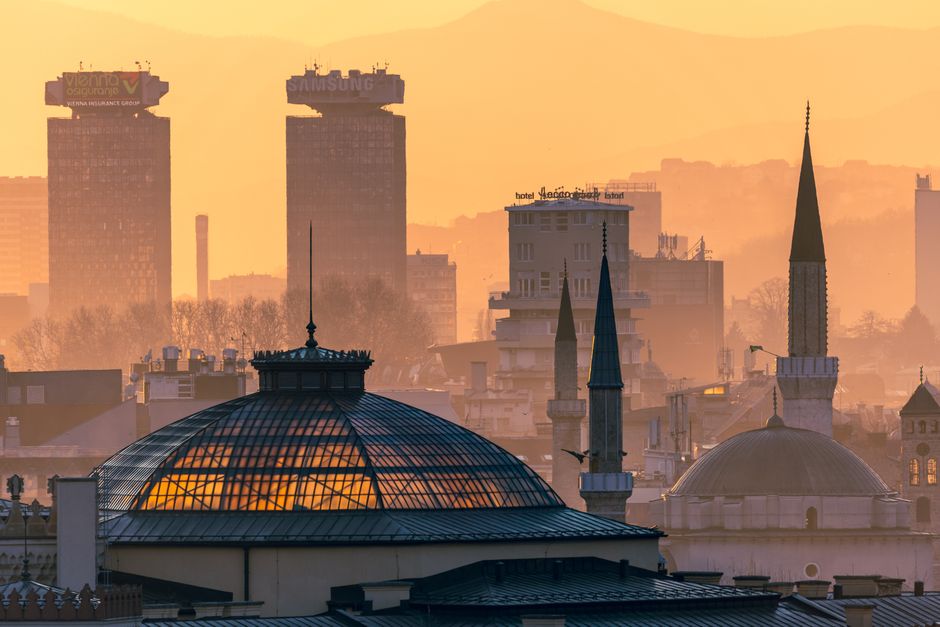
Sarajevo is a city where you can hear the call to prayer, church bells and a tram bell in the same minute. It lies in a narrow valley of the Miljacka river, ringed by green hills and the mountains of the 1984 Winter Olympics, with an Ottoman bazaar at one end and Austro-Hungarian boulevards at the other. It is also a city that lived through the longest siege of a capital in modern history, from 1992 to 1996, and it tells that story with honesty and grace. You come to drink Bosnian coffee in Baščaršija, eat ćevapi, visit the mosques, churches and synagogues, stand on the Latin Bridge where the First World War was set in motion, walk through the Tunnel of Hope and ride the cable car up Mount Trebević. Give it two or three days, four or five to add the mountains and a day trip.
Right now in Sarajevo
- Wed 9–21°C 49–70°F Clear
- Thu 11–22°C 51–71°F 1 mm Partly cloudy
- Fri 13–16°C 55–61°F 17 mm Heavy showers
Weather: MET Norway (CC BY 4.0) · Air quality: OpenAQ
Top tours in Sarajevo
See all tours for Sarajevo →
From local operators, with prices and reviews; you check availability and book on Viator, our partner. We may earn a commission at no extra cost to you. How we earn money
Sarajevo at a glance
- Best for: history from the Ottomans to the siege, coffee and food, mosques, churches and synagogues side by side, mountain views and good-value city breaks.
- How long: 2 days for the old town, the museums and the Tunnel of Hope; 3–4 days to add Trebević, Vrelo Bosne and a day trip.
- Best time: May, June and September for warm days and cool nights; August for the film festival; December to March for skiing at Jahorina and Bjelašnica.
- Getting in: Sarajevo Airport is at Butmir, on the western edge of the city; the airport bus to Baščaršija costs 5 KM. Trains and buses arrive from Mostar in about two to two and three-quarter hours.
- Getting around: trams run the length of the valley; as of October 2026, a single ticket costs 2.20 KM and a day ticket 7.10 KM.
- Before you go: Bosnia and Herzegovina uses the convertible mark (KM), fixed at 1.95583 to the euro, and is not in the EU. Entry rules, registration and safety, including landmines in the countryside, are covered on our Bosnia and Herzegovina country page.
Sarajevo, area by area
The city stretches for about 20 km along the valley, from the old town in the east to the airport and Ilidža in the west. Almost everything a visitor wants is in the first two or three kilometres.
Baščaršija and the old town (Stari Grad)
The Ottoman heart of the city, founded in the 15th century: a maze of low wooden shops, coppersmiths’ street (Kazandžiluk), the Sebilj fountain, the Gazi Husrev-beg Mosque, caravanserais and coffee houses. The Yellow and White fortresses look down from the hills above. Best for: atmosphere, food and the main sights.
Ferhadija and the Austro-Hungarian centre
West of the bazaar, a line on the pavement of Ferhadija street marks where Ottoman Sarajevo meets the Austro-Hungarian city built after 1878: pedestrian streets, the Catholic Cathedral, the Orthodox Cathedral, the Old Synagogue and the eternal flame. Best for: shopping, cafés and walking.
Marijin Dvor and the “Sniper Alley” boulevards
Further west, the main boulevard, nicknamed Sniper Alley during the siege, leads past the yellow Holiday Inn, where journalists stayed during the war, the National Museum and the Historical Museum. Best for: modern history and museums.
Ilidža, Butmir and the mountains
At the western end of the valley, the spa suburb of Ilidža has a long avenue of plane trees leading to Vrelo Bosne, the springs of the Bosna river; nearby, at Butmir by the airport, is the Tunnel of Hope. The Olympic mountains, Trebević, Jahorina, Bjelašnica and Igman, rise above the city. Best for: green escapes and siege history.
Top things to see in Sarajevo
Prices and hours below were checked on the official sites in October 2026. They change, so check before you go.
Baščaršija and the Sebilj
The old bazaar square with its wooden Sebilj fountain (1891) is the meeting point of the city. Wander the copper, leather and carpet workshops, eat ćevapi in a somun flatbread, and drink coffee from a copper džezva. Free.
The Gazi Husrev-beg Mosque
Built in 1531 by the Ottoman governor Gazi Husrev-beg, the city’s great benefactor, this is the most important mosque in the country and one of the finest Ottoman buildings in the Balkans, with a courtyard fountain where the faithful wash before prayer, a clock tower nearby that still keeps old Ottoman time, reset each day at sunset, and the founder’s tomb in the garden. As of October 2026, tourist visits cost 3 KM, including an English-speaking guide, from 1 April to 31 October at 09:00–12:00, 14:30–16:00 and 17:30–19:00, and from November to March at 09:00–11:00; the mosque closes to visitors at prayer times. Dress modestly: women cover their hair (scarves are provided), everyone covers shoulders and knees and takes off their shoes.
The Latin Bridge and the Museum Sarajevo 1878–1918
On 28 June 1914, at the corner by the Latin Bridge, the Bosnian Serb student Gavrilo Princip shot Archduke Franz Ferdinand of Austria and his wife Sophie, the event that set off the First World War. The small Museum Sarajevo 1878–1918, on the corner where it happened, tells the story of the city under Austro-Hungarian rule and of the assassination. As of October 2026, it costs 5 KM for adults (2 KM for students, 1 KM for children), with a combined ticket for all five branches of the Museum of Sarajevo, including Svrzo’s House, a beautifully preserved Ottoman family home, for 20 KM. It opens 09:00–17:00 (from 10:00 in winter, until 15:00 on Saturdays) and closes on Sundays.
The City Hall (Vijećnica)
Sarajevo’s City Hall, built in 1896 in a striking neo-Moorish style, became the National and University Library and was shelled and burned in August 1992, destroying most of its collection. Restored and reopened in 2014, it is a symbol of the city’s recovery, with a dazzling painted atrium and exhibitions on its history. As of October 2026, entry costs 10 KM (5 KM for children, students and seniors), daily 09:00–17:00 except during official events; a combined ticket with the Trebević cable car costs 35 KM.
The Tunnel of Hope
During the siege of 1992–95, an 800-metre tunnel dug under the airport runway was the city’s only link to the outside world, used to bring in food, weapons and people. At Butmir, at the airport end, the Kolar family house where the tunnel came out is now the Tunnel of Hope museum (Tunel spasa), with a short stretch of the tunnel you can walk through, a film and exhibits. As of October 2026, entry costs 20 KM (8 KM for students and concessions, plus 3 KM for an audio guide), payable in cash marks only; it opens 08:30–17:00 from April to October and 09:00–16:00 from November to March. Take a taxi, or tram to Ilidža and then a taxi or bus; many guided tours include it.
The Trebević cable car and the Olympic bobsleigh track
The cable car up Mount Trebević, first opened in 1959, was destroyed in the war and reopened in 2018. It climbs from the old town (the station is a short walk east of Baščaršija) to about 1,160 metres in under ten minutes, with views over the whole city. From the top station, walk down through the woods to the graffiti-covered concrete bobsleigh track from the 1984 Winter Olympics. As of October 2026, a return ticket costs 30 KM and a one-way ticket 20 KM (free for children under 7), and the cable car runs 09:00–19:00 (from 12:00 on Mondays), with shorter hours possible in winter. Lock your car and leave nothing visible if you drive up: there have been thefts from cars on the mountain.
The War Childhood Museum and Galerija 11/07/95
Two excellent small museums tell the human story of the 1990s. The War Childhood Museum collects objects and memories from people who grew up during the siege: a toy, a diary, a ballet shoe, each with its story. As of October 2026, it costs 15 KM for adults and opens daily 11:00–19:00. Galerija 11/07/95, near the cathedral, is a memorial gallery to the Srebrenica genocide of July 1995, with photographs, films and testimony; it opens daily 09:00–21:00, with audio guides in 12 languages. Its ticket price was not published on its own website when we checked; recent visitors report about 15 KM. Both are moving and best visited before a day trip or a quiet evening.
The Yellow Fortress
The Yellow Fortress (Žuta tabija), an 18th-century bastion on the hill above the old town, is Sarajevo’s favourite sunset viewpoint, with cafés on its terrace and views over the minarets and the valley. It is free. During Ramadan, a cannon is fired from here at sunset to mark the breaking of the fast. The walk up from Baščaršija takes about 15–20 minutes, past the Kovači martyrs’ cemetery.
Coffee, food and Sarajevo evenings
Sarajevo’s day revolves around coffee. Order a bosanska kafa in a traditional café in Baščaršija, pour it from the copper pot into the small cup, nibble the sugar cube and the rahat lokum, and take your time. For lunch, queue at a ćevabdžinica for ten ćevapi with onions, or try burek and its cousins at a buregdžinica; for dinner, look for Bosnian home cooking such as begova čorba, klepe and stuffed vegetables. During Ramadan, the old town fills with families at sunset for iftar, the meal that breaks the fast. In the evening, bars and live music cluster around the centre and Baščaršija, and the Yellow Fortress is the place to watch the sun set over the city.
Day trips from Sarajevo
- Mostar: about two hours by train down the Neretva valley, one of Europe’s most scenic rail journeys (departures at 07:15 and 16:46 in the 2025–26 timetable), or about 2 hours 40 minutes by bus; a long day trip, better with a night.
- Konjic and Jablanica: on the way to Mostar: Konjic’s Ottoman bridge, rafting on the Neretva and Tito’s secret nuclear bunker (ARK D-0), and the war memorial bridge at Jablanica.
- Lukomir: the highest and most remote village in the country, on Bjelašnica, with stone houses and shepherds; reach it on a guided hike or a jeep tour, and stay on marked paths.
- Vrelo Bosne: in Ilidža, at the end of a long avenue of plane trees, a park of streams, bridges and swans at the source of the Bosna river; as of 2026, foreign adults pay 6 KM.
- Jahorina and Bjelašnica: the 1984 Olympic ski mountains, under an hour away. For 2026–27, a peak-season adult day pass costs 98 KM on Jahorina and 69 KM on Bjelašnica (65 KM online); the season usually runs from December to March.
- Srebrenica: the Srebrenica–Potočari Memorial and Cemetery, about two and a half to three hours east, is best visited with a guide.
Nearby destinations
- Mostar75 km
- Durmitor National Park93 km
- Međugorje95 km
- Zlatibor104 km
- Makarska Riviera127 km
- Dubrovnik137 km
- Hvar155 km
- Herceg Novi156 km
Getting to Sarajevo
By air. Sarajevo International Airport (SJJ) is at Butmir, about 12 km from the old town. The Centrotrans airport bus runs to Baščaršija in about 30 minutes for 5 KM as of October 2026 (one bag free); trolleybus 103 is cheaper but slower. Taxis cost roughly 15–20 KM to the centre; use the meter or agree the price first, as some drivers at the airport quote high fixed fares. In winter 2026–27, Ryanair suspends its Sarajevo flights, while Wizz Air flies from London Luton and Rome and adds Berlin, Bratislava and Prague in December. Fog sometimes disrupts flights in December and January.
By train. The railway station is about 3 km west of the old town, linked by tram. Two trains a day run from Mostar and Čapljina (about 2 hours from Mostar). By bus. The main bus station, next to the railway station, serves Mostar (about eight buses a day, 2 hours 40 minutes), most of the country, Croatia and Western Europe; buses to and from Republika Srpska, Belgrade and Montenegro mostly use the East Sarajevo (Lukavica) bus station, about 7 km south-west. By car. Sarajevo is reached by the A1 motorway from the north and by the M17 road from Mostar; parking in the centre is limited, so choose a hotel with parking or use a public car park.
Getting around Sarajevo
Sarajevo’s trams run along the valley from Baščaršija past the railway station to Ilidža, and buses, trolleybuses and minibuses fill the gaps. A new tram line 11 between Baščaršija and Hrasnica opened on 27 September 2026, after a fatal derailment in February 2026 led to a review of the network. As of October 2026, fares from the transport company GRAS are:
- Single ticket: 2.20 KM (1.10 KM for children), valid for one ride; buy it at kiosks or in the canton’s public transport app, and validate it as you board.
- Day ticket: 7.10 KM for unlimited rides.
- Mountain bus: 6.10 KM one way or 8.50 KM return to the Olympic mountains.
The old town and the Austro-Hungarian centre are best explored on foot; the hills around them are steep, so the Yellow Fortress and Trebević are worth the climb or a taxi. Taxis are cheap and metered; use registered companies.
When to go and how long to stay
Sarajevo sits at about 500–650 metres in a mountain valley, so it is cooler than the coast: warm summers with fresh nights, and cold, snowy winters when fog and smog can settle in the valley. The table uses the official 1991–2020 averages for the Sarajevo (Bjelave) station that Bosnia and Herzegovina submitted to the World Meteorological Organization.
| Season | Average daily high | Average nightly low | Rain per month | What it’s like |
|---|---|---|---|---|
| Winter (Dec–Feb) | 4.1–6.6 °C | −2.9 to −1.7 °C | 67–89 mm | Cold, often snowy and foggy, with smog on still days; skiing on Jahorina and Bjelašnica |
| Spring (Mar–May) | 11.5 °C rising to 21.4 °C | 1.4 °C rising to 9.0 °C | 67–89 mm | Fresh and green, with changeable weather and blossom in the hills |
| Summer (Jun–Aug) | 25.4–28.3 °C | 12.6–14.3 °C | 63–88 mm | Warm, sunny days and cool nights; the Sarajevo Film Festival in August |
| Autumn (Sep–Nov) | 22.5 °C falling to 10.6 °C | 10.4 °C falling to 2.8 °C | 85–91 mm | Golden hills in September and October, wetter and colder in November |
Sarajevo gets about 950 mm of rain a year, spread fairly evenly, and about 1,900 hours of sunshine.
Sarajevo in 2 days
Day 1: Baščaršija, the Sebilj and the coppersmiths’ street, the Gazi Husrev-beg Mosque, the Old Orthodox Church and the cathedral, then the Latin Bridge and the City Hall, and sunset at the Yellow Fortress. Day 2: the Tunnel of Hope in the morning, the War Childhood Museum or Galerija 11/07/95 in the afternoon, and the Trebević cable car for the views and the old bobsleigh track.
Sarajevo in 4 days
Add Vrelo Bosne and Ilidža and the National Museum on day 3, and on day 4 take a day trip: the hike to the stone village of Lukomir, the train down the Neretva valley to Mostar, or Konjic and Jablanica.
Where to stay in Sarajevo
- Baščaršija and Stari Grad: the most atmospheric area, in walking distance of almost everything, with small hotels and guesthouses in old houses; streets can be steep and some are noisy at night.
- The Austro-Hungarian centre (Ferhadija, Maršala Tita): central, flat and walkable, with good mid-range hotels and apartments.
- Marijin Dvor: business hotels, a short tram ride from the old town.
- Ilidža: a quieter spa suburb near the airport and Vrelo Bosne, with larger hotels and a tram to the centre.
Hotels and apartments add a tourist tax per person per night: 3 KM in Sarajevo Canton since January 2025, with a higher “festival” rate planned for peak festival periods. Rooms are scarce and expensive during the Sarajevo Film Festival in August, so book early.
Practical tips for Sarajevo
- Carry cash marks: for ćevapi shops, bakeries, the Tunnel of Hope (cash only) and small cafés; cards are fine in hotels and restaurants.
- Visit mosques outside prayer times: especially Friday midday prayers, and dress modestly.
- Ask before you photograph people, and treat siege memorials and the “Sarajevo roses” (shell scars filled with red resin) with respect.
- Stay on paths in the hills: the mountains around the city were front lines, and while popular trails are cleared, never wander off marked paths.
- Watch your bag on trams and in the crowded bazaar, and lock your car at viewpoints.
- Ramadan: in 2027 expected from about 8 February to 9 March; most restaurants stay open, but eat discreetly in the old town during the day.
What to pack for Sarajevo
Comfortable shoes with grip for cobbles and steep lanes, layers for cool evenings even in summer, and a warm coat, hat, gloves and boots from November to March. Bring a scarf for mosque visits (women cover their hair; everyone covers shoulders and knees), a light rain jacket for showers at any time of year, hiking shoes if you plan to walk on Trebević or to Lukomir, and a type F travel adapter if you come from the UK, North America or Australia.
Sarajevo travel FAQ
How much is the Trebević cable car?
As of October 2026, 30 KM return or 20 KM one way for visitors; children under 7 ride free. A combined ticket with the City Hall costs 35 KM. It runs 09:00–19:00, from 12:00 on Mondays.
How much is the Tunnel of Hope?
As of October 2026, 20 KM for adults and 8 KM for students, paid in cash marks only. It opens 08:30–17:00 until 31 October and 09:00–16:00 from November to March.
How do I get from Sarajevo Airport to the city centre?
The Centrotrans airport bus goes to Baščaršija in about 30 minutes for 5 KM as of October 2026. A taxi costs roughly 15–20 KM; use the meter or agree the fare first.
Can I visit the Gazi Husrev-beg Mosque?
Yes, outside prayer times. As of October 2026, entry costs 3 KM with a guide; it opens three times a day from April to October and 09:00–11:00 in winter. Cover your shoulders and knees; women cover their hair.
How much is public transport in Sarajevo?
As of October 2026, a single tram, bus or trolleybus ticket costs 2.20 KM and a day ticket 7.10 KM.
How many days do you need in Sarajevo?
Two days covers the old town, the museums, the Tunnel of Hope and Trebević. Three or four days let you add Vrelo Bosne, Lukomir or a day trip to Mostar or Konjic.
Can I pay in euros in Sarajevo?
Sometimes, in hotels and tourist shops, usually at 2 KM to the euro, but you will get change in marks. It is better to pay in marks or by card.
Is Sarajevo safe?
Yes, generally. Watch for pickpockets on trams and in the bazaar, lock your car at viewpoints, keep away from demonstrations, and in the countryside around the city stay on paved roads and marked paths because of landmines.
Do I have to pay a tourist tax in Sarajevo?
Yes: 3 KM per person per night in Sarajevo Canton, added by your hotel or host, with a higher rate planned for big festivals.
Sources and last review
Researched and last reviewed on 4 October 2026. Trebević cable car prices and hours: the cable car operator; Gazi Husrev-beg Mosque: the mosque; City Hall: the City Hall and the city’s tourism guide; War Childhood Museum and Galerija 11/07/95 hours: the museums; Museum Sarajevo 1878–1918 and Svrzo’s House: the Museum of Sarajevo; public transport fares: GRAS; airport bus: Sarajevo International Airport; Sarajevo–Mostar trains: ŽFBH; climate: the official 1991–2020 normals for Sarajevo submitted to the World Meteorological Organization. The Tunnel of Hope prices and hours, Vrelo Bosne and ski-pass prices, the Galerija 11/07/95 price, the airport taxi fare, tram line 11, the tourist tax and the bus stations come from press reports or secondary sources and are flagged for checking. Prices, timetables and rules change, so check the official sites before you go.
Plan your trip
Partner links: TravelerCenter may earn a commission if you book, at no extra cost to you.