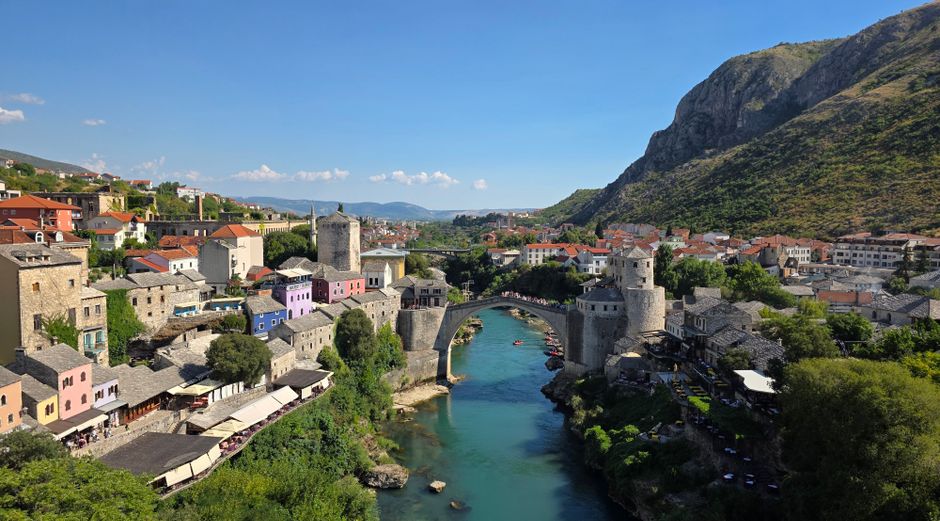
Mostar is the jewel of Herzegovina: a stone town on the emerald Neretva river, built around one of the most famous bridges in the world. The Old Bridge (Stari Most), a single slender arch built by the Ottomans in 1566, stood for 427 years until it was destroyed in the war in 1993; rebuilt with the original techniques and reopened in 2004, it is now a UNESCO World Heritage Site and a symbol of reconciliation. You come to watch the divers leap from it, wander the cobbled bazaar, climb a minaret for the view, visit Ottoman family houses and learn about the city’s war, then take day trips to the dervish house at Blagaj, the fortified village of Počitelj and the Kravica waterfalls. Give it a full day and a night, two or three days with the day trips.
Right now in Mostar
- Wed 14–26°C 56–78°F Mostly clear
- Thu 15–22°C 59–71°F 27 mm Rain
- Fri 17–21°C 62–70°F 43 mm Heavy showers
Weather: MET Norway (CC BY 4.0)
Top tours in Mostar
See all tours for Mostar →
From local operators, with prices and reviews; you check availability and book on Viator, our partner. We may earn a commission at no extra cost to you. How we earn money
Mostar at a glance
- Best for: the Old Bridge and the bridge divers, Ottoman architecture, recent history, Herzegovinian food and wine, and day trips to waterfalls and villages.
- How long: 1 day for the old town; 2–3 days to add Blagaj, Počitelj, Kravica and Međugorje.
- Best time: April to June and September to October; July and August are very hot (average highs of 33 °C) and crowded with day-trippers from the coast.
- Getting in: two trains a day from Sarajevo (about 2 hours down the Neretva valley) and buses from Sarajevo, Split, Dubrovnik and Međugorje; Mostar’s small airport has a few flights.
- Getting around: the old town is compact and pedestrian; you need a car, taxi or tour for the day trips.
- Before you go: Bosnia and Herzegovina uses the convertible mark (KM), but euros are widely accepted in Mostar. Entry rules, the EU border queues and safety are covered on our Bosnia and Herzegovina country page.
Mostar, area by area
Mostar stretches along both banks of the Neretva. The old town around the bridge is small and walkable.
The Old Bridge and Kujundžiluk (east bank)
The bridge links the two halves of the old town. On the east bank, the cobbled bazaar street of Kujundžiluk, once the street of goldsmiths, is lined with stalls selling copper, carpets and souvenirs, and leads to the Koski Mehmed-Pasha Mosque. Best for: the classic views and the main sights.
The west bank old town
Across the bridge, the lanes around the Tara and Halebija towers, the Crooked Bridge (Kriva Ćuprija) over the little Radobolja stream, and terrace restaurants above the river. Best for: dinner with a view and quieter lanes.
The Austro-Hungarian centre and the former front line
North-west of the old town, the 19th-century city of parks and boulevards includes the Spanish Square and the Bulevar, the street that was the front line in 1993–94; some buildings still carry war damage, alongside the restored Gymnasium. Best for: understanding the city’s recent history.
Top things to see in Mostar
Prices and hours below were checked on the official sites in October 2026. They change, so check before you go.
The Old Bridge (Stari Most)
The Old Bridge was built in 1566 by the Ottoman architect Mimar Hayruddin, a pupil of the great Sinan, to replace a wooden bridge over the Neretva. Its single stone arch spans about 29 metres and rises about 20 metres above the water, a daring piece of engineering for its time. During the war between Bosnian Croat and Bosniak forces, it was destroyed by Bosnian Croat (HVO) artillery on 9 November 1993. It was rebuilt between 2001 and 2004, using stone from the original quarry and Ottoman building techniques, and the Old Bridge area of the old city became a UNESCO World Heritage Site in 2005. Crossing the bridge is free. Its surface is steep, with raised stone ridges, and polished smooth by centuries of feet, so wear shoes with grip, especially when it rains. The best views are from the riverbanks below, from the Koski Mehmed-Pasha Mosque and from the terraces of the restaurants on the west bank.
The bridge divers
Jumping from the bridge is a tradition going back centuries: young men of Mostar have dived into the Neretva from at least the 17th century. Today the divers belong to the Mostari divers’ club, which has about 30 members. On summer days, mostly between late morning and mid-afternoon from May to October, a diver in swimming trunks walks along the bridge collecting money from onlookers and jumps once enough has been collected, typically €25–40 in total; visitors usually give a few euros each. The drop is more than 20 metres into cold, fast water, so it takes years of training: the UK government warns that diving from the bridge has caused serious injuries and deaths, so leave it to the professionals. The traditional diving competition takes place in late July (the 460th edition was on 26 July 2026), and Red Bull Cliff Diving has held ten world series events here since 2015.
The Koski Mehmed-Pasha Mosque
This small mosque on the east bank, built in 1618, has the most famous view in Mostar: from its courtyard terrace on the river, and even more from the top of its minaret, up 89 narrow, steep steps, the Old Bridge frames the old town perfectly. Entry costs a few euros, more if you climb the minaret; no official price list was published when we checked, and reported 2026 prices vary, so carry some cash. Women don’t need to cover their hair just to see the courtyard and view, but dress modestly inside.
The Museum of the Old Bridge
In the Tara tower at the east end of the bridge, the Museum of the Old Bridge shows the archaeological finds made during the reconstruction and tells the story of the bridge’s building, destruction and rebuilding, with a film; you can also climb the tower for a view down onto the bridge. Opening hours and prices vary by season and were not confirmed on an official site, so check locally.
Ottoman houses: Kajtaz and Muslibegović
Two Ottoman family houses show how Mostar’s wealthy families lived: the 16th-century Kajtaz House, still owned by the same family, with its walled garden, women’s quarters and original furniture, and the 17th- and 18th-century Muslibegović House, a national monument that also works as a boutique guesthouse. Visitors report entry of about €3 each, cash only; hours vary, especially out of season.
The Crooked Bridge and the Karađoz-beg Mosque
The Crooked Bridge (1558), a tiny version of the Old Bridge over the Radobolja stream, is said to have been a trial run for its big brother; it was washed away by floods in 2000 and rebuilt. The Karađoz-beg Mosque (1557), the largest in Mostar, is attributed to the great Ottoman architect Sinan; its minaret can be climbed.
Food, wine and evenings in Mostar
Herzegovinian food is rich and sunny: try ćevapi and Mostarski uštipci, grilled trout from the Neretva and Buna rivers, stuffed vegetables (dolma), and the local cheese and cured meats. Herzegovina is wine country: ask for the white Žilavka and the red Blatina, from wineries around Mostar, Čitluk and Međugorje. In the evening, once the day-trippers have gone, the old town is calm and magical, with the floodlit bridge reflected in the river.
Day trips from Mostar
- Blagaj: 12 km south-east, a 16th-century dervish house (tekija) stands beside the Buna spring, which gushes from a cave below a 200-metre cliff. As of October 2026, it opens daily 08:30–20:30; visitors report a 10 KM ticket, and shoulders and knees must be covered (wraps are provided). Riverside restaurants serve fresh trout.
- Počitelj: 30 km south, an Ottoman fortified village climbing a hill above the Neretva, with a mosque, a hammam and a tower; it is free to wander, and the climb to the top is steep but worth it.
- Kravica waterfalls: about 40 km south-west, a wide horseshoe of cascades on the Trebižat river, with a lake below where you can swim at your own risk. As of October 2026, entry costs 20 KM for adults (10 KM for ages 7–18), and it is open all year, from 07:00 to 17:00 in winter and until 22:00 from June to September; parking costs 6 KM a day.
- Međugorje: 25 km south-west, the Catholic pilgrimage village; see our Međugorje guide.
- Stolac and Radimlja: about 40 km south-east, an old town of mills and mosques, with the UNESCO-listed medieval tombstones (stećci) of the Radimlja necropolis nearby.
- Konjic and the Neretva: north towards Sarajevo, rafting on the Neretva and the war memorial bridge at Jablanica.
Tours from Mostar often combine Blagaj, Počitelj and Kravica in one day.
Nearby destinations
- Međugorje20 km
- Makarska Riviera58 km
- Sarajevo75 km
- Dubrovnik82 km
- Hvar88 km
- Durmitor National Park102 km
- Split112 km
- Herceg Novi116 km
Getting to Mostar
By train. In the 2025–26 timetable, two trains a day run from Sarajevo (07:15 and 16:46), taking about 2 hours along one of the most scenic lines in Europe, and continue to Čapljina; a one-way ticket costs about 11.90 KM. By bus. Mostar’s bus station is next to the railway station on the east side of the city, about 10–15 minutes’ walk from the old town. As of October 2026, about eight buses a day run to Sarajevo (2 hours 40 minutes, about 36 KM one way online), about six to Split (3 hours 45 minutes to 5 hours), two to Dubrovnik (about 3 hours 15 minutes) and several to Međugorje (30–45 minutes); more run in summer.
By air. Mostar Airport (OMO), about 7 km south, has year-round flights to Belgrade, Zagreb and Stuttgart and a few seasonal routes. Dubrovnik and Split airports, about two and a half to three hours away, have many more flights. By car. From Sarajevo, the road follows the Neretva valley (about two and a half hours); from Split and Dubrovnik you cross the border into Bosnia and Herzegovina, which since April 2026 means EU Entry/Exit System registration for non-EU travellers when you re-enter Croatia, and long queues in summer. Parking near the old town is limited; use paid car parks or ask your guesthouse.
Getting around Mostar
The old town is pedestrian and very compact: everything is within a 10-minute walk of the bridge, but the cobbles are polished smooth and slippery, and the bridge itself is steep with raised stone ridges, so wear shoes with good grip. Taxis are cheap; for Blagaj, Počitelj and Kravica, local buses run to Blagaj, but a car, taxi or tour is much easier for the others.
When to go and how long to stay
Mostar is one of the hottest cities in the Balkans, sheltered in the Neretva valley and close to the Adriatic. Summers are long, dry and very hot; winters are mild but very wet. The table uses the official 1991–2020 averages for the Mostar station that Bosnia and Herzegovina submitted to the World Meteorological Organization.
| Season | Average daily high | Average nightly low | Rain per month | What it’s like |
|---|---|---|---|---|
| Winter (Dec–Feb) | 9.3–11.6 °C | 2.7–3.9 °C | 125–181 mm | Mild but very wet, with occasional cold bura wind; quiet streets and low prices |
| Spring (Mar–May) | 15.8 °C rising to 25.1 °C | 6.2 °C rising to 13.5 °C | 93–123 mm | Pleasant and green, the best time for sightseeing and rafting |
| Summer (Jun–Aug) | 29.8–33.5 °C | 17.4–20.3 °C | 56–71 mm | Hot and sunny, often above 38 °C at midday; crowds and the diving competitions |
| Autumn (Sep–Nov) | 27.2 °C falling to 15.1 °C | 15.8 °C falling to 7.5 °C | 137–189 mm | Warm in September, with the grape harvest; heavy rain from October |
Mostar gets about 1,450 mm of rain a year, most of it from October to April, and about 2,430 hours of sunshine.
Mostar in 1 day
Arrive early, before the tour buses, to see the Old Bridge and Kujundžiluk in the morning light. Climb the minaret of the Koski Mehmed-Pasha Mosque, visit the Kajtaz or Muslibegović house, see the Crooked Bridge and the Museum of the Old Bridge, then walk the former front line along the Bulevar. Stay for dinner on a terrace above the river and see the bridge lit up at night.
Mostar in 3 days
Add a day trip to Blagaj, Počitelj and the Kravica waterfalls (swim in summer), and a day for Međugorje and a winery near Čitluk, or rafting on the Neretva.
Where to stay in Mostar
- The old town: small guesthouses and boutique hotels in stone houses, some with views of the bridge; the most atmospheric choice, but book ahead in summer and expect steps and cobbles.
- Just outside the old town: family-run pensions and apartments within a 10–15 minute walk, often with parking, at lower prices.
- Blagaj: a quiet alternative 12 km away, with riverside guesthouses near the tekija.
Guesthouses and hotels add a tourist tax of 3 KM per person per night (Herzegovina-Neretva Canton, from January 2026). Book well ahead for July and August and for the diving competition.
Practical tips for Mostar
- Beat the crowds: tour buses from the Croatian coast arrive by mid-morning and leave by late afternoon; early morning and evening are magical.
- Mind your step: the bridge and the cobbles are slippery, especially when wet; wear shoes with grip.
- Carry cash: euros and marks are both accepted in the old town, but the houses, mosques and small shops often take cash only.
- Respect the divers: if you watch a jump, chip in a few euros.
- Keep cool in summer: July and August afternoons often top 35 °C; sightsee early and late, and rest in the shade at midday.
- Remember the recent past: war damage and memorials are still visible; ask before photographing people, and be respectful.
- Haggle gently: prices in the bazaar are often negotiable, but stay friendly.
What to pack for Mostar
Shoes with good grip for the slippery cobbles and the ridged bridge, light clothes, a sun hat, sunscreen and a refillable water bottle for the summer heat, water shoes and a swimsuit for Kravica, a scarf for mosque visits, a light rain jacket or umbrella from October to April, and a type F travel adapter if you come from the UK, North America or Australia.
Mostar travel FAQ
Is it free to cross the Old Bridge in Mostar?
Yes. The bridge is free to cross at any time. The museum in the Tara tower, the mosques’ minarets and the Ottoman houses charge small entry fees.
When do the divers jump from the Old Bridge?
Mostly on summer days from late morning to mid-afternoon, from May to October. A diver collects money from onlookers and jumps once enough has been raised, typically €25–40; the traditional competition is in late July.
How do I get from Sarajevo to Mostar?
By train in about 2 hours (two departures a day, at 07:15 and 16:46 in the 2025–26 timetable), or by bus in about 2 hours 40 minutes, with about eight departures a day.
How do I get to Mostar from Dubrovnik or Split?
By bus: about 3 hours 15 minutes from Dubrovnik and 3 hours 45 minutes to 5 hours from Split, with more departures in summer. Day tours also run from both. Allow time for border queues.
How much is Kravica waterfall?
As of October 2026, 20 KM for adults and 10 KM for ages 7 to 18, all year round. You can swim in the lake below the falls at your own risk.
How many days do you need in Mostar?
One full day and a night for the old town; two or three days to add Blagaj, Počitelj, Kravica and Međugorje.
Is Mostar worth an overnight stay?
Yes. Day-trippers fill the old town from late morning to late afternoon; staying the night lets you see the bridge lit up in the evening and almost empty early in the morning.
Can I pay in euros in Mostar?
Yes, in most of the old town, usually at about 2 KM to the euro, with change often given in marks. Carry small notes for entry fees.
Is Mostar safe?
Yes, generally. The main hazards are slippery stones on the bridge, summer heat and petty theft in crowds. Don’t try diving from the bridge, and in the countryside stay on paved roads and marked paths because of landmines.
Sources and last review
Researched and last reviewed on 4 October 2026. Kravica prices and hours: the Kravica waterfall’s official site; Blagaj tekke hours: the tekke; trains: ŽFBH; Sarajevo buses: Centrotrans; climate: the official 1991–2020 normals for Mostar submitted to the World Meteorological Organization; bridge diving safety: the UK FCDO; the Old Bridge’s UNESCO listing: UNESCO. Prices for the mosque, the Old Bridge museum, the Ottoman houses and the Blagaj tekke, the divers’ customs, the competition dates, bus times to Split, Dubrovnik and Međugorje, airport routes and the tourist tax come from press reports or secondary sources and are flagged for checking. Prices, timetables and rules change, so check the official sites before you go.
Plan your trip
Partner links: TravelerCenter may earn a commission if you book, at no extra cost to you.