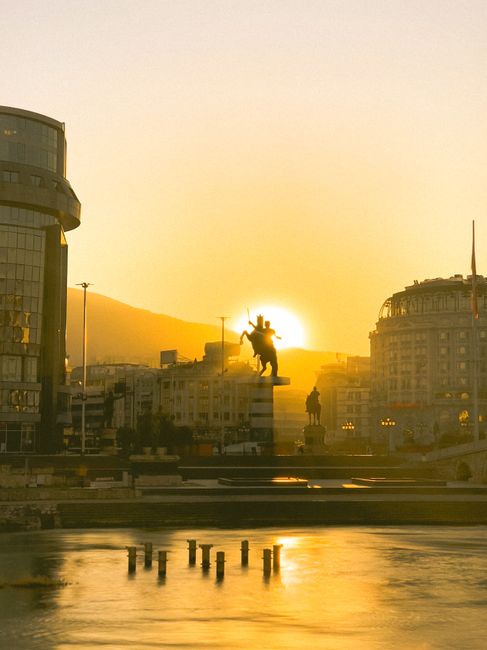
Skopje is a capital of surprises. On one bank of the Vardar river lies one of the largest and liveliest Ottoman bazaars in the Balkans, a maze of mosques, caravanserais, tea houses and kebab grills below a medieval fortress; on the other, a city centre rebuilt after a devastating earthquake in 1963 and transformed again in the 2010s with giant statues, fountains and neoclassical facades. Around it rise Mount Vodno, with its cable car and huge illuminated cross, and the Matka canyon, where you can kayak to a cave between cliffs and medieval monasteries. You come for the bazaar, the food, the cafés of Debar Maalo, Mother Teresa’s birthplace and the canyon, and as a gateway to Ohrid. Give it two days, three or four with day trips.
Right now in Skopje
- Wed 12–23°C 53–73°F Partly cloudy
- Thu 11–23°C 52–73°F Mostly clear
- Fri 14–21°C 58–69°F 3 mm Cloudy
- Sun 11 Oct Revolution Day (Ден на востанието, Den na vostanieto)
Weather: MET Norway (CC BY 4.0) · Holidays: Nager.Date
Top tours in Skopje
See all tours for Skopje →
From local operators, with prices and reviews; you check availability and book on Viator, our partner. We may earn a commission at no extra cost to you. How we earn money
Skopje at a glance
- Best for: the Old Bazaar, Ottoman and Byzantine heritage, offbeat monuments, food and cafés, and the Matka canyon.
- How long: 2 days for the bazaar, the fortress, the centre and Matka; 3–4 days to add Vodno and day trips.
- Best time: April to June and September to October; July and August are very hot, and winter brings fog and smog.
- Getting in: Skopje Airport is about 20 km east, linked by shuttle bus (199 denars) and fixed-fare taxis (1,500 denars).
- Getting around: the centre and the bazaar are walkable; city buses, including red double-deckers, cost 35–40 denars a ride as of October 2026.
- Before you go: North Macedonia uses the denar; entry rules, registration and money are covered on our North Macedonia country page.
Skopje, area by area
The Vardar divides Skopje into the Old Bazaar and the fortress on the north bank and the modern centre on the south bank, linked by the Stone Bridge.
Centar and Macedonia Square
The south bank around Macedonia Square is the heart of the modern city: pedestrian Macedonia Street, the Memorial House of Mother Teresa, the old railway station whose clock stopped at the moment of the 1963 earthquake, and the riverbanks lined with the statues and buildings of the “Skopje 2014” project. Best for: first visits, shopping and hotels.
The Old Bazaar (Čaršija) and Kale
Across the Stone Bridge, the Old Bazaar climbs towards the fortress: cobbled lanes of craftsmen, jewellers and cafés, Ottoman mosques, hammams and inns, and the Church of the Holy Saviour. Best for: atmosphere, food and history.
Debar Maalo and Karpoš
West of the centre, the leafy old quarter of Debar Maalo is packed with restaurants, wine bars and cafés, and the City Park along the Vardar is the place for a stroll. Best for: evenings out and a quieter stay.
Vodno and Matka
South of the city rises Mount Vodno (1,066 m), with the Millennium Cross on top; the Matka canyon lies about 15 km south-west. Best for: fresh air and nature.
Top things to see in Skopje
Prices and hours below were checked in October 2026, on official sites where available. They change, so check before you go.
The Stone Bridge and Macedonia Square
The 15th-century Stone Bridge, built on Roman foundations, has linked the two halves of the city for more than 500 years. On the south side, Macedonia Square is dominated by a huge fountain and statue of a “Warrior on a Horse”, widely understood to be Alexander the Great, part of the Skopje 2014 project, which added dozens of statues, bridges, a triumphal arch and neoclassical facades to the centre at great cost. Locals are divided about it; visitors find it fascinating either way. Free to wander, and especially lively in the evening, when the fountains are lit.
The Old Bazaar
One of the largest surviving Ottoman bazaars in Europe, dating from the 12th century and rebuilt by the Ottomans. Explore the Mustafa Pasha Mosque (1492) on the hill, the Kapan and Suli inns (an), the covered Bezisten market and the Daut Pasha Hamam, a 15th-century bathhouse that now houses part of the National Gallery (about 100 denars, closed on Mondays, as reported in 2026). Don’t miss the small, half-sunken Church of the Holy Saviour, with a superb carved walnut iconostasis, or a coffee or boza in one of the old cafés.
Skopje Fortress (Kale)
The walls of the fortress on the hill above the bazaar date mostly from the 6th to the 11th centuries, with Ottoman rebuilding. Walk around the ramparts for views over the city and Mount Vodno. Entry has traditionally been free, but hours vary and parts can be closed for restoration, so check locally.
The Memorial House of Mother Teresa
Mother Teresa of Calcutta was born Anjezë Gonxhe Bojaxhiu in Skopje in 1910. A small modern memorial house, with a chapel, stands near the site of the church where she was baptised, with photos and personal items. Entry is free; as reported in 2026, it opens 09:00–20:00 on weekdays and 09:00–14:00 at weekends.
The Museum of the Macedonian Struggle
A large, theatrical museum of wax figures and paintings telling the story of the country’s fight for independence, from Ottoman times to 1991, visited on a compulsory guided tour. As of October 2026, foreign visitors pay 300 denars, including the tour (60% off with an ISIC student card).
The Millennium Cross and the Vodno cable car
A 66-metre steel cross, put up on the summit of Mount Vodno in 2002 and lit up at night, can be seen from all over the city. The cable car from Sredno Vodno climbs to the summit for wide views; as of October 2026, a return ticket costs 100 denars for adults and 50 denars for children aged 6 to 13, and over-65s ride free. Its opening hours vary by season and it may close on some Mondays or in strong wind, so check locally. You can also hike up through the forest in about two hours.
The Matka canyon
About 15 km south-west of the city, the Treska river flows through a steep limestone canyon dammed to form a narrow green lake. Walk the path along the cliffs, visit the 14th-century monastery of St Andrew by the dam, and take a boat or kayak to the Vrelo cave. Entry to the canyon is free. Boat trips to the cave cost about 400–500 denars and take about an hour, and kayaks rent for about 300 denars an hour, according to 2026 visitor reports. City bus 60 runs from the centre in about 40 minutes; a taxi is quicker. Weekends are busy.
Food, cafés and Skopje evenings
Skopje is a city of long coffees and long meals. Try tavče gravče (baked beans in a clay pot), ajvar and šopska salad, grilled kebapi in the Old Bazaar, pastrmajlija (a boat-shaped bread topped with cured meat) and burek with yoghurt for breakfast. In the evening, the restaurants and wine bars of Debar Maalo serve good local wines, especially Vranec reds from Tikveš. In October, the Skopje Jazz Festival (15–18 October 2026) brings international names to the city; in summer, concerts are held at the fortress.
Day trips from Skopje
- The Matka canyon: half a day, by city bus or taxi (see above).
- Tetovo: about 45 minutes west, the colourfully painted Šarena (Painted) Mosque and the Arabati Baba tekke, a Bektashi dervish complex; the Šar Mountains rise above the town.
- Stobi and the Tikveš wineries: about an hour south, the Roman and early Byzantine city of Stobi, with mosaics and theatres, and wine tastings around Kavadarci and Negotino.
- Kratovo and Kuklica: about an hour and a half north-east, a town in an old volcanic crater crossed by medieval stone bridges, and the stone pillars of Kuklica nearby.
- Pristina: about an hour and a half north in Kosovo; if you plan to continue to Serbia, check the border rule first.
Nearby destinations
Getting to Skopje
By air. Skopje International Airport (SKP) is about 20 km east of the city. As of October 2026, the airport shuttle bus costs 199 denars (roughly 08:00–20:00, timed to flight arrivals, about 30–40 minutes), and the official airport taxis charge fixed fares of 1,500 denars (€25) to Skopje. By bus. The intercity and international bus station is in the transport centre, next to the railway station east of the city centre, with frequent buses to Ohrid (about three to three and a half hours), Bitola and other towns, and to Pristina, Sofia, Belgrade, Thessaloniki and Tirana. By train. A few slow trains run to Bitola and towards Greece. By car. Motorways arrive from Serbia, Greece and Tetovo; tolls are paid at booths, in denars or euros.
Getting around Skopje
The centre, the Stone Bridge and the Old Bazaar are all within a 15-minute walk of each other. JSP, the city bus company, runs a large network, including red double-decker buses. As of October 2026:
- Single ride: 35 denars with the Skopje card (Skopska karta) or the Skopjebus app, 40 denars with a paper ticket.
- Day ticket: 120 denars (electronic paper ticket).
- Night buses: 50 denars a ride.
Taxis are cheap and metered; use registered companies with a roof sign, or ask your hotel to call one.
When to go and how long to stay
Skopje sits in the Vardar valley and has hot, dry summers and cold winters, when fog and air pollution often settle over the city. The table uses the averages for Skopje published by the WMO’s World Weather Information Service, from North Macedonia’s Hydrometeorological Service (period not stated).
| Season | Average daily high | Average nightly low | Rain per month | What it’s like |
|---|---|---|---|---|
| Winter (Dec–Feb) | 4.0–8.4 °C | −3.6 to −1.3 °C | 36–51 mm | Cold, often foggy and smoggy, with some snow |
| Spring (Mar–May) | 13.6 °C rising to 23.9 °C | 1.9 °C rising to 10.0 °C | 40–60 mm | Mild and green, the best time for walking and Matka |
| Summer (Jun–Aug) | 27.4–30.0 °C | 13.0–14.8 °C | 27–46 mm | Hot and dry, often above 35 °C; evenings are lively |
| Autumn (Sep–Nov) | 26.1 °C falling to 11.2 °C | 11.4 °C falling to 1.4 °C | 36–56 mm | Warm and golden in September and October, the jazz festival in October |
Skopje gets only about 500 mm of rain a year, one of the lowest totals of any European capital.
Skopje in 2 days
Day 1: Macedonia Square and the riverbanks, the Memorial House of Mother Teresa, then across the Stone Bridge to the Old Bazaar for lunch, the mosques, inns and the Church of the Holy Saviour, and sunset from the fortress. Day 2: the Matka canyon in the morning, with a boat or kayak to the Vrelo cave, then the Vodno cable car and dinner in Debar Maalo.
Skopje in 4 days
Add the Museum of the Macedonian Struggle and the Daut Pasha Hamam gallery on day 3, with a day trip to Tetovo’s Painted Mosque, and on day 4 head south to Stobi and a Tikveš winery, or continue to Ohrid.
Where to stay in Skopje
- Centar: hotels of every level around Macedonia Square and the river, close to everything; the easiest choice for a first visit.
- The Old Bazaar: a few small hotels and guesthouses in restored buildings, full of character but noisier at night.
- Debar Maalo: boutique hotels and apartments in a leafy area with the best restaurants and bars.
Hotels add a small tourist tax per person per night.
Practical tips for Skopje
- Carry cash in the bazaar: small shops, cafés and craftsmen often take cash only.
- Check air quality in winter: on still winter days, Skopje’s smog is among the worst in Europe; people with breathing problems should plan accordingly.
- Keep cool in summer: sightsee in the morning and evening and rest at midday.
- Dress modestly in mosques and churches, and take your shoes off in mosques.
- Many museums close on Mondays.
- Watch your belongings in crowded areas and nightlife spots late at night.
What to pack for Skopje
Light, breathable clothes, a sun hat and sunscreen for hot summers; a warm coat, hat and gloves from November to March. Comfortable shoes for the cobbles of the Old Bazaar and the fortress, hiking shoes if you plan to walk up Vodno or along Matka, a light rain jacket for spring and autumn, a scarf for mosque and church visits, and a type F travel adapter if you come from the UK, North America or Australia.
Skopje travel FAQ
How do I get from Skopje Airport to the city centre?
Take the airport shuttle bus (199 denars as of October 2026, timed to flight arrivals) or an official airport taxi at a fixed fare of 1,500 denars (€25). The trip takes about 30 minutes.
How much is the Vodno cable car?
As of October 2026, a return ticket costs 100 denars for adults and 50 denars for children aged 6 to 13. Hours vary by season, so check before you go.
How do I get to the Matka canyon?
City bus 60 runs from the centre in about 40 minutes, or take a taxi (about 20–30 minutes). Entry to the canyon is free; boat trips to the Vrelo cave cost about 400–500 denars.
How much is a bus ticket in Skopje?
As of October 2026, 35 denars a ride with the Skopje card or app, 40 denars with a paper ticket, or 120 denars for a day ticket.
Is Skopje Fortress free?
Entry to the fortress has traditionally been free, but hours vary and parts may close for works, so check locally.
How many days do you need in Skopje?
Two days for the Old Bazaar, the fortress, the centre and the Matka canyon; three or four to add Vodno, museums and day trips to Tetovo or Stobi.
Is Skopje safe?
Yes. Violent crime against visitors is rare. Watch for pickpockets and bag snatchers in crowded and nightlife areas late at night, and follow local news for occasional protests.
How do I get from Skopje to Ohrid?
By bus in about three to three and a half hours, with frequent departures from the bus station, or by car in about three hours. There is no train to Ohrid.
Can I pay in euros in Skopje?
Sometimes, in hotels and some shops, but the denar is the currency, and cards are widely accepted. Carry denars for buses, markets and small cafés.
Sources and last review
Researched and last reviewed on 4 October 2026. Airport bus and taxi fares: Skopje International Airport; bus fares and the Vodno cable car prices: JSP Skopje; the Museum of the Macedonian Struggle: the museum; the Skopje Jazz Festival: the festival; climate: the WMO World Weather Information Service (data from UHMR). The Daut Pasha Hamam gallery price, the Mother Teresa house hours, Matka boat and kayak prices, the fortress access, bus 60 and bus times to Ohrid come from secondary sources and are flagged for checking. Prices, timetables and rules change, so check the official sites before you go.
Plan your trip
Partner links: TravelerCenter may earn a commission if you book, at no extra cost to you.
🇲🇰 Useful Macedonian phrases for Skopje
All 38 Macedonian phrases: restaurant, hotel, emergencies, romance (printable) →