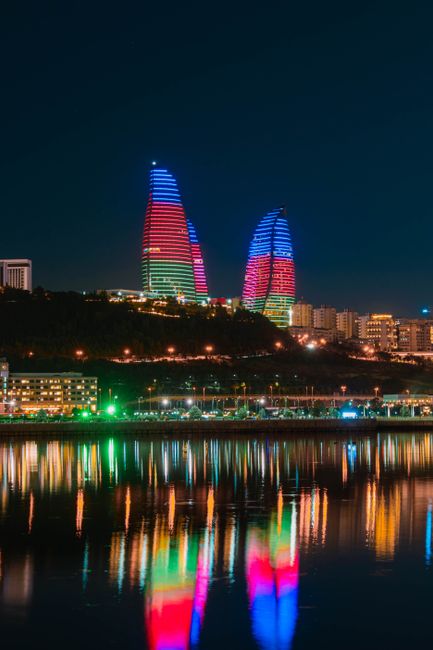
Azerbaijan, the “land of fire”, sits on the western shore of the Caspian Sea, where the Caucasus mountains run down to semi-desert, oil fields and a long coastline. Its capital, Baku, joins a walled medieval Old City to glittering 21st-century towers, and around it lie Stone Age rock carvings, bubbling mud volcanoes and hillsides where natural gas has burned for centuries. Inland, the green foothills of the Greater Caucasus hide the silk town of Sheki with its painted palace, mountain villages and forests. Azerbaijan is mostly Muslim but largely secular, hospitable and proud of its tea, carpets and music. Plan carefully: most visitors need an e-visa, the land borders are closed to ordinary travellers, so you must arrive by air, and the border with Armenia, parts of the south-west and the southern border with Iran need care. Read the safety section below first. April–June and September–October are the best months. Give it a week.
Right now in Azerbaijan
- Wed 17–20°C 62–69°F 2 mm Cloudy
- Thu 17–22°C 63–72°F Partly cloudy
- Fri 18–22°C 64–72°F 2 mm Light rain
Weather: MET Norway (CC BY 4.0)
Multi-day tours of Azerbaijan
Multi-day tours from local operators. You check dates and book on Viator, our partner; we may earn a commission at no extra cost to you. How we earn money
Safety and current conditions
Most visits to Baku, Gobustan, Sheki, Gabala and the northern mountains go smoothly. A few areas need care: the strip within about 5 km of the border with Armenia (not including the border between the Nakhchivan exclave and Armenia); the south-western districts affected by the conflicts of 2020 and 2023 (Kelbajar, Lachin, Qubadli, Zengilan, Jabrayil, Fuzuli, Khojavand, Shusha, Khojali, Khankendi, Aghdam and Tartar), because of landmines and unexploded weapons; and the southern border region with Iran. Since hostilities between the United States and Iran began on 28 February 2026 there have been drone and missile incidents, including a drone strike on Nakhchivan International Airport on 5 March 2026, and regional tension can close airspace and disrupt flights. Points to know:
- Karabakh and the south-west: the former Nagorno-Karabakh region and surrounding districts came fully under Azerbaijani control in 2023, and the government is rebuilding towns such as Shusha. It is illegal to enter certain areas there without the permission of the Azerbaijani authorities, and mine clearance is still under way. Anyone who visited these areas in the past without Azerbaijan’s permission, for example from Armenia before 2023, could be refused entry; contact an Azerbaijani embassy before you travel.
- The Iranian border and the south: Lankaran, Astara and the Hyrcanian forests lie close to the southern border region with Iran, so check current conditions before going south of Baku.
- Terrorism and demonstrations: there is a terrorist threat to places such as hotels, transport hubs, places of worship and events. Demonstrations are illegal and dealt with swiftly; avoid them. Carry your passport at all times, as police check identity documents.
- Everyday risks: crime in Baku is generally low, but watch for bag-snatching after dark and card skimming at street cash machines, and use a taxi app rather than unmarked cabs.
Land borders and the peace process
- Arrive by air: Azerbaijan closed its land borders in 2020 and keeps extending the closure; Azerbaijani press reported in September 2026 that it now runs until 2 January 2027. You can enter without restrictions only by air; the land borders with Georgia, Iran and Russia are closed to ordinary travellers, and leaving by road needs permission from the authorities.
- The Baku–Tbilisi train: a daily overnight train restarted on 26 May 2026, but according to Azerbaijan’s State Migration Service, as reported in the press, it is open only to Azerbaijani citizens and nationals who can enter Azerbaijan visa-free. Travellers on an e-visa, including people from the UK, the US and the EU, cannot use it.
- Armenia: the border is closed. Azerbaijan and Armenia initialled a peace agreement in Washington in August 2025, but it had not been signed by October 2026. To combine the two countries, fly via Tbilisi, Istanbul or another hub.
- By sea: cargo ferries cross the Caspian from near Baku to Turkmenistan and Kazakhstan, with irregular schedules; they are an option only for experienced overland travellers.
Conditions change, so check the latest official information shortly before you travel.
Azerbaijan at a glance: overview and geography
Azerbaijan is about the size of Portugal or Indiana. The Greater Caucasus forms its northern border with Russia, with peaks above 4,000 m around Shahdag and Bazarduzu; the Lesser Caucasus rises in the west; and between them the wide, dry plains of the Kura and Araz rivers run down to the Caspian Sea, which lies below sea level. The Absheron peninsula, where Baku stands, juts into the Caspian, and the exclave of Nakhchivan is separated from the rest of the country by southern Armenia. The State Statistical Committee counted about 10.26 million people at the start of 2026.
The region has been settled since the Stone Age, as the rock art at Gobustan shows. Fire worship and Zoroastrianism left their mark on the “land of fire”; later came Persian dynasties, the Shirvanshahs who built Baku’s palace, Arab and Turkic rulers and a patchwork of khanates such as Sheki’s. The Russian Empire took over in the early 19th century, and Baku boomed as the world’s leading oil producer around 1900. The Azerbaijan Democratic Republic of 1918–1920 was one of the first secular democracies in the Muslim world, before Soviet rule. Independent since 1991, Azerbaijan has grown rich on oil and gas. It has five UNESCO World Heritage Sites: the Walled City of Baku with the Shirvanshahs’ Palace and Maiden Tower, the Gobustan Rock Art Cultural Landscape, the Historic Centre of Sheki with the Khan’s Palace, the Hyrcanian Forests, and the Cultural Landscape of Khinalig People and the “Köç Yolu” transhumance route.
Time zone: Azerbaijan uses UTC+4 all year, with no summer time.
The regions
- Baku and Absheron: the capital, Gobustan, the mud volcanoes, the fire temple at Surakhani, Yanar Dag and Caspian beaches.
- The north: Guba, the mountain village of Khinalig and the Shahdag ski and summer resort.
- The north-west (Shaki-Zagatala): Sheki, the ancient church at Kish, Gabala’s mountains, and the copper-working village of Lahij on the way.
- The west: Ganja, the second city, and Lake Goygol in the Lesser Caucasus.
- The south: Lankaran’s tea gardens and the Hyrcanian forests near the Iranian border; check current conditions before going.
- Nakhchivan: the exclave between Armenia, Iran and Turkey, reached by air from Baku.
- Karabakh and East Zangezur: the south-western districts, where landmines remain and some areas need permission to enter.
Where to go: Baku, the land of fire and the mountains
Almost every trip starts in Baku. A simple first visit has four or five nights there, with day trips across Absheron and to Gobustan, followed by two or three nights in Sheki or Gabala in the Caucasus foothills.
Baku
Baku’s Old City, Icherisheher, is a walled maze of lanes, caravanserais and mosques around the Shirvanshahs’ Palace and the mysterious Maiden Tower. Around it spread the grand oil-boom mansions of the late 19th century, the long seaside Boulevard, and landmarks of the new Baku: the three Flame Towers, which light up at night, and Zaha Hadid’s flowing Heydar Aliyev Center. Our Baku guide (coming soon) covers sights, transport and day trips.
Gobustan, the mud volcanoes and the fire sites
About an hour south-west of Baku, Gobustan has thousands of rock carvings of hunters, boats and animals, some made more than 10,000 years ago, and nearby grey mud volcanoes burp and bubble on a bare hillside. On the Absheron peninsula, the Ateshgah fire temple at Surakhani was used by Hindu and Zoroastrian worshippers, and at Yanar Dag a hillside burns day and night from natural gas. According to the Yanar Dag reserve, foreign visitors pay 15 manat there, or 25 manat for a combined ticket with Ateshgah, valid for 72 hours, and 35 manat with the mud volcano complex too; it opens daily from 10:00 to 19:00.
Sheki and the north-west
Five to six hours by road from Baku, Sheki lies among forested hills below the Caucasus. Its 18th-century Palace of the Shaki Khans is covered in paintings and stained glass, and travellers once slept in its great caravanserai, now a hotel. Nearby are the ancient Albanian church at Kish and, an hour away, the mountain resort of Gabala. Our Sheki guide (coming soon) has the details.
Guba, Khinalig and Shahdag
Three hours north of Baku, Guba is famous for apples and carpets, with the old Jewish town of Qırmızı Qəsəbə across the river. A mountain road climbs from there to Khinalig, one of the highest and most isolated villages in the Caucasus, with its own language and a UNESCO listing. The Shahdag mountain resort offers skiing in winter and hiking and cable cars in summer.
A few more worth your time
Lahij, a cobbled village of coppersmiths in the mountains of Ismayilli; Shamakhi’s Juma Mosque and vineyards on the road to Sheki; Ganja, with its Nizami Mausoleum, and nearby Lake Goygol; the Caspian beaches north of Baku at Nardaran and Novkhani in summer; and, by air, Nakhchivan’s mausoleums and salt mine.
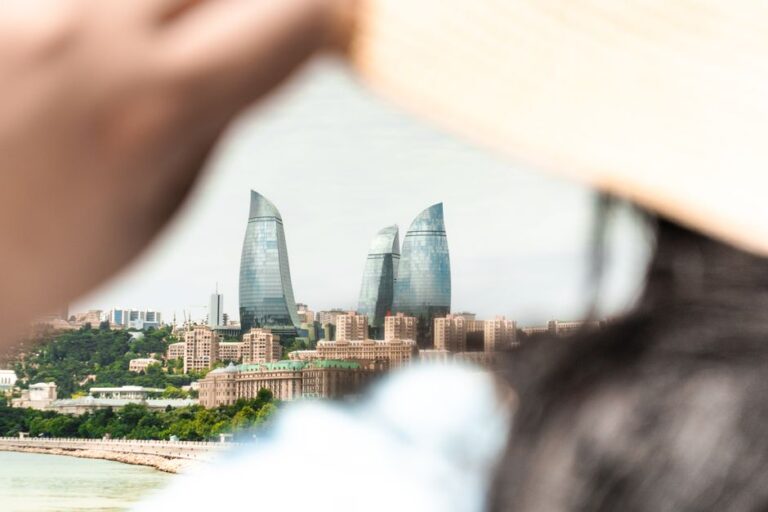
Baku Travel Guide
Plan a trip to Baku: the walled Old City (Icherisheher) with the Shirvanshahs' Palace and Maiden Tower, the Flame Towers and Highland Park, the…
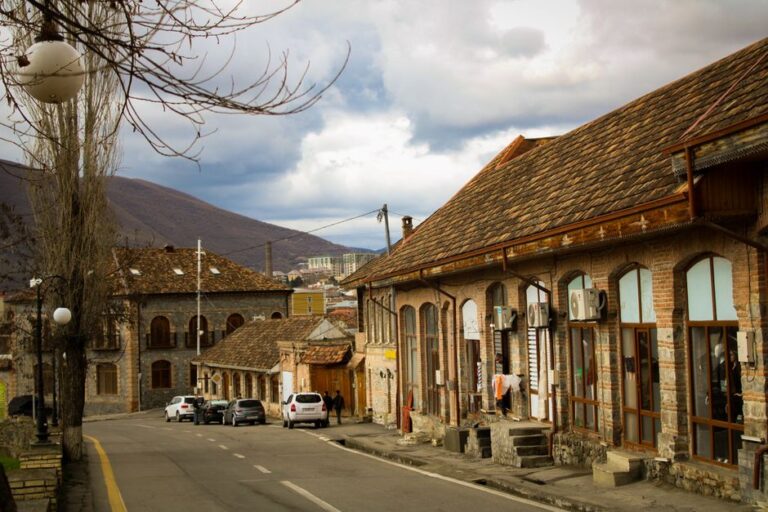
Sheki Travel Guide
Plan a trip to Sheki (Shaki) in Azerbaijan's Caucasus foothills: the UNESCO-listed Palace of the Shaki Khans and its stained glass, the Upper Caravanserai,…
Best time to visit Azerbaijan
Azerbaijan has many climates for its size. Baku is dry and windy, with hot summers and mild, grey winters; the foothills around Sheki are greener and wetter, with warm summers and cold winters; and the high Caucasus is snowy from November to April. Azerbaijan’s most recent official climate normals in the World Meteorological Organization’s archive are for 1971–1990, shown below; recent decades have been warmer, especially in summer.
| Area (weather station) | Spring (Mar–May) | Summer (Jun–Aug) | Autumn (Sep–Nov) | Winter (Dec–Feb) | Best months |
|---|---|---|---|---|---|
| Baku and Absheron (Mashtaga, 28 m) | highs 10–22 °C | highs 27–30 °C, lows 18–22 °C | highs 26 °C falling to 14 °C | highs 6–9 °C, lows 1–4 °C | May–June, September–October |
| Sheki and the foothills (Shaki, 641 m) | highs 10–22 °C | highs 26–30 °C, lows 16–19 °C | highs 25 °C falling to 17 °C | highs 5–8 °C, lows −2 to 0 °C | May–June, September–October |
Baku is very dry, with only about 220 mm of rain a year, mostly from October to March, and almost none in July. It is famously windy: the strong northerly khazri can blow for days, making the city feel cold in winter and stirring up dust in summer. Sheki gets about 770 mm, with May and October the wettest months.
Seasons, crowds and festivals
Spring and autumn are the most comfortable seasons in Baku and the countryside. July and August are hot, with Caspian beach life and mountain escapes at Shahdag and Gabala. Winter brings skiing at Shahdag and Tufandag. The biggest celebration is Novruz, the spring new year around 20–21 March, with bonfires, painted eggs and sweet pastries, and several days of public holiday. The Formula 1 Azerbaijan Grand Prix races through Baku’s streets in September, filling hotels and closing roads around the Old City. Other public holidays include 20 January (a day of mourning), 8 March, Independence Day (28 May), National Salvation Day (15 June), Armed Forces Day (26 June), Victory Day (8 November), Flag Day (9 November), Solidarity Day (31 December), and the Muslim festivals of Ramadan and Gurban Bayram, whose dates move each year.
How long to stay: sample itineraries
Baku to Gobustan is about an hour by road, Baku to Guba about three hours, and Baku to Sheki five to six hours by road or overnight by train.
4 days: Baku and Absheron
Two days in Baku for the Old City, the Boulevard, the Flame Towers and the Heydar Aliyev Center; a day trip to Gobustan and the mud volcanoes; and an evening loop to Ateshgah and Yanar Dag.
7–8 days: Baku, Sheki and the mountains
Four nights in Baku, then drive west via Shamakhi and Lahij to Sheki for two or three nights, with a day in Gabala, and return to Baku. Add two nights in Guba and Khinalig if you have time.
2 weeks: the South Caucasus
Spend a week in Azerbaijan, then fly to Tbilisi for Georgia and on to Yerevan, or reverse the route. Because the land borders are closed to most visitors and the Armenian border is shut, plan the order around flights. Istanbul is the most common connecting hub; see our Istanbul guide.
Entry, money, fees and costs
Entry and visas (last reviewed October 2026)
- The ASAN e-visa: most visitors, including UK, US, EU, Canadian and Australian citizens, need a visa, and the usual route is the official ASAN e-visa (evisa.gov.az). It is normally single-entry and allows a 30-day visit within a 90-day validity period; apply at least three days ahead, or pay extra for a three-hour urgent service, and print it to show with your passport. Fees are reported at US$25 for the standard service and US$60 for urgent processing; we could not read the official site.
- Visa-free and visa on arrival: citizens of Turkey, Georgia, Russia, Ukraine, Kazakhstan, Uzbekistan and several other countries can enter visa-free, and a few nationalities, including China, Japan, South Korea, Singapore and some Gulf states, can get a visa on arrival or enter visa-free for 30 days, according to published lists. A special visa on arrival was available for Formula 1 visitors between 25 August and 30 September 2026.
- Passports: your passport must be valid for at least six months after the date you arrive and have at least two blank pages.
- Registration: if you stay longer than 15 days, you must register with the State Migration Service, online or in person; hotels often do this for guests. If you don’t, you pay a fine before you can leave. Overstaying a visa brings a fine of 300 to 400 manat.
- Past travel to Karabakh: people who visited the south-western districts without the Azerbaijani authorities’ permission could be refused entry. Travellers of Armenian descent have reported being refused entry; check with an Azerbaijani embassy before booking.
- Phones and customs: if you use a local SIM card for more than 30 days, you must register it and pay a fee at a post office. You need an export certificate to take carpets, antiques or art out of the country; reputable sellers provide one.
The manat, cash and tipping
The currency is the Azerbaijani manat (AZN, ₼). The Central Bank of Azerbaijan has held it at 1.70 manat to the US dollar for several years, which made about 1.92 manat to the euro in early October 2026. Cards and contactless payment are widely accepted in Baku, including on the metro, but carry cash in the regions, at markets and for small purchases. To avoid card skimming, use cash machines inside banks. In restaurants, a service charge of around 10% is often included; if not, leaving 5–10% is appreciated.
Language and a few useful words
Azerbaijani, a Turkic language close to Turkish and written in the Latin alphabet, is the official language. Russian is widely spoken in Baku, and English is common in hotels and among younger people, less so in the regions. Try salam (hello), sağ olun (thank you), bəli and xeyr (yes and no), zəhmət olmasa (please) and nuş olsun (enjoy your meal).
Typical travel costs
Baku is more expensive than Tbilisi or Yerevan, especially for hotels and smart restaurants; the regions are cheaper. These estimates, per person per day, are a planning guide as of October 2026:
| Style | Estimated cost per day | What that looks like |
|---|---|---|
| Budget | about €35–55 | Hostel or simple guesthouse, street food and teahouses, metro and buses, free sights |
| Mid-range | about €90–150 | 3–4 star hotel shared by two, restaurant meals, a driver or tour for day trips, site tickets |
| High-end | about €280+ | Five-star hotel on the Boulevard, fine dining, private guides and mountain resorts |
The figures are our estimates, not official statistics. Prices rise sharply during the Formula 1 weekend.
Getting there and getting around
Arrival airports
Nearly all visitors arrive at Heydar Aliyev International Airport (GYD), about 25 km north-east of central Baku, the hub of Azerbaijan Airlines. According to Baku Metro, the H1 express bus leaves from outside Terminals 1 and 2 every 15 minutes, with room for luggage, free Wi-Fi and payment by contactless bank card; travel guides report a fare of about 1.30 manat to the city. Gabala, Ganja, Lankaran and Nakhchivan also have airports with mainly domestic or regional flights.
Trains and buses
Azerbaijan Railways (ADY) runs overnight and day trains from Baku to Ganja, Gabala and the north-west, including a night train that stops at Sheki’s station, about 17 km from town. Intercity buses and minibuses leave from the Baku International Bus Terminal to almost every town; they are cheap and frequent, and buses to Sheki take five to six hours. Many visitors hire a driver for day trips, which makes sense for Gobustan, Absheron and the mountains.
In Baku
Baku has a metro with three lines, plus city buses. According to Baku Metro, you can pay with a BakıKart transport card, a QR ticket in the BakıKart and other apps, local NFC bank cards, or Apple Pay and Google Pay; travel guides report a fare of about 0.60 manat a ride in 2026. In 2026 the metro is carrying out works to separate its Red and Green lines, with a changed route between Nizami and 28 May, so check the operator’s notices. Ride-hailing apps such as Bolt and Uber are widely available and a better choice than unmarked taxis.
Driving
Driving is on the right. You need a 1968 International Driving Permit with your licence and a green card for insurance, right-hand-drive cars are illegal, and any alcohol in your blood can mean a severe fine or prison. Standards of driving are erratic, roads can be poorly lit, and speed cameras are everywhere, with fines sent to the car’s owner. Snow can block mountain roads in winter. Bringing your own car means shipping it to Baku, since land borders are closed.
Safety, health and connectivity
Everyday safety and local laws
Start with the safety section at the top of this page. Day to day, Azerbaijan is safe and hospitable. Be respectful at places of commemoration such as the Alley of Martyrs in Baku, where disrespectful behaviour can lead to police action. Never photograph military sites, and you cannot bring in a drone unless you are a resident: customs will hold it until you leave. Drug laws are very strict. Same-sex relationships are legal but not openly accepted, so LGBT+ travellers tend to keep a low profile. Outside Baku, dress more conservatively. Emergency numbers: 112, or 102 police, 103 ambulance and 101 fire.
Health
Take travel insurance that covers medical treatment and evacuation. Baku has good private hospitals; facilities in the regions are basic. Drink bottled or filtered water. Summer heat and the strong sun on the Absheron call for a hat and plenty of water.
Connectivity and power
EU roaming rules do not apply. Local SIM cards from Azercell, Bakcell and Nar are cheap; remember the 30-day registration rule. Coverage is good in towns and along main roads. Plugs are the European two-pin type (C and F); see our travel adapters guide.
Food, tea and culture
Azerbaijani cooking is rich and fragrant: dozens of kinds of plov (saffron rice), including the spectacular shah plov baked in a crust of flatbread; dolma in vine and cabbage leaves; qutab, thin pancakes stuffed with herbs, meat or pumpkin; lamb kebabs; tiny dushbara dumplings in broth; and, in Sheki, piti, a lamb and chickpea stew cooked in a clay pot, followed by layered Sheki halva. Black tea is served everywhere from pear-shaped glasses with jam and sweets. Wine comes from the Shamakhi and Ganja areas, and pomegranates are a national symbol. Listen for mugham, a classical music tradition on UNESCO’s list of intangible heritage, and look for carpets, a living art. Most Azerbaijanis are Muslim but the society is largely secular; during Ramadan most restaurants stay open, but be considerate.
Things to do: cities, mountains and the Caspian
- City sightseeing: Baku’s Old City and modern architecture, and Sheki’s palace and caravanserai. See our city sightseeing guide.
- Hiking: the foothills above Sheki and Gabala, Khinalig and Shahdag in summer. See our hiking guide.
- Beaches: Caspian beaches on the northern Absheron coast in July and August. See our beaches guide.
- Wine tasting: wineries around Shamakhi and Ismayilli. See our wine tasting guide.
- Skiing: Shahdag and Tufandag (Gabala) from about December to March.
What to pack
Light clothes, a sun hat and sunscreen for summer; a windproof jacket for Baku’s khazri wind; warm layers from November to March. Pack modest clothes for mosques and the regions, with a scarf for women, comfortable shoes for the Old City’s stones, hiking shoes for the mountains and a rain jacket for Sheki’s spring and autumn showers. Keep your printed e-visa and passport with you.
Azerbaijan travel FAQ
Is Azerbaijan safe to visit?
Baku and the main tourist areas are generally safe. The areas that need care are the border with Armenia, the south-western districts, where landmines remain, and the southern border region with Iran. Regional tension linked to Iran can close airspace at short notice.
Do I need a visa for Azerbaijan?
Most Western visitors do. Apply for the ASAN e-visa online at least three days ahead; it allows a 30-day stay within 90 days. Citizens of some neighbouring countries can enter visa-free.
Are Azerbaijan’s land borders open?
Not to ordinary travellers. Entry is by air; the closure was reported extended until 2 January 2027. The Baku–Tbilisi train is open only to people who can enter Azerbaijan visa-free.
Can I visit Karabakh or Shusha?
Landmines and unexploded weapons remain across the region, and entering certain areas needs Azerbaijani permission. Check current rules first.
Can I travel from Azerbaijan to Armenia?
Not directly. The border is closed and the peace agreement had not been signed as of October 2026. Fly via Tbilisi or Istanbul.
Do I need to register in Azerbaijan?
Only if you stay more than 15 days: register with the State Migration Service, online or in person. Hotels often do it for you.
When is the best time to visit Azerbaijan?
May–June and September–October. July and August are hot in Baku but good in the mountains; winter is mild in Baku and snowy at Shahdag.
How many days do you need in Azerbaijan?
Four days for Baku, Gobustan and Absheron; a week to add Sheki and the mountains.
What currency does Azerbaijan use?
The manat (AZN), held at 1.70 to the US dollar, about 1.92 to the euro in early October 2026. Cards work widely in Baku.
Can I bring a drone to Azerbaijan?
Not unless you are a resident. Customs will take it at the border and return it when you leave.
Is Azerbaijan expensive?
Baku is the priciest city in the South Caucasus, especially for hotels, but transport and food in local places are cheap, and the regions are good value.
Sources and last review
Researched and last reviewed on 4 October 2026. Safety, entry, registration, SIM and driving rules come from GOV.UK foreign travel information (updated 2 September 2026) and the US State Department’s country information (27 April 2026); population from the State Statistical Committee of Azerbaijan; UNESCO sites from UNESCO; Yanar Dag prices from the reserve’s own site; airport bus and metro payment details from Baku Metro; climate from Azerbaijan’s 1971–1990 WMO normals as archived by NOAA. The border closure date, the Baku–Tbilisi train rules, e-visa fees, visa-free lists, metro and bus fares, the manat’s peg and euro rate, train routes and holiday dates come from press reports and secondary sources and are flagged for checking. Daily costs are estimates. Check the official sites before you travel.
Plugs and power in Azerbaijan
Azerbaijan uses 220 V, 50 Hz and these plugs (left) and wall sockets (right):
All plug types and voltages by country → · Check what you need to pack →
Plan your trip
Partner links: TravelerCenter may earn a commission if you book, at no extra cost to you.
🇦🇿 Useful Azerbaijani phrases for Azerbaijan
All 38 Azerbaijani phrases: restaurant, hotel, emergencies, romance (printable) →