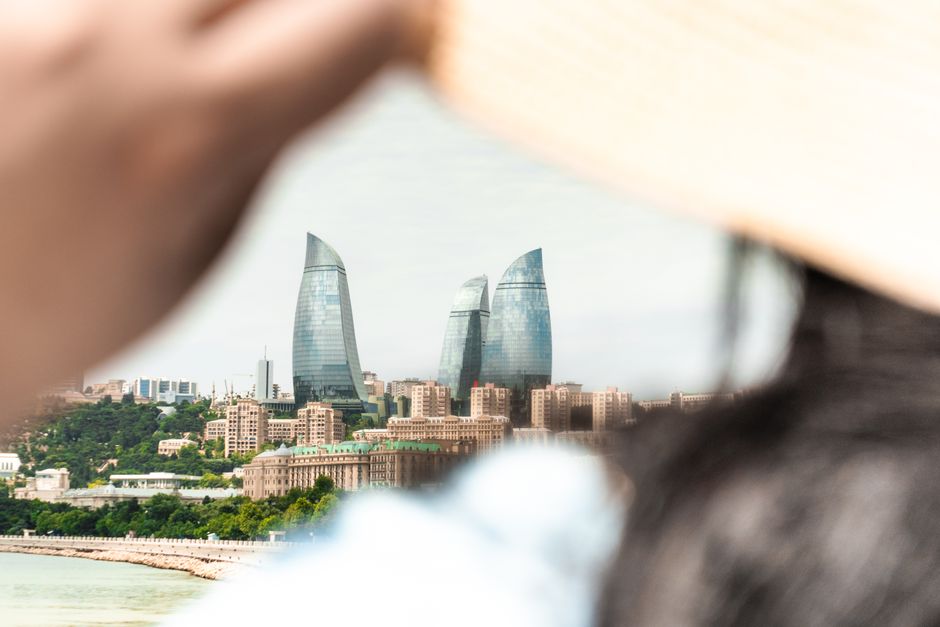
Baku is a city of striking contrasts on the shore of the Caspian Sea. At its heart lies a walled medieval Old City of stone lanes, caravanserais and the mysterious Maiden Tower; around it spread the grand mansions built by oil millionaires a century ago; and above them rise the three glowing Flame Towers and other bold 21st-century buildings. It is a polished, safe-feeling capital with a long seaside promenade, excellent food and teahouses, and the “land of fire” right on its doorstep, from hillsides that burn day and night to Stone Age rock carvings and bubbling mud volcanoes. Give it three or four days, including a day trip to Gobustan. Spring and autumn are the best seasons; summer is hot and winter is mild but windy. You will need an e-visa and must arrive by air, so read our Azerbaijan guide and the safety notes below before you book.
Right now in Baku
- Thu17–21°C62–69°FPartly cloudy
- Fri17–21°C62–70°F9 mm rain
- Sat17–19°C62–65°F1 mm rain
Top tours in Baku
See all tours for Baku →
From local operators, with prices and reviews; you check availability and book on Viator, our partner. We may earn a commission at no extra cost to you. How we earn money
Baku at a glance
- Best months: May–June and September–October, with average highs of about 19–27 °C; July and August average about 30 °C in the afternoon and feel hotter (Azerbaijan’s official 1971–1990 normals, recent years warmer).
- Days needed: 2 for the city; 3–4 with Gobustan and the Absheron fire sites.
- Getting there: by air to Heydar Aliyev International Airport (GYD); the H1 express bus runs to the city every 15 minutes. Land borders are closed to ordinary travellers.
- Getting around: the Old City and centre are walkable; the metro takes contactless cards; Bolt and Uber are cheap.
- Budget level: the most expensive city in the South Caucasus for hotels, but transport and local food are cheap.
Safety in Baku
Baku is far from the border areas of Azerbaijan. There is a terrorist threat to places such as hotels, restaurants, transport hubs and events, and regional tension linked to the conflict between the United States and Iran can close airspace at short notice. In practice: stay alert in crowded places, follow local news, avoid demonstrations, which are illegal, and carry your passport, since police check identity documents. Crime in Baku is generally low, but watch for bag-snatching after dark and card skimming at street cash machines, and behave respectfully at memorial sites such as the Alley of Martyrs.
Baku’s neighbourhoods and who each one suits
- Icherisheher (the Old City): boutique hotels and guesthouses inside the walls, steps from the main sights. Atmospheric, but cars are restricted, so arrange luggage drop-off.
- Fountains Square and Nizami Street: the pedestrian shopping heart, full of cafés and grand 19th-century buildings, next to the Old City. Best all-round base.
- The Boulevard: high-end hotels with Caspian views along the seaside park.
- Around 28 May and the railway station: good-value hotels with metro and train links.
- Near the Flame Towers and Highland Park: big international hotels on the hill above the bay, with views but a walk or funicular ride to the centre.
Top things to see in Baku
Prices and hours are as of October 2026, in manat (about 1.92 manat to the euro). Some ticket prices are not published on official sites and are flagged in our sources.
Icherisheher: the Old City
The walled Icherisheher, part of a UNESCO World Heritage Site since 2000, is an open district that you enter through gates such as the Double Gate (Qoşa Qala) or the Salyan Gate. Inside are winding lanes, carpet shops, small mosques, old bathhouses and the 15th-century Bukhara and Multani caravanserais, now restaurants. The reserve’s administration names the Palace of the Shirvanshahs and the Maiden Tower as the most visited monuments. The palace is a 15th-century complex of courtyards, a mosque, a mausoleum and a bathhouse, built by the rulers of Shirvan; the Maiden Tower is a squat, mysterious stone tower of uncertain age and purpose, with a rooftop view over the Old City and the bay. Both charge foreign visitors for entry, with tickets last reported at about 10–15 manat each, so check at the door. The Old City’s tourist information centre at 55 Boyuk Gala Street is open daily from 10:00 to 19:00, according to the reserve.
The Boulevard, the Carpet Museum and Fountains Square
The seaside Boulevard, laid out in 1909, runs for kilometres along the bay, with parks, cafés, a Ferris wheel, a mini-Venice of canals, and the best view of the Flame Towers at dusk. At its western end, the Azerbaijan Carpet Museum is housed in a building shaped like a rolled-up carpet and shows centuries of weaving from every region of the Caucasus. Behind the Boulevard, Fountains Square and the pedestrian Nizami Street are the city’s living room in the evening, lined with ornate oil-boom buildings.
The Flame Towers and Highland Park
The three curved glass Flame Towers, completed in 2012, dominate the skyline above the bay. At night, thousands of LED panels turn them into flickering flames, waving flags and figures, visible from all over the city. Below them, Highland Park (Dağüstü Park) has the finest panorama of Baku, and the solemn Alley of Martyrs, which commemorates those killed in January 1990 and in the Karabakh wars, with an eternal flame. Reach the park on foot by steps from the Boulevard or on the funicular. Be respectful at the memorial.
The Heydar Aliyev Center
Zaha Hadid’s flowing white Heydar Aliyev Center, opened in 2012 north-east of the centre, is one of the most photographed buildings of the century, rising from a sloping lawn without a single straight line. Inside are exhibitions on the country’s history and the former president after whom it is named, as well as changing art shows, a collection of Azerbaijani national dress and models of the country’s landmarks. The park outside is free; the exhibitions charge a fee. We could not read current hours on the centre’s website, so check before you go.
The land of fire: Yanar Dag, Ateshgah and Gobustan
- Yanar Dag: about 25 km north of the centre, a hillside where natural gas leaking from the rock has burned for as long as anyone remembers, most dramatic after dark. According to the reserve, it opens daily from 10:00 to 19:00, and foreign visitors pay 15 manat (children under 12 free); a 30-minute guided tour in a foreign language costs 10 manat.
- Ateshgah: the fire temple at Surakhani, east of the city, a pentagonal courtyard of cells around a fire altar, used by Hindu and Zoroastrian worshippers from India until the late 19th century. A combined ticket for Yanar Dag and Ateshgah costs 25 manat, valid for 72 hours after first use, according to the Yanar Dag reserve.
- Gobustan: about 60 km south-west, the UNESCO-listed Gobustan Rock Art Cultural Landscape has thousands of carvings of hunters, dancers, boats and animals, some more than 10,000 years old, with a modern museum at the entrance. Combine it with the nearby mud volcanoes, a grey moonscape of little cones gurgling cold mud, reached by 4×4 or taxi over dirt tracks. The 35-manat combined ticket from Yanar Dag also covers the mud volcano complex.
- Absheron beaches: in July and August, locals head to the beaches on the peninsula’s north coast; resort hotels have the cleanest stretches. See our beaches guide.
Most visitors see Gobustan and the mud volcanoes in a half-day by taxi or tour, and Yanar Dag and Ateshgah in an afternoon or evening. See our city sightseeing guide.
Nearby destinations
- Sheki242 km
Food, tea and nightlife
Eat plov in its many forms, including shah plov baked in a golden crust, qutab pancakes filled with herbs or meat, dolma, lamb kebabs, dushbara dumplings and fresh Caspian fish. End the meal at a teahouse (çayxana) with black tea in pear-shaped glasses, jam and sweets. The Old City’s caravanserais make atmospheric dinner spots, and the area around Fountains Square has everything from street food to fine dining. Baku has a lively bar and club scene, mostly around the centre, and wine from Shamakhi and Ganja is on many menus. See our wine tasting guide.
Getting there and getting around
From the airport
Heydar Aliyev International Airport (GYD) is about 25 km north-east of the centre. According to Baku Metro, the H1 express bus leaves from outside Terminals 1 and 2 every 15 minutes, with plenty of room for luggage, free Wi-Fi and payment by contactless bank card. Travel guides report the fare at about 1.30 manat and the route ending near the main railway station and 28 May metro. Taxis and Bolt or Uber rides take 25–40 minutes depending on traffic; agree the fare first if you take an airport taxi.
Metro, buses and taxis
Baku’s metro, famous for its Soviet-era stations, has three lines. According to the operator, you can pay with a BakıKart transport card, a QR ticket in the BakıKart, Birbank and other apps, local NFC bank cards, or Apple Pay and Google Pay; travel guides report a fare of about 0.60 manat in 2026. A long project to separate the Red and Green lines has changed some routes, including between Nizami and 28 May, so check the operator’s notices. Some stations prohibit photography. Buses use the same BakıKart. Taxis are cheap through Bolt or Uber, a better choice than unmarked street taxis, which often overcharge.
Trains and buses beyond Baku
Azerbaijan Railways trains leave the main railway station (28 May metro) for Ganja, Gabala and the north-west, including night trains via Sheki. The overnight train to Tbilisi runs daily, but only Azerbaijani citizens and travellers who can enter Azerbaijan visa-free may use it, according to the State Migration Service as reported in the press. Intercity buses and minibuses leave the Baku International Bus Terminal for Sheki, Guba, Gabala and other towns.
When to go and how long to stay
Baku has a dry, semi-arid climate: hot summers, mild winters and very little rain, about 220 mm a year, mostly from October to March. Its signature is the wind: the strong northerly khazri can blow for days, cooling summer heat but making winter feel raw.
| Season | Average high / low | Rain a month | What it’s like |
|---|---|---|---|
| Spring (Mar–May) | 10–22 °C / 3–13 °C | 15–25 mm | Windy March, lovely May; good for sightseeing. |
| Summer (Jun–Aug) | 27–30 °C / 18–22 °C | 2–7 mm | Hot and dry, humid by the sea; beach season. |
| Autumn (Sep–Nov) | 26 °C falling to 14 °C / 18–8 °C | 17–36 mm | Warm September and October, wetter November. |
| Winter (Dec–Feb) | 6–9 °C / 1–4 °C | 22–27 mm | Mild but grey, with biting winds; rare snow. |
Figures are Azerbaijan’s official 1971–1990 climate normals for the Mashtaga station on the Absheron peninsula, the most recent official set in the World Meteorological Organization’s archive; recent summers have been hotter. The Formula 1 Azerbaijan Grand Prix is held on a street circuit around the Old City in September, when hotel prices rise and roads close. Novruz, around 20–21 March, fills the Old City with bonfires and festivities.
2 days in Baku
Day 1: the Old City, the Palace of the Shirvanshahs and the Maiden Tower, lunch in a caravanserai, the Carpet Museum and a sunset walk on the Boulevard. Day 2: the Heydar Aliyev Center, Highland Park and the Alley of Martyrs, Fountains Square, and the Flame Towers light show at night.
4 days in Baku
Add a morning at Gobustan and the mud volcanoes, and an afternoon and evening at Ateshgah and Yanar Dag. Then head to Sheki or Guba in the mountains for a few days.
Where to stay in Baku
- First visit: near Fountains Square or inside the Old City.
- Sea views: hotels on the Boulevard or by the Flame Towers.
- Budget: hostels around the Old City and near 28 May.
- Formula 1 weekend: book months ahead, or stay outside the circuit area.
If you stay more than 15 days, you must register with the State Migration Service; hotels often do this for you.
Practical tips for Baku
- Passport: carry it at all times; police may check.
- Cash machines: use those inside banks to avoid card skimming.
- Taxis: use Bolt or Uber, or agree the fare first.
- Photography: avoid military and government buildings and some metro stations; ask before photographing people or at memorials.
- Wind: pack a windproof layer, even in spring and autumn.
- Emergencies: call 112, or 102 police and 103 ambulance.
What to pack for Baku
Pack light clothes, a sun hat and sunscreen for summer, a windproof jacket for the khazri, and a warm coat from December to February. Comfortable shoes for the Old City’s stone lanes are essential, and modest clothes and a scarf help at mosques. Add a rain jacket for winter showers, hiking shoes for Gobustan’s rocky paths and the mud volcanoes, and water shoes for the Caspian’s beaches. Plugs are the European two-pin type; bring a travel adapter if you need one.
Baku travel FAQ
Is Baku safe for tourists?
Generally, yes. Crime is low, but there is a terrorist threat and regional tension, so stay alert in crowded places and avoid demonstrations.
How do I get from Baku airport to the city?
Take the H1 express bus, which leaves every 15 minutes and takes contactless cards, reported at about 1.30 manat, or a Bolt or Uber ride of 25–40 minutes.
Can I pay by card on the Baku metro?
Yes. The metro accepts BakıKart, app QR tickets, local NFC bank cards, and Apple Pay and Google Pay, according to the operator.
How much does it cost to visit Yanar Dag?
15 manat for foreign visitors, or 25 manat combined with Ateshgah and 35 manat with the mud volcanoes too. It opens daily from 10:00 to 19:00.
How many days do you need in Baku?
Two days for the city, and three or four to add Gobustan, the mud volcanoes, Ateshgah and Yanar Dag.
When do the Flame Towers light up?
Every evening after dark. The best views are from the Boulevard and from the Old City walls.
Can I take the train from Baku to Tbilisi?
Only if you are an Azerbaijani citizen or a national who can enter Azerbaijan visa-free. E-visa holders, including UK, US and EU citizens, must fly.
What is the best time to visit Baku?
May–June and September–October, when it is warm and dry. Summer is hot, winter is mild but very windy, and the Formula 1 weekend in September is busy and expensive.
Can you swim in the Caspian Sea at Baku?
Not in the city centre’s bay. Locals swim at beaches on the northern Absheron coast in July and August, where resort hotels keep the cleanest stretches.
Do I need a visa to visit Baku?
Most Western visitors need the ASAN e-visa, applied for online at least three days ahead. See our Azerbaijan guide for details.
Plan your trip
Partner links: TravelerCenter may earn a commission if you book, at no extra cost to you.
🇦🇿 Useful Azerbaijani phrases for Baku
All 38 Azerbaijani phrases: restaurant, hotel, emergencies, romance (printable) →
Sources · last reviewed 4 October 2026
Researched and last reviewed on 4 October 2026. Old City details come from the Icherisheher reserve administration; Yanar Dag and combined ticket prices from the Yanar Dag reserve; airport bus and metro payment details from Baku Metro; safety from GOV.UK foreign travel information and the US State Department’s country information; UNESCO listings from UNESCO; climate from Azerbaijan’s official 1971–1990 WMO normals for Mashtaga. Palace and Maiden Tower prices, metro and bus fares, the Baku–Tbilisi train rules and the Formula 1 timing come from travel guides and the press and are flagged for checking. Prices and hours change, so check the official sites before you visit.
Data: Weather: MET Norway (CC BY 4.0) · Sea temperature: NOAA CoastWatch · Air quality: OpenAQ · Rates: ECB · Costs: World Bank ICP and price levels · Wikidata (CC0)