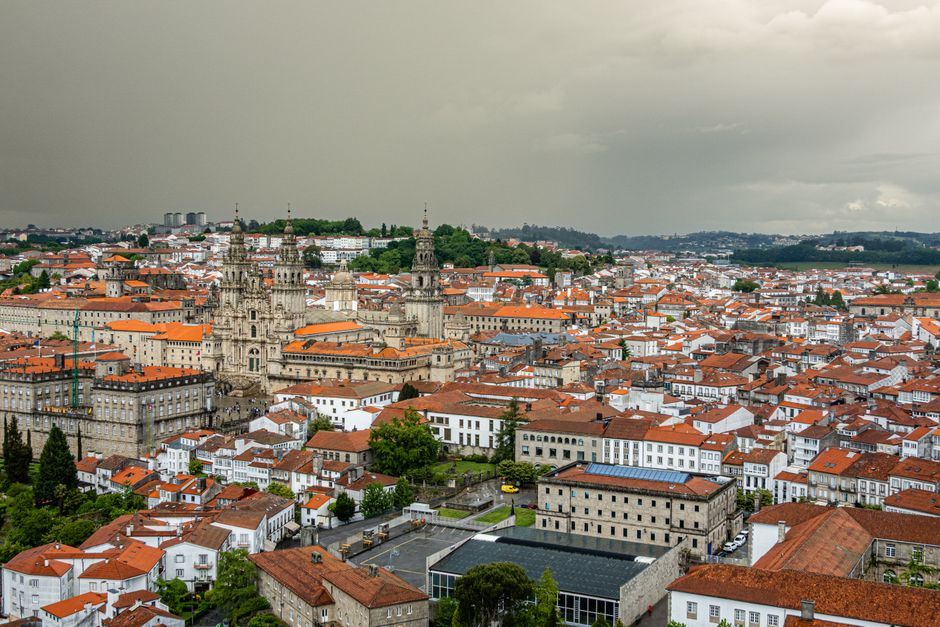
Santiago de Compostela, the capital of Galicia, is the end of the Camino de Santiago, the pilgrimage that has led people across Europe to the tomb of Saint James the Apostle for more than a thousand years. Its old town, a UNESCO World Heritage Site, is a granite maze of arcaded streets, monasteries and squares crowned by the great Romanesque and Baroque cathedral. Every day pilgrims with backpacks and walking poles stream into the Praza do Obradoiro, and the city has the lively feel of a university town, with excellent food markets and tapas bars. Rain is part of its charm, and the old town glistens after a shower. The best months are May, June and September. July 2027 is a Holy Year, so expect big crowds.
Right now in Santiago de Compostela
- Wed 14–20°C 57–67°F 1 mm Light showers
- Thu 12–19°C 53–66°F Cloudy
- Fri 10–19°C 51–67°F Clear
- Mon 12 Oct National Day of Spain (Fiesta Nacional de España)
Weather: MET Norway (CC BY 4.0) · Rates: ECB · Holidays: Nager.Date
Top tours in Santiago de Compostela
See all tours for Santiago de Compostela →
From local operators, with prices and reviews; you check availability and book on Viator, our partner. We may earn a commission at no extra cost to you. How we earn money
Santiago de Compostela at a glance
- Best for: the cathedral and the end of the Camino, a granite old town, the cathedral rooftops, seafood and market food, and trips to the Galician coast.
- How long: 2 days for the city; 3–4 days to add Finisterre, A Coruña or the Rías Baixas.
- Best time: May, June and September. July and August are the driest months but the busiest; from October to April it rains on 12–15 days a month.
- Getting there: fly to Santiago airport (SCQ), linked by city bus 6A; high-speed trains from Madrid; regional trains to A Coruña and Vigo.
- Getting around: on foot in the old town, which is largely closed to traffic; city buses for the station and the Cidade da Cultura.
- Before you go: entry rules, money, trains and general safety are on our Spain travel guide.
Santiago’s neighbourhoods and who each one suits
Santiago is a small city of about 100,000 people, and almost everything a visitor wants lies within a 15-minute walk of the cathedral.
The old town (Zona Vella)
The walled medieval city around the cathedral, with the arcaded Rúa do Vilar and Rúa Nova, the busy bar street of Rúa do Franco and squares such as Quintana and Praterías. Hotels range from pilgrim hostels to historic palaces. The best base for a short stay; it is pedestrian, so expect to walk the last stretch with your bags.
The Ensanche
The 20th-century grid south of the old town, with shops, everyday cafés and better-value hotels, 5–10 minutes’ walk from the cathedral and closer to the train and bus station. Practical for travellers with luggage or a car.
San Pedro and the Camino approach
The Rúa de San Pedro, where the French Way enters the city, is a lively, local street of bars and guesthouses, with the Museo do Pobo Galego and the Bonaval park nearby. Good for pilgrims and anyone who wants a neighbourhood feel.
Monte do Gozo and the outskirts
The hill 5 km east where pilgrims get their first glimpse of the cathedral towers has a large public hostel and hotel complex. Quieter and cheaper, but you need the bus or a taxi to reach the centre.
Top things to see in Santiago de Compostela
Prices and hours below were checked on the official sites in October 2026, unless we say otherwise; check again before you go. Remember that the cathedral is a working church with services through the day.
The cathedral
Begun in 1075 over the tomb of Saint James, the cathedral is a Romanesque pilgrimage church wrapped in a Baroque shell. Its main façade on the Obradoiro dates from the 18th century; behind it, the Portico of Glory, carved by Master Mateo in the 12th century, is one of the masterpieces of medieval sculpture. Inside, you can climb the stairs behind the gilded high altar to embrace the statue of the Apostle and visit the crypt with his silver casket. As of October 2026 entry to the basilica is free, every day 7:00–21:00, through the Praterías door. Backpacks are not allowed inside for security reasons, so leave them at your hotel or a left-luggage office.
Pilgrim’s Mass and the Botafumeiro
The cathedral holds a Pilgrim’s Mass at the main altar every day at 7:30, 9:30, 12:00 and 19:30, with a simultaneous translation app, and a Mass in English at 10:30 in the chapel of the Pilgrim’s Office every day except Wednesday. The Botafumeiro, the giant 53 kg censer swung across the transept by eight men, normally flies only on major feast days (such as 6 January, Easter Sunday, 23 May, Pentecost, 25 July, 15 August, 1 November, Christ the King, 8 and 25 December and 30 December) and when pilgrim groups book it. In October 2026 the cathedral says the Botafumeiro is temporarily out of use for restoration, so do not plan your visit around it.
The cathedral rooftops and museum
The guided rooftops tour (Cubiertas) takes you across the stepped granite roofs of the cathedral, with views over the old town and the Obradoiro, in about an hour. As of October 2026 it costs €15 (€12 reduced); tours are mostly in Spanish, with some in English, and are not wheelchair-accessible. The ticket also includes the Cathedral Museum’s permanent collection, the cloister, the Gelmírez Palace, the crypt of the Portico of Glory, the MuSar collegiate church museum and the Diocesan Museum. The museum alone costs €9 (€7 reduced for students, accredited pilgrims, over-65s and others, with some free categories), and a complete ticket with the rooftops and a timed 25-minute visit to the Portico of Glory costs €23 (€19 reduced). The museum opens daily 10:00–20:00, with the ticket office closing 30 minutes earlier; arrive 15 minutes before your timed slot. Book online in summer, and note that bags over 40×40 cm are not allowed and photography is banned inside the museum.
The Praza do Obradoiro and the old town squares
The great square in front of the cathedral is where the Camino ends, and pilgrims lie on the stones to gaze at the façade. Around it stand the Hostal dos Reis Católicos, a royal pilgrims’ hospital founded in 1499 and now a luxury Parador hotel, the neoclassical Pazo de Raxoi (the town hall) and the College of San Xerome. Walk on through the Praza da Quintana, the Praterías square with its horse fountain, and the monastery of San Martiño Pinario, one of the largest in Spain.
Mercado de Abastos
Santiago’s food market, in granite halls on the edge of the old town, is one of the city’s great sights: stalls of octopus, scallops, barnacles, Galician cheeses such as tetilla, and peppers from Padrón, with farm women from the surrounding villages selling their produce. You can buy seafood at a stall and have it cooked at the market’s bars. According to the market, it opens Monday to Saturday, 8:00–14:00; Thursday and Saturday mornings are busiest.
More to see
- Alameda park: a 19th-century park with the classic view of the cathedral’s west side from the Paseo da Ferradura.
- Cidade da Cultura de Galicia: Peter Eisenman’s vast complex of stone-clad buildings on Mount Gaiás, with exhibitions, a library and a park; the grounds are free to walk.
- Museo do Pobo Galego: the Galician folk museum in the convent of San Domingos de Bonaval, with a remarkable triple spiral staircase.
- Colexiata de Santa María do Sar: a Romanesque church whose columns lean dramatically, with a museum included in the cathedral ticket.
- CGAC: the Galician Centre of Contemporary Art, by Álvaro Siza, next to Bonaval park.
Other things to do in Santiago de Compostela
Walk the last stage of the Camino
Even if you are not a pilgrim, walking into Santiago along the Camino is memorable. A popular half day is the last 5 km from Monte do Gozo, where the cathedral spires first appear, down through the suburbs and the Porta do Camiño to the Obradoiro. To earn the Compostela certificate you need much more: see below and our hiking guide for planning the routes.
The Pilgrim’s Office and the Compostela
The Pilgrim’s Reception Office on Rúa das Carretas, just below the Obradoiro, issues the Compostela, the Latin certificate of pilgrimage. It is granted to those who make the pilgrimage for religious or spiritual reasons and who have walked or ridden on horseback at least the last 100 km, or cycled at least the last 200 km, on a recognised route. You prove it with the credencial, the pilgrim passport, stamped along the way; if you do only the minimum distance, get a stamp at the start and end of each day’s stage. Pilgrims who prefer it can ask instead for the Certificate of Distance, which records the kilometres walked, for €3. The office opens daily 9:00–19:00, except 25 December and 1 January, and uses a QR queue system; at busy times you may not collect your certificate the same day.
Food and wine
Order pulpo á feira (octopus with paprika and olive oil), pimientos de Padrón, scallops, empanada and caldo galego, and finish with tarta de Santiago, the almond cake stamped with the cross of Saint James. Galicia’s crisp albariño and ribeiro whites go with everything. The Rúa do Franco and Rúa da Raíña are lined with tapas bars. See our wine tasting guide.
Day trips and onward travel
Finisterre and the Costa da Morte
Many pilgrims continue to Cape Finisterre, once thought the end of the world, about 90 km west, where the lighthouse looks out over the Atlantic. Combine it with Muxía and the wild cliffs of the Costa da Morte on a coach tour or by car; the Finisterre and Muxía routes can also be walked in three or four days.
A Coruña, the Rías Baixas and Portugal
A Coruña, with its Roman lighthouse (the Tower of Hercules) and glassed-in seafront balconies, is about half an hour by train. South, the Rías Baixas offer albariño vineyards, beaches and islands, with Pontevedra’s pretty old town and Vigo for boats to the Cíes Islands. Porto, in Portugal, is about 3 hours by road, the start of the popular Portuguese Way.
Nearby destinations
- Rías Baixas61 km
- Porto193 km
- Douro Valley209 km
- Coimbra297 km
Getting there and getting around
From Santiago airport
Santiago–Rosalía de Castro airport (SCQ) lies at Lavacolla, about 12 km east of the city. According to Aena, city bus line 6A links the airport with Santiago, ending at the intermodal train and bus station; the fare is about €1 and buses run roughly every half hour, taking about 30 minutes. Monbus coaches also run from the airport to A Coruña and Lugo. Taxis wait outside arrivals. A Coruña and Vigo airports, each under an hour away, are alternatives.
By train and coach
Santiago’s station, south of the centre and next to the bus station, has high-speed trains from Madrid taking from about 3 hours 20 minutes, run by Renfe and its low-cost Avlo brand. The Atlantic axis line links Santiago with A Coruña in about half an hour and with Pontevedra and Vigo in about an hour. Coaches go to every corner of Galicia, Porto and beyond. The old town is a 15-minute walk uphill from the station.
Getting around and driving
The old town is mostly closed to traffic, and the best way to explore is on foot; wear shoes with good grip, as the granite gets slippery in the rain. City buses link the station, the Ensanche, Monte do Gozo and the Cidade da Cultura. If you arrive by car, leave it in a car park on the edge of the old town; hotels inside can advise on access for unloading.
When to go and how long to stay
Santiago is one of the rainiest cities in Spain, with a mild Atlantic climate: cool, wet winters and pleasant, mostly dry summers. The table uses AEMET’s 1991–2020 climate normals for the Santiago airport weather station at Lavacolla, 370 m above sea level and about 12 km east of the city: average daily highs and lows, and days with at least 1 mm of rain. The city itself is lower and often slightly warmer.
| Season | Average high / low | Rainy days per month | What it’s like | Good for |
|---|---|---|---|---|
| Winter (Dec–Feb) | 12–13 °C / 4–5 °C | 12–15 | Cool, wet and often grey; few pilgrims | The cathedral without crowds, food, low prices |
| Spring (Mar–May) | 16–19 °C / 5–9 °C | 11–14 | Fresh and green, with showers; the Camino season builds | Walking the Camino, city sightseeing |
| Summer (Jun–Aug) | 22–24 °C / 11–14 °C | 5–7 | Mild and the driest season; busiest with pilgrims | Festivals, day trips to the coast |
| Autumn (Sep–Nov) | 22 °C falling to 14 °C / 12 °C falling to 7 °C | 8 in September, 16 in November | September is often lovely; the rains return in October | Walking, food, fewer crowds |
The station averages about 1,680 mm of rain a year, with October to January the wettest months. Locals say the rain is an art form here; bring an umbrella and enjoy the glistening streets.
Events worth planning around
- 2027, Holy Year: a Compostela Holy Year falls whenever 25 July is a Sunday, as it is in 2027. The Holy Door of the cathedral opens for the whole year and pilgrim numbers soar, so book rooms early.
- Late July: the Festas do Apóstolo, with concerts, the fireworks show on the Obradoiro on the night of 24 July and the feast of Saint James on 25 July.
- Easter week: processions through the old town.
How long to stay: 1, 2 and 3 days
1 day: the cathedral and the noon Pilgrim’s Mass, lunch at the Mercado de Abastos, the rooftops tour in the afternoon, then sunset from the Alameda park and tapas on the Rúa do Franco.
2 days: add the Cathedral Museum and the Portico of Glory, San Martiño Pinario, the Museo do Pobo Galego and Bonaval park. 3 days: add a day trip to Finisterre or A Coruña, or walk in from Monte do Gozo.
Where to stay in Santiago de Compostela and the tourist tax
- Old town: boutique hotels, historic Paradores and pilgrim hostels, steps from the cathedral.
- Ensanche: better value and easier access by car or from the station.
- San Pedro: lively and local, on the French Way.
- Monte do Gozo: budget beds outside the centre, by bus.
Book well ahead for July, August and the whole of 2027. Santiago charges a tourist tax (imposto sobre estadías turísticas), the first in Galicia, which started on 1 October 2025 and is collected by your accommodation. As reported when the city council approved its ordinance, rates run from €1 to €2.50 per person per night depending on the category: €2.50 in five-star and four-star superior hotels, €2 in three- and four-star hotels and tourist flats, €1.50 in one- and two-star hotels and guesthouses, and €1 in private hostels, campsites, rural houses and tourist apartments, for up to five nights. Under-18s are exempt under the Galician rules. Ask your accommodation for the exact amount when you book.
Practical tips for Santiago de Compostela
- No backpacks in the cathedral: drop them at your hotel or a left-luggage office first.
- Book the rooftops: timed tours sell out in summer; book online and arrive 15 minutes early.
- Go to Mass early: the noon Pilgrim’s Mass fills up, so arrive at least 30 minutes ahead if you want a seat.
- Market mornings: the Mercado de Abastos closes at 14:00 and on Sundays.
- Language: Galician and Spanish are both official; street names are in Galician.
- Emergencies: call 112.
What to pack for Santiago de Compostela
Rain gear is the first priority: a good waterproof jacket and a compact umbrella, whatever the season. Bring shoes with grippy soles for the wet granite streets, and if you are walking the Camino, broken-in hiking shoes or boots, merino socks, a lightweight rucksack with a rain cover, blister plasters and a headtorch for early starts. Layers work best, as mornings can be cool even in summer. A smaller day bag is useful, as large backpacks are not allowed in the cathedral and bags over 40×40 cm are refused at the museum.
Santiago de Compostela travel FAQ
Is entry to Santiago Cathedral free?
Yes. The basilica is free and open daily 7:00–21:00 through the Praterías door. The rooftops tour, the museum and the Portico of Glory are paid visits.
When does the Botafumeiro swing?
Normally on major feast days and when pilgrim groups request it. As of October 2026 the cathedral says it is temporarily out of use for restoration; check the cathedral’s site before you go.
What are the Pilgrim’s Mass times?
Daily at 7:30, 9:30, 12:00 and 19:30 at the main altar, plus an English-language Mass at 10:30 in the Pilgrim’s Office chapel every day except Wednesday.
How far do I need to walk to get the Compostela?
At least the last 100 km on foot or horseback, or the last 200 km by bicycle, on a recognised route, with your pilgrim passport stamped along the way. The Pilgrim’s Office opens daily 9:00–19:00.
How much is the cathedral rooftop tour?
€15, or €12 reduced, as of October 2026, including the Cathedral Museum and other collections. A complete ticket with the Portico of Glory costs €23.
Is there a tourist tax in Santiago de Compostela?
Yes. Since 1 October 2025 the city charges €1–€2.50 per person per night depending on the type of lodging, for up to five nights, paid at your accommodation.
How do I get from Santiago airport to the old town?
Take city bus 6A to the centre or the intermodal station, about 30 minutes, or a taxi. The old town is pedestrian, so you will finish on foot.
Is 2027 a Holy Year in Santiago?
Yes. A Holy Year falls when 25 July is a Sunday, which happens in 2027. Expect many more pilgrims and visitors, and book accommodation early.
How many days do I need in Santiago de Compostela?
Two days covers the cathedral, its rooftops and museum, the market and the old town. Add a day for Finisterre or A Coruña.
Sources and last review
Researched and last reviewed on 4 October 2026. Cathedral hours, Masses and the Botafumeiro notice: the Cathedral of Santiago; rooftops and museum prices: the cathedral’s official ticketing site; the Compostela, the Certificate of Distance and office hours: the Pilgrim’s Reception Office; market hours: the Mercado de Abastos; airport bus line: Aena; climate: AEMET’s 1991–2020 normals for Santiago airport, published through the WMO. The tourist tax rates come from regional press reports of the city’s ordinance, and the bus fare and frequency, train journey times and event details come from secondary sources; these are flagged for checking. Prices, hours and timetables change, so check the official sites before you go. For entry rules, money and general safety, see our Spain travel guide.
Plan your trip
Partner links: TravelerCenter may earn a commission if you book, at no extra cost to you.
🇪🇸 Useful Spanish phrases for Santiago de Compostela
All 38 Spanish phrases: restaurant, hotel, emergencies, romance (printable) →