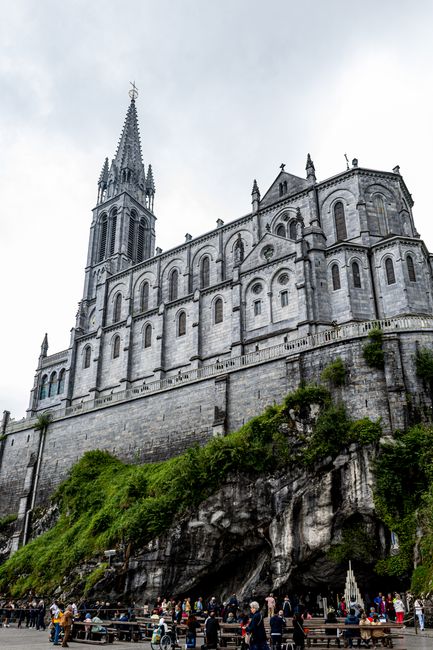
Lourdes is a small town at the foot of the Pyrenees in south-west France, and one of the largest pilgrimage sites in the world. Since a young local girl, Bernadette Soubirous, reported 18 apparitions of the Virgin Mary in a grotto by the river in 1858, millions of pilgrims have come every year to pray at the Grotto of Massabielle, drink the spring water and walk in the evening torchlight procession. Believers and curious travellers alike are welcome, and entry to the Sanctuary is free. Beyond it, a medieval castle, a funicular to a mountain viewpoint and some of the finest scenery in the Pyrenees, from the Cirque de Gavarnie to the Pic du Midi, are within an hour. Give it one full day for the Sanctuary, two or three with the mountains.
Right now in Lourdes
- Wed 14–18°C 57–65°F 21 mm Heavy rain
- Thu 11–14°C 52–58°F 20 mm Showers
- Fri 6–14°C 42–58°F Clear
Weather: MET Norway (CC BY 4.0) · Rates: ECB
Top tours in Lourdes
See all tours for Lourdes →
From local operators, with prices and reviews; you check availability and book on Viator, our partner. We may earn a commission at no extra cost to you. How we earn money
Lourdes at a glance
- Best for: pilgrimage and prayer, religious history, the torchlight procession, and day trips into the high Pyrenees.
- How long: 1 day for the Sanctuary and town; 2–3 days with the Pic du Jer, Gavarnie, Pont d’Espagne or the Pic du Midi.
- Best time: April to October, the pilgrimage season, when the torchlight procession takes place every evening; May, June and September are calmer than July and August.
- Getting in: direct trains from Paris and regional trains from Toulouse, Pau and Bordeaux; Tarbes-Lourdes-Pyrénées airport is about 10 km away, with a €3 shuttle.
- Getting around: on foot in town; a car or bus for the mountains.
- Before you go: entry rules, money and general safety are in our France travel guide; for the nearest big city, see Toulouse.
Lourdes’ areas and who each one suits
Lourdes lies in the valley of the Gave de Pau, where the river leaves the mountains. The town has two quite different halves: the Sanctuary and the streets of hotels and shops leading to it, and the older town centre above, around the castle and the market.
Around the Sanctuary
The streets leading down to the Sanctuary’s gates, such as the Boulevard de la Grotte and the Rue de la Grotte, are lined with hotels, cafés and shops selling candles, rosaries and souvenirs. Best for: pilgrims who want to walk to the evening procession and early Masses; book early for summer and the big feast days.
The old town
Up the hill, around the Château fort, the covered market and the parish church, is an ordinary Pyrenean town with places linked to Bernadette’s life, such as the Moulin de Boly where she was born and the “Cachot”, the former prison where her poor family lived at the time of the apparitions. Best for: travellers who want local life and restaurants, and easy access to the station.
Top things to see in Lourdes
Prices and hours below were checked on official websites in October 2026. They change with the seasons, so check before you go.
The Sanctuary of Our Lady of Lourdes
The Sanctuary covers 53 hectares on both banks of the river, with 22 places of worship, and is open to everyone, of any faith or none, without charge. As of October 2026 it is open daily from 6:00 to 1:00. Dress modestly, keep your voice down near the Grotto and follow the volunteers’ directions, especially around sick and disabled pilgrims, who have priority everywhere. The Sanctuary’s information centre organises free guided walks “In the footsteps of Bernadette” and shows a film about Lourdes most afternoons.
The Grotto of Massabielle. The heart of Lourdes is a modest limestone cave in a 27-metre rock face, about 3.8 m high and 9.5 m deep, with the marble statue of the Virgin in a niche above. Visitors file through silently, touching the rock. Since the ninth apparition in 1858 a spring has flowed here; you can drink the water from taps nearby and fill bottles to take home, free of charge. Thousands of candles burn day and night beside it.
The basilicas. Above the Grotto stands the neo-Gothic Basilica of the Immaculate Conception (1871), with stained glass telling the story of the apparitions, and below it the Romano-Byzantine Basilica of Our Lady of the Rosary (1889), with 2,000 m² of mosaics. Underground, the vast concrete Basilica of St Pius X, consecrated in 1958 and 201 m long, can hold about 20,000 people and is used for international Masses.
Water, baths and the “water gesture”. Next to the spring, pilgrims can wash their face, hands and forearms in the pool area, a simple rite called the water gesture. The traditional baths (piscines), where pilgrims are immersed with the help of volunteers, are open at set times; in the October 2026 schedule, the water gesture at the sacristy of the Grotto ran from 9:00 to 11:00 and 14:00 to 16:30, and immersions in the baths were offered on most days in the morning (and some afternoons). Times change with the season; check the Sanctuary’s daily schedule.
The torchlight Marian procession
Lourdes’ most famous ceremony, held since 1863: every evening at 21:00 between Easter and the end of October, thousands of pilgrims walk the esplanade with candles, praying the rosary and singing the Lourdes Ave Maria in many languages. It lasts about 1 to 1½ hours, takes place whatever the weather and starts near the Rosary Basilica. The Sanctuary holds about 200 processions a year from April to October, plus winter processions for the feasts of 8 December and 11 February. Candles with paper wind shields are sold on site. A Eucharistic procession, ending with the blessing of the sick in the St Pius X basilica, takes place at 17:00 in season.
Château fort and Musée pyrénéen
The fortress on its rock above the town has been a count’s residence, a military stronghold and a royal prison, and since 1921 it has housed the Musée pyrénéen, a rich collection on Pyrenean life, traditions and the history of mountaineering in the range. The ramparts give the best view over the town, the Sanctuary and the mountains, and the botanical garden has models of traditional valley houses. Allow 1–3 hours.
How to visit: as of October 2026, a self-guided visit costs from €8 for an adult and a guided visit from €9, with family tickets from €18; book online or at the entrance at 25 Rue du Fort. In early October 2026 it was open Tuesday to Sunday from 9:30 to 12:00 and 14:00 to 16:30, closed on Mondays; hours are longer in summer, so check before you go.
Pic du Jer funicular
A historic funicular climbs from the southern edge of town to the summit of the Pic du Jer, at nearly 1,000 m, in a few minutes. From the top, a short walk leads to viewpoints over Lourdes, the plain of Tarbes and the high peaks; there are also caves and walking trails. How to visit: in 2026 the funicular runs daily until 1 November, from 9:30 to 18:00 in the autumn, and as of October 2026 a return ticket costs €14.50 for adults and €11 for children (6–17), students and disabled visitors; a family ticket is €35. It reopens in spring; check the dates with the tourist office.
Lac de Lourdes
About 3 km north-west of the centre, this glacial lake is ringed by woods and a footpath, with a golf course and picnic spots nearby. It is a peaceful place for a walk or a run away from the crowds, and especially pretty in the autumn colours.
Pilgrimages, feast days and the season
Lourdes lives by the rhythm of the pilgrimage season, from Easter to the end of October, when organised pilgrimages arrive from all over the world, often with sick and disabled pilgrims cared for by volunteers. The busiest days are around 15 August (the Assumption) and the big diocesan and international pilgrimages in spring and summer. In winter the town is very quiet and many hotels close, but the Grotto and basilicas stay open, and the feast of Our Lady of Lourdes on 11 February, the anniversary of the first apparition, draws crowds even in the cold. Individual visitors do not need to join a group; groups and those wishing to bring sick pilgrims organise their stay through the Sanctuary’s pilgrimage service.
- Daily Masses: in the October 2026 schedule, Mass at 9:30 in the Basilica of the Immaculate Conception, an international Mass in the Basilica of St Pius X on Sundays and Wednesdays, and an evening Mass in the Adoration Chapel at 18:00.
- Rosary at the Grotto: every afternoon at 15:00, broadcast live online.
- Confession: in the reconciliation chapel, mornings and afternoons, in several languages.
Day trips from Lourdes into the Pyrenees
Cirque de Gavarnie
About an hour’s drive south, past Luz-Saint-Sauveur, Gavarnie is a natural amphitheatre of cliffs nearly 1,500 m high, part of the Pyrénées–Mont Perdu UNESCO World Heritage site and the Pyrenees National Park. From the village, a broad path leads in about 1½ hours each way to the foot of the Grande Cascade, one of the highest waterfalls in Europe. Go early in summer to avoid the crowds, and bring layers: it is much cooler than in Lourdes. See our hiking guide.
Pont d’Espagne and Cauterets
Above the spa town of Cauterets, about 40 minutes from Lourdes, the Pont d’Espagne at 1,500 m is a site of waterfalls, pine forest and bridges at the gateway to the Pyrenees National Park. The site itself is free all year, with paid parking; in 2026 its gondola and chairlift towards the Lac de Gaube, below the Vignemale, ran daily from 14 May to 27 September, from 9:00 to 17:00. Shuttles link the site with Cauterets bus station, and a forest path, the Chemin des Cascades, climbs from just above Cauterets in about 1½ hours.
Pic du Midi de Bigorre
A cable car from La Mongie, about an hour and a quarter by road from Lourdes, rises to the observatory at 2,877 m, with a panorama along the whole chain, a planetarium, an exhibition and a glass-floored “pontoon in the sky”. How to visit: as of October 2026, dated tickets bought in advance start at €34 and the flexible “Liberty Pass” at €54; a combined Pic du Midi and Pont d’Espagne ticket starts at €54. The summer season runs until 1 November 2026; the site closes in November for maintenance and reopens for winter from 5 December 2026 to 11 April 2027, with departures from 9:30 to 16:00 and a break from 12:30 to 14:00. Opening depends on the weather each day, so check the website’s banner before driving up.
Toulouse, Biarritz and Carcassonne
Lourdes combines well with a wider trip through the south-west: Toulouse is about 2 hours by train, the Atlantic surf town of Biarritz about 2 hours by road, and medieval Carcassonne about 3 hours.
Nearby destinations
- Biarritz130 km
- Toulouse133 km
- Andorra la Vella144 km
- San Sebastián159 km
- Zaragoza175 km
- Carcassonne195 km
- Bordeaux199 km
- Arcachon Bay199 km
Getting there and getting around
By train
Lourdes station is on the line between Toulouse, Tarbes, Pau and Bayonne, about 15 minutes’ walk from the Sanctuary. Direct TGV INOUI trains from Paris-Montparnasse take about 5 hours via Bordeaux; regional TER trains run from Toulouse in about 2 hours and from Pau in about 30 minutes. Night trains (Intercités de nuit) from Paris have served Lourdes in the past, but check SNCF Connect for the current timetable before planning on one. Large pilgrimage trains also run in season from many French and European cities.
By air
Tarbes-Lourdes-Pyrénées airport, about 10 km north of town, has flights to and from Paris-Orly with Volotea and seasonal Ryanair and other routes to European cities. A dedicated shuttle runs between the airport and Lourdes (Avenue du Paradis) all year, timed to the regular Ryanair and Volotea flights, for €3 a trip as of October 2026. The TL bus line also links Tarbes station, the airport and Lourdes station about every hour from Monday to Saturday (not on Sundays and public holidays). Pau and Toulouse airports are alternatives.
Driving and getting around
Lourdes is about 20 km from the A64 motorway between Toulouse and Bayonne. The town is compact and best explored on foot; car parks fill up near the Sanctuary on big pilgrimage days. For Gavarnie, Cauterets and the Pic du Midi a car is the easiest option; regional buses run up the valleys towards Argelès-Gazost, Cauterets and Luz-Saint-Sauveur, with fewer services out of season; check the Occitanie region’s liO network for timetables. Mountain roads can be snowy in winter, and the Col du Tourmalet road above La Mongie is closed in winter.
When to go and how long to stay
Lourdes has a mild, damp climate under the influence of the Atlantic and the mountains: green and rainy in spring, warm in summer with thunderstorms, and often sunny in autumn. The table uses Météo-France’s 1991–2020 normals for the Tarbes-Lourdes-Pyrénées airport station, about 10 km north of town at 360 m; Lourdes is similar, and the mountains above are much colder.
| Season | Average high / low | Rainy days per month | What it’s like | Good for |
|---|---|---|---|---|
| Winter (Dec–Feb) | 10–12 °C / 1–2 °C | 10–11 | Cool, damp, occasional frost; town very quiet | 11 February feast, quiet visits, skiing nearby |
| Spring (Mar–May) | 15–20 °C / 4–10 °C | 10–13 | Changeable and green; the wettest season | Pilgrimages from Easter, waterfalls in full flow |
| Summer (Jun–Aug) | 23–26 °C / 13–15 °C | 8–10 | Warm, sometimes hot, with afternoon storms | Processions, mountain trips, Gavarnie |
| Autumn (Sep–Nov) | 23 °C falling to 14 °C / 12 °C falling to 4 °C | 9–11 | Often sunny in September and October, wet in November | Calmer pilgrimages, hiking, Pic du Midi |
The station records about 1,080 mm of rain a year and nearly 2,000 hours of sunshine. August is the warmest month, with an average high of about 26 °C; April, May and November are the wettest. Pack an umbrella for the evening procession in any season.
How long to stay: 1-, 2- and 3-day plans
1 day: morning at the Grotto and the basilicas, a free guided walk in Bernadette’s footsteps, the Château fort in the afternoon and the torchlight procession at 21:00. 2 days: add Mass or the rosary at the Grotto, the Pic du Jer funicular and a walk around the Lac de Lourdes. 3 days: add a mountain day: Gavarnie in summer, Pont d’Espagne from mid-May to September, or the Pic du Midi on a clear day.
Where to stay in Lourdes
- Near the Sanctuary: dozens of hotels within a few minutes’ walk of the Grotto, many with full board for pilgrims.
- Old town and station: quieter, convenient for trains and local restaurants.
- Sanctuary accommodation: the Accueil Notre-Dame welcomes sick and disabled pilgrims, usually as part of an organised pilgrimage.
- Argelès-Gazost, Luz or Cauterets: for a mountain base with day trips back to Lourdes.
Lourdes is said to have more hotel rooms than any French city except Paris, so outside the peak pilgrimage dates finding a room is easy; many hotels close from November to March. The Commune of Lourdes adds a nightly tourist tax (taxe de séjour) per adult; under-18s are exempt. In its latest published rates, which include the department’s and the region’s surcharges, the tax is €1.44 per adult per night in a 2-star hotel, €2.30 in a 3-star, €3.60 in a 4-star and €4.75 in a 5-star; unclassified rentals pay 7.2% of the nightly price per person, up to a cap.
Practical tips for Lourdes
- Respect the place: keep silence at the Grotto, dress modestly in the basilicas and give way to wheelchairs and stretchers.
- Take water home: bring an empty bottle to fill at the taps; it is free, and souvenir bottles are sold in town.
- Check the daily schedule: Mass, procession and bath times change with the season and on feast days; the Sanctuary’s website and app have the day’s programme.
- Mountain weather: the Pic du Midi, Pont d’Espagne and Gavarnie can be cloudy or snowy when Lourdes is sunny; check webcams before you go.
- Beware of scams: the Sanctuary warns about fake websites and messages asking for donations or selling Mass offerings; use only its official site.
What to pack for Lourdes
Comfortable walking shoes, modest clothes for the basilicas, an umbrella or light rain jacket, and a warm layer for the evening procession, which can be chilly even in summer. Bring an empty bottle for the spring water and a small torch or phone light for walking back after dark. For mountain day trips, add walking shoes with grip, a fleece, sunscreen, a hat and water; at the Pic du Midi it can be below freezing even in summer.
Lourdes travel FAQ
Is it free to visit the Sanctuary of Lourdes?
Yes. The Sanctuary, the Grotto, the basilicas, the processions and the spring water are free for everyone. As of October 2026 the Sanctuary is open daily from 6:00 to 1:00.
What time is the torchlight procession in Lourdes?
Every evening at 21:00 from Easter to the end of October, starting near the Rosary Basilica. It lasts about 1 to 1½ hours and goes ahead in any weather. In winter there are processions only on the feasts of 8 December and 11 February.
Can you still bathe in the Lourdes baths?
Yes, at set times shown in the Sanctuary’s daily schedule, mostly in the mornings. There is also the simpler water gesture, washing your face and hands at the pools beside the spring, available morning and afternoon.
Do I need to come with a pilgrimage group?
No. Individual visitors can attend every Mass, procession and the Grotto freely. Groups, and anyone wishing to bring sick or disabled pilgrims, organise their stay through the Sanctuary’s pilgrimage service.
How much is the Château fort of Lourdes?
As of October 2026, a self-guided visit of the castle and the Musée pyrénéen costs from €8 for an adult and a guided visit from €9. In early October it was open Tuesday to Sunday, 9:30–12:00 and 14:00–16:30.
How much is the Pic du Jer funicular?
As of October 2026, a return ticket costs €14.50 for adults and €11 for children aged 6–17, and a family ticket €35. The funicular runs until 1 November 2026 and reopens in spring.
Is the Pic du Midi open in winter?
Yes, from 5 December 2026 to 11 April 2027, after a maintenance closure in November. The 2026 summer season ends on 1 November. Dated tickets start at €34 as of October 2026, and opening depends on the weather each day.
How do I get from Tarbes-Lourdes airport to Lourdes?
Take the airport shuttle to the centre of Lourdes for €3 a trip (as of October 2026), timed to the regular flights, or the TL bus via Tarbes station from Monday to Saturday. A taxi takes about 15 minutes.
How long is the train from Paris to Lourdes?
About 5 hours by direct TGV INOUI from Paris-Montparnasse via Bordeaux. From Toulouse, regional trains take about 2 hours. Check times on SNCF Connect.
How much is the tourist tax in Lourdes?
In the commune’s latest published rates, €2.30 per adult per night in a 3-star hotel, €3.60 in a 4-star and €4.75 in a 5-star, including the department’s and region’s surcharges; unclassified rentals pay 7.2% of the price per person. Under-18s are exempt.
Can I visit Gavarnie from Lourdes without a car?
It is possible but slow: regional buses run up the valley towards Luz-Saint-Sauveur, with connections to Gavarnie mostly in summer. Many visitors join a day tour or hire a car for the hour’s drive.
Sources and last review
Researched and last reviewed on 4 October 2026. Sanctuary hours, the Grotto, basilicas, baths, the water gesture and the torchlight procession: the Sanctuary of Our Lady of Lourdes; Château fort prices and hours: the Château fort and Musée pyrénéen; Pic du Jer: the Lourdes tourist office; Pic du Midi and Pont d’Espagne: their operator N’PY and the Pic du Midi’s official site; airport shuttles: Tarbes-Lourdes-Pyrénées airport; tourist tax: the French tax authority’s open data; climate: Météo-France normals for Tarbes-Lourdes-Pyrénées. Train times are approximate. Prices, schedules and opening dates change, so check the official sites before you go. For entry rules, money and general safety, see our France travel guide.
Plan your trip
Partner links: TravelerCenter may earn a commission if you book, at no extra cost to you.
🇫🇷 Useful French phrases for Lourdes
All 38 French phrases: restaurant, hotel, emergencies, romance (printable) →