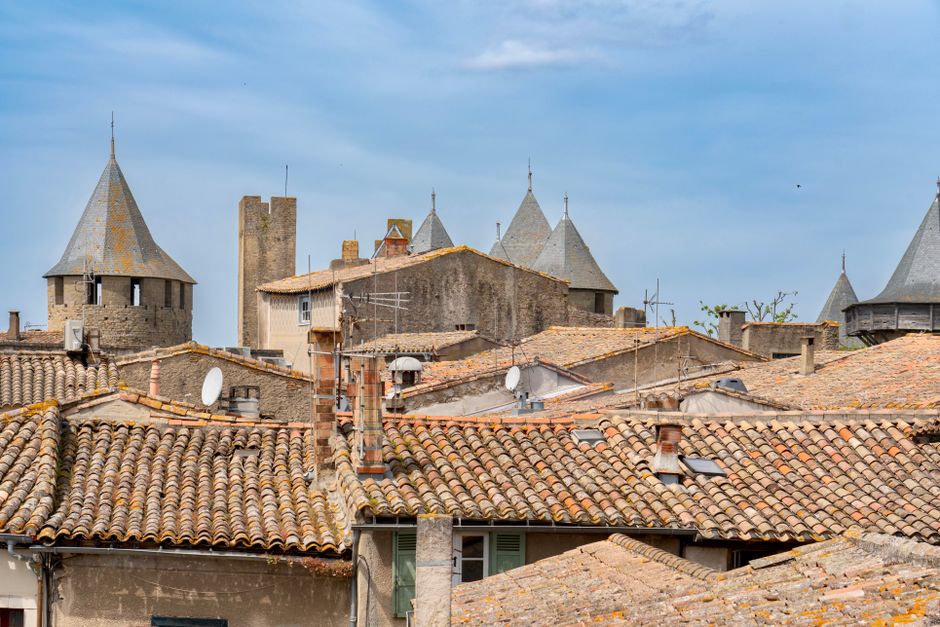
Carcassonne is two towns in one. On the hill stands La Cité, a walled medieval city with 52 towers, two rings of ramparts and a castle, the kind of place children draw when they draw a castle. Across the River Aude lies the Bastide Saint-Louis, the lower town, with arcaded squares, markets, cafés and the Canal du Midi. You can walk into the Cité for free at any hour; the castle and the walk along the ramparts need a ticket. One full day covers the highlights. Stay two or three days to add the Cathar castles in the hills, a boat on the canal and a glass of sparkling wine in Limoux.
Right now in Carcassonne
- Wed 16–23°C 61–73°F 13 mm Heavy showers
- Thu 14–17°C 58–63°F 4 mm Light showers
- Fri 9–16°C 48–62°F Partly cloudy
Weather: MET Norway (CC BY 4.0) · Rates: ECB
Top tours in Carcassonne
See all tours for Carcassonne →
From local operators, with prices and reviews; you check availability and book on Viator, our partner. We may earn a commission at no extra cost to you. How we earn money
Carcassonne at a glance
- Best for: medieval history, castles, cassoulet and wine, easy cycling along the Canal du Midi and day trips into Cathar country.
- How long: 1 day for the Cité and the lower town, 2–3 days with the Cathar castles or the canal.
- Best time: May, June, September and October; 14 July for the famous fireworks over the walls.
- Getting in: 40 minutes to 1 hour 10 minutes by train from Toulouse; Carcassonne’s small airport is 4 km from the centre, with a €6 shuttle bus.
- Getting around: on foot, plus city buses (€1.20 a ticket, as of October 2026) up to the Cité.
- Before you go: entry rules, money, trains and general safety are on our France travel guide.
Carcassonne’s two towns and who each one suits
The Cité sits on a low hill on the east bank of the Aude; the lower town spreads out on the west bank, between the river and the railway station. The two are about 20–30 minutes apart on foot, across the old bridge (Pont Vieux), which has fine views of the walls. The Cité has been on UNESCO’s World Heritage List since 1997, and the Canal du Midi since 1996.
La Cité
The medieval city is a real neighbourhood, with a few hundred residents, cobbled lanes, small squares, hotels, restaurants and many souvenir shops. Between the inner and outer walls runs a grassy gap called the lices, the best place for a quiet walk. By day the main streets are very busy; early in the morning and after dark, when the walls are lit, the Cité is magical. Staying inside suits a romantic short break, but bring light luggage, as cars are restricted.
The Bastide Saint-Louis (lower town)
Founded in the 13th century on a grid plan, the Bastide is where Carcassonne lives: Place Carnot with its fountain and market stalls, shopping streets, the cathedral of Saint-Michel, covered market halls and the gardens along the old boulevards. It is cheaper and more practical than the Cité, close to the station, and a good base if you plan day trips by train or bus.
The Canal du Midi and the riverside
The canal’s port sits right in front of the railway station, with boats, plane trees and towpaths. The banks of the Aude below the Cité are green and open, and in summer they fill with picnics on the evening of 14 July.
Top things to see in Carcassonne
Walking the lanes and the lices of the Cité is free. The castle and ramparts are run by the Centre des monuments nationaux, the French state’s monuments body, and need a ticket.
The walls and the Porte Narbonnaise
Most visitors enter through the Porte Narbonnaise, the main gate on the east side, with its drawbridge and twin towers. The Cité has roots going back to Roman times; the double walls you see were built and strengthened in the 13th century, when the French crown took the city during the crusade against the Cathars. By the 1800s the walls were crumbling, and the architect Eugène Viollet-le-Duc led a long restoration. His pointed slate roofs are still debated, but they gave Carcassonne its fairy-tale skyline. Walk the full loop of the lices between the walls for the best views, and leave by the Porte d’Aude on the west side for the path down to the old bridge.
Château comtal and the ramparts
The counts’ castle is a fortress inside the fortress, with its own moat and towers. The ticket covers the castle rooms, a small museum of stone carvings and a long walk along a section of the ramparts; allow about two hours. As of October 2026, a ticket costs €19 from 1 April to 30 September and €13 from 1 October to 31 March. Under-18s go free, as do 18–25-year-olds who are EU nationals or long-term residents of France. Opening hours are 10:00–18:30 from April to September (last entry 17:45) and 9:30–17:00 from October to March (last entry 16:15); it closes on 1 January, 1 May and 25 December. Entry is free on the first Sunday of the month from January to March and during the European Heritage Days in September. Places are limited, so booking online is strongly advised in summer. If you arrive by TGV INOUI or Intercités train, show your ticket (less than five days old) for a lower price. Audioguides cost €5, and suitcases are not allowed inside.
In July 2026, UNESCO inscribed the “Royal Fortresses of Languedoc” on the World Heritage List: eight castles, including Carcassonne’s castle and ramparts and the mountain castles of Lastours, Peyrepertuse, Quéribus, Aguilar, Puilaurens, Termes and Montségur, which guarded the old frontier with Aragon.
Basilica of Saint-Nazaire
The “jewel of the Cité” mixes a sturdy Romanesque nave with a soaring Gothic choir, lit by some of the finest stained glass in southern France. Entry is free, and Mass is held on Sundays at 11:00. Next to it, the open-air Théâtre Jean-Deschamps, with about 3,000 seats, hosts the big concerts of the summer festival.
The Bastide, the cathedral and the old bridge
In the lower town, start at Place Carnot, where market stalls set up on several mornings a week. Walk to the Gothic cathedral of Saint-Michel, the remains of the bastions and the Portail des Jacobins gate, then down to the Pont Vieux, a 14th-century stone bridge over the Aude with the classic view of the Cité. It is a pleasant, free half-day.
The Canal du Midi
Pierre-Paul Riquet’s canal, finished in 1681, links the Garonne at Toulouse with the Mediterranean, and in 2026 it celebrates 30 years as a World Heritage Site. From the port opposite the station, boat trips of an hour or two run in the warmer months, and you can hire a bike or an electric boat for the day. The towpath is flat and shady, and the regional liO train-and-bike offer lets you ride one way along the canal and come back by train.
Eating in Carcassonne: cassoulet and Languedoc wine
The local dish is cassoulet, a slow-baked casserole of white beans with duck confit, Toulouse sausage and pork, served bubbling in an earthenware pot. Many restaurants in the Cité cater for passing crowds; the lower town and the streets just outside the walls often give better value. Also try croustade pastry, local goat’s cheese and olives from the Lucques variety. The wines around the city come from the Cabardès, Malepère, Minervois and Corbières areas, and Limoux makes some of France’s oldest sparkling wine, Blanquette de Limoux. The Bastide’s covered market and the stalls on Place Carnot are the places for picnic food; check market days with the tourist office.
Other things to do
- Cycle the canal: cycling the towpath east to Trèbes or west towards Bram is easy and mostly shaded.
- Ride the little trains: the white “petit train” links the lower town and the Cité with commentary (€7 return, as of October 2026); a separate red train circles the ramparts.
- Swim at the Lac de la Cavayère: a lake with beaches a few kilometres east, reached by city bus line 2, with extra buses in summer.
- Taste wine: cellar doors in the Cabardès and Minervois hills are a short drive away; see our wine tasting guide.
Events: Bastille Day fireworks, the summer festival and Christmas
The Embrasement de la Cité takes place every year on 14 July at 22:30. For 30 minutes, fireworks burst above the 600 metres of walls facing the lower town; at one point the lights go out and red smoke makes the whole Cité look as if it is on fire. The tourist office says more than 500,000 people come to watch. It is free and best seen from the banks of the Aude or the Bastide; arrive in the afternoon, bring water and a blanket, and expect road closures and full trains afterwards. Many nearby villages hold their own fireworks on 13 July instead.
- Summer: the Festival de Carcassonne brings concerts, theatre and dance to the Théâtre Jean-Deschamps and other stages; 2027 dates and line-up are announced on the festival’s official site.
- 16–18 October 2026: “Grands Vins en Grand Carcassonne”, three days of wine experiences in the surrounding vineyards.
- December to early January: the “Magie de Noël”, with a Christmas market and ice rink on Place Carnot, a big wheel and lights in the lower town; the market and rink close on 25 December and 1 January.
- 5–6 December 2026: the medieval Saint-Nicolas weekend in the lices, ending with a torchlit procession from the Porte Narbonnaise down to the Bastide.
Day trips from Carcassonne: Cathar castles, Limoux and the canal
The hills south and north of Carcassonne are scattered with ruined castles linked to the Cathars, a Christian movement crushed by a crusade in the 13th century. Most need a car; times are approximate. Paths are steep and exposed, so wear proper shoes, carry water and avoid the hottest hours in summer; some sites close during heatwaves or high winds.
Lastours
The closest, about half an hour north in the Montagne Noire: four castles strung along a rocky ridge above a river gorge. A 4 km trail of about 2½ hours visits all four and the remains of the medieval village. As of October 2026, entry costs €9 for adults, €6 for 16–25-year-olds and €4.50 for children aged 6–15. From October to December the site opens 9:30–16:30; it closes on 25 December and in January outside school holidays. A separate viewpoint across the valley (the Belvédère, €3) gives the classic photo.
Peyrepertuse and Quéribus
About 1½ hours south-east in the Corbières hills, these two are the most dramatic. Peyrepertuse stretches along a knife-edge ridge; Quéribus is a single tower on a pinnacle with views to the Mediterranean and the Pyrenees. As of October 2026, both charge €9 for adults. Peyrepertuse opens every day of the year except 24, 25 and 31 December and 1 January, with hours of 10:00–18:00 in October and 10:00–17:00 in November. Quéribus charges €5.50 for children aged 6–12, and its ticket also covers a small theatre in the village of Cucugnan below. Combine both in one long day.
Limoux and the upper Aude valley
Limoux, about 30 minutes south by car or regional bus, is the home of Blanquette and Crémant de Limoux; visit a cellar for a tasting. The town is known for its long-running carnival, held on winter and early-spring weekends.
Toulouse, Narbonne and the coast
Toulouse, the “pink city”, is under an hour away by fast train. Narbonne, with its Roman road and cathedral, is about 30 minutes east by Intercités train, and the Mediterranean beaches beyond it make an easy summer outing.
Nearby destinations
- Toulouse85 km
- Andorra la Vella104 km
- Montpellier131 km
- Girona142 km
- Costa Brava151 km
- Lourdes195 km
- Barcelona204 km
- Avignon214 km
Getting there and getting around
By train
Carcassonne station sits in the lower town, opposite the Canal du Midi port, about 30 minutes’ walk from the Cité. Trains from Toulouse take between 40 minutes and 1 hour 10 minutes; Narbonne is about 30 minutes, and Perpignan and Montpellier 1½–2 hours. From Paris, the journey takes around 5½–6 hours with a change in Toulouse or Narbonne. Check times on the SNCF Connect app.
By air
Carcassonne airport, 4 km from the centre, has mainly Ryanair flights to the UK, Ireland, Belgium, Portugal, Italy and Morocco. A shuttle bus meets each arriving flight and runs to the station, the lower town and the Cité; as of October 2026 it costs €6, paid on board by card, and under-5s ride free. Toulouse-Blagnac airport is about 1½ hours away by road.
Buses, little trains and walking
The city’s RTCA buses link the station and the lower town with the Cité. As of October 2026, a ticket costs €1.20 from the driver (€1 in the RTCA app) and is valid for one hour with changes; a 10-trip ticket costs €10. Line 3 stops about 150 metres from the Porte Narbonnaise, line 2 about 500 metres away, and line 4 at the Porte d’Aude, at the bottom of a steep cobbled slope. From June to September a free electric shuttle, the Touc, loops around the centre from Tuesday to Saturday. Regional liO buses run to Limoux, Narbonne and other towns for €1–2 a trip.
Driving and parking
Carcassonne is on the A61 motorway, about an hour from Toulouse and Perpignan and two hours from Montpellier. Cars are not allowed to drive freely inside the Cité; use the paid car parks just outside the walls, which can be booked in advance on the city’s website, or the underground car parks in the lower town. Carcassonne has no low-emission zone (ZFE), so no Crit’Air sticker is needed. A car is the easiest way to reach the Cathar castles.
When to go and how long to stay
Carcassonne has a sunny climate between the Atlantic and the Mediterranean, with hot, dry summers, mild winters and a strong wind, the cers, blowing from the west. The table uses Météo-France’s official 1991–2020 normals for the Carcassonne station: average daily highs and lows, and days with at least 1 mm of rain.
| Season | Average high / low | Rainy days per month | What it’s like | Good for |
|---|---|---|---|---|
| Winter (Dec–Feb) | 10–11 °C / 3–4 °C | 8–10 | Cool, often windy, some frosty nights | Quiet Cité, Christmas market, cassoulet |
| Spring (Mar–May) | 15–21 °C / 6–12 °C | 8–9 | Mild, green, changeable | Castles, cycling, Limoux carnival |
| Summer (Jun–Aug) | 26–29 °C / 15–17 °C | 5–6 | Hot and dry; heatwaves can pass 40 °C | Festival, 14 July fireworks, the lake |
| Autumn (Sep–Nov) | 25 °C falling to 14 °C / 14 °C falling to 7 °C | 6 in September, 7–9 in October–November | Warm September, wetter November | Grape harvest, wine, walking |
Carcassonne gets about 665 mm of rain a year, spread over 88 days. July and August are the warmest months, with average highs of about 29 °C, and the Cité is busiest then. In summer, visit the castle at opening time and spend the afternoon by the canal or the lake.
How long to stay: 1-, 2- and 3-day plans
1 day: the castle and ramparts at opening time, the Basilica of Saint-Nazaire and a walk round the lices; down to the Pont Vieux for lunch in the Bastide, then Place Carnot, the canal port and back up to the Cité to see the walls lit at night.
2 days: add Lastours in the morning and a bike ride or boat trip on the Canal du Midi in the afternoon. 3 days: add a long day to Peyrepertuse and Quéribus, or Limoux and its sparkling wine.
Where to stay in Carcassonne
- Inside the Cité: unforgettable evenings and mornings inside the walls; pricier, with limited car access and luggage carried over cobbles.
- Just below the Cité (Trivalle, Barbacane): guesthouses and small hotels with views of the walls and easier parking.
- The Bastide Saint-Louis: best value and everyday life, with restaurants and markets; 20–30 minutes’ walk to the Cité.
- Near the station and canal: practical for trains, cycling and early departures.
- Countryside: wine estates and gîtes in the Cabardès or Minervois if you have a car.
The town of Carcassonne charges a tourist tax (taxe de séjour) per adult per night; under-18s are exempt. As of October 2026, the 2026 rates, including the 10% Aude department surcharge and the 34% surcharge that funds the new Montpellier–Perpignan rail line, are €1.15 in a 1-star hotel, chambre d’hôtes or hostel, €1.44 in a 2-star, €2.45 in a 3-star, €3.08 in a 4-star, €3.73 in a 5-star and €4.81 in a palace. Unclassified rentals pay 5% of the nightly price per person, capped, plus the surcharges. Rooms sell out and prices jump around 14 July and during the summer festival.
Practical tips for Carcassonne
- Book the castle: in summer, buy a timed ticket online and go at opening time.
- Visit the Cité twice: once early in the morning and once after dark, when day-trippers have gone.
- Keep your train ticket: a recent TGV INOUI or Intercités ticket gives a lower castle price.
- Check the wind and heat: the hilltop castles can close in heatwaves or storms, so check their websites on the day.
- Leave the big bags: suitcases are not allowed in the castle, and the Cité’s cobbles are hard on wheels.
What to pack for Carcassonne
Bring comfortable shoes with good grip for cobbles, rampart stairs and the rocky paths to the Cathar castles. In summer, pack a sun hat, sunscreen and a refillable bottle; there is little shade on the walls or at Peyrepertuse. A windproof layer helps all year, as the wind can be strong on the hilltops, and in winter you will want a warm coat. For 14 July, a light blanket and a small torch make the evening by the river easier.
Carcassonne travel FAQ
Is it free to enter the Cité of Carcassonne?
Yes. You can walk through the gates, streets and lices of the medieval Cité and visit the Basilica of Saint-Nazaire for free, at any time. Only the Château comtal and the rampart walk need a ticket.
How much is the ticket for the castle and ramparts?
As of October 2026, €19 from 1 April to 30 September and €13 from 1 October to 31 March. Under-18s and EU nationals or residents aged 18–25 go free. Booking online is strongly advised in summer.
What are the castle’s opening hours?
As of October 2026, 10:00–18:30 from April to September and 9:30–17:00 from October to March, with last entry 45 minutes before closing. It closes on 1 January, 1 May and 25 December. Allow about two hours.
How many days do you need in Carcassonne?
One full day covers the Cité, the castle and the lower town. Two or three days let you add the Cathar castles of Lastours, Peyrepertuse and Quéribus, the Canal du Midi and Limoux.
When are the Carcassonne fireworks?
Every year on 14 July, Bastille Day, at 22:30. The “Embrasement de la Cité” lasts about 30 minutes and is free; watch from the banks of the Aude or the lower town and arrive early.
How do I get from Toulouse to Carcassonne?
By train in 40 minutes to 1 hour 10 minutes, depending on the service, or about an hour by car on the A61. The station is in the lower town, about 30 minutes’ walk or a short bus ride from the Cité.
How do I get from Carcassonne airport to the Cité?
Take the shuttle bus that meets every flight; as of October 2026 it costs €6, paid on board by card, and stops at the station, the lower town and the Cité. The airport is only 4 km from the centre, so a taxi is also quick.
Where do I park to visit the Cité?
In the paid car parks just outside the walls, which you can book on the city’s website, or in the lower town’s underground car parks and walk or take a bus up. Cars cannot drive freely inside the Cité.
Which Cathar castles can I visit from Carcassonne?
Lastours is about 30 minutes away; Peyrepertuse and Quéribus about 1½ hours. As of October 2026, adult tickets cost €9 at each. All three became part of UNESCO’s “Royal Fortresses of Languedoc” in July 2026.
How much is the tourist tax in Carcassonne?
As of October 2026, from €1.15 per adult per night in a 1-star hotel or B&B to €2.45 in a 3-star and €3.08 in a 4-star, surcharges included. Under-18s don’t pay.
Is Carcassonne worth visiting in winter?
Yes, if you like quiet. Average highs are about 10–11 °C, the castle ticket drops to €13 (as of October 2026), entry is free on the first Sunday from January to March, and December brings the Christmas market.
Sources and last review
Researched and last reviewed on 4 October 2026. Castle prices and hours: the Centre des monuments nationaux (Château et remparts de la cité de Carcassonne); UNESCO listing: the monument and the Château de Termes; buses, airport shuttle, train times, fireworks and Christmas events: the Grand Carcassonne tourist office; tourist tax: the town’s official tax portal; Cathar castles: the official sites of Lastours, Peyrepertuse and Quéribus (Cucugnan); climate: Météo-France 1991–2020 normals for Carcassonne. Paris journey times and market days are general guidance. Prices, hours and timetables change, so check the official links before you go. For entry rules, money and general safety, see our France travel guide.
Plan your trip
Partner links: TravelerCenter may earn a commission if you book, at no extra cost to you.
🇫🇷 Useful French phrases for Carcassonne
All 38 French phrases: restaurant, hotel, emergencies, romance (printable) →