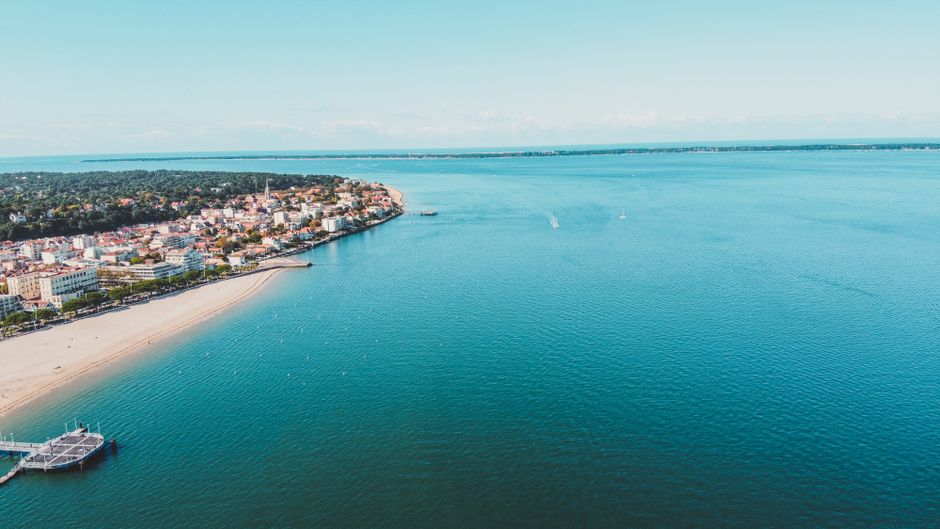
The Arcachon Bay (Bassin d’Arcachon) is a great tidal lagoon on the Atlantic coast west of Bordeaux, ringed by pine forests, oyster ports and seaside towns, with Europe’s highest sand dune standing guard at its mouth. You come to climb the Dune du Pilat at sunset, eat oysters straight from the farmers’ huts, sail round the Île aux Oiseaux and its stilt houses, cycle through the pines and swim in the calm bay or surf the ocean beaches. It is under an hour from Bordeaux by train. Give it two or three days for the highlights, five days to a week for a relaxed beach holiday.
Right now in Arcachon Bay (Arcachon)
- Wed18–20°C64–68°F18 mm rain
- Thu15–18°C58–64°F3 mm rain
- Fri13–18°C55–64°FCloudy
Top tours in Arcachon Bay
See all tours for Arcachon Bay →
From local operators, with prices and reviews; you check availability and book on Viator, our partner. We may earn a commission at no extra cost to you. How we earn money
Arcachon Bay at a glance
- Best for: the Dune du Pilat, oysters, boat trips, family beaches, surfing on the ocean side, cycling and birdwatching.
- How long: a day trip from Bordeaux for Arcachon and the dune; 3 days for the bay; 5–7 days for a beach holiday.
- Best time: June and September for warm water and fewer crowds; July and August for the full beach season; spring and autumn for birds and quiet oyster ports.
- Getting in: regional trains from Bordeaux Saint-Jean to Arcachon in about 50 minutes; Bordeaux-Mérignac airport about 45 minutes by road.
- Getting around: Baïa buses at €1 a trip outside summer, ferries across the bay, cycle paths everywhere; a car helps for Cap Ferret.
- Before you go: entry rules, money, trains and general safety are on our France travel guide; the city and wine country are in our Bordeaux guide.
The bay’s areas and who each one suits
The bay is a near-circle of water about 150 km² at high tide, half of it uncovered at low tide, open to the ocean through a narrow pass between the tip of Cap Ferret and the Dune du Pilat. Ten towns ring its shores, each with its own character.
Arcachon
The main resort, born in the 19th century, has a long sandy seafront with piers, a marina, a casino and the Ville d’Hiver, a hillside of fanciful villas. It has the train station, the most hotels and restaurants, and boats to everywhere. Best for: a first visit and stays without a car.
Pyla, Le Moulleau and La Teste-de-Buch
South-west of Arcachon, Le Moulleau is a village-like seaside quarter with a church on the dune and a pier, and Pyla-sur-Mer has villas in the pines right up to the Dune du Pilat. La Teste-de-Buch, the largest town, has a busy oyster port, a market and the ocean beaches beyond the dune. Best for: families and beach lovers who want the dune nearby.
The Cap Ferret peninsula
Across the water, the long, narrow Cap Ferret peninsula has the bay on one side and wild ocean beaches on the other, with oyster villages such as L’Herbe and Le Canon, holiday homes in the pines and a lighthouse near its tip. Chic and relaxed, it is crowded with traffic in summer. Best for: oysters, cycling, surf beaches and a laid-back stay.
Gujan-Mestras, Le Teich and the inner bay
On the southern and eastern shores, Gujan-Mestras has seven oyster ports lined with wooden huts, Le Teich has its bird reserve on the Leyre delta, and Andernos and Arès have long piers and calm, shallow water. Best for: oyster tastings, nature, quieter and cheaper stays.
Top things to see in the Arcachon Bay
The dune, the beaches and the oyster ports are free. Prices are as of October 2026; check the official sites before you go.
The Dune du Pilat
Europe’s highest sand dune rises between the pine forest and the ocean at the mouth of the bay. The tourism office gives its height as 100 to 115 metres depending on the year, because it moves a few metres inland every year, slowly burying the forest. From Easter to All Saints’ Day a staircase of about 160 steps helps you up the steep forest side; the sea side slopes gently down to the beach. From the top, the view over the bay, the Banc d’Arguin sandbanks, Cap Ferret and the Atlantic is extraordinary at sunset. Close to 2 million people visit each year, and it is a protected Grand Site de France.
How to visit: entry is free; only the car park at the visitor area is paid. As of October 2026, a car pays €7 for up to 4 hours, €9 for 8 hours and €11 for 12 hours in high season, which runs from the first day of the February school holidays to the last day of the All Saints’ holidays, and €1, €2 and €4 the rest of the year; the first 30 minutes are free. The car park is closed to parking from 2:00 to 5:00, and parking on the roadside is banned and fined. Smoking, fires and leisure drones are forbidden on the whole site, and the forest is at high risk of fire, so keep to the rules. Without a car, take Baïa bus line 3 from Arcachon towards Plage de la Salie to the Dune du Pilat stop in about 25 minutes (all year except Sundays and public holidays), or in July and August the 101 Express from Arcachon station. The dune is also on the Vélodyssée cycle route.
Arcachon’s Ville d’Hiver and seafront
In the 1860s the Pereire brothers, who had brought the railway, laid out the Ville d’Hiver (Winter Town) on a pine-covered hill sheltered from the wind, for wealthy visitors and invalids seeking the healthy forest air. Its winding lanes are lined with Swiss chalets, Moorish and Gothic-style villas with carved wooden balconies. Walk up from the seafront, cross the iron footbridge and visit the Parc Mauresque viewpoint; the tourist office runs guided walks. Down below, the Ville d’Été has the beach, the Thiers and Eyrac piers, the promenade and the lively Marché d’Arcachon.
Cap Ferret and its lighthouse
Near the tip of the peninsula, the red-topped Cap Ferret lighthouse, 57 metres tall, has 258 steps to a panorama over the bay, the dune and the ocean. How to visit: as of October 2026 tickets cost €7 for ages 13 and over and €4 for children aged 4–12. In October, November and December it opens Wednesday to Sunday from 14:00 to 17:00, from April to June and in September daily 10:00–12:30 and 14:00–18:30, and in July and August daily 10:00–19:30; last visits 30 minutes before closing. It closes for its annual break from 2 November to 18 December 2026. Nearby, the ocean beach at the Pointe and the bay side at Bélisaire, where the ferry lands, are both a short walk or ride away.
Le Teich ornithological park
In the Leyre delta at the back of the bay, the Réserve ornithologique du Teich has a 6 km trail with hides overlooking lagoons and salt meadows, where you can watch herons, spoonbills, storks and, in autumn and winter, thousands of migrating waders and ducks. How to visit: as of October 2026, tickets cost €9.90 for adults and €7.70 for ages 5–18, free under 5, or €30 for a family of four; holders of a TER train ticket pay the reduced €7.70. Binoculars can be hired at the entrance. Le Teich has a station on the Bordeaux–Arcachon line. The wider bay is protected by the Parc naturel marin du Bassin d’Arcachon, a marine nature park created in 2014.
Boats on the bay: the Île aux Oiseaux and Cap Ferret
Boats are part of daily life here. The Bateliers Arcachonnais (UBA) run year-round ferries between Arcachon’s Thiers pier and Bélisaire on Cap Ferret in about 30 minutes, a much quicker trip than the long drive round the bay; you must choose your outward and return times when you book, dogs pay a €2 supplement, and bikes are allowed if fully unloaded (electric bikes only with a removable battery). Book online and check the fares, which vary by season. In summer, more shuttles link Le Moulleau, the Dune du Pilat beach and the Banc d’Arguin sandbanks with Cap Ferret.
The classic cruise circles the Île aux Oiseaux, the bird island in the middle of the bay, and its two cabanes tchanquées, wooden huts on stilts that seem to float at high tide, the symbol of the bay. As of October 2026, the Bateliers’ 2-hour commented tour starts from €23.40 and a shorter 1-hour trip towards the island from €15.40; longer cruises take in Cap Ferret and the Banc d’Arguin from €29.40. You cannot land on the island, which is protected. See our boat trips guide.
Oysters and the oyster villages
The bay is one of France’s great oyster nurseries: young oysters born here are sent to farms all along the coast. Tasting them is the essential experience. In Gujan-Mestras, the self-styled oyster capital, the seven ports such as Larros and La Hume are lined with farmers’ huts that serve a dozen oysters with bread, butter, lemon and a glass of white Bordeaux, sometimes with little grilled sausages (crépinettes) on the side, as the locals like them; the Maison de l’Huître at Larros explains how they are farmed. On Cap Ferret, the villages of L’Herbe and Le Canon have tasting huts right on the water. Most open from late morning to sunset, daily in summer and on fewer days out of season; oysters are good all year, at their best from September to April.
Beaches, surfing and cycling
Bay beaches and ocean beaches
Inside the bay, beaches like those of Arcachon, Le Moulleau, Pereire and the bay side of Cap Ferret are calm and shallow, ideal for families, though the water retreats a long way at low tide and currents run strongly in the channels near the pass. On the ocean side, the long beaches south of the dune (La Corniche, Petit Nice, La Salie) and on Cap Ferret (the Pointe, Le Truc Vert) have powerful waves and dangerous currents: swim only at lifeguarded beaches, between the flags, in the summer season. The sea reaches about 20–22 °C in August. See our beaches guide.
Surfing
Cap Ferret’s ocean beaches and the beaches south of the dune have consistent Atlantic waves and surf schools from spring to autumn, good for lessons in the gentler summer swell. Experienced surfers come in autumn, when the swells grow. For bigger and more famous breaks further south, see our Biarritz guide and our surfing guide.
Cycling round the bay
A network of flat, car-free cycle paths links most of the bay towns through the pines, and the Vélodyssée coastal route passes along it from Cap Ferret’s shore and on past the dune towards Biscarrosse. Popular rides go from Arcachon to the Dune du Pilat, along Cap Ferret from Lège to the lighthouse, and around the bird reserve at Le Teich. Bike hire shops are everywhere, and you can combine a ferry and a hired bike on Cap Ferret. See our cycling guide.
Day trips from the Arcachon Bay
Bordeaux, with its UNESCO-listed riverside, the Cité du Vin and the vineyards of Saint-Émilion and the Médoc, is about an hour by train. South along the coast, the Landes forest and its lakes lead to the surf towns of Hossegor and, about 2 hours by car, Biarritz and the Basque coast.
Nearby destinations
- Bordeaux48 km
- Biarritz139 km
- Dordogne156 km
- La Rochelle162 km
- San Sebastián167 km
- Île de Ré168 km
- Lourdes199 km
- Bilbao214 km
Getting there and getting around
Arriving
By train: regional TER trains run from Bordeaux Saint-Jean to Arcachon about 25 times a day each way, taking about 50 minutes, with stops including Le Teich and La Teste; high-speed trains link Paris with Bordeaux in a little over two hours. By air: Bordeaux-Mérignac airport is about 45 minutes from the dune by car; without one, take the 30’Direct shuttle (about 30 minutes, €9 online or €10 on board as of October 2026) or tram line F to Saint-Jean, then the train. By car: from Bordeaux, take the A630 ring road and the A660 towards the Bassin d’Arcachon, about an hour outside rush hour.
Baïa buses, boats and the car
The Baïa bus network serves Arcachon, La Teste-de-Buch, Gujan-Mestras and Le Teich, including the Dune du Pilat. As of October 2026, a ticket valid for one hour costs €1, a 1-day visitor pass €2 and a 2-day pass €3.50; summer prices from 29 June to 30 August 2026 were double (€2 a trip, €4 a day). Baïa tickets are also valid on TER trains between Arcachon and Le Teich. The northern shore and Cap Ferret are on other lines, so the ferry is often the best link across. A car is useful for Cap Ferret and the oyster villages, but traffic on the peninsula is very heavy in July and August, and the bay towns have no low-emission zone.
When to go and how long to stay
The bay has a mild, sunny Atlantic climate, warmer in summer than the Breton coast but with more rain in autumn and winter. The table uses Météo-France’s official 1991–2020 normals for the Cazaux station, in La Teste-de-Buch on the south side of the bay, the nearest station with a full sheet: average daily highs and lows, and days with at least 1 mm of rain.
| Season | Average high / low | Rainy days per month | What it’s like | Good for |
|---|---|---|---|---|
| Winter (Dec–Feb) | 11–12 °C / 3–4 °C | 11–13 | Mild days, chilly nights, wet spells | Oysters, quiet walks, birdwatching at Le Teich |
| Spring (Mar–May) | 16–21 °C / 5–11 °C | 9–11 | Fresh and increasingly sunny | Cycling, the dune without crowds, nesting birds |
| Summer (Jun–Aug) | 24–27 °C / 14–15 °C | 7–8 | Warm and sunny, occasional heatwaves; busy | Beaches, surfing, boat trips, evening markets |
| Autumn (Sep–Nov) | 24 °C falling to 15 °C / 12 °C falling to 6 °C | 9 in September, 11–14 in October–November | Warm September, wet November | Surf, oyster season, dune sunsets |
August is the warmest month, with an average high of about 27 °C, and around 21 days a year top 30 °C. Cazaux gets about 950 mm of rain a year, with November the wettest month, and about 2,120 hours of sunshine.
3 days on the Arcachon Bay
Day 1, Arcachon’s seafront and the Ville d’Hiver, then the Dune du Pilat at sunset. Day 2, the ferry to Cap Ferret, a bike ride to the lighthouse and the ocean beach, and oysters at L’Herbe or Le Canon. Day 3, a cruise round the Île aux Oiseaux, then the oyster ports of Gujan-Mestras.
5 days on the Arcachon Bay
Add the bird reserve at Le Teich, a surf lesson or a beach day on the ocean side, and a boat to the Banc d’Arguin sandbanks in summer.
A week or more
Slow down with long bike rides round the bay, a day in Bordeaux and a day among the Saint-Émilion vineyards, or continue south along the coast towards the Basque Country.
Where to stay on the Arcachon Bay
- Arcachon: the most hotels, the station and the ferries; ideal without a car.
- Le Moulleau and Pyla: a village feel near the dune, with boutique hotels and villas.
- Cap Ferret: holiday homes and smart hotels in the pines, between bay and ocean; book far ahead.
- Gujan-Mestras, Le Teich and Andernos: cheaper hotels and rentals, close to the oyster ports and nature.
- Campsites: several large campsites sit in the forest at the foot of the dune; book early for summer.
Each town sets its own nightly tourist tax (taxe de séjour) per adult, and in Gironde it includes a 10% department surcharge and a 34% regional surcharge; under-18s are exempt. According to the French tax administration’s data, the 2026 rates in Arcachon are €1.90 per adult per night in a 3-star hotel, €2.83 in a 4-star and €3.57 in a 5-star; in La Teste-de-Buch (which includes Pyla and the dune) €1.39, €1.66 and €3.06; and in Lège-Cap-Ferret €1.83 for a 3-star. Unclassified rentals pay a percentage of the nightly price per person.
Practical tips for the Arcachon Bay
- Climb the dune early or late: the sand burns at midday in summer, and the light is best at sunset.
- Respect the forest: no smoking or fires anywhere on the dune, and check fire-risk access rules in summer.
- Swim between the flags: ocean currents are dangerous; bay channels near the pass are strong too.
- Use the boats: the ferry to Cap Ferret beats the summer traffic jams round the bay.
- Check the tide: beaches, boat departures and oyster huts all follow it.
What to pack for the Arcachon Bay
Swimwear, a towel, sunscreen, a hat and sunglasses for the bright beaches and the white sand of the dune; climb barefoot or in light shoes you can empty of sand. Add a windproof layer for boat trips and evenings, a light rain jacket outside summer, binoculars for the bird reserve and the Île aux Oiseaux, and a refillable water bottle for the dune and bike rides.
Arcachon Bay travel FAQ
Is the Dune du Pilat free?
Yes, the dune itself is free. Only the car park is paid: as of October 2026, €7 for 4 hours, €9 for 8 hours and €11 for 12 hours in high season (until the end of the All Saints’ holidays), and €1–4 in low season, with the first 30 minutes free.
How do I get to the Dune du Pilat without a car?
Take the train from Bordeaux to Arcachon (about 50 minutes), then Baïa bus line 3 to the Dune du Pilat stop in about 25 minutes, all year except Sundays and public holidays, or the 101 Express in July and August. A ticket costs €1 outside summer as of October 2026.
How high is the Dune du Pilat?
About 100 to 115 metres, depending on the year, according to the tourism office; it moves a few metres inland every year. A staircase helps you up from Easter to All Saints’ Day.
How do I get from Arcachon to Cap Ferret?
By the Bateliers Arcachonnais ferry from the Thiers pier to Bélisaire, about 30 minutes, all year. Book your outward and return times online; bikes are allowed if unloaded. By road it is a long drive round the bay.
How much is a boat trip to the Île aux Oiseaux?
As of October 2026, the Bateliers’ 2-hour commented tour round the island and its stilt huts starts from €23.40, and a 1-hour trip from €15.40. You cannot land on the island.
How much is the Cap Ferret lighthouse?
€7 for ages 13 and over and €4 for children aged 4–12 as of October 2026. In October it opens Wednesday to Sunday, 14:00–17:00, and it closes from 2 November to 18 December 2026.
Where can I taste oysters on the Arcachon Bay?
At the farmers’ huts in the seven oyster ports of Gujan-Mestras, such as Larros, and in the villages of L’Herbe and Le Canon on Cap Ferret, with a glass of white wine. Opening days are fewer out of season.
Can you swim in the Arcachon Bay?
Yes. The bay beaches are calm and shallow, good for families, though the water goes out far at low tide. Ocean beaches have strong waves and currents; swim only at lifeguarded beaches between the flags.
How much is the Le Teich bird reserve?
As of October 2026, €9.90 for adults and €7.70 for ages 5–18, free under 5, or €30 for a family of four. TER ticket holders pay the reduced price, and Le Teich has its own station.
How much is the tourist tax in Arcachon?
In 2026, €1.90 per adult per night in a 3-star hotel, €2.83 in a 4-star and €3.57 in a 5-star, including the department and regional surcharges, according to the French tax administration’s data. Under-18s are exempt.
Is the Arcachon Bay a good day trip from Bordeaux?
Yes. Trains reach Arcachon in about 50 minutes, about 25 times a day, and the Baïa bus continues to the dune. A day covers the dune, the seafront and an oyster lunch; stay a night or two for Cap Ferret.
Plan your trip
Partner links: TravelerCenter may earn a commission if you book, at no extra cost to you.
🇫🇷 Useful French phrases for Arcachon Bay
All 38 French phrases: restaurant, hotel, emergencies, romance (printable) →
Sources · last reviewed 4 October 2026
Researched and last reviewed on 4 October 2026. Dune du Pilat parking, access, rules and transport: the Grand Site de la Dune du Pilat; dune height and staircase: the Bordeaux tourism office (as on our Bordeaux guide); Cap Ferret lighthouse: its official site; boat trips and ferry: the Bateliers Arcachonnais (UBA); Le Teich: the Réserve ornithologique du Teich; buses: Baïa; airport shuttle: 30’Direct, as on our Bordeaux guide; tourist tax: French tax administration (DGFiP) data; climate: Météo-France 1991–2020 normals for Cazaux. Ferry fares, oyster-hut hours and the Ville d’Hiver details are flagged for checking. Prices, hours and timetables change, so check the official links before you go. For entry rules, money and general safety, see our France travel guide.
Data: Weather: MET Norway (CC BY 4.0) · Sea temperature: NOAA CoastWatch · Rates: ECB · Costs: World Bank ICP and price levels · Wikidata (CC0)