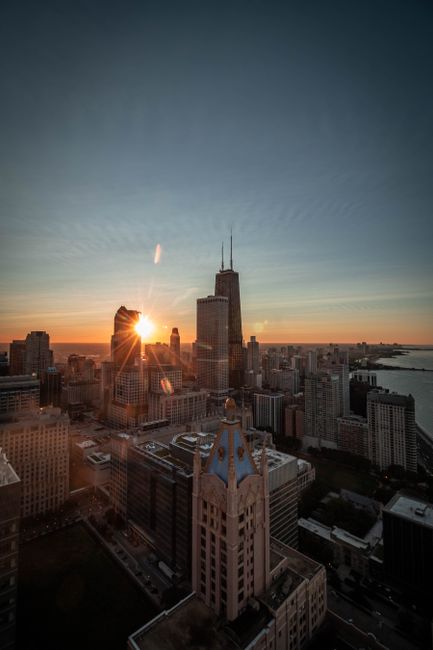
Chicago is the great city of the American Midwest, spread along the shore of Lake Michigan, and the place where the modern skyscraper was born. Its walkable center packs in a river lined with a century of landmark towers, Millennium Park and the mirrored Cloud Gate, one of the world’s great art museums, and free beaches and parks along 26 miles (42 km) of lakefront. Beyond the Loop, Chicago is a city of neighborhoods, from the blues clubs of the South Side to the bars around Wrigley Field. Come hungry: deep-dish pizza, Italian beef and Chicago-style hot dogs are local institutions. Summers are warm and lively; winters are long, snowy and properly cold.
Right now in Chicago
- Wed13–23°C56–74°FPartly cloudy
- Thu13–18°C55–65°FMostly clear
- Fri10–18°C50–65°FCloudy
- Mon 12 Oct Columbus Day · regional holiday in Illinois
Top tours in Chicago
See all tours for Chicago →
From local operators, with prices and reviews; you check availability and book on Viator, our partner. We may earn a commission at no extra cost to you. How we earn money
Chicago at a glance
- Best for: architecture, art and science museums, the lakefront, live music, sports and great food.
- How long: 3 days for the highlights; 4–5 days to add the neighborhoods, a ball game and a day trip.
- Best time: late May to early October. July averages highs of about 85 °F (29 °C); January highs hover around freezing.
- Getting there: fly to O’Hare (ORD) or Midway (MDW), both linked to downtown by CTA trains; Amtrak trains arrive at Union Station.
- Getting around: walk the Loop and the riverfront, and ride the CTA “L” trains and buses with a Ventra card, the Ventra app or a contactless bank card.
- Before you go: entry rules (visas and ESTA), money, tipping and driving are covered in our United States travel guide.
Chicago’s neighborhoods and who each one suits
Most visitors stay in or near the center, where the main sights are, and ride the “L” out to the rest of the city.
The Loop and the South Loop
The business district inside the ring of elevated tracks, with the Art Institute, Millennium Park, the theater district and Willis Tower. Every “L” line passes through, but it is quiet at night. The South Loop, next door, has the Museum Campus and Grant Park; good for families.
River North, the Magnificent Mile and Streeterville
North of the river, North Michigan Avenue (the Magnificent Mile) is the grand shopping street. River North, to the west, is full of restaurants, bars and the classic deep-dish pizzerias; Streeterville, to the east, runs to Navy Pier and the lake. The most popular first-time base, with the widest choice of hotels.
West Loop and Fulton Market
Former meatpacking streets west of the river, now the city’s hottest dining district, with Randolph Street’s “Restaurant Row,” food halls and boutique hotels. Walkable to Union Station.
Lincoln Park, Lakeview and Wrigleyville
Leafy North Side neighborhoods with brownstones, cafés, the free Lincoln Park Zoo and beaches. Wrigleyville, around the ballpark, is lively on game days and weekend nights. A relaxed base on the Red and Brown Lines.
Wicker Park, Pilsen and Hyde Park
Wicker Park, on the Blue Line, has independent shops, music venues and the elevated 606 trail. Pilsen is the heart of Mexican Chicago, with murals and taquerías. Hyde Park, on the South Side, has the University of Chicago and the Museum of Science and Industry, a short Metra ride from downtown.
Top things to see in Chicago
Prices and hours below were checked on the official sites in October 2026, unless we say otherwise; check again before you go. US prices exclude sales tax, which is added when you pay for shopping, food and many tours.
The Chicago Architecture Center river cruise
After the Great Fire of 1871 the city rebuilt itself in steel, and the best way to see the result is from the river. On the Chicago Architecture Center’s cruise aboard First Lady boats, volunteer docents cover more than 50 buildings in 90 minutes, from the Wrigley Building and Tribune Tower to Marina City’s “corncob” towers and Willis Tower. As of October 2026 tickets start at $57. Cruises run several times a day from March to November (the 2026 season ends on 22 November) from the dock at the southeast corner of the Michigan Avenue Bridge and Wacker Drive (112 E. Wacker Drive); arrive 30 minutes early. Tours go rain or shine, with a climate-controlled cabin, and tickets cannot be refunded or exchanged. The center itself, at 111 E. Wacker Drive, has exhibitions and a big city model: $15, or $5 added to a cruise ticket.
Millennium Park and Cloud Gate
Chicago’s front yard, between Michigan Avenue and the lake, is free and open daily from 6 am to 11 pm. Its star is Anish Kapoor’s Cloud Gate, the polished steel sculpture everyone calls “the Bean”; come early for photos without crowds. Nearby are the Crown Fountain, with the faces of Chicagoans on two glass towers, Frank Gehry’s Jay Pritzker Pavilion, home to free summer concerts, and the Lurie Garden. An outdoor ice rink usually opens in winter, and Grant Park’s Buckingham Fountain lies to the south.
The Art Institute of Chicago
One of the world’s great art museums, guarded by two bronze lions, with Grant Wood’s American Gothic, Edward Hopper’s Nighthawks, Seurat’s A Sunday on La Grande Jatte, a superb Impressionist collection and Renzo Piano’s Modern Wing. As of October 2026 admission is $32 for adults and $26 for seniors (65+), students and teens aged 14–17; under-14s go free. A $40 Fast Pass skips the line and includes special exhibitions. It opens 11 am–5 pm, Thursdays until 8 pm, and is closed on Tuesdays. Free tours run daily at 1 pm and 3 pm; bags larger than 13 × 17 × 4 inches go in the free cloakroom.
Skydeck Chicago and 360 Chicago
Skydeck Chicago, on the 103rd floor of Willis Tower (formerly the Sears Tower), is 1,450 feet (442 m) up, and The Ledge’s glass boxes let you stand over the street below. As of October 2026 timed tickets start at $32 for adults and $24 for children aged 3–11; from 1 October to 28 February it opens daily 9 am–8 pm (Saturdays to 9 pm), last entry 30 minutes before closing. 360 Chicago, on the 94th floor of 875 North Michigan Avenue (the former John Hancock Center), about 1,000 feet (305 m) up, has wide lake views and TILT, a window that tips you out over the city. General admission starts at $27 online for adults ($35 at the gate); with TILT from $45. Pick one, ideally at sunset.
The Museum Campus: Field Museum, Shedd Aquarium and Adler Planetarium
Three big museums share a lakeside park south of Grant Park, a 20-minute walk from Millennium Park. The Field Museum is home to SUE, one of the most complete T. rex skeletons ever found, plus Egyptian tombs and halls of animals and gems. As of October 2026 admission starts at $30 for visitors from outside Illinois ($3 off for seniors and students, free under 3); it opens daily 9 am–5 pm, last entry 4 pm. The Shedd Aquarium, in a 1930 Beaux-Arts building, has beluga whales, sharks and a Caribbean reef; book a timed ticket and check prices on its website. The Adler Planetarium, America’s first, has the best skyline view in the city from its lawn. Admission starts at $25 for adults and $13 for children; it opens 9 am–4 pm Thursday to Tuesday and 4–10 pm on Wednesdays, and closes on Thanksgiving and Christmas Day.
Seeing several big attractions? The Chicago CityPASS costs $144 for adults and $114 for children aged 3–11 as of October 2026 and covers five attractions over 9 days, from a list that includes the Shedd, the Adler, Skydeck, an architecture river tour (not the Architecture Center’s own), the Field Museum, the Art Institute and 360 Chicago.
Navy Pier
Opened in 1916, Navy Pier stretches more than six city blocks into Lake Michigan, with the Centennial Wheel, restaurants, the Chicago Shakespeare Theater, lake cruises and free events. Entry is free. From 8 September to 31 December 2026 it opens Sunday to Thursday 11 am–8 pm and Friday and Saturday 11 am–10 pm, and closes on Thanksgiving (26 November) and Christmas Day. The wheel runs daily all year, weather permitting; the other rides close in winter. Fireworks are held in summer and at midnight on New Year’s Eve.
The Lakefront Trail and Chicago’s beaches
The Lakefront Trail runs about 18 miles (29 km) from Ardmore Avenue in the north to 71st Street in the south, with separate paths for cyclists and for walkers and runners. Rent a Divvy bike and ride from Navy Pier to North Avenue Beach and Lincoln Park, or south past the Museum Campus. In September 2026 the Chicago Park District announced repairs that will continue for several months, so expect short detours.
The beaches are free. Swimming season runs from the Friday before Memorial Day to Labor Day, with lifeguards from 11 am to 7 pm; outside those hours and that season, swimming is prohibited, and red flags mean no swimming. The 2027 season starts on Memorial Day weekend. North Avenue Beach has skyline views, Oak Street Beach is next to the Magnificent Mile and Montrose is further north. See our beaches and cycling guides.
Wrigley Field
Home of the Chicago Cubs since 1916, Wrigley Field is famous for its ivy-covered outfield walls, hand-turned scoreboard and rooftop seats on neighboring buildings. A summer day game is a classic Chicago experience; the regular season runs from about April to September. Guided tours last 75–90 minutes, rain or shine, on game days and non-game days; check dates and prices on the Cubs’ website. Take the Red Line to Addison.
More to see
- The Chicago Riverwalk: a promenade along the river with cafés, wine bars and summer kayak rental.
- Museum of Science and Industry: in Hyde Park, in a building from the 1893 World’s Fair, with a German U-boat.
- Chicago Cultural Center: the former public library, free, with two stained-glass domes.
- Garfield Park Conservatory: one of the country’s largest greenhouses, on the Green Line.
Other things to do in Chicago
Eat deep-dish pizza and the other local classics
Deep-dish pizza, baked in a tall pan with the cheese under the tomato sauce, was born in River North in the 1940s; it takes 30–45 minutes to bake, so order early. Many locals prefer thin, square-cut “tavern-style” pizza. Also try an Italian beef sandwich, dipped in its juices, and a Chicago-style hot dog with all the toppings but never ketchup.
Blues, jazz, comedy and theater
Chicago gave the world electric blues, and small clubs still have live music every night. Add jazz clubs, the Lyric Opera, the Chicago Symphony Orchestra, a huge theater scene and improv comedy in Old Town.
On the water and on two wheels
Lake cruises leave from Navy Pier, and in summer you can kayak on the river. The Lakefront Trail and the 606, a 2.7-mile (4.3 km) old rail line turned elevated park, are ideal by bike. See our city sightseeing and boat trips guides.
Day trips and onward travel
Oak Park and Frank Lloyd Wright
The suburb of Oak Park, at the end of the Green Line, has the world’s largest group of Frank Lloyd Wright buildings, including his Home and Studio and Unity Temple. As of October 2026 the Frank Lloyd Wright Trust runs Home and Studio tours daily from 10 am to 4 pm, from $24 to $38; book ahead.
Indiana Dunes National Park
About 50 miles (80 km) east, dunes, beaches and wetlands line the southern tip of Lake Michigan, reached by the South Shore Line train from Millennium Station. As of October 2026 the National Park Service charges $15–$25 for a standard entrance pass ($45 annual); Indiana Dunes State Park, inside the area, has separate state fees. Good for hiking and summer swimming.
Milwaukee and the long-distance trains
Amtrak’s Hiawatha trains reach Milwaukee, Wisconsin, in about 90 minutes. Chicago is also the hub of Amtrak’s long-distance network, with overnight trains to the West Coast, the East Coast and New Orleans, which we cover in our New Orleans travel guide.
Getting there and getting around
From O’Hare airport (ORD)
O’Hare is about 17 miles (27 km) northwest of the Loop. The CTA Blue Line leaves from a station linked to Terminals 1, 2 and 3 (follow “Trains to City”); from Terminal 5 take the free airport train first. Trains run 24 hours a day and take 40–45 minutes to downtown. As of October 2026 the fare when entering at O’Hare is $5, but any 1-day or longer pass covers it. CTA warned in 2026 of a modified Blue Line timetable on the O’Hare branch at off-peak times and weekends because of construction.
From Midway airport (MDW)
Midway, about 10 miles (16 km) southwest of the Loop, is linked by an enclosed walkway to the CTA Orange Line, which takes 20–25 minutes to the Loop for the standard $2.50 fare. It does not run overnight, when the N62 Archer bus takes over.
By train
Union Station, on the west edge of the Loop, is Amtrak’s Midwest hub, with trains from New York, Washington, D.C., New Orleans, Los Angeles and Seattle, and a Metra station; its Great Hall is worth a look.
The “L”, buses and Ventra
The Chicago Transit Authority (CTA) runs eight color-coded “L” train lines and the city buses. As of October 2026 a train ride costs $2.50 and a bus ride $2.25, with up to two free transfers within 2 hours. Tap a contactless bank card or phone at the gate to pay the full fare, or get unlimited passes: $5 for 1 day, $15 for 3 days and $20 for 7 days, valid on CTA and Pace buses from first use. Passes go on a Ventra card (a $5 fee, returned as credit if you register it within 90 days) or in the Ventra app, and 1-day and 3-day Ventra tickets are sold at station machines. The Red and Blue Lines run 24 hours.
Metra, bikes and driving
Metra commuter trains serve the suburbs, Hyde Park and the North Shore, with zone fares; as of October 2026 a Saturday, Sunday or holiday Day Pass costs $7 and an app-only Weekend Pass $10, and up to three children aged 11 and under ride free with each paying adult on weekends. Divvy bikes and scooters are everywhere. You don’t need a car downtown, where hotel parking is expensive; for driving rules, see our United States travel guide.
When to go and how long to stay
Chicago has four strong seasons: warm, humid summers, crisp autumns and long, snowy winters made colder by the wind off the lake. The table uses NOAA’s 1991–2020 climate normals for Chicago O’Hare, the city’s official weather station: average daily highs and lows and monthly precipitation. The lakefront is often cooler in spring and summer.
| Season | Average high / low | Precipitation | What it’s like | Good for |
|---|---|---|---|---|
| Winter (Dec–Feb) | 32–37 °F (0–3 °C) / 19–24 °F (−7 to −4 °C) | About 2 in (50 mm) a month, much of it snow | Cold, gray and windy, with bitter cold snaps | Museums, theater, holiday lights, low hotel prices |
| Spring (Mar–May) | 47–71 °F (8–21 °C) / 31–51 °F (−1 to 10 °C) | 2.5–4.5 in (62–114 mm) | Changeable, from late snow to warm May days | River cruises, baseball, parks in bloom |
| Summer (Jun–Aug) | 80–85 °F (27–29 °C) / 61–66 °F (16–19 °C) | About 4 in (94–108 mm), often in thunderstorms | Warm to hot and humid, the liveliest season | Beaches, festivals, the Lakefront Trail |
| Autumn (Sep–Nov) | 76 °F (24 °C) falling to 48 °F (9 °C) / 57 °F (14 °C) falling to 34 °F (1 °C) | 2.5–3.5 in (61–87 mm) | September and early October are often glorious | Sightseeing, fall colors, food |
O’Hare averages about 38 inches (962 mm) of precipitation and 38 inches (98 cm) of snow a year. January is the coldest month, with an average high of 32 °F (0 °C) and low of 19 °F (−7 °C); dress for real winter from December to March.
Events worth planning around
- March: the river is dyed green for St. Patrick’s Day.
- June to August: free music festivals in Millennium Park and Grant Park, including the Chicago Blues Festival, and Lollapalooza.
- October: the Chicago Marathon and Open House Chicago, when normally closed buildings open their doors.
- November and December: holiday lights on the Magnificent Mile and the Christkindlmarket.
How long to stay: 3, 4 and 5 days
3 days: day one, the river cruise, the Riverwalk and Millennium Park, with deep-dish pizza in River North; day two, the Art Institute and an observation deck at sunset; day three, the Museum Campus and a bike ride along the lake to Navy Pier.
4 days: add Lincoln Park, Wrigley Field and a blues club. 5 days: add Oak Park, Hyde Park and the Museum of Science and Industry, or a summer day at Indiana Dunes.
Where to stay in Chicago and the hotel tax
- River North and the Magnificent Mile: the widest choice, near restaurants and the river.
- The Loop: walk to the Art Institute and Millennium Park; historic hotels in landmark buildings.
- Streeterville: near Navy Pier and the lake, quieter at night.
- West Loop: boutique hotels in the dining district.
Rates jump during big conventions, Lollapalooza and summer weekends, and fall from January to March. Prices are usually quoted before tax. According to the Illinois Department of Revenue, Chicago hotels collect a combined hotel tax of 17.4%: 11.9% in state-administered taxes, the city’s 4.5% Hotel Accommodations Tax and Cook County’s 1%. From 1 May 2026 the City of Chicago adds a 1.5% Tourism Improvement District charge at hotels with 100 or more rooms in the downtown ZIP codes, so most large downtown hotels now total about 18.9%. Vacation rentals pay a further 6% city surcharge. Many hotels also add a daily “destination” or amenity fee and charge for parking, so compare total prices.
Practical tips for Chicago
- Buy a pass: a 3-day CTA pass ($15) pays off after six train rides and covers the O’Hare fare.
- Tuesdays: the Art Institute is closed, so plan museum days around it.
- Tipping: 18–22% of the restaurant bill before tax is usual; our United States travel guide explains tipping in full.
- Safety: the center, the lakefront and the main neighborhoods are busy and generally fine for visitors; as in any big city, watch your phone on trains and stay in lit, busy areas late at night.
- Lake safety: swim only at guarded beaches in season; Lake Michigan has strong currents.
- Emergencies: call 911.
What to pack for Chicago
From December to March you need a proper winter coat, a hat, gloves, a scarf and warm, waterproof boots with good grip for icy sidewalks. In summer bring light clothes, sunscreen, a swimsuit and a layer for air-conditioned museums and breezy lake evenings. In spring and autumn, layers and a waterproof jacket cover the quick changes. Comfortable walking shoes are essential all year, and a small bag suits museum and ballpark bag rules.
Chicago travel FAQ
How do I get from O’Hare to downtown Chicago?
Take the CTA Blue Line, which runs 24 hours and reaches downtown in 40–45 minutes. As of October 2026 the fare from O’Hare is $5, or covered by any 1-day or longer pass.
How much is a CTA train ride in Chicago?
As of October 2026, $2.50 on the “L” ($5 when boarding at O’Hare) and $2.25 on buses, with two free transfers within 2 hours. Passes cost $5 for 1 day, $15 for 3 days and $20 for 7 days.
How much is the Chicago architecture boat tour?
The Chicago Architecture Center’s 90-minute river cruise starts at $57 as of October 2026. It runs from March to November; the 2026 season ends on 22 November.
How much does the Art Institute of Chicago cost?
As of October 2026, $32 for adults, $26 for seniors, students and teens, and free under 14. It opens 11 am–5 pm (Thursdays to 8 pm) and is closed on Tuesdays.
Is Skydeck or 360 Chicago better?
Skydeck is higher, with The Ledge’s glass boxes, from $32. 360 Chicago has closer lake views and the TILT ride, from $27 online. Both are good; one is enough for most visitors.
What is the hotel tax in Chicago?
The combined state, county and city hotel tax is 17.4%. Since May 2026, hotels with 100 or more rooms downtown add a 1.5% Tourism Improvement District charge, about 18.9% in total, and many add a daily fee.
Can you swim in Lake Michigan in Chicago?
Yes, at city beaches from the Friday before Memorial Day to Labor Day, 11 am to 7 pm, when lifeguards are on duty. Swimming is prohibited at other times and on red-flag days.
How cold is Chicago in winter?
Very. In January O’Hare averages a high of 32 °F (0 °C) and a low of 19 °F (−7 °C), and the wind makes it feel colder. The city gets about 38 inches (98 cm) of snow a year.
How many days do you need in Chicago?
Three days covers the river cruise, Millennium Park, the Art Institute, an observation deck and the Museum Campus. Four or five days adds the neighborhoods, Wrigley Field and a day trip.
Plan your trip
Partner links: TravelerCenter may earn a commission if you book, at no extra cost to you.
Sources · last reviewed 4 October 2026
Researched and last reviewed on 4 October 2026. River cruise: Chicago Architecture Center; Millennium Park: City of Chicago; museums: the Art Institute of Chicago, the Field Museum and the Adler Planetarium (including CityPASS prices); observation decks: Skydeck Chicago and 360 Chicago; Navy Pier hours: Navy Pier; beaches and the Lakefront Trail: Chicago Park District; Wrigley Field tours: Chicago Cubs; fares and airport trains: CTA and Metra; Oak Park tours: Frank Lloyd Wright Trust; Indiana Dunes fees: National Park Service; hotel taxes: Illinois Department of Revenue and City of Chicago Department of Finance; climate: NOAA’s 1991–2020 normals for Chicago O’Hare. Shedd Aquarium prices could not be read; distances, taxi and train journey times and event timings are general references flagged for checking. Prices and timetables change, so check the official sites before you go. For entry rules, money, tipping and driving, see our United States travel guide.
Data: Weather: MET Norway (CC BY 4.0) · Air quality: OpenAQ · Rates: ECB · Holidays: Nager.Date · Costs: World Bank ICP and price levels · Wikidata (CC0)