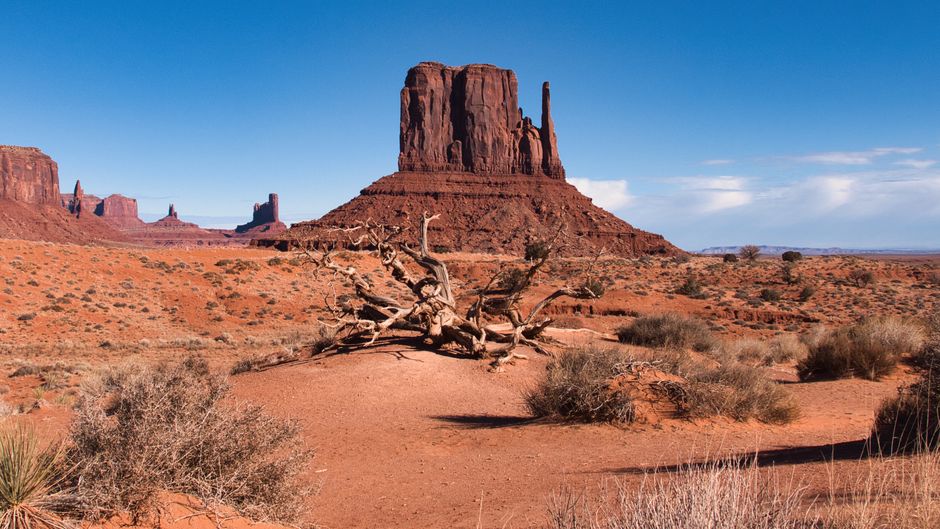
Monument Valley, on the Arizona–Utah border, is the classic image of the American West: sandstone buttes and spires rising 400 to 1,000 ft (120 to 300 m) from a red desert floor, made famous by decades of western films. The valley lies on the Navajo Nation, and its heart is protected as Monument Valley Navajo Tribal Park, known in Navajo as Tsé Biiʼ Ndzisgaii. It is run by Navajo Nation Parks & Recreation, not the National Park Service, so it has its own fees, hours and rules, and national park passes are not accepted. You can drive the rough 17-mile (27 km) Valley Drive yourself, but the most rewarding way to see it is with a Navajo guide, who can take you to arches and rock art that are closed to private cars. Remember that this is a living homeland, where Navajo families still live and herd livestock.
Right now in Monument Valley (Monument Valley Visitor Center)
- Tue13–26°C56–79°FPartly cloudy
- Wed14–27°C57–80°FClear
- Thu13–25°C56–78°FClear
- Mon 12 Oct Columbus Day · regional holiday in Utah
Top tours in Monument Valley
See all tours for Monument Valley →
From local operators, with prices and reviews; you check availability and book on Viator, our partner. We may earn a commission at no extra cost to you. How we earn money
Monument Valley at a glance
- Best months: April–May and September–October, with highs of about 65–80 °F (18–27 °C). Summer is hot with afternoon storms; winter is cold, with the odd dusting of snow on the buttes.
- Time needed: half a day for the visitor center and Valley Drive; a full day or an overnight stay for a guided tour, sunset and sunrise.
- Getting there: by car on US 163, about 25 miles (40 km) north of Kayenta, Arizona, and roughly 150 miles (240 km) south of Moab or 175 miles (280 km) from the Grand Canyon’s South Rim.
- Fees (as of October 2026): $10 per person per day, bought online or at the fee booth; the park also lists a $15 vehicle fee. National park passes are not valid.
- Before you go: entry rules for international visitors (ESTA or visa), driving and tipping are on our United States travel guide.
A Navajo tribal park, not a national park
Navajo Nation Parks & Recreation, founded in 1957, manages Monument Valley along with other tribal parks such as Four Corners Monument, Lake Powell Navajo Tribal Park (which includes the Antelope Canyon area), Little Colorado River Navajo Tribal Park and the Tseyi Diné Heritage Area at Canyon de Chelly. The Navajo Nation covers more than 25,000 square miles (65,000 km²) across Arizona, Utah and New Mexico, and its own laws apply here. The tribal park covers 91,696 acres (371 km²) spanning both states; the visitor center, at 5,564 ft (1,696 m), stands just inside Utah.
In practice this means three things for visitors. First, the America the Beautiful pass and other national park passes are not accepted; the park says so clearly. Second, Navajo law applies, including bans on alcohol, drones, pets and climbing. Third, outside the visitor center area, the Valley Drive and designated trails, the land is closed to non-Navajos unless you have a permit or are with a licensed Navajo guide; wandering off is trespassing.
Entry fee and hours (October 2026)
The entry fee is $10 per person per day, which you can buy online in advance through the park’s website or on arrival at the fee booth; the park page also lists a $15 vehicle fee, so check what applies to your group when you buy. Fees for all Navajo tribal parks, permits and entry rose on 1 January 2026, so ignore older prices you may see online. Guided tours, backcountry permits and camping are charged separately, and permits do not include the entry fee.
| Dates (2026) | Visitor center viewpoint and patio | Museum | Valley Drive |
|---|---|---|---|
| 3 to 16 October | 7 a.m.–7 p.m. | 8 a.m.–6:45 p.m. | 8 a.m.–6 p.m., last entry 3:30 p.m. |
| From 17 October (winter hours) | 8 a.m.–5 p.m. | 8 a.m.–4:45 p.m. | 8 a.m.–5 p.m., last entry 2:30 p.m. |
The park is closed on Thanksgiving Day (26 November 2026), Navajo Nation Family Day (the day after Thanksgiving), Christmas Day and New Year’s Day. Entry to the Valley Drive is first come, first served, and in busy periods there can be long waits, so arrive early. Summer hours run longer, with later last entry; check the park’s website for the 2027 spring and summer schedule. Hours are given in local time, which brings us to the valley’s famous time puzzle.
What time is it? The Navajo Nation time zone puzzle
Arizona does not use daylight saving time: the state stays on Mountain Standard Time all year. The Navajo Nation does use daylight saving time, from March to November, matching Utah, Colorado and New Mexico. So in summer, Monument Valley, Kayenta and the rest of the Navajo Nation are one hour ahead of Flagstaff, Page, Sedona, Phoenix and the Grand Canyon, even though they are all in Arizona. In winter, from November to March, everyone is on the same time. To add to the confusion, the Hopi Reservation, surrounded by the Navajo Nation, follows Arizona and does not change its clocks.
This matters for tour bookings, Valley Drive last-entry times and sunrise plans. Phones sometimes jump between towers in different zones, so set your watch to local Navajo time and confirm the time zone when you book a tour. Driving from the Grand Canyon in summer, you lose an hour on arrival; driving back to Page or Flagstaff, you gain it again.
The Valley Drive: driving it yourself
From the visitor center, a 17-mile (27 km) loop of unpaved road drops into the valley past the Mitten Buttes and Merrick Butte, with pullouts at the famous viewpoints. It is all dirt, with very rough sections and deep sand, and the park warns that you drive it at your own risk; a sturdy SUV or truck is best. Rules on what can go on the drive are strict:
- Not allowed: motorcycles, RVs, camper vans, and large SUVs or off-road vehicles. Ordinary cars can usually manage in dry weather if driven slowly, but some get stuck on the steep sandy hill on the way out.
- Stay on the designated route and obey all signs. Off-road driving is prohibited, and some side tracks are for guided tours only.
- Allow about two to three hours with stops, and enter well before the last-entry time.
- Rain: dirt roads can become impassable in wet weather, and the park is not liable for damage to vehicles.
Along the drive and before the visitor center, Navajo vendors sell jewelry, crafts and food such as fry bread; buying direct from the artisan is a good way to support local families.
Guided tours: the areas you can only see with a Navajo guide
Some of the valley’s most beautiful places, such as the Ear of the Wind arch and other landmarks deep in the valley, can only be reached on a guided tour with a Navajo operator licensed by Navajo Nation Parks & Recreation. Tours leave from the lower parking lot near the visitor center, where guides wait for walk-up customers, or you can book ahead with one of the more than 25 licensed operators listed on the park’s website. Options include:
- Open-air jeep or truck tours of 1.5 to 4 hours, the most popular choice, often with stops at arches, petroglyphs and a traditional hogan.
- Sunrise and sunset tours, and photography tours timed for the best light.
- Horseback rides with Navajo outfitters, from an hour to overnight.
- Guided hikes, including treks such as Hunts Mesa with an overnight camp.
Prices are set by each operator; compare before you choose, and confirm the meeting time in Navajo local time. A guide also brings the place to life with Navajo stories, history and sometimes music, which many visitors remember as the highlight of their trip.
Top things to see in Monument Valley
The Mittens and Merrick Butte from the visitor center
The world-famous panorama opens right from the visitor center terrace: West Mitten Butte, East Mitten Butte and Merrick Butte standing in a row above the desert. Come at sunrise, when the sun climbs behind the Mittens, or in the late afternoon, when the buttes glow orange and their shadows stretch across the valley. The visitor center has a small museum, a shop and restrooms open all year, and in summer the Haskenneini Restaurant serves Navajo and American food.
John Ford’s Point, Three Sisters and Artist’s Point
Along the Valley Drive, John Ford’s Point is named after the director who filmed classic westerns here from the late 1930s; it is a favorite photo stop, sometimes with a Navajo rider on horseback at the edge. Nearby stand the slender spires of the Three Sisters, and Artist’s Point gives one of the widest views back across the valley. Farther along, the Totem Pole and Yei Bi Chei spires rise from the sand dunes.
Arches and rock art in the guided-only areas
With a guide you can reach Ear of the Wind, Sun’s Eye and Big Hogan arches and ancient petroglyphs left by the Ancestral Puebloans. These areas are closed to private vehicles.
The view along US 163
Heading north toward Mexican Hat, US 163 runs straight as an arrow toward the buttes, a view known from the film Forrest Gump. If you stop for a photo, pull fully off the road; standing in the highway is dangerous.
Hiking, camping and permits
The only trail you can walk on your own is the Wildcat Trail, a loop around West Mitten Butte from near the visitor center. Sign in and out at the visitor center, carry plenty of water and avoid the midday heat; trails are open during park hours. See our hiking guide for general advice.
Any other hiking or camping in Navajo tribal parks needs a backcountry permit, sold at the visitor center or online, and usually a Navajo guide. Camping costs $15 per person per night under tribal park rules, on top of the permit. Photography or filming for commercial use, weddings and painting need a special use permit. Trails on the Navajo Nation are not maintained, water is scarce, and rescue is far away, so never hike alone and always tell someone your plans.
Rules and respect on Navajo land
- No alcohol or drugs: possession and drinking of alcohol are prohibited on the Navajo Nation, and the law is enforced.
- No drones: drones are prohibited in all Navajo tribal parks and will be confiscated.
- No pets: dogs are prohibited at all tribal park locations.
- No climbing: rock climbing and BASE jumping are strictly prohibited; the buttes are sacred, so do not climb on them.
- Ask before photographing people. Personal photos of the landscape are fine; commercial photography and filming need a permit.
- Respect homes and livestock: do not wander toward houses or disturb animals; the backcountry is open range.
- Leave everything as you find it: do not remove rocks, plants or artifacts, write on rock, or leave trash. Scattering cremated remains is strictly prohibited.
- No firearms on tribal lands, and no open ground fires.
Getting there
Monument Valley is remote, and a car is the only practical way to get there unless you join a tour. The turnoff to the tribal park is on US 163 between Kayenta, Arizona, and Mexican Hat, Utah. Fill your tank before you go, as distances between fuel stops are long. Driving tips are in our United States travel guide.
| From | Approximate distance | Route and time |
|---|---|---|
| Kayenta, AZ | 25 miles (40 km) | US 163 north; about 30 minutes |
| Page, AZ | 125 miles (200 km) | Highways 98 and 160; about 2 hours |
| Moab, UT | 150 miles (240 km) | US 191 and US 163; about 2.5–3 hours |
| Grand Canyon South Rim | 175 miles (280 km) | Desert View, Cameron, US 160; about 3.5 hours |
| Flagstaff, AZ | 175 miles (280 km) | US 89 and US 160; about 3 hours |
| Las Vegas, NV | 400 miles (645 km) | Via Page; about 6.5 hours |
Monument Valley fits naturally into a Southwest loop between the Grand Canyon and the Utah parks: drive out of the South Rim through Desert View, stay a night in the valley, then continue to Moab and Arches. For planning the Grand Canyon end, see our Grand Canyon National Park guide; if you are flying in, see our Las Vegas travel guide. Day tours from Las Vegas are very long; staying at least one night is far better. The nearest major airports are Las Vegas, Phoenix and Salt Lake City, all a long day’s drive away.
Around Monument Valley
- Four Corners Monument: another Navajo tribal park, where Arizona, Utah, Colorado and New Mexico meet, about two hours east; separate entry fee.
- Antelope Canyon and Lake Powell: near Page, in Lake Powell Navajo Tribal Park; the slot canyons can only be visited with a licensed Navajo tour operator.
- Canyon de Chelly: red-rock canyons with cliff dwellings, still farmed by Navajo families, about two and a half hours southeast.
- Goosenecks and Valley of the Gods: deep river meanders and quiet buttes near Mexican Hat, on the Utah side.
- Moab, Arches and Canyonlands: about three hours north, for the next stage of a Utah road trip.
Nearby destinations
- Moab183 km
- Bryce Canyon National Park197 km
- Arches National Park200 km
- Grand Canyon National Park208 km
- Zion National Park257 km
- Sedona281 km
When to go and how long to stay
At about 5,500 ft (1,700 m), Monument Valley is a little cooler than the lower deserts, with big swings between day and night. Spring is windy, sometimes with blowing sand; summer is hot, with thunderstorms and flash floods from July to September; autumn is clear and calm; winter brings cold nights and the occasional snowfall, which looks spectacular on the red rock.
| Season | Average high | Average low | What it’s like |
|---|---|---|---|
| Spring (Mar–May) | 59–77 °F (15–25 °C) | 36–54 °F (2–12 °C) | Mild but windy; dust storms possible. |
| Summer (Jun–Aug) | 89–93 °F (32–34 °C) | 65–68 °F (18–20 °C) | Hot sun, little shade; afternoon storms from July. |
| Autumn (Sep–Nov) | 82–53 °F (28–12 °C) | 58–34 °F (14–1 °C) | Clear, calm and the best light; shorter hours from mid-October. |
| Winter (Dec–Feb) | 41–48 °F (5–9 °C) | 25–29 °F (−4 to −2 °C) | Cold and quiet; occasional snow; closed on major holidays. |
Temperatures are NOAA 1991–2020 normals for the Monument Valley weather station near the park. The area is very dry: nearby Mexican Hat, about 1,400 ft (430 m) lower, gets only about 6.3 inches (161 mm) of rain a year, with the most in late summer and early autumn.
Heat, storms and flash floods
Summer sun is fierce and shade is almost nonexistent in the valley. Carry plenty of water in the car and on any walk, wear a hat, and plan walks for early morning or evening. The tribal park warns that flash floods are most likely in the summer monsoon, from July to September, but can happen at any time of year. Never drive into a flooded wash, and turn back if the Valley Drive is muddy; dirt roads can become impassable after rain. When thunderstorms build, stay in your vehicle or a building.
How long to stay
A few hours gives you the visitor center view and the self-drive Valley Drive. One night is far better: arrive in the afternoon for a guided sunset tour, watch the stars from the valley rim, and wake up for sunrise behind the Mittens. With a second day, add a horseback ride or a guided hike, or continue to the Goosenecks and Valley of the Gods.
Where to stay in and near Monument Valley
- The View Hotel: the only lodging inside the tribal park, beside the visitor center, with balconies facing the Mittens. The same Navajo-owned business runs cabins, a campground with RV sites, a restaurant and a trading post with one of the largest selections of Native American crafts in the Southwest. Book months ahead for spring and autumn.
- Goulding’s area (Oljato–Monument Valley, Utah): a historic trading post with a lodge, campground and tours, a few miles west of the park entrance road.
- Kayenta, Arizona: chain hotels about 30 minutes south; a practical, cheaper base.
- Mexican Hat and Bluff, Utah: small towns to the north and northeast, handy for the Goosenecks and Valley of the Gods.
Taxes: hotels on the Navajo Nation add the Navajo Nation’s 8% hotel occupancy tax to room rates, and the Navajo Nation also charges a 6% sales tax on retail sales. Hotels just off the reservation charge state and local taxes instead. Ask for the total price with all taxes when you book.
Practical tips for Monument Valley
- Fuel and supplies: fill up in Kayenta or Mexican Hat; services in the valley are limited.
- Phones: coverage is patchy and may switch time zones. Download maps before you arrive.
- Emergencies: call 911. The Navajo Nation Police Kayenta District is on 928-697-5600, and park offices are on 928-357-4207 and 928-871-6647.
- Cash: bring some for roadside vendors and tips for guides.
- Liability: the Navajo Nation is not responsible for theft or vehicle damage, so lock your car and keep valuables out of sight.
- Time zone: remember the summer one-hour difference from the rest of Arizona.
What to pack for Monument Valley
Bring plenty of water, a sun hat, sunglasses and sunscreen, a scarf or buff against blowing sand, closed shoes for sandy trails, and a warm layer for chilly mornings and evenings, even in summer. Open-air tours are dusty and cold at sunrise, so bring a jacket. Pack a camera bag that seals against sand, a headlamp for stargazing, and in winter a warm coat, hat and gloves.
Monument Valley travel FAQ
How much does it cost to enter Monument Valley?
$10 per person per day in 2026, bought online or at the fee booth; the park also lists a $15 vehicle fee. Guided tours cost extra.
Can I use my national park pass at Monument Valley?
No. Monument Valley is a Navajo tribal park run by Navajo Nation Parks & Recreation, and it does not accept the America the Beautiful or any other National Park Service pass.
Can you drive through Monument Valley on your own?
Yes, on the 17-mile (27 km) dirt Valley Drive, but not on a motorcycle or in an RV, camper van or large off-road vehicle. Some areas, such as Ear of the Wind, are open only on guided tours.
What are the Monument Valley hours?
From 17 October 2026 (winter hours), the Valley Drive is open 8 a.m.–5 p.m., with last entry at 2:30 p.m. The park is closed on Thanksgiving, the day after, Christmas and New Year’s Day.
What time zone is Monument Valley in?
Mountain Time. The Navajo Nation uses daylight saving time from March to November, so in summer it is one hour ahead of the rest of Arizona, including the Grand Canyon and Page.
Can I fly a drone or bring alcohol to Monument Valley?
No. Drones are prohibited and will be confiscated, and alcohol is prohibited across the Navajo Nation. Pets are not allowed either.
Is a guided tour worth it?
Yes, for most visitors. A Navajo guide takes you to arches and rock art closed to private cars and shares the valley’s stories. Book ahead in busy months or find a guide at the lower parking lot.
How far is Monument Valley from the Grand Canyon?
About 175 miles (280 km) from the South Rim via Desert View and Cameron, roughly 3.5 hours. Remember the one-hour time difference in summer.
Can I stay inside Monument Valley?
Yes. The View Hotel, its cabins and campground are the only lodging inside the tribal park. Book early; rooms add the Navajo Nation’s 8% hotel occupancy tax.
Plan your trip
Partner links: TravelerCenter may earn a commission if you book, at no extra cost to you.
Sources · last reviewed 4 October 2026
Researched and last reviewed on 4 October 2026. Entry fees, opening hours and holiday closures, Valley Drive rules, guided tours and licensed operators, permits, camping, park rules and lodging inside the park come from Navajo Nation Parks & Recreation; the hotel occupancy and sales tax rates from the Navajo Tax Commission; the Navajo Nation’s daylight saving time from the National Park Service pages for Navajo National Monument and Canyon de Chelly; temperatures from NOAA’s 1991–2020 normals for the Monument Valley station and rainfall for Mexican Hat. Driving distances, viewpoint names and nearby sights are general references flagged for checking. Fees and hours change, so check the tribal park’s website before you go. For entry rules, driving and tipping, see our United States travel guide.
Data: Weather: MET Norway (CC BY 4.0) · Air quality: OpenAQ · Rates: ECB · Holidays: Nager.Date · Costs: World Bank ICP and price levels · Wikidata (CC0)