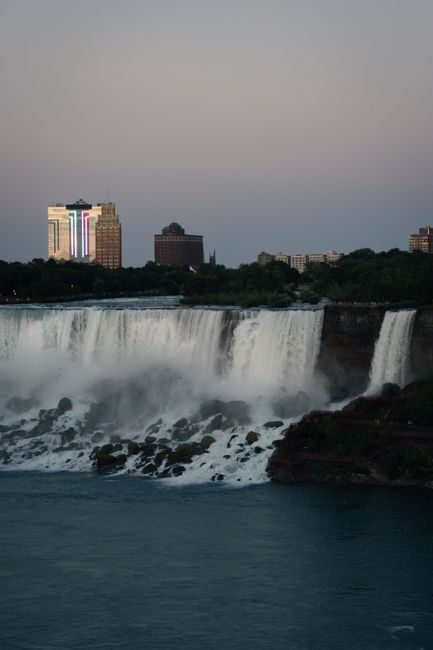
Niagara Falls, Ontario, is a city of about 88,000 people built around one of the world’s great natural sights: the Horseshoe Falls, a curving wall of water where the Niagara River drops into its gorge on the border between Canada and the United States. The Canadian side has the best views of all three falls, a long riverside park run by the Niagara Parks Commission, boat trips into the spray, tunnels behind the water and nightly illuminations. Above the park rise the hotels, casinos and neon of Clifton Hill and the Fallsview district, and a short drive north are the vineyards and Victorian streets of Niagara-on-the-Lake. It is about 130 km (80 miles) from Toronto, close enough for a day trip, but staying a night lets you see the falls lit up and enjoy the quieter early mornings.
Right now in Niagara Falls
- Tue 6–15°C 43–58°F Mostly clear
- Wed 12–19°C 54–67°F 14 mm Mostly clear
- Thu 10–17°C 51–63°F Clear
- Mon 12 Oct Thanksgiving
Weather: MET Norway (CC BY 4.0) · Air quality: OpenAQ · Rates: ECB · Holidays: Nager.Date
Top tours in Niagara Falls
See all tours for Niagara Falls →
From local operators, with prices and reviews; you check availability and book on Viator, our partner. We may earn a commission at no extra cost to you. How we earn money
Niagara Falls at a glance
- Best months: June to early October for the boats, gardens and Niagara Parkway; mid-November to early January for the free Winter Festival of Lights; spring and autumn weekdays for smaller crowds.
- Time needed: one full day covers the falls, a boat trip and Journey Behind the Falls; two days add the gorge, the Power Station and Niagara-on-the-Lake.
- Getting there: GO Transit trains and buses from Toronto’s Union Station all year; about 1.5 to 2 hours by car from Toronto; Buffalo, New York, is across the river.
- Costs (as of October 2026): prices are in Canadian dollars (CA$1 is about US$0.72). Journey Behind the Falls is $33 for adults; a 24-hour WEGO bus pass is $16; the views from the riverside walkway are free.
- Before you go: entry rules for Canada (including the eTA for visitors who fly in), money and general safety are in our Canada travel guide.
The areas of Niagara Falls and who each one suits
Queen Victoria Park and Table Rock
The green strip along the river between the Rainbow Bridge and the brink of the Horseshoe Falls is the heart of any visit: lawns, flower beds and a stone wall where you can stand a few metres from the edge of the falls. Table Rock Centre, at the brink, houses Journey Behind the Falls, shops, a restaurant and a Niagara Parks Welcome Centre. It is all owned and run by the Niagara Parks Commission, an agency of the Government of Ontario, and the walkways are free.
Clifton Hill and the Fallsview district
Clifton Hill, the steep street that climbs from the river near the Rainbow Bridge, is Niagara’s famous strip of wax museums, haunted houses, arcades, mini-golf and the Niagara SkyWheel, a big Ferris wheel. It is loud, bright and fun for families. Up the escarpment, the Fallsview district has tall hotels with rooms looking straight over the falls, the Fallsview Casino and the Skylon Tower, whose revolving restaurant and observation deck sit 236 metres (775 ft) above the river. Lundy’s Lane, running west, has cheaper motels and chain restaurants.
The Niagara Parkway and Niagara-on-the-Lake
North of the falls, the Niagara Parkway follows the gorge for some 56 km (35 miles) between Fort Erie and Niagara-on-the-Lake, past the Whirlpool, the Niagara Glen, the Botanical Gardens and the Floral Clock, then through orchards and vineyards to the old town at the mouth of the river. This is the quieter, greener side of Niagara, best for couples, cyclists, wine lovers and anyone who wants to escape the neon.
Top things to see in Niagara Falls
The Horseshoe Falls, American Falls and Bridal Veil Falls
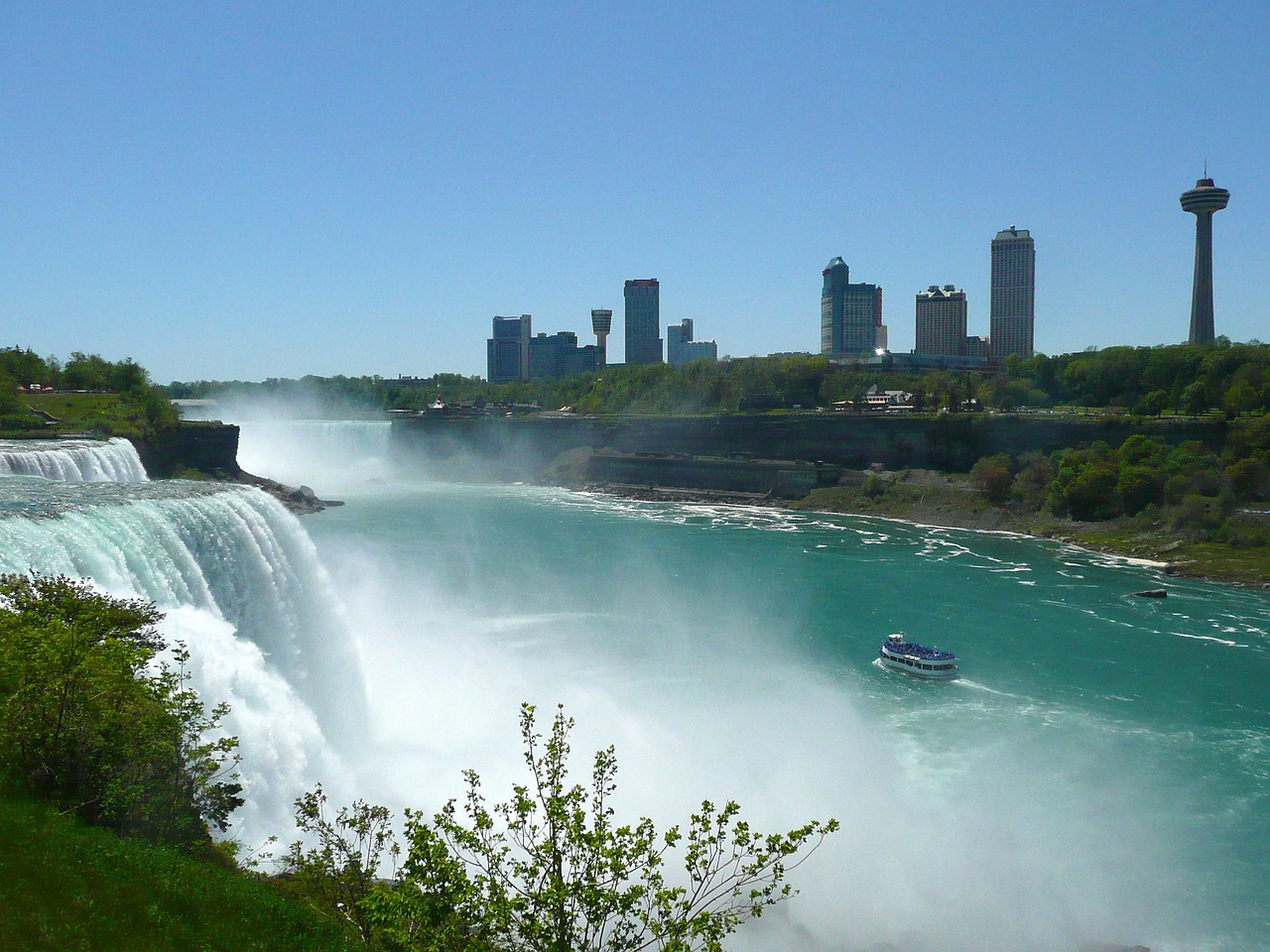
Niagara Falls is three waterfalls. The Horseshoe Falls, by far the largest, curves across the border, with most of it on the Canadian side; the smaller American Falls and Bridal Veil Falls are entirely in the US and face Canada, which is why the Canadian side has the classic full view. Walk the riverside path from the Rainbow Bridge to Table Rock (about 2 km or 1.2 miles) for constantly changing angles, and expect to get damp near the brink when the wind blows the spray. Every evening, the falls are lit in changing colours, and on fireworks nights there is a short show over the water; the Niagara Parks events calendar lists the dates.
Niagara City Cruises
The boat trip into the mist at the foot of the Horseshoe Falls is the experience most people remember. Niagara City Cruises is the official boat tour operator for Niagara Parks on the Canadian side; its boats leave from a landing in the gorge near the Rainbow Bridge, reached by an elevator and walkway from River Road. Ponchos are handed out, and you will still get wet. The cruises run from spring to late autumn, and evening fireworks and illumination cruises are offered in summer. From June to Labour Day, expect queues to reach the landing and board, even with a timed ticket, so go early in the morning. Check current prices, timings and the end of the 2026 season on the operator’s website and book ahead.
Journey Behind the Falls
From Table Rock Centre (6650 Niagara Parkway), a lift takes you down 125 ft (38 m) through the bedrock to 130-year-old tunnels that end at portals behind the curtain of falling water, and to an observation deck at the foot of the Horseshoe Falls. It is open all year, which makes it the best close-up in winter, when the boats do not run. The visit takes about an hour. Admission is $33 for adults (13+) and $21.50 for children aged 3–12; children 2 and under go free. Tickets are timed online, or you can buy “Anytime” tickets; strollers are not allowed. In the evening, “Journey at Night” lets you watch the illuminations and fireworks from the lower deck. Works continue while it stays open: a restored historic tunnel with a new covered, heated viewing platform is due in spring 2027, and an upgraded Rainbow Platform in spring 2028.
Niagara Parks Power Station and its tunnel
This 1905 hydroelectric power station beside the upper river has been turned into one of Niagara’s most interesting attractions: a vast hall of original generators, interactive exhibits on the story of electricity and a tunnel, 2,200 ft (670 m) long, that leads down to a viewing platform at the foot of the gorge near the falls. It is open year-round. Regular admission is $33 for adults and $21.50 for children; with a premium guided tour it is $53 and $34.50. In the evening the building reopens for “Currents: Niagara’s Power Transformed”, a sound-and-light show. The tunnel platform may close in bad weather.
The Niagara Gorge: White Water Walk, Whirlpool Aero Car and Niagara Glen
Downstream from the falls, the river races through a narrow gorge. At the White Water Walk, a lift and tunnel lead to a boardwalk beside some of the wildest Class 6 rapids in North America ($21 adults, $13.50 children). Further on, the Whirlpool Aero Car, a cable car designed by Spanish engineer Leonardo Torres Quevedo and running since 1916, crosses high above the swirling Whirlpool ($25 adults, $16.50 children). Both are seasonal, open from about April to November. The Niagara Glen nature area has free trails down into the gorge among boulders and old forest; the steps are steep, so wear proper shoes.
Gardens and the Butterfly Conservatory
The Niagara Parks Botanical Gardens, north of the Whirlpool, are free to walk and include a rose garden; next door, the Butterfly Conservatory has thousands of tropical butterflies flying freely in a warm glasshouse, a good choice on a cold or rainy day. The Floral Showhouse near Table Rock has seasonal flower shows, and the Floral Clock, made of thousands of plants, stands beside the Parkway on the way to Niagara-on-the-Lake.
Niagara Parks sells bundles of its attractions, including the Niagara Falls Pass, which includes two days of WEGO travel; compare the price with the attractions you actually plan to visit.
Viewpoints
- Skylon Tower
- Whirlpool Aero Car
Nature
- Horseshoe Falls
- Niagara Whirlpool
Other sights
- Journey Behind the Falls
- Niagara SkyWheel
Museums
- Niagara Parks Power Station
Activities and best months
- Boat tripsNiagara City Cruises is the official boat tour operator for Niagara Parks, leaving from the Niagara Gorge; in peak season (June to Labour Day) expect queues even with timed tickets. · source
- City sightseeingNiagara Parks' Journey Behind the Falls takes visitors 125 ft down through 130-year-old tunnels to portals and an observation deck, all year (adult $33); the White Water Walk by the Class 6 rapids runs April to November. · source
Other things to do in Niagara Falls
- Clifton Hill: the SkyWheel, arcades, mini-golf and fun houses; go after dark when the neon is at its brightest.
- Zipline and adventures: a zipline runs along the gorge towards the falls in the warmer months, and Niagara Parks has added new attractions in recent years; check the Niagara Parks website for what is open.
- Cycling the Parkway: a paved recreation trail follows the Niagara Parkway, flat and scenic, between the falls and Niagara-on-the-Lake; rent bikes in town.
- History: Queenston Heights, with Brock’s Monument, and Fort George in Niagara-on-the-Lake recall the War of 1812, when this frontier was a battlefield.
- Casinos and shows: Fallsview Casino and Casino Niagara are open around the clock for adults 19 and over, with concert theatres.
Day trips and onward travel
Niagara-on-the-Lake and the wineries
About 25 km (15 miles) north, where the Niagara River flows into Lake Ontario, Niagara-on-the-Lake is a beautifully kept 19th-century town of inns, tea rooms and gardens, home of the Shaw Festival theatre season. The surrounding Niagara Peninsula is Ontario’s main wine region, best known for icewine made from grapes frozen on the vine, with dozens of wineries offering tastings, many along the Niagara Parkway and around Virgil and St. Davids. Do not drink and drive: join a tour, cycle, or use the shuttle. In 2026, the WEGO Niagara-on-the-Lake shuttle (Orange Line) is included in WEGO passes and runs hourly from the Floral Clock to Fort George from April through October, with the last return from Fort George at 7 p.m.
Crossing the Rainbow Bridge to Niagara Falls, New York
The Rainbow Bridge links the two cities of Niagara Falls just downstream from the American Falls, and you can cross on foot, by bike or by car. This is an international border: carry a passport (US and Canadian citizens can also use a NEXUS card, a US passport card or an enhanced driver’s licence), expect customs checks both ways and allow extra time on summer weekends. On the American side, Niagara Falls State Park has walkways at the brink of the American Falls and Goat Island, and Buffalo is about 30 km (20 miles) away. Full entry details are in our Canada travel guide; for the US side, see our United States travel guide.
Toronto, Hamilton and beyond
Toronto is the natural partner for Niagara: museums, neighbourhoods and the CN Tower, 1.5 to 2 hours away (see our Toronto travel guide). On the way, Hamilton and the Niagara Escarpment have dozens of waterfalls of their own, and St. Catharines has the Welland Canal, where you can watch big lake ships rise and fall in the locks. Amtrak’s Maple Leaf train continues from Niagara Falls across the border to New York City (see our New York City travel guide).
Nearby destinations
- Toronto67 km
- Muskoka District Municipality229 km
Getting there and getting around
By GO Train or bus from Toronto
GO Transit, Ontario’s regional transit system, serves Niagara Falls all year, on weekdays and at weekends. Direct trains on the Lakeshore West line run from Toronto’s Union Station to Niagara Falls GO Station, near the VIA station on Bridge Street, in roughly two hours; when there is no direct train, ride to Burlington and change to GO bus route 12. Pay by tapping a PRESTO card or a credit or debit card on and off. GO also sells GO + WEGO combo tickets that bundle a return trip with a WEGO pass; check the GO website for current prices and train times, as weekend schedules change through the year. From the station, the WEGO Green Line runs along the river to Table Rock.
WEGO, the visitor bus
WEGO is the hop-on, hop-off bus system linking all the Niagara Parks sites, the hotels and the tourist districts, meeting at Table Rock Centre. It runs all year, with seasonal timetables. Passes, including tax, are $16 for adults (13+) for 24 hours or $20 for 48 hours, and $12 or $16 for children aged 3–12; children 2 and under ride free. Buy online and scan the e-ticket on board, or buy at Niagara Parks attractions and welcome centres. The pass also covers the Niagara-on-the-Lake shuttle. The former WEGO Red Line is now Niagara Region Transit’s local route 116/216, and the Blue Line is operated by Niagara Parks. All WEGO buses are accessible, with ramps and space for wheelchairs.
Driving and parking
From Toronto, follow the Queen Elizabeth Way (QEW) around the end of Lake Ontario; traffic is heavy on summer Fridays and Sundays. Parking near the falls is plentiful but not cheap. Niagara Parks’ Falls Parking (Lot A), opposite Table Rock, has variable rates; the lot by the Rainbow Bridge is $12 an hour; and the seasonal Rapidsview park-and-ride (Lot C) on Upper Rapids Road is $10 a day, a 7- to 8-minute WEGO ride from Table Rock. A Niagara Parks parking pass ($50, valid to 31 December) covers most of its lots, and is aimed at frequent visitors. In winter, the lake can bring heavy snow squalls to the QEW.
By air and train
The nearest big airports are Toronto Pearson, about 1.5 hours by car, and Buffalo Niagara International across the border, about 40 minutes, but you have to clear customs at the bridge. VIA Rail and Amtrak’s daily Maple Leaf between Toronto and New York City stop at the Niagara Falls station.
When to go and how long to stay
The falls flow every day of the year, but the experience changes with the seasons. Summer is warm and humid, the boats and gorge attractions are all open and the crowds are at their peak, especially at weekends. Spring and autumn are cooler, quieter and good value; the autumn colours along the gorge peak in October. Winter is cold, with snow and ice building up in the gorge and frozen spray coating the railings, a magical sight on a sunny day; the boats stop, but Journey Behind the Falls, the Power Station and the Festival of Lights carry on.
| Season | Average high | Average low | What it’s like |
|---|---|---|---|
| Spring (Mar–May) | 6–19 °C (43–67 °F) | −3 to 8 °C (26–46 °F) | Cool and changeable; boats and gorge attractions reopen; blossom in May. |
| Summer (Jun–Aug) | 25–27 °C (76–81 °F) | 14–17 °C (57–63 °F) | Warm and humid, with thunderstorms; peak season and longest hours. |
| Autumn (Sep–Nov) | 22 to 9 °C (71–48 °F) | 12 to 1 °C (54–34 °F) | Pleasant September, colourful October, grey November; grape harvest. |
| Winter (Dec–Feb) | 0 to 3 °C (31–37 °F) | −8 to −4 °C (18–25 °F) | Cold, with about 1.5 m (60 in) of snow a winter; ice in the gorge; Festival of Lights. |
Figures are Environment and Climate Change Canada’s 1981–2010 climate normals for the Niagara Falls NPCSH station. The city gets about 950 mm (37 in) of rain and melted snow a year, spread across all months, and about 153 cm (60 in) of snow from November to April.
Winter Festival of Lights 2026/27
The 44th Niagara Falls Winter Festival of Lights runs from 14 November 2026 to 10 January 2027. It is free: about three million lights and big illuminated displays stretch for more than 8 km (5 miles) through the Niagara Parkway, Dufferin Islands, the Fallsview district and Lundy’s Lane, lit nightly from 5 p.m. to midnight, holidays included. Fireworks over the falls are scheduled on Friday and Saturday nights in November and December, at 8 p.m. according to the festival’s FAQ. Park at your hotel and walk, take WEGO, or drive slowly through Dufferin Islands, where voluntary donations support the displays. GO Transit runs promotions for the festival.
How long to stay: 1, 2 and 3 days
- One day: walk from the Rainbow Bridge to Table Rock, take the boat (in season), Journey Behind the Falls, and stay for the evening illuminations.
- Two days: add the Power Station tunnel, the White Water Walk or Aero Car, the Niagara Glen and Clifton Hill at night.
- Three days: add Niagara-on-the-Lake, a few wineries and Fort George, or cross the Rainbow Bridge to the American side.
Where to stay in Niagara Falls and the hotel taxes
- Fallsview: tall hotels with falls-view rooms (pay extra for a high floor facing the Horseshoe Falls), the casino and walking distance to Table Rock.
- Clifton Hill and the Rainbow Bridge area: family hotels close to the boats and attractions; noisy at night.
- Lundy’s Lane: budget motels and chains, a bus or drive from the falls.
- Niagara-on-the-Lake: historic inns, bed and breakfasts and winery resorts; quiet and romantic, 25 minutes from the falls.
Taxes: room rates are usually quoted before tax. Ontario adds 13% HST, and the City of Niagara Falls charges a Municipal Accommodation Tax of 4% of the room rate since 1 April 2026 (a flat rate that replaced the old star-based charge); it rises to 5% from 1 April 2027. Many hotels in the tourist districts also add a destination marketing or resort fee and charge for parking, so compare total prices. Prices jump at summer weekends and on holidays.
Practical tips for Niagara Falls
- Time zone: Eastern Time, the same as Toronto and New York, with daylight saving time.
- Beat the crowds: walk the brink early in the morning, book timed tickets for the boats and Journey Behind the Falls, and avoid summer Saturday afternoons.
- Spray and ice: the paths near the falls are wet all year and icy in winter; wear shoes with good grip and keep cameras in a bag. Never climb the railings: the current above the falls is lethal.
- Prices and tipping: most prices exclude the 13% HST (WEGO fares include it); tip about 15–20% in restaurants.
- Border: if you plan to cross into the US, carry your passport or other accepted document, and check whether your rental car may cross.
- Emergencies: call 911.
What to pack for Niagara Falls
Whatever the season, bring a light waterproof jacket and shoes that can get wet: the spray reaches far beyond the boat, especially at Table Rock. A waterproof phone pouch or a small dry bag is useful. In summer, add sunscreen, a hat and a water bottle; for evenings by the river, a light sweater. From November to March, pack a warm winter coat, hat, gloves, a scarf and boots with good grip for the icy paths and the Festival of Lights. Comfortable walking shoes matter on the 2 km riverside walk and the steep Niagara Glen trails.
What to pack
- City walking shoesLisbon and Porto are steep, with polished limestone cobbles that get slippery, so grippy soles matter.
- Day packs and anti-theft bagsA small zipped or anti-theft bag makes crowded trams and viewpoints less stressful.
- Dry bags and phone pouchesSpray soaks phones and cameras on open boats to the Algarve caves and on whale-watching trips.
- Fleeces and warm layersIt is cooler at sea than on land, especially on morning whale-watching trips.
- Rain jacketsA windproof, waterproof shell keeps you warm on open boats, where wind and spray cool you quickly.
- Reef-friendly sunscreenSun reflects off the water on cruises and cave tours.
- Travel adapters and convertersPortugal uses Type C and F sockets at 230 V, so most visitors from outside Europe need an adapter.
- Water shoesKayak and small-boat trips to the Algarve grottoes land on rock and wet sand.
Niagara Falls travel FAQ
Is the Canadian or American side of Niagara Falls better?
For views, the Canadian side: it faces all three falls, including the full curve of the Horseshoe Falls. The American side gets you closer to the American Falls on Goat Island. You can walk between them over the Rainbow Bridge with a passport or other accepted document.
How much is Journey Behind the Falls?
$33 for adults aged 13 and over and $21.50 for children aged 3–12; children 2 and under go free. It is open all year, and the visit takes about an hour.
When does the Niagara Falls boat tour run?
Niagara City Cruises sail from spring to late autumn and stop in winter. Expect queues from June to Labour Day; book a timed ticket online and go early, and check the end-of-season date on the operator’s website.
How do I get from Toronto to Niagara Falls without a car?
Take a GO train from Union Station to Niagara Falls GO Station, roughly two hours; it runs all year, and when there is no direct train, change at Burlington to GO bus 12. From the station, WEGO buses run to the falls.
How much is a WEGO bus pass?
$16 for 24 hours or $20 for 48 hours for adults, and $12 or $16 for children aged 3–12, tax included. Passes include the Niagara-on-the-Lake shuttle.
When is the Winter Festival of Lights 2026/27?
From 14 November 2026 to 10 January 2027. It is free, and the lights are on nightly from 5 p.m. to midnight, with fireworks on Friday and Saturday nights in November and December.
What documents do I need to cross the Rainbow Bridge?
A passport; US and Canadian citizens can also use a NEXUS card, a US passport card or an enhanced driver’s licence. Non-US visitors need whatever the US requires for their nationality. See our Canada travel guide for entry rules.
What taxes are added to Niagara Falls hotel bills?
Ontario’s 13% HST plus the city’s 4% Municipal Accommodation Tax, which rises to 5% on 1 April 2027. Many hotels add their own destination or resort fees and parking charges.
Are the falls lit up at night?
Yes, every evening all year the falls are illuminated in changing colours, and fireworks are held on scheduled nights. Watch from Queen Victoria Park, the Fallsview hotels or Journey at Night.
Sources
- © OpenStreetMap contributors · ODbL · fetched 4 Oct 2026
- Wikidata · CC0 · fetched 4 Oct 2026
Sources and last review
Researched and last reviewed on 4 October 2026. Attraction prices, WEGO fares and parking rates come from the Niagara Parks Commission; boat tour information from Niagara City Cruises; the Winter Festival of Lights dates and hours from the festival’s official website; the Municipal Accommodation Tax from the City of Niagara Falls; GO train and shuttle information from GO Transit; climate from Environment and Climate Change Canada’s 1981–2010 normals for the Niagara Falls NPCSH station; population from Wikidata. Boat tour prices and the 2026 closing date could not be read on the operator’s website, and GO journey times, distances, the Skylon Tower height, historical dates and some district details are general references; all are flagged for checking. Prices and timetables change, so check the official sites before you go. For entry rules, money and general safety, see our Canada travel guide.
Plan your trip
Partner links: TravelerCenter may earn a commission if you book, at no extra cost to you.