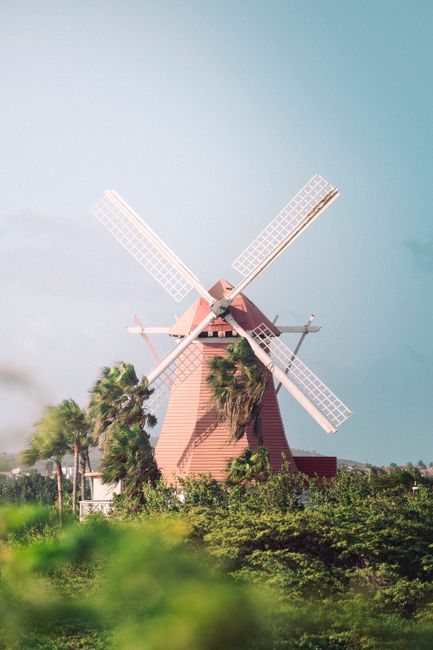
Aruba is a small, dry, sunny island in the southern Caribbean, about 29 km (18 miles) off the coast of Venezuela, and one of the most dependable beach destinations in the region. Its west coast is one long run of powder-white sand and calm turquoise water, from Eagle Beach, regularly named among the best beaches in the world, to the high-rise hotels of Palm Beach. Inland, the landscape is closer to a desert than a rainforest: cactus, boulders, divi-divi trees bent by the trade winds, and the rugged national park of Arikok, with caves, a natural rock pool and a wild, wave-battered north coast. Aruba is part of the Kingdom of the Netherlands, so you hear Papiamento and Dutch, but English and Spanish are spoken everywhere and the US dollar is accepted almost as widely as the Aruban florin. It sits south of the main hurricane belt, rain is rare, and the breeze takes the edge off the heat, so it works all year. Plan a long weekend for a beach break, or a week to explore the whole island.
Right now in Aruba
- Tue 28–30°C 83–86°F 1 mm Partly cloudy
- Wed 28–30°C 82–86°F 1 mm Mostly clear
- Thu 28–30°C 82–86°F 2 mm Showers
Weather: MET Norway (CC BY 4.0)
Multi-day tours of Aruba
Multi-day tours from local operators. You check dates and book on Viator, our partner; we may earn a commission at no extra cost to you. How we earn money
Aruba at a glance: overview and geography
Aruba is about 32 km (20 miles) long and at most 10 km (6 miles) wide, with an area of roughly 180 km² (69 square miles), so nothing is more than about 45 minutes’ drive away. Together with Bonaire and Curaçao it forms the “ABC islands”, the Dutch Leeward Islands. The calm, sheltered southwest and west coasts hold the beaches, the hotels and the capital, Oranjestad; the northeast coast faces the open trade winds and is rocky, dramatic and mostly unsafe for swimming. The highest point, Jamanota, reaches only 188 m (617 feet). Roughly 110,000 people live on the island.
Aruba’s first people were the Caquetío, an Arawak people from the mainland, whose rock drawings survive in Arikok’s caves. Spain claimed the island in 1499 but largely left it alone; the Dutch took it in 1636. A small gold rush in the 19th century, aloe plantations and, from the 1920s, a huge oil refinery at San Nicolas shaped the modern island, before tourism took over from the 1980s. In 1986 Aruba left the Netherlands Antilles and gained its Status Aparte, becoming a separate country within the Kingdom of the Netherlands. It has its own government, currency, immigration rules and laws; the Netherlands handles defense and foreign affairs. Aruba is not part of the European Union or the Schengen area.
Time zone: Aruba is on Atlantic Standard Time (UTC−4) all year, with no daylight saving, so it matches US Eastern Daylight Time in summer and is one hour ahead of New York in winter.
The areas of the island
- Oranjestad: the small, colorful capital with its cruise terminal, harbor-front shopping, Fort Zoutman and the Willem III Tower, museums and the main bus station; the airport is just southeast of town.
- Eagle Beach and the low-rise hotels: a few minutes north of Oranjestad, a wide, uncrowded beach backed by smaller resorts and the famous fofoti trees.
- Palm Beach and Noord: the high-rise resort strip, with big hotels, casinos, restaurants, water sports and nightlife, and the residential district of Noord behind it.
- The north tip: Arashi and Boca Catalina for snorkeling, Malmok, and the California Lighthouse above the sand dunes.
- The interior and north coast: the Ayo and Casibari rock formations, Alto Vista Chapel, the old gold mill ruins at Bushiribana and Balashi, and the remains of the Natural Bridge.
- Arikok and the east: Arikok National Park, with its caves, the Natural Pool (Conchi), Boca Prins and Dos Playa, and the old town of Santa Cruz.
- San Nicolas and the south: Aruba’s second town, now known for its street art and murals, plus Baby Beach, Rodger’s Beach and Savaneta, the island’s oldest settlement and its seafood spots.
Where to go: beaches, Arikok and the island’s corners
Most visitors stay along the west coast between Oranjestad and Palm Beach and use it as a base for day trips. Choose Palm Beach for big resorts, restaurants and activity; Eagle Beach for space and a quieter feel; Oranjestad for a town atmosphere and lower prices; and Savaneta or the south for a local, low-key stay.
Eagle Beach
Eagle Beach is the picture on the postcard: a very wide strip of fine, white sand, gently sloping water and the two twisted fofoti trees that photographers line up for at sunrise. It is public, with free parking along the road, beach shade huts (palapas) that are first come, first served, and stretches that feel almost empty early in the morning. From about March to December, sea turtles nest here; nests are marked and should be left alone.
Palm Beach and the north coast
Palm Beach is Aruba’s busiest stretch: calm, clear water, piers with bars, catamaran and snorkel trips, parasailing, jet skis and a lively promenade of restaurants and shops. Farther north, Arashi Beach and Boca Catalina are good for easy snorkeling from the shore, and the California Lighthouse, built in the early 20th century and named after a ship wrecked offshore, looks over the dunes at the island’s northern tip. Sunsets from here are excellent.
Oranjestad
Aruba’s capital is small, walkable and painted in pastel colors. Stroll the main shopping street and the harbor front, see Fort Zoutman, the island’s oldest building, and the Willem III Tower beside it, and visit the National Archaeological Museum Aruba for the story of the Caquetío. Wilhelmina Park has a statue of the Dutch queen and a view over the water. On Tuesday evenings the Bon Bini Festival at the fort is a gentle introduction to local music, dance and food.
Arikok National Park and the Natural Pool
Arikok National Park covers a large part of eastern Aruba, roughly a fifth of the island: cactus-covered hills, old farmsteads, caves and a coastline of crashing surf and small coves. Highlights include the Fontein and Quadirikiri caves (the latter has skylights that fill the chamber with light), the sand dunes and bay at Boca Prins, Dos Playa, and the Natural Pool, or Conchi, a pool of calm water enclosed by volcanic rock on the wild north coast. The road to the Natural Pool is very rough, so go with a tour, a 4×4 or on foot; never swim there when waves are breaking over the rocks. The park is managed by the Aruba Conservation Foundation and charges an entrance fee for adult visitors, paid at the main entrance at San Fuego near Santa Cruz.
San Nicolas and Baby Beach
San Nicolas, Aruba’s “Sunrise City”, grew up around the oil refinery and has reinvented itself with dozens of large murals painted during annual art festivals, a small community museum and a handful of local bars and restaurants. Just south, Baby Beach is a shallow, sheltered lagoon with calm water ideal for children and for snorkeling at its edge, and neighboring Rodger’s Beach is quieter still. Stay inside the protected area: currents beyond the lagoon’s mouth are strong.
Rocks, chapels and ruins of the interior
The giant diorite boulders at Casibari and Ayo make easy scrambles with views across the island, and Ayo has ancient rock drawings. The small yellow Alto Vista Chapel stands on a quiet hill near the north coast, on the site of the island’s first Catholic church. The ruins of the Bushiribana gold smelter sit right by the rough northern sea, and the Natural Bridge, a coral arch that collapsed in 2005, still has a smaller “baby bridge” next to its remains.
A few more worth your time
Mangel Halto near Savaneta, a calm, mangrove-fringed bay with good snorkeling; the Butterfly Farm and the Donkey Sanctuary near Santa Cruz; the Aruba Aloe factory and museum in Hato; Hadicurari (Fisherman’s Huts), a windsurfing and kitesurfing beach between Palm Beach and Malmok; the shipwreck of the SS Antilla, one of the largest wrecks in the Caribbean, which can be snorkeled from a boat; and Flamingo Beach on Renaissance Island, a private islet whose flamingos are reserved mainly for guests of its owner resort, with limited day passes.
Best time to visit Aruba
Aruba has a hot, semi-arid climate: sunny almost every day, with steady easterly trade winds and very little rain. The Meteorological Department of Curaçao, which describes the climate of all three ABC islands, puts the dry season from February to May and the short rainy season from October to January, when most rain falls in brief showers, often at night or early in the morning. Afternoon highs stay between about 30 °C (86 °F) and 33 °C (92 °F) all year. The table shows 1991–2020 averages for Queen Beatrix International Airport.
| Season (Queen Beatrix Airport, 1991–2020) | Average afternoon high | Average night low | Days with rain a month | What it’s like |
|---|---|---|---|---|
| Jan–Mar | 30–31 °C (86–88 °F) | 25 °C (77 °F) | 2–11 (fewest in March) | Peak season: breezy, sunny, end of the rainy months; the busiest and priciest time. |
| Apr–Jun | 32–32.5 °C (89–91 °F) | 26–27 °C (79–81 °F) | 1.5–3 | The driest months, strong trade winds, great for windsurfing and kitesurfing; lower prices after Easter. |
| Jul–Sep | 32.5–33 °C (90–92 °F) | 27 °C (81 °F) | 3–4 | The hottest time; the wind eases in September; quiet and good value outside July. |
| Oct–Dec | 31–32 °C (87–90 °F) | 25–27 °C (77–81 °F) | 7–11 | The “rainy” season: short showers, greener hills, calmer winds; very busy over Christmas. |
The sea is warm all year: according to the Meteorological Department of Curaçao, sea temperatures around the ABC islands average about 27 °C (81 °F), from about 26 °C (79 °F) in February and March to 28 °C (83 °F) in September and October.
Hurricanes, wind and sargassum
The Atlantic hurricane season runs from 1 June to 30 November, peaking from August to October, but Aruba lies on the southern edge of the hurricane region. The Meteorological Department of Curaçao notes that direct hits on the ABC islands are rare; storms usually pass well to the north. The most significant recent event was Tropical Storm Bonnie in June 2022, which brought tropical storm warnings, heavy rain and rough seas to all three islands, and Hurricane Beryl in July 2024 passed far to the north with minimal effect. The 2026 season had been quiet through early October, with no hurricanes in the Atlantic and no storm warnings for Aruba. That makes Aruba a sensible choice in late summer and fall, though travel insurance is still wise. The trade winds blow hardest from about May to July, sometimes making boat trips choppy, and ease from September to November. Sargassum seaweed, which plagues many eastern Caribbean beaches, rarely reaches Aruba’s sheltered west coast.
Crowds and prices through the year
Mid-December to mid-April is peak season, with the highest hotel rates and the most visitors from North America and the Netherlands; Christmas, New Year, Carnival and US spring break are the busiest weeks. From late April to mid-December, prices fall noticeably, the weather is just as sunny, and the beaches are calmer, apart from summer school holidays. Cruise ships call mainly in the winter season, filling Oranjestad and the beaches near town on ship days.
Festivals and public holidays
Aruba’s Carnival season builds from January to the big parades in Oranjestad and San Nicolas on the weekend before Ash Wednesday, including the night-time Jouvert Morning and Lighting Parades. Other highlights are Dia di Betico (25 January, birthday of the political leader Betico Croes), National Anthem and Flag Day (18 March), King’s Day (27 April), Labor Day (1 May) and Dera Gai, the traditional St John’s Day celebration on 24 June. Christmas brings gaita music and plenty of fireworks around New Year. Public holidays also include Carnival Monday, Good Friday, Easter Monday and Ascension Day; banks and many shops close, but beaches and restaurants stay busy.
How long to stay: sample itineraries
Aruba is small enough to see in a few days, but most people come to slow down. Base yourself on the west coast and add day trips.
4 days: beaches and the highlights
Day 1: settle in on Eagle Beach and watch the sunset. Day 2: a morning snorkel at Boca Catalina and Arashi, the California Lighthouse and Alto Vista Chapel, then Palm Beach in the evening. Day 3: a 4×4 or guided tour through Arikok to the Natural Pool and the caves. Day 4: Oranjestad’s museums and fort, then a catamaran sunset cruise.
7 days: the whole island at an easy pace
Add San Nicolas’s murals and Baby Beach, Mangel Halto and a seafood lunch in Savaneta, the Ayo and Casibari rocks and the Bushiribana ruins, a day of windsurfing or kitesurfing lessons at Fisherman’s Huts, and a dive or snorkel trip to the Antilla wreck. Keep at least two days with nothing planned except the beach.
10 days: Aruba plus Curaçao or Bonaire
Combine a week on Aruba with a few days on Curaçao, for Willemstad’s colorful waterfront and quiet coves, or on Bonaire, for some of the best shore diving in the Caribbean. Short flights link the three islands; see our Curaçao guide and Bonaire guide.
Entry, money, fees and costs
Entry and the ED card (last reviewed October 2026)
Aruba sets its own entry rules: it is not part of the Schengen area, and EU rules such as the Entry/Exit System and ETIAS do not apply. Every traveler, including babies, needs their own passport, valid on entry and for the whole stay. According to Aruba Tourism Authority, US citizens can stay up to 90 days without a visa; visitors from Canada, the UK, the EU and many other countries are also visa-free for a tourist stay, but visa rules depend on nationality, so check yours. You also need a return or onward ticket, enough money for your stay, and a confirmed place to stay, and travel insurance covering medical costs is required for stays longer than 30 days.
- Online ED card: every visitor must complete the Embarkation and Disembarkation (ED) card on the government’s official portal, edcardaruba.aw, within 7 days before arrival. The form itself is free. You receive a document with a QR code that airlines check at check-in and immigration scans on arrival. Ignore look-alike sites that charge extra “processing” fees.
- Aruba Sustainability Fee: since 2024, visitors aged 8 and over who arrive by air pay a US$20 fee (about AWG 36) when they submit the ED card, by Visa, Mastercard or Discover. It is charged once per 365 days, so returning visitors within a year do not pay again. Children under 8, Aruban residents, same-day visitors and working crew are exempt; cruise passengers don’t fill in the ED card.
- US preclearance: if you fly from Aruba to the United States, you clear US immigration and customs at Aruba’s airport before boarding, and land in the US as a domestic passenger. Allow plenty of time: arrive about three hours before a US-bound flight.
Rules change, so check the official ED card portal and Aruba Tourism Authority’s entry page shortly before you travel, along with your own government’s information on Aruba.
Languages and a few useful words
Aruba’s official languages are Papiamento and Dutch, and almost everyone also speaks English and Spanish, often switching between all four in one conversation. Papiamento mixes Spanish, Portuguese, Dutch, English and African roots. A few words: bon dia (good morning), bon tardi (good afternoon), bon nochi (good evening), danki (thank you), por fabor (please), con ta bai? (how are you?) and bon bini (welcome), which you will see everywhere.
Money: the florin, US dollars and tipping
Aruba’s currency is the Aruban florin (AWG, also written Afl.), fixed to the US dollar at about AWG 1.79 to US$1. US dollars in cash and US-issued cards are accepted almost everywhere, from hotels to supermarkets and buses, though change often comes in florins and shops may round the rate in their favor. Major credit cards are widely accepted; ATMs dispense florins and sometimes dollars. Tipping: many hotels and some restaurants add a service charge, often 10–15%; if it is on the bill, an extra tip is optional. Otherwise 10–15% in restaurants is normal, and drivers and guides appreciate a tip.
Hotel taxes and service charges
Aruba’s room rates rarely include everything. The government charges a tourist levy of 12.5% of the room rate at hotels and vacation rentals (all-inclusive resorts pay it on half of the package price), plus an environmental levy of US$3 per occupied room per night at hotels and vacation rentals; timeshare stays pay different fixed amounts. On top come the hotel’s own service charge and, at many resorts, a daily resort or energy fee, so the final bill can be roughly a quarter to a third higher than the headline rate. Compare total prices when booking.
Typical travel costs
Aruba is one of the more expensive Caribbean islands: most food is imported and beachfront hotels are pricey, though eating locally and staying in apartments saves a lot. These estimates, per person per day, are a planning guide as of October 2026:
| Style | Estimated cost per day | What that looks like |
|---|---|---|
| Budget | about US$110–170 (AWG 200–300) | Guesthouse or apartment shared by two, supermarket breakfasts, food trucks and local snack bars, Arubus day passes, free public beaches |
| Mid-range | about US$230–380 (AWG 410–680) | Low-rise hotel near Eagle Beach shared by two, restaurant meals, a hire car for a few days, a snorkel cruise or Arikok tour |
| High-end | about US$550+ (AWG 980+) | Palm Beach resort or boutique adults-only hotel, fine dining on the beach, private boat charters and 4×4 tours |
Add the US$20 Sustainability Fee once a year, the room taxes and service charges, and the Arikok entrance fee if you visit the park. The figures are our estimates, not official statistics.
Getting there and getting around
Flights and cruise ships
Queen Beatrix International Airport (AUA), just southeast of Oranjestad, has nonstop flights from many US cities, including Miami, Fort Lauderdale, New York, Boston, Atlanta and Charlotte, as well as from Canada, the Netherlands and South America; regional flights link Aruba with Curaçao and Bonaire. Flights from Miami take about 2.5 hours. Airport departure charges are included in airline tickets. The trip from the airport to Palm Beach is about 15 km (9 miles), roughly 20–25 minutes by taxi at a fixed fare. Cruise ships dock right in Oranjestad, a short walk from the shops.
Buses
Arubus, the public bus company, runs from its main stations in Oranjestad and San Nicolas along the hotel strip to Eagle Beach, Palm Beach and Arashi, and down the south coast to San Nicolas and Baby Beach. Fares on its website are US$2.60 (AWG 4.50) for a single trip, US$5 (AWG 8.75) for a return card and US$15 (AWG 26.25) for a day pass; regular riders use a rechargeable smartcard. Buses are clean and cheap but less frequent in the evening and on Sundays, and they don’t reach Arikok’s interior or the north coast.
Driving, taxis and tours
Aruba drives on the right, roads are mostly good, and a hire car is the easiest way to explore for a few days; a US, Canadian or European license is accepted. Watch for roundabouts, where traffic already on the roundabout has priority, and for goats and donkeys on rural roads. Ordinary rental contracts usually exclude unpaved roads, so for the Natural Pool and much of Arikok, rent a 4×4 or UTV from a company that allows it, or join a jeep tour. Taxis don’t have meters but charge fixed fares by destination; agree the price first. Bikes and e-bikes are handy along the flat west coast, where a paved path runs beside the beaches.
Beaches, the sea and safety in the water
All of Aruba’s beaches are public by law, even those in front of resorts, though sunbeds and shade huts belong to the hotels. The west and southwest coasts are calm, shallow and ideal for swimming: Eagle Beach, Palm Beach, Arashi, Boca Catalina, Surfside and Druif near Oranjestad, Mangel Halto and Baby Beach. The north and east coasts face the open trade winds, with powerful waves and currents; enjoy the views, but don’t swim there except in protected spots such as the Natural Pool on calm days. See our beaches guide, plus snorkeling, diving and boat trips.
- No lifeguards on most beaches: watch children closely, and don’t swim alone or after drinking.
- Boats and jet skis: stay inside the buoyed swimming zones along Palm Beach, where water-sports boats operate close to shore.
- Reefs and rocks: don’t stand on or touch coral, wear water shoes on rocky entries such as Boca Catalina and Mangel Halto, and watch for sea urchins.
- Currents: at Baby Beach and Mangel Halto, strong currents run beyond the protected lagoon; snorkel only inside it unless you are with a guide.
- Turtles: nests are fenced off on Eagle Beach and elsewhere in the nesting season; keep away, and never use flash or lights near hatchlings.
Safety, health and connectivity
Safety
Aruba has a low rate of violent crime and is generally relaxed and friendly. The usual problems are opportunistic: theft from rental cars and unattended bags on beaches, especially at quieter spots, so lock valuables away or leave them at the hotel. Take care at night on unlit roads, where pedestrians and cyclists are hard to see, and drink responsibly in the Palm Beach bars. Off-road driving in Arikok and on the north coast causes the most visitor injuries; drive slowly and stay on marked tracks. Emergency number: 911 for police, ambulance and fire. The main hospital is Dr. Horacio E. Oduber Hospital, near Eagle Beach.
Sun, heat and health
The breeze makes Aruba feel cooler than it is, and sunburn is the most common health complaint: use high-factor, reef-friendly sunscreen, wear a hat, and drink plenty of water, especially when hiking in Arikok, where there is little shade. Tap water is produced by desalination and is safe and good to drink. Mosquito-borne diseases such as dengue occur in the region; use repellent at dawn and dusk. Travel insurance with medical cover is strongly recommended, and is required for stays longer than 30 days.
Accessibility
The west coast is flat, the major resorts and many restaurants are accessible, and some beaches have mats or beach wheelchairs. Arikok’s caves, rocky coves and the Natural Pool are not accessible, and pavements in Oranjestad can be uneven.
Connectivity and power
Mobile coverage is good across the island, with local providers selling prepaid SIM and eSIM plans; check roaming charges first, as Aruba is not covered by most US or EU domestic plans. Wi-Fi is standard in hotels and cafés. Electricity is 127 V at 60 Hz, mostly with US-style type A and B sockets, so visitors from North America need no adapter, while Europeans need a travel adapter.
Food, drink and culture
Aruban food blends Dutch, Caribbean, South American and Asian influences. Try keshi yena (a ball of Edam or Gouda cheese stuffed with spiced chicken or beef and baked), pastechi (fried pastries filled with cheese, meat or tuna, the classic breakfast), funchi (cornmeal, like polenta), pan bati (a slightly sweet pancake bread), goat or beef stew (stoba), fresh catch of the day such as wahoo, mahi-mahi or red snapper with Creole sauce, and bitterballen with a cold Balashi, the local beer. Ponche crema is a rum eggnog for the holidays. For local flavor, head to the snack trucks that open in the evening, the seafood places in Savaneta, and the beach shacks near Arashi. Aruba’s population comes from more than 90 nationalities, and the island is proud of its tolerance and friendliness. Beachwear is fine on the beach but not in town shops or churches.
Things to do: water sports, hiking and island tours
- Snorkeling and diving: the SS Antilla wreck, Boca Catalina, Arashi, Mangel Halto and Baby Beach, plus deliberately sunk wrecks and a sunken aircraft for divers. The south coast’s reefs are part of a marine protected area.
- Windsurfing and kitesurfing: world-class conditions at Hadicurari (Fisherman’s Huts) and Boca Grandi, with the strongest wind from about April to August.
- Catamaran and sunset cruises: from the Palm Beach piers, often combined with snorkel stops.
- Hiking: marked trails in Arikok, including the climb up Jamanota and coastal walks; start early. See our hiking guide.
- 4×4, UTV and horseback tours: along the north coast and through Arikok to the Natural Pool.
- Culture: the National Archaeological Museum, the murals of San Nicolas, the Bon Bini Festival and Carnival.
What to pack
Bring light, breathable clothes, a sun hat that won’t blow away in the wind, sunglasses, high-factor reef-friendly sunscreen, swimwear, a refillable water bottle, a snorkel mask, and water shoes for rocky entries and the Natural Pool. Pack closed shoes or sandals with grip for Arikok’s trails, and a light layer for air-conditioned restaurants. An umbrella is rarely needed. Europeans need a type A/B (US-style) plug adapter.
Aruba travel FAQ
Do I need a passport to visit Aruba?
Yes. Every traveler, including US citizens and babies, needs their own passport valid for the whole stay. US citizens can stay up to 90 days without a visa; other nationalities should check Aruba’s visa rules.
What is the Aruba ED card?
A free, mandatory online immigration form that every visitor completes on the official portal, edcardaruba.aw, within 7 days before arrival. You get a QR code to show at check-in and at immigration.
How much is the Aruba Sustainability Fee?
US$20 per person aged 8 or older arriving by air, paid by card with the ED card and valid for 365 days. Children under 8 and cruise passengers don’t pay it.
When is the best time to visit Aruba?
Any time. The weather is sunny and dry all year; mid-April to mid-December is cheaper and calmer than the winter peak, and February to May are the driest months.
Does Aruba get hurricanes?
Rarely. Aruba lies south of the main hurricane belt and direct hits are very uncommon, though passing storms can bring rain and rough seas, as Tropical Storm Bonnie did in 2022.
Can I use US dollars in Aruba?
Yes. US dollars and cards are accepted almost everywhere. The local currency, the Aruban florin, is fixed at about AWG 1.79 to US$1, and you may get change in florins.
What taxes are added to hotel bills in Aruba?
A 12.5% tourist levy on the room rate, a US$3 environmental levy per room per night, and usually a hotel service charge and resort fee. Check the total price before you book.
Do I clear US customs in Aruba?
Yes. Flights to the United States go through US preclearance at Aruba’s airport, so you arrive in the US as a domestic passenger. Get to the airport about three hours before departure.
Do I need a car in Aruba?
Not if you stay on the west coast: Arubus buses run often along the hotel strip and to San Nicolas. A car for a day or two helps you see the north coast; for the Natural Pool, take a 4×4 tour.
Can you swim at the Natural Pool?
Yes, on calm days. It lies in Arikok National Park at the end of a very rough track, so most people go by 4×4, UTV or on foot. Don’t enter the water when waves are breaking over the rocks.
Is the tap water safe to drink in Aruba?
Yes. Aruba’s tap water is desalinated seawater and is safe and pleasant to drink.
Is Aruba safe for tourists?
Yes, it is one of the calmer islands in the Caribbean. Don’t leave valuables in cars or on the beach, swim only on the sheltered west and south coasts, and call 911 in an emergency.
How many days do you need in Aruba?
Four days covers the main beaches and Arikok; a week lets you see the whole island and relax; add a few days to combine it with Curaçao or Bonaire.
Sources and last review
Researched and last reviewed on 4 October 2026. Entry rules, the ED card and the Sustainability Fee come from Aruba Tourism Authority and the government’s ED card portal; the hurricane history, rainy and dry seasons and sea temperatures from the Meteorological Department of Curaçao; the 2026 hurricane season from the US National Hurricane Center; bus fares from Arubus. The tourist and environmental levy rates come from a professional tax summary, and the climate averages (Queen Beatrix Airport, 1991–2020), the Arikok entrance fee, the population and the electricity supply come from secondary sources; these are flagged for checking. Daily costs are estimates. Prices and rules change, so check the official sites before you travel.
Plugs and power in Aruba
Aruba uses 127 V, 60 Hz and these plugs (left) and wall sockets (right):
All plug types and voltages by country → · Check what you need to pack →
Plan your trip
Partner links: TravelerCenter may earn a commission if you book, at no extra cost to you.
🇳🇱 Useful Dutch phrases for Aruba
All 38 Dutch phrases: restaurant, hotel, emergencies, romance (printable) →