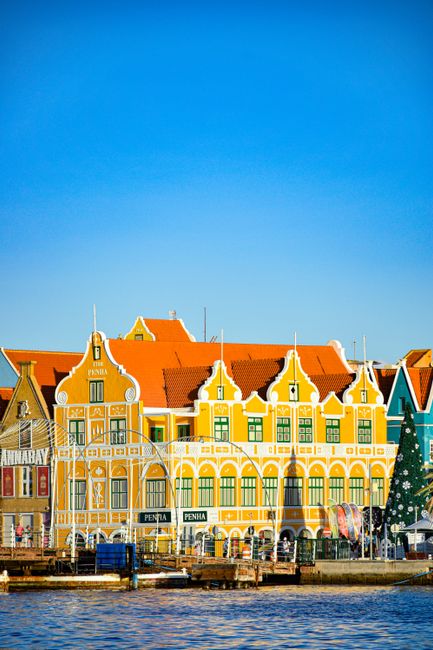
Curaçao is the largest of the Dutch “ABC islands” in the southern Caribbean, about 65 km (40 miles) off the coast of Venezuela, and it has more character than its size suggests. Its capital, Willemstad, is a UNESCO World Heritage city of candy-colored Dutch gabled houses lining a deep natural harbor, crossed by a floating pontoon bridge that swings open for passing ships. Beyond town, the dry, cactus-covered west of the island hides dozens of small coves with brilliant blue water, some of the best shore snorkeling and diving in the Caribbean, and a national park crowned by Christoffelberg, the island’s highest hill. Curaçao is part of the Kingdom of the Netherlands, so you hear Papiamentu, Dutch, English and Spanish in the same street. It is sunny and breezy all year and lies south of the main hurricane belt. A week is ideal: a few days in Willemstad and a few on the beaches of the west.
Right now in Curaçao
- Tue 28–31°C 82–87°F 3 mm Light showers
- Wed 27–31°C 81–88°F 1 mm Light showers
- Thu 28–31°C 82–88°F 3 mm Showers
- Sat 10 Oct Curaçao Day (Dag van Curaçao)
Weather: MET Norway (CC BY 4.0) · Holidays: Nager.Date
Multi-day tours of Curaçao
Multi-day tours from local operators. You check dates and book on Viator, our partner; we may earn a commission at no extra cost to you. How we earn money
Curaçao at a glance: overview and geography
Curaçao is a long, narrow island, about 60 km (37 miles) from end to end and up to roughly 14 km (9 miles) wide, covering some 444 km² (171 square miles). The north coast faces the trade winds and is wild and rocky, with crashing surf and blowholes; the south coast is sheltered and indented with bays, beaches and inlets, among them Willemstad’s harbor, the Schottegat, and the large lagoon of Spanish Water. The western end, called Bandabou, is rural and hilly and holds the best coves; the eastern end, Bandariba, has resorts, marinas and the uninhabited tip of Oostpunt. Christoffelberg rises to 372 m (1,220 feet). About 155,000 people live on the island.
The Caquetío people lived here before Spanish explorers arrived in 1499. The Dutch West India Company took the island in 1634, and Willemstad became a busy trading port and, sadly, a major center of the Caribbean slave trade. Sephardic Jews arrived from the 1650s, and their Mikvé Israel-Emanuel synagogue of 1732 is the oldest in continuous use in the Americas. In 1795 an enslaved man named Tula led a large revolt, remembered every 17 August. Oil arrived in 1915, when Shell built a huge refinery on the Schottegat, and tourism, finance and the port came later. Curaçao was the capital of the Netherlands Antilles until 2010, when it became a separate country within the Kingdom of the Netherlands, with its own government, laws, central bank and immigration rules. It is not part of the European Union or the Schengen area.
Time zone: Curaçao is on Atlantic Standard Time (UTC−4) all year, with no daylight saving, the same as US Eastern Daylight Time in summer and one hour ahead of New York in winter.
The areas of the island
- Willemstad: Punda and Otrobanda on either side of the harbor entrance, the restored mansions of Pietermaai and Scharloo, and the cruise terminals.
- The resort coast east of town: Mambo Beach, the Curaçao Sea Aquarium, Jan Thiel and Spanish Water, with beach clubs, restaurants and marinas.
- Central Curaçao: the Hato Caves near the airport, plantation houses (landhuizen), the salt pans and their flamingos, and the north-coast views at Boka Tabla.
- Bandabou (the west): Christoffel National Park and Shete Boka, and the coves of Cas Abao, Daaibooi, Porto Mari, Playa Lagun, Kenepa Grandi and Kleine Knip, plus the fishing village of Westpunt.
- Klein Curaçao: a flat, uninhabited islet with a lighthouse and a white beach, about two hours away by boat.
Where to go: Willemstad, the west and the coves
Many visitors split their stay: a few nights in Willemstad for history, restaurants and nightlife, then a few nights on the west coast for beaches and diving. If you prefer one base, the Pietermaai district or the resort coast near Mambo Beach puts you close to both town and the sea, but you will want a car either way.
Willemstad: Punda and the Handelskade
Punda, the old walled town on the east side of the harbor entrance, is the heart of Willemstad. The Handelskade, its waterfront row of brightly painted 18th-century merchant houses, is Curaçao’s signature view, best seen from across the water in Otrobanda. Walk to Fort Amsterdam, the seat of government, visit the Mikvé Israel-Emanuel synagogue with its sand-covered floor, browse the floating market where Venezuelan traders once sold fish and fruit from boats, and explore the side streets, now full of murals, cafés and shops. Willemstad’s historic area and harbor have been on the UNESCO World Heritage List since 1997.
Otrobanda and the Queen Emma Bridge
The Queen Emma Bridge, a pontoon bridge first opened in 1888, links Punda with Otrobanda, the “other side”. When a ship approaches, the bridge swings aside on its motorized pontoons and free ferries carry pedestrians across. In Otrobanda, wander the narrow lanes of Kura Hulanda, visit the Kura Hulanda Museum, which tells the story of the slave trade and African history, and climb Rif Fort, now a shopping and dining complex with views over the harbor mouth. High above, the Queen Juliana Bridge carries traffic across the harbor at about 56 m (185 feet), one of the highest bridges in the Caribbean.
Pietermaai and Scharloo
East of Punda, Pietermaai has turned its crumbling seaside mansions into boutique hotels, restaurants and bars, and is the liveliest place to eat and go out in the evening. Across a small bridge, Scharloo has the grandest merchant villas, including the pistachio-green “Wedding Cake House”, and colorful street art.
The west-coast coves
Curaçao’s most beautiful beaches are small coves framed by cliffs on the drive west from Willemstad. Cas Abao has white sand, facilities and great snorkeling; Daaibooi and Porto Mari are calm and family-friendly; Playa Lagun is a narrow inlet where turtles often feed; Kenepa Grandi (Grote Knip) is the postcard cove with a viewpoint above; Kleine Knip next door is smaller and quieter; and at Playa Piskado in Westpunt, sea turtles swim among the fishing boats. Some beaches are free, others charge a small entrance or parking fee and rent sunbeds; bring cash.
Christoffel National Park and Shete Boka
Christoffel National Park, in the far west and managed by the CARMABI foundation, protects dry forest, cacti, orchids, deer and birds around Christoffelberg. The climb to the summit is short but steep and rocky, with a view over the whole island; start early, before the heat, as rangers stop new climbers setting out once the day gets hot. The park’s entrance fee is US$15 for adults and US$2 for children aged 6 to 12, with under-6s free. Nearby, Shete Boka National Park protects the north coast’s limestone inlets, where waves explode into caves such as Boka Tabla, and beaches where sea turtles nest.
Klein Curaçao
Klein Curaçao is a tiny, flat, uninhabited island southeast of Curaçao with a pink-painted old lighthouse, a shipwreck on its rocky windward side and a dazzling white beach with turtles in the shallows. Catamarans and motorboats run day trips from Spanish Water and Jan Thiel, about two hours each way; the crossing can be rough, so take seasickness precautions if you need them.
A few more worth your time
The Hato Caves, limestone caves with stalactites, bats and old rock drawings, near the airport; Landhuis Chobolobo, where the orange-peel liqueur Blue Curaçao is made; the flamingos at the Sint Willibrordus salt pans and Jan Kok; the Tugboat wreck in Caracas Bay, an easy snorkel; the Curaçao Sea Aquarium near Mambo Beach; plantation houses such as Landhuis Knip, a museum of the island’s rural and slave history; and sunset at the cliff-top bars of Westpunt.
Best time to visit Curaçao
Curaçao has a warm, semi-arid climate, with steady easterly trade winds and plenty of sunshine all year. The Meteorological Department of Curaçao puts the dry season from February to May and the rainy season from October to January, with July to September as transitional months; even in the “rainy” season, showers are usually short and often fall at night or early in the morning. The table shows the department’s official averages for Hato Airport, 1981–2010.
| Season (Hato Airport, 1981–2010) | Average afternoon high | Average night low | Rain a month | Days with rain a month | What it’s like |
|---|---|---|---|---|---|
| Jan–Mar | 30–31 °C (86–87 °F) | 24–25 °C (76–77 °F) | 14–46 mm (0.6–1.8 in) | 2.5–8.5 | Peak season: sunny and breezy, drying out after the rains; Carnival. |
| Apr–Jun | 31–32 °C (88–90 °F) | 26–26.5 °C (78–80 °F) | 19–22 mm (0.7–0.9 in) | 2–3 | Dry and windy; great value after Easter; the best months for many. |
| Jul–Sep | 32–33 °C (90–91 °F) | 26–26.5 °C (79–80 °F) | 40–49 mm (1.6–1.9 in) | 4.5–6 | The hottest months, calmer winds and the calmest, clearest sea for diving. |
| Oct–Dec | 30–32 °C (87–90 °F) | 25–26 °C (77–79 °F) | 96–122 mm (3.8–4.8 in) | 8–11.5 | The rainy season: short showers and thunderstorms, greener hills; busy at Christmas. |
That adds up to only about 600 mm (24 inches) of rain a year, with 250–300 hours of sunshine every month. Sea temperatures average about 27 °C (81 °F), from about 26 °C (79 °F) in February and March to 28 °C (83 °F) in September and October.
Hurricanes and sargassum
The Atlantic hurricane season runs from 1 June to 30 November, peaking from August to October, but Curaçao lies on the southern fringe of the hurricane region. According to the Meteorological Department of Curaçao, no hurricane or tropical storm has ever been recorded making direct landfall on the island, and on average a tropical cyclone passes within 100 nautical miles (185 km) only once every 11 years. Passing storms can still bring heavy rain, flooding and rough seas: Tropical Storm Bonnie in June 2022 led to warnings, school closures and coastal flooding on all three ABC islands. The 2026 season had been quiet through early October, with no Atlantic hurricanes and no storm warnings for Curaçao. Sargassum seaweed occasionally washes onto the north and east coasts, but the sheltered south and west coasts, where people swim, are rarely affected.
Crowds and prices through the year
December to April is high season, with visitors from North America and the Netherlands, higher hotel prices and the most cruise ships in Willemstad. Dutch school holidays in summer (July and August) also fill hotels and car rentals. May, June, September, October and November are quieter and cheaper, and the weather is just as dependable.
Festivals and public holidays
Carnival is the year’s biggest party, with weeks of tumba music contests and street parades in Willemstad culminating in the Gran Marcha on the Sunday before Ash Wednesday and the burning of King Momo. Seú, the harvest festival, is celebrated on Easter Monday with a parade of traditional music and dance. Other public holidays include New Year’s Day, Carnival Monday, Good Friday, King’s Day (27 April), Labor Day (1 May), Ascension Day, the Day of the Flag (2 July), Curaçao Day (10 October), Christmas and Boxing Day. Tula Day (17 August) commemorates the 1795 slave revolt.
How long to stay: sample itineraries
Curaçao rewards a slower pace: the best beaches are scattered along the west coast, and you will want time in the water. Rent a car for at least part of your stay.
4 days: Willemstad and the west
Day 1: Punda, the Handelskade, the synagogue and the Queen Emma Bridge, dinner in Pietermaai. Day 2: Otrobanda and the Kura Hulanda Museum, then the Hato Caves and Landhuis Chobolobo. Day 3: drive west for Cas Abao, Playa Lagun and Kenepa Grandi. Day 4: Christoffelberg at dawn, Shete Boka, and lunch in Westpunt.
7 days: town, coves and Klein Curaçao
Three nights in Willemstad and four on the west coast. Add a day trip to Klein Curaçao, a dive or snorkel at the Tugboat and along the west-coast reefs, the flamingos at the salt pans, and a few lazy beach days at Daaibooi or Porto Mari.
10 days or more: the ABC islands
Combine a week on Curaçao with a few days of shore diving on Bonaire, about 30 minutes away by plane, or the resort beaches of Aruba, about 25 minutes away. See our Bonaire guide and our Aruba guide.
Entry, money, fees and costs
Entry and the Digital Immigration Card (last reviewed October 2026)
Curaçao sets its own entry rules within the Kingdom of the Netherlands. It is not part of the Schengen area, so the EU’s Entry/Exit System and ETIAS do not apply here. You need a passport valid for your whole stay, a return or onward ticket and enough money for your visit. Citizens of the United States, Canada, the UK, the EU and many other countries can visit as tourists without a visa, usually for up to 90 days; other nationalities should check the visa rules, which follow a Kingdom-wide list for the Dutch Caribbean islands.
- Digital Immigration Card (DI card): every foreign visitor must complete this online form on the official site, dicardcuracao.com, up to 7 days before departure. There is one card per person per trip; for later visits you update your existing card. Residents of Curaçao are exempt. The official form is free, so avoid sites that charge for “processing”.
- No entry fee yet: unlike Aruba and Bonaire, Curaçao did not charge visitors an entry or sustainability fee as of October 2026. The government has proposed replacing the 7% tax on accommodation with a flat tourist entry tax from 2027, but it was not in force; check the Curaçao Tourist Board before you travel.
- Departure: airport charges are included in airline tickets. There is no US preclearance in Curaçao: you clear US immigration on arrival in the United States.
Languages and a few useful words
Curaçao’s official languages are Papiamentu, Dutch and English, and Spanish is widely spoken. Papiamentu, the everyday language, is a Creole with Portuguese, Spanish, Dutch and African roots. Try bon dia (good morning), bon tardi (good afternoon), bon nochi (good evening), danki (thank you), por fabor (please), kon ta bai? (how are you?) and bon bini (welcome).
Money: the Caribbean guilder and US dollars
On 31 March 2025, Curaçao and Sint Maarten replaced the old Netherlands Antillean guilder with a new currency, the Caribbean guilder (code XCG, written Cg), according to their joint central bank. It is pegged to the US dollar at Cg 1.79 to US$1; the old guilder stopped being legal tender after 30 June 2025, so don’t accept old notes. US dollars are accepted in most hotels, restaurants, shops and taxis, though change usually comes in guilders. Cards are widely accepted; carry some cash for beach entrance fees, snack trucks (truk’i pan) and small shops. Tipping: check the bill for a service charge, often 10–15%; if there isn’t one, tip about 10–15% in restaurants.
Hotel taxes and service charges
Since 2016, Curaçao’s old room tax has been part of the sales tax: according to the Curaçao Tourist Board, accommodation is charged 7% sales tax (omzetbelasting). Hotels usually add a service charge of their own, often around 10–12%, and some add a small daily fee for the tourist board or for energy, so compare the full price when booking. As noted above, the government has proposed abolishing the 7% tax on short stays and introducing a per-visitor entry tax from 1 January 2027; press reports in September 2026 cited US$75 for adults, but the law had not been passed.
Typical travel costs
Curaçao is somewhat cheaper than Aruba, especially for food and apartments, but a hire car is close to essential. These estimates, per person per day, are a planning guide as of October 2026:
| Style | Estimated cost per day | What that looks like |
|---|---|---|
| Budget | about US$90–140 (Cg 160–250) | Apartment or guesthouse shared by two, supermarket breakfasts, truk’i pan and local lunch spots (snèks), a small hire car shared by two, free beaches |
| Mid-range | about US$180–300 (Cg 320–540) | Boutique hotel in Pietermaai or a resort near Mambo Beach shared by two, restaurant dinners, guided dives or a Klein Curaçao trip |
| High-end | about US$450+ (Cg 800+) | Luxury resort or villa with a pool, fine dining, private boat trips and guided tours |
Add beach entrance and parking fees (a few dollars at many west-coast coves), park entrance fees such as Christoffel’s US$15, and fuel. The figures are our estimates, not official statistics.
Getting there and getting around
Flights and cruise ships
Curaçao International Airport (CUR), at Hato on the north side of the island, is about 12 km (7.5 miles) from central Willemstad. It has nonstop flights from several US gateways, including Miami and other East Coast cities, from Toronto, from Amsterdam with KLM and TUI, and from South America and other Caribbean islands; regional airlines fly to Aruba and Bonaire in under 30 minutes. Cruise ships dock at the Mega Pier in Otrobanda and the terminal near Punda, both within walking distance of the old town.
Driving and getting around
A hire car is the most practical way to explore Curaçao: public buses are infrequent and don’t reach most beaches, and taxis are expensive for longer trips. Curaçao drives on the right; a valid US, Canadian, UK or EU license is accepted. Roads are generally fine, but watch for potholes, goats, speed bumps and roundabouts. Park in visible places and never leave valuables in the car. Taxis are unmetered with set fares; agree the price first. In Willemstad, Punda, Otrobanda and Pietermaai are best explored on foot, and free ferries cross the harbor when the pontoon bridge is open.
Beaches, the sea and safety in the water
Curaçao has more than 35 beaches, almost all on the calm south and west coasts. Most are small coves with coarse coral sand and pebbles, clear water and a reef that starts just offshore, so snorkeling and diving from the shore are excellent. The north coast is beautiful but dangerous for swimming. See our beaches guide, plus snorkeling, diving and boat trips.
- Water shoes: many coves have rocky or pebbly entries and sea urchins; wear water shoes.
- Turtles: sea turtles are common at Playa Lagun, Playa Piskado and Klein Curaçao. Watch them from a distance, don’t touch or feed them, and don’t chase them.
- Reef care: don’t stand on coral, don’t take shells or coral, and use reef-friendly sunscreen. The reef east of Willemstad is a protected marine park.
- Cliff jumping: popular at Kenepa Grandi and Playa Forti in Westpunt; check the depth and never jump alone.
- Lifeguards: few beaches have them; keep children in sight and avoid swimming after drinking.
Safety, health and connectivity
Safety
Most visits to Curaçao are trouble-free. The common problems are theft from parked cars, especially at beaches and viewpoints, and bag snatching or pickpocketing in crowded areas; leave nothing visible in the car and use hotel safes. Some neighborhoods of Willemstad away from the tourist areas have higher crime, so stick to well-lit, busy streets at night and take a taxi back to your hotel late in the evening. Drive carefully at night, when roads are poorly lit. Emergency number: 911 for police, ambulance and fire. The main hospital is the Curaçao Medical Center in Willemstad.
Health and the sun
The trade wind hides the strength of the sun: wear high-factor sunscreen and a hat, and drink plenty of water, especially when climbing Christoffelberg. Tap water is desalinated and safe to drink. Dengue and other mosquito-borne illnesses occur in the region, so use repellent, especially in the rainy season. Travel insurance with medical cover is essential, as care in Curaçao can be costly and serious cases may need evacuation.
Accessibility
Punda’s main streets are flat and partly pedestrianized, and the larger resorts are accessible, but many sidewalks are uneven, and the coves are reached by steps or rocky paths. Christoffelberg and the north-coast parks are not accessible for wheelchair users.
Connectivity and power
Mobile coverage is good on most of the island, and local providers sell prepaid SIM and eSIM plans. Wi-Fi is standard in hotels and cafés. Electricity is about 127 V at 50 Hz, with US-style type A and B sockets; most phone and laptop chargers work fine, but some American appliances with motors or clocks may run differently, and Europeans need a travel adapter.
Food, drink and culture
Curaçao’s cooking mixes African, Dutch, Latin American, Sephardic and Asian influences. Look for keshi yená (cheese stuffed with spiced meat), stobá (stews of goat, beef or papaya), sòpi di piská (fish soup), funchi (cornmeal), pastechi for breakfast, sate and bami with Indonesian roots, and very fresh fish grilled at the beach shacks of Westpunt. Eat lunch the local way at the Plasa Bieuw (old market) behind Punda, where cooks serve hearty plates at long tables, and try a truk’i pan sandwich truck late at night. Drink Amstel Bright beer brewed locally, fresh juices, and, of course, a cocktail with Blue Curaçao. Music is everywhere, from tambú drumming to tumba, salsa and Dutch and Caribbean pop. Willemstad’s churches, synagogue and mansions reflect the island’s long mixed history; cover up when you leave the beach.
Things to do: diving, hiking and history
- Diving: dozens of shore dives along the west coast, the Tugboat, the Superior Producer wreck near Willemstad, the “Mushroom Forest” and the drop-offs around Klein Curaçao. Many dive shops offer unguided shore diving with a truck and tanks.
- Snorkeling: Playa Lagun, Cas Abao, Playa Piskado, the Tugboat and Klein Curaçao.
- Hiking: Christoffelberg and the trails of Christoffel and Shete Boka parks; start at dawn. See our hiking guide.
- Boat trips: Klein Curaçao, sunset sails along the coast, and kayaking in Spanish Water.
- History and culture: Punda’s synagogue and Jewish Cultural Historical Museum, the Kura Hulanda Museum, the Maritime Museum, Landhuis Knip and the street art of Otrobanda and Scharloo. See our city sightseeing guide.
What to pack
Light clothes, swimwear, a sun hat, sunglasses, high-factor reef-friendly sunscreen, a refillable water bottle, a snorkel mask and water shoes for the rocky coves. Bring proper walking shoes if you plan to climb Christoffelberg, insect repellent, a light rain jacket from October to January, and something a little smarter for dinner in Pietermaai. Europeans need a US-style plug adapter.
Curaçao travel FAQ
Do I need a visa or passport for Curaçao?
You need a passport valid for your stay. US, Canadian, UK and EU citizens don’t need a visa for a tourist visit; other nationalities should check the Dutch Caribbean visa list.
What is the Curaçao Digital Immigration Card?
A free, mandatory online immigration form for all foreign visitors, completed on dicardcuracao.com up to 7 days before departure. Each person needs one card per trip.
Is there a tourist tax in Curaçao?
Accommodation is charged 7% sales tax, and hotels add service charges. As of October 2026 there was no entry fee, but the government has proposed one from 2027 to replace the tax on rooms.
What currency does Curaçao use?
The Caribbean guilder (XCG), introduced on 31 March 2025 and pegged at Cg 1.79 to US$1. US dollars and cards are widely accepted.
When is the best time to visit Curaçao?
Any time of year. February to May is driest; May, June and September to November are quieter and cheaper; October to January brings short showers.
Does Curaçao get hurricanes?
Very rarely. The island lies south of the main hurricane belt, and the local met service has no record of a hurricane making direct landfall. Passing storms can bring heavy rain.
Do I need to rent a car in Curaçao?
For the beaches and parks, yes. Buses are infrequent and don’t serve most coves. In Willemstad you can walk.
What are the best beaches in Curaçao?
Kenepa Grandi, Kleine Knip, Playa Lagun, Cas Abao, Daaibooi and Porto Mari on the west coast, and the white beach of Klein Curaçao.
How much does Christoffel National Park cost?
US$15 for adults, US$2 for children aged 6 to 12, free for under-6s. Start the climb early, before the midday heat.
Is the tap water safe in Curaçao?
Yes. It is desalinated seawater and safe to drink.
Is Curaçao safe for tourists?
Generally yes. Don’t leave valuables in parked cars, stay in busy areas at night in Willemstad, and call 911 in an emergency.
How far is Curaçao from Aruba and Bonaire?
About 25–30 minutes by plane to either island; there is no regular passenger ferry. See our Aruba guide and our Bonaire guide.
Sources and last review
Researched and last reviewed on 4 October 2026. The Digital Immigration Card rules come from the official dicardcuracao.com portal; the currency from the Centrale Bank van Curaçao en Sint Maarten; the 7% sales tax on rooms from the Curaçao Tourist Board; the climate averages (Hato Airport, 1981–2010), the hurricane record and sea temperatures from the Meteorological Department of Curaçao; the 2026 hurricane season from the US National Hurricane Center; and Christoffel Park fees from CARMABI’s park site. The proposed 2027 entry tax, the population, visa-free stay lengths, flight routes, the electricity supply and the hotel service charges come from secondary sources and are flagged for checking. Daily costs are estimates. Prices and rules change, so check the official sites before you travel.
Plugs and power in Curaçao
Curaçao uses 127 V, 50 Hz and these plugs (left) and wall sockets (right):
All plug types and voltages by country → · Check what you need to pack →
Plan your trip
Partner links: TravelerCenter may earn a commission if you book, at no extra cost to you.
🇳🇱 Useful Dutch phrases for Curaçao
All 38 Dutch phrases: restaurant, hotel, emergencies, romance (printable) →