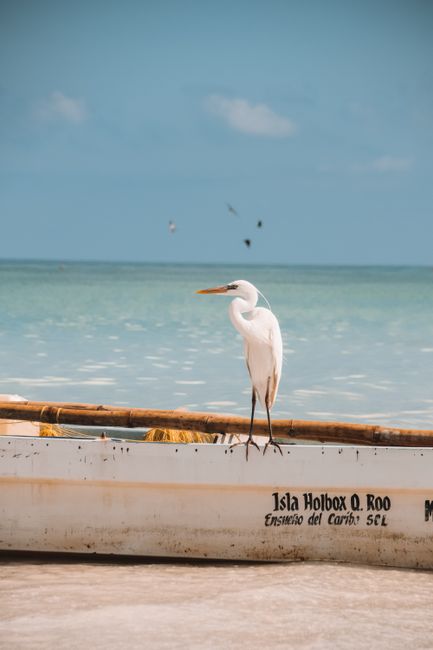
Holbox is a long, thin island off the northern tip of the Yucatán Peninsula, in the state of Quintana Roo, where the Caribbean meets the Gulf of Mexico. Its single village has sandy streets, brightly painted houses and murals, and almost no cars: people get around on foot, by bike and in golf carts. The island lies inside the Yum Balam protected area, between a shallow lagoon full of birds and a sea of pale green water, and from mid-May to mid-September it is one of the best places in the world to swim with whale sharks. Visitors come for slow days in hammocks, sandbars at low tide, flamingos, sunsets and, on dark nights, glowing bioluminescent plankton. It is a ferry ride from the small port of Chiquilá, about two hours by road from Cancún.
Right now in Holbox
- Tue 25–30°C 78–86°F 6 mm Rain
- Wed 25–30°C 76–86°F 7 mm Heavy showers
- Thu 25–31°C 76–87°F 4 mm Rain
Weather: MET Norway (CC BY 4.0) · Sea temperature: NOAA CoastWatch · Rates: ECB
Top tours in Holbox
See all tours for Holbox →
From local operators, with prices and reviews; you check availability and book on Viator, our partner. We may earn a commission at no extra cost to you. How we earn money
Holbox at a glance
- Best for: a laid-back island escape, whale sharks in summer, birds and flamingos, kitesurfing, fly-fishing, sunsets and barefoot village life.
- How long: 2–3 days for the beaches, sandbars and a boat tour; 4–5 days in whale shark season or to really slow down.
- Best time: December to April for dry weather (highs of 29–31 °C, 84–88 °F); May 15 to September 17 for whale sharks. September and October are the rainiest months and the peak of hurricane season.
- Getting there: fly to Cancún (CUN), then about two hours by bus, shuttle or car to Chiquilá and a 20- to 30-minute ferry crossing.
- Getting around: on foot, by bike or golf-cart taxi; no rental cars on the island.
- Before you go: pay the Quintana Roo VISITAX (MXN 293 per foreign visitor as of October 2026); entry rules, money and general safety are in our Mexico travel guide; for the rest of the coast, see our Cancún and Isla Mujeres guides.
Holbox’s areas: where things are
The island is about 40 km (25 miles) long but only a few hundred meters wide in places. The village sits at its western end, facing the open sea to the north and the Yalahau lagoon to the south; the beaches run east and west of it.
The village
A grid of sandy streets around the main square, with its church, basketball court and food stalls in the evening. Restaurants, shops, tour agencies and guesthouses line the streets, many decorated with large murals. The ferry dock is on the lagoon side, a short golf-cart ride from the beach.
Playa Holbox and the eastern beaches
The beach in front of the village runs east past beach bars and boutique hotels, with calm, shallow water and hammocks strung in the sea. Further east, the hotels thin out and the beach becomes quieter toward Punta Mosquito.
Punta Cocos and the west
West of the village, a sandy track leads to Punta Cocos, the island’s western tip, a favorite spot for sunset and, on moonless nights, for seeing bioluminescence in the water.
Top things to see in Holbox
Prices and hours below were checked on the official sites in October 2026, unless we say otherwise; check again before you go.
Swimming with whale sharks
The world’s largest fish gather to feed on plankton in the open sea between Holbox, Cabo Catoche and Isla Mujeres. The authorized season for watching and swimming with them in the Mexican Caribbean runs from May 15 to September 17 for 2025 to 2027, under the environment ministry’s (Semarnat) management plan, and sightings usually peak in July and August. Trips leave early and spend a long time at sea; only authorized boats with permits may operate, a guide takes small groups into the water at a time, and you must keep your distance, never touch the sharks and wear a life jacket or wetsuit. The National Commission of Natural Protected Areas (CONANP) charges MXN 225 (about US$12) per person per day for the Whale Shark Biosphere Reserve, usually included in the tour price.
Punta Mosquito and the sandbars
East of the village, at low tide, you can wade along shallow sandbars to Punta Mosquito, where flamingos, pelicans and other birds often feed. Parts of the area are protected nesting zones: stay behind any ropes or signs, keep your distance from birds, and go with the tide table, as the water rises quickly.
Three-island boat tour
The classic half-day boat trip visits Isla Pasión, a tiny islet with a beach; Isla de los Pájaros (Bird Island), a refuge for frigatebirds, cormorants, herons and sometimes flamingos, seen from wooden walkways and towers; and the Yalahau spring, a freshwater cenote at the edge of the lagoon, once used by pirates for water. Choose operators who keep away from nesting birds.
Bioluminescence
On dark nights, especially from about May to October, plankton glow blue-green when the water moves. Punta Cocos and the shallow lagoon side are the usual places; go with a guide or in a group, without lights, and don’t use sunscreen or repellent in the water.
More to see
- The murals: giant street paintings by Mexican and international artists all over the village.
- Sunset at the pier and the beach bars: the west-facing beaches have some of the best sunsets in Quintana Roo.
- Cabo Catoche: the north-eastern tip of the Yucatán, with a lighthouse, reached by boat tours that combine snorkeling and fishing.
- Yum Balam Protected Area
Activities and best months
- SnorkelingMayJunJulAugSepCONANP's Whale Shark Biosphere Reserve off Holbox holds Mexico's largest concentration of whale sharks; it opens daily 7:00-18:00 (MXN 225), and the swimming season in the Mexican Caribbean runs 15 May-17 September on permitted boats. · source
Other things to do in Holbox
Kitesurfing, kayaking and paddleboarding
Steady winds and shallow, flat water make Holbox a good place to learn kitesurfing, especially from about November to March, when northerly winds blow; schools on the beach rent gear. Kayaks and paddleboards are ideal for exploring the mangroves on the lagoon side with a guide. See our beaches guide.
Fly-fishing and snorkeling
The shallow flats around the island are famous for fly-fishing for tarpon, especially in early summer, and for bonefish and permit; book a licensed guide. Snorkeling is limited near the village, as the water is shallow and often murky, but boat trips go to reefs near Cabo Catoche. See our snorkeling guide.
Food
Holbox’s signature dish is lobster pizza, but also try fresh ceviche, fish tacos and Yucatecan food at the stalls on the main square in the evening. Many restaurants close one day a week and some close in the quiet months of September and October.
Day trips from Holbox
- Yalahau and the lagoon: a boat trip through the Yum Balam lagoon to the freshwater spring and Isla de los Pájaros.
- Cabo Catoche and Isla Contoy area: boat tours east to the cape’s lighthouse, reefs and fishing grounds.
- Chiquilá and the mainland: Chiquilá itself is just a ferry port, but with a car you can explore El Cuyo, a quiet fishing village on the Yucatán coast with pink salt lagoons nearby.
- Valladolid and Chichén Itzá: about two to three hours south by road; see our Mérida guide for the Yucatán’s Maya sites and colonial towns.
Nearby destinations
- Cancun70 km
- Isla Mujeres72 km
- Riviera Maya104 km
- Playa del Carmen104 km
- Cozumel Island132 km
- Tulum146 km
- Mérida240 km
Getting there and getting around
From Cancún to Chiquilá
Most visitors fly into Cancún International Airport (CUN). According to ADO, its buses link Chiquilá and Cancún airport Terminal 2 in about 2 hours 5 minutes, with up to four departures a day, for about MXN 542 (about US$30) one way; buses also run from downtown Cancún. Private shuttles go door to dock, and with a rental car you can leave it in one of the guarded parking lots in Chiquilá, as cars are not allowed on the island.
The ferry from Chiquilá
Two passenger ferry companies, Holbox Express and 9 Hermanos, cross between Chiquilá and Holbox. According to ADO, they alternate so that there is a departure roughly every 30 minutes in the daytime; the crossing takes about 20–30 minutes. Pay at the dock, and allow at least an hour between the ferry and your bus back. Since December 2025, day visitors who do not stay overnight also pay Lázaro Cárdenas’s environmental fee, collected by the ferry operator (see the taxes section below).
Getting around Holbox
The village is small enough to walk. Golf-cart taxis wait at the ferry dock and around town and charge fixed fares in cash; bikes are the best way to reach the beaches and Punta Cocos. You can rent golf carts, but the sandy streets get muddy after rain and traffic is restricted in places.
When to go and how long to stay
Holbox is warm all year. The table uses the National Meteorological Service’s (SMN-Conagua) 1961–1990 climate normals for the Isla Holbox station, the only official normals measured on the island: average daily highs and lows, and days with rain.
| Season | Average high / low | Rainy days per month | What it’s like | Good for |
|---|---|---|---|---|
| Winter (Dec–Feb) | 29–30 °C (85 °F) / 20–21 °C (68–70 °F) | 3–4 | Warm and mostly dry; northerly fronts bring windy, cooler days | Kitesurfing, birds, quiet beaches |
| Spring (Mar–May) | 31–32 °C (87–90 °F) / 21–22 °C (69–72 °F) | 2–4 | Dry, sunny and calm; whale shark season opens May 15 | Beaches, sandbars, flamingos |
| Summer (Jun–Aug) | 32 °C (89–90 °F) / 22–23 °C (72–73 °F) | 6–7 | Hot and humid, with short storms; busy with whale shark trips | Whale sharks, bioluminescence, tarpon |
| Fall (Sep–Nov) | 32 °C falling to 30 °C (89 to 87 °F) / 23 °C falling to 22 °C (73 to 71 °F) | 7–8 in September and October, 4 in November | The wettest and quietest months; some places close | Low prices; watch the forecast |
The station recorded about 875 mm (34 in) of rain a year; September is the wettest month, with about 119 mm (5 in). These are older normals (1961–1990); nearby mainland stations with 1991–2020 normals, such as Solferino, record more rain.
Hurricane season: according to NOAA’s National Hurricane Center, the Atlantic hurricane season runs from June 1 to November 30, peaking from mid-August to mid-October. Holbox is low-lying, and ferries stop in storms. If a storm threatens, follow the instructions of Quintana Roo’s civil protection authorities and your hotel, and check Mexico’s National Meteorological Service (SMN) and the National Hurricane Center; travel insurance that covers weather is wise.
Sargassum and bugs: Holbox’s north-facing beaches usually see less sargassum seaweed than the coast south of Cancún, but it can arrive in some seasons; the Mexican Navy (SEMAR) publishes daily bulletins for Quintana Roo. Mosquitoes and tiny biting sand flies are common at dusk, especially after rain.
2 to 3 days in Holbox
Day one, arrive, walk the village and the murals, and watch the sunset from the beach. Day two, the three-island boat tour in the morning, an afternoon in a hammock and a low-tide walk toward Punta Mosquito. Day three, cycle to Punta Cocos, try kayaking in the mangroves and, on a dark night, look for bioluminescence.
4 to 5 days in Holbox
In season, add a whale shark trip, best early in your stay in case the weather cancels it. Otherwise, add a kitesurfing lesson, a fishing trip or a boat to Cabo Catoche, and simply slow down.
Where to stay in Holbox and the hotel taxes
- The village: hostels, guesthouses and small hotels near the square; the cheapest and most convenient.
- The beach east of the village: boutique hotels and cabañas on the sand, within walking distance of town.
- Further east toward Punta Mosquito: quieter, more expensive eco-hotels; you will depend on golf carts or bikes.
- Punta Cocos side: a few small hotels and rentals near the island’s west end and its sunsets.
Rooms carry 16% federal IVA plus Quintana Roo’s lodging tax of 5% (6% when booked through a platform such as Airbnb), according to the state’s lodging tax law. The municipality of Lázaro Cárdenas also charges an environmental sanitation fee of 30% of Mexico’s daily UMA reference unit, MXN 35.19 (about US$2) per visitor per night as of 2026, collected by the hotel; since December 2025, day visitors to the island who do not stay overnight pay the same amount through the ferry operator. Residents of the municipality and people with disabilities are exempt. Every foreign visitor must also pay the state’s VISITAX of MXN 293 before leaving Quintana Roo.
Practical tips for Holbox
- Cash: bring plenty of pesos from Cancún; the island has few ATMs, they can run out of cash, and many places, golf-cart taxis and ferries take cash only.
- Tides: check the tide times before walking out to the sandbars, and stay inside marked areas near bird colonies.
- Protect wildlife: never touch whale sharks or flamingos, keep your distance from nesting birds, and use biodegradable sunscreen.
- Tipping: 10–15% in restaurants; tip boat crews and guides.
- Safety: Holbox is a small, quiet island. Watch your belongings on the beach, use lights on bikes at night, don’t swim far out alone or after drinking, and don’t buy drugs.
- Emergencies: call 911; medical services on the island are basic, and serious cases are taken to the mainland.
What to pack for Holbox
Pack light: beachwear, a hat, sunglasses and biodegradable, reef-friendly sunscreen, a rash guard or thin wetsuit for whale shark trips, and sandals or water shoes for the sandbars. Bring strong insect repellent, a light long-sleeved layer for dusk, a headlamp for the dark streets and beaches, a dry bag for boat trips, enough cash, and a light rain jacket from June to November. Plugs are the US type.
What to pack
- Reef-friendly sunscreenSnorkelers burn their backs fast; mineral sunscreen and a rash vest are kinder to marine life.
- Snorkel masks and finsYour own mask fits better than a rental and makes clear-water coves and lava pools more fun.
- Water shoesEntries are often over rock, so water shoes protect feet getting in and out.
- WetsuitsEven in summer, 30+ minutes in 19–23 °C water gets cold; a 2–3 mm suit extends sessions.
Holbox travel FAQ
When is whale shark season in Holbox?
The authorized season in the Mexican Caribbean runs from May 15 to September 17 (2025–2027), under Semarnat’s management plan; sightings usually peak in July and August.
How do I get from Cancún to Holbox?
Take an ADO bus, shuttle or car to Chiquilá, about two hours, then a passenger ferry of 20–30 minutes. ADO’s buses between Chiquilá and Cancún airport cost about MXN 542.
How often do the ferries to Holbox run?
Two companies alternate, with a departure roughly every 30 minutes in the daytime, according to ADO. The crossing takes about 20–30 minutes.
Can you bring a car to Holbox?
No. Visitors’ cars are not allowed on the island; leave yours in a guarded lot in Chiquilá. On Holbox, people walk, cycle or use golf carts.
Do I have to pay VISITAX to visit Holbox?
Yes. Holbox is in Quintana Roo, so every foreign visitor pays VISITAX, MXN 293 as of October 2026, online at visitax.gob.mx before leaving the state.
What fees and taxes are added in Holbox?
16% IVA, Quintana Roo’s 5% lodging tax (6% via platforms) and Lázaro Cárdenas’s fee of MXN 35.19 per visitor per night; day visitors pay that fee through the ferry. VISITAX is separate.
Are there ATMs on Holbox?
Only a few, and they can run out of cash. Bring enough pesos from Cancún; many businesses take cash only.
When can you see bioluminescence in Holbox?
On dark nights without a moon, most often from about May to October. Go with a guide to Punta Cocos or the lagoon side, and don’t use lights.
How much is the Whale Shark Reserve fee?
CONANP charges MXN 225 (about US$12) per person per day for the Whale Shark Biosphere Reserve, usually included in tour prices.
What is the best time to visit Holbox?
December to April for dry, sunny weather, or May 15 to September 17 for whale sharks. September and October are the wettest months.
Sources
- © OpenStreetMap contributors · ODbL · fetched 4 Oct 2026
- Wikidata · CC0 · fetched 4 Oct 2026
Sources and last review
Researched and last reviewed on 4 October 2026. Whale shark season: the environment ministry’s (Semarnat) management plan for the Mexican Caribbean, 2025–2027; protected-area fees: the National Commission of Natural Protected Areas (CONANP); buses and the ferry frequency: ADO; the island’s environmental fee: the Lázaro Cárdenas municipal finance law, as reformed on December 10, 2025, published by the Quintana Roo congress; lodging tax and VISITAX: Quintana Roo’s state laws and visitax.gob.mx; hurricane season: NOAA’s National Hurricane Center; climate: SMN-Conagua 1961–1990 normals for the Isla Holbox station. Distances, crossing times, golf-cart and ATM details, bioluminescence, kitesurf and fishing seasons and local sights come from secondary sources or general knowledge and are flagged for checking. Prices and timetables change, so check the official sites before you go. For entry rules, money and general safety, see our Mexico travel guide.
Plan your trip
Partner links: TravelerCenter may earn a commission if you book, at no extra cost to you.
🇪🇸 Useful Spanish phrases for Holbox
All 38 Spanish phrases: restaurant, hotel, emergencies, romance (printable) →