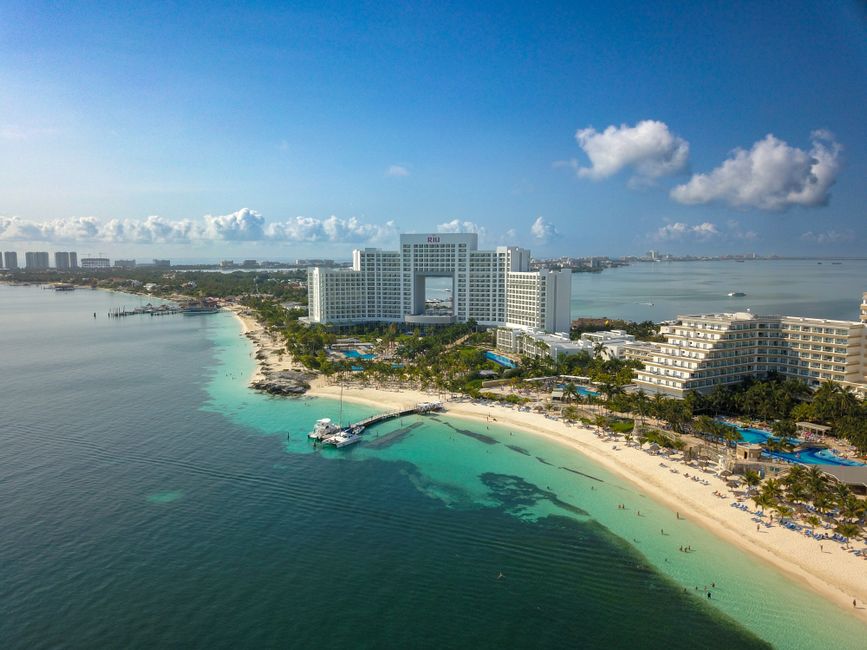
Cancún is Mexico’s biggest beach resort and the gateway to the whole Mexican Caribbean: a 7-shaped sandbar of white beaches and turquoise water lined with hotels, a busy Mexican city on the mainland behind it, and the reefs, islands, cenotes and Maya ruins of Quintana Roo within easy reach. Come for the sea, the nightlife and the all-inclusive resorts, but also for the underwater sculptures of MUSA, the Maya Museum, ferries to Isla Mujeres, and day trips to Chichén Itzá, Tulum and Playa del Carmen. The best weather is from December to April, when it is warm, sunny and fairly dry; summer is hot and humid, and the Atlantic hurricane season runs from June to November, with September and October the wettest months.
Right now in Cancun
- Tue 25–31°C 76–88°F 4 mm Showers
- Wed 25–31°C 76–89°F 5 mm Rain
- Thu 24–31°C 75–87°F 3 mm Heavy rain
Weather: MET Norway (CC BY 4.0) · Sea temperature: NOAA CoastWatch · Rates: ECB
Top tours in Cancun
See all tours for Cancun →
From local operators, with prices and reviews; you check availability and book on Viator, our partner. We may earn a commission at no extra cost to you. How we earn money
Cancún at a glance
- Best for: white-sand beaches, all-inclusive resorts, snorkeling and diving, nightlife, family holidays, and a base for the islands, the Riviera Maya and the Maya sites.
- How long: 4–5 days for the beaches, MUSA and Isla Mujeres; a week or more to add Chichén Itzá, cenotes and Tulum.
- Best time: December to April, with highs of 29–34 °C (84–94 °F) and fewer rainy days. Summer highs reach 35 °C (95 °F); September and October are the wettest months and the peak of hurricane season.
- Getting there: Cancún International Airport (CUN), about 20 minutes from the southern Hotel Zone, with ADO buses, shuttles and authorized taxis; the Tren Maya’s Cancún Aeropuerto station is nearby.
- Getting around: city buses run the length of the Hotel Zone and into downtown day and night; taxis, ferries to Isla Mujeres, and a rental car or tours for day trips.
- Fees to know: every foreign visitor to Quintana Roo pays VISITAX, MXN 293 (about US$16) per person as of October 2026, online at visitax.gob.mx before leaving the state.
- Before you go: entry rules, money and general safety are in our Mexico travel guide; for the rest of the coast, see our Playa del Carmen, Isla Mujeres, Cozumel, Tulum and Riviera Maya guides.
Cancún’s areas: where things are
Cancún was planned by the Mexican government in the early 1970s on an almost empty coast. It has two halves: the Hotel Zone (Zona Hotelera), a long, thin barrier island between the Caribbean and the Nichupté lagoon, and downtown Cancún (El Centro), the real city where most locals live. Hotel Zone addresses are given by the kilometer marker on Boulevard Kukulcán, its single road, from about km 1 near downtown to about km 25 at Punta Nizuc, near the airport.
Hotel Zone north (km 1–9)
The short top of the “7” faces north onto the Bahía de Mujeres and has the calmest, shallowest water in Cancún, good for children. Playa Langosta, Playa Tortugas and Playa Caracol are small and sheltered, and hotels are often cheaper and closer to downtown.
Punta Cancún (km 9)
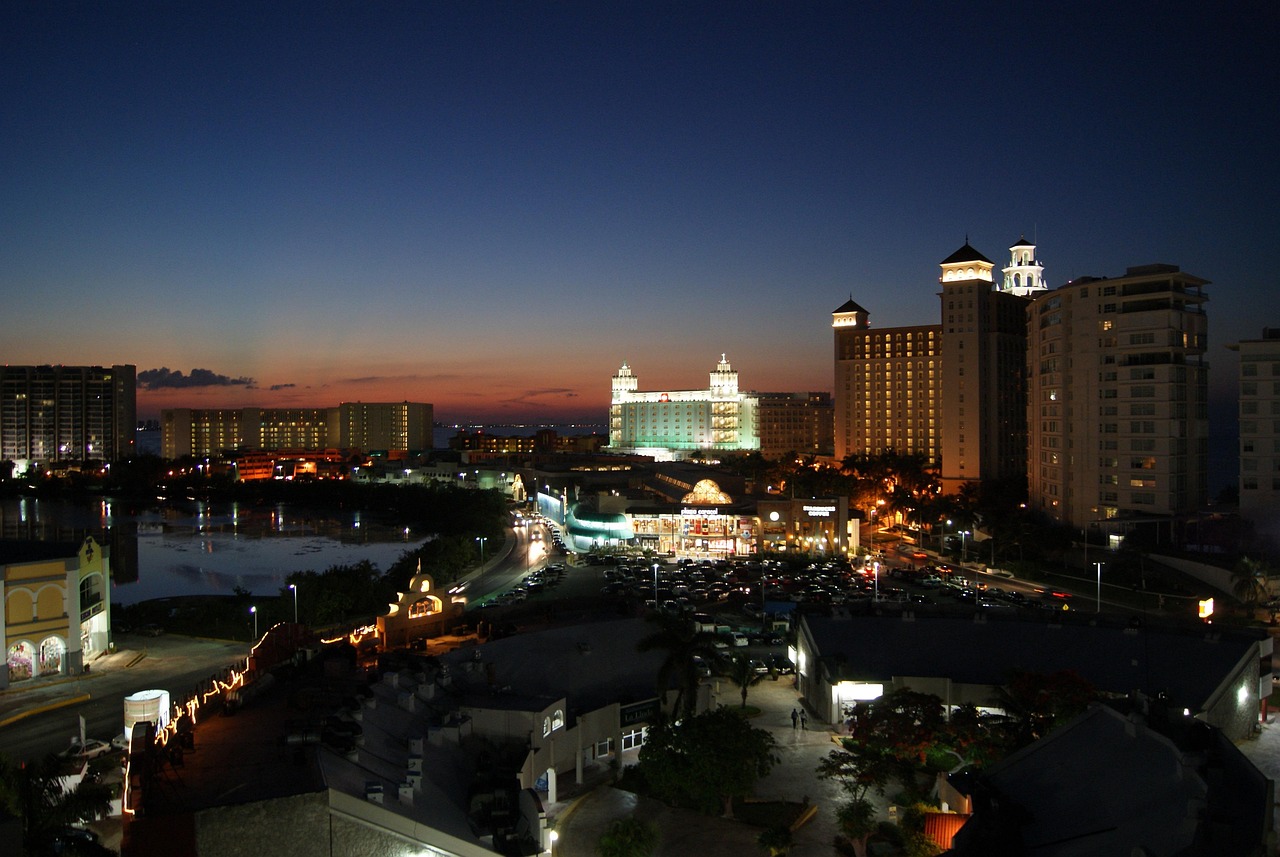
At the corner of the “7”, the “Party Center” packs in the big nightclubs, bars, the convention center and malls such as La Isla and Plaza Caracol. It is loud late at night and full of spring breakers in March.
Hotel Zone south (km 9–25)
The long side of the “7” faces the open sea, with wide, powdery beaches, bigger waves and most of the large all-inclusive resorts. Playa Chac Mool, Playa Marlín and Playa Delfines are the best-known public beaches, and the Maya Museum, El Rey ruins and the MUSA boats for Punta Nizuc are here.
Downtown, Puerto Juárez and Costa Mujeres
Downtown is where you find local prices: taquerías, the Parque de las Palapas square, the Mercado 28 crafts market, the ADO bus terminal and Avenida Tulum, the main street. Just north, Puerto Juárez is the main ferry port for Isla Mujeres, and beyond it Costa Mujeres has newer, quieter resorts.
Top things to see in Cancún
Prices and hours below were checked on the official sites in October 2026, unless we say otherwise; check again before you go. Many museums close on Mondays.
The Maya Museum of Cancún and San Miguelito
The Museo Maya de Cancún, run by the National Institute of Anthropology and History (INAH) at about km 16.5 of the Hotel Zone, shows some of the best finds from Quintana Roo’s Maya sites and the flooded caves around Tulum. The ticket includes San Miguelito, a small archaeological zone in the jungle behind it. As of October 2026, it opens Tuesday to Sunday, 9 a.m. to 6 p.m. (last entry to San Miguelito 4:30 p.m.), and entry costs MXN 210 (about US$12) for foreign visitors and MXN 105 for Mexicans and residents; under-13s and over-60s go free. Quintana Roo’s fees law also sets a separate state charge for foreign visitors at these sites, so ask at the ticket office what you will pay in all.
MUSA, the Underwater Museum of Art
MUSA is a collection of concrete sculptures placed on the seabed to draw divers and snorkelers away from the natural reefs and give corals a new place to grow; Jason deCaires Taylor’s “Silent Evolution” alone is a crowd of about 450 figures. The galleries are at Punta Nizuc (shallow, for snorkeling and glass-bottom boats), Manchones (deeper, off Isla Mujeres, for diving) and Punta Sam. As of October 2026, MUSA’s own tours start at about US$58 for snorkeling or a glass-bottom boat at Punta Nizuc and about US$115 for certified divers. The galleries lie inside a national park where the national protected areas agency, CONANP, charges a wristband of MXN 125 (about US$7) per person per day, usually collected by the operator. Life jackets are compulsory, and you must not touch the sculptures or the coral.
El Rey and El Meco archaeological zones
El Rey, near km 18 of the Hotel Zone, is a small Maya settlement of platforms along a main street, famous for the iguanas sunning on its stones. According to INAH it opens daily from 8 a.m. to 5 p.m., and entry costs MXN 145 (about US$8), or MXN 80 for Mexicans and residents. El Meco, on the road north to Punta Sam, has the tallest pyramid in the Cancún area; it opens daily from 8 a.m. to 4:30 p.m., also MXN 145. Both are quiet and worth an hour early in the morning.
Playa Delfines and El Mirador
Near km 18, Playa Delfines is Cancún’s most photographed public beach, a long stretch of sand with no hotels, a lookout point and the colorful “Cancún” letters. The sea here is often rough, so watch the lifeguards’ flags. El Rey and the Maya Museum are a short walk away.
More to see
- The Nichupté lagoon: the mangrove lagoon behind the Hotel Zone, a protected area (CONANP wristband MXN 125), for speedboat “jungle tours”, kayaking and sunset cruises. Crocodiles live here, so never swim in it.
- Parque de las Palapas: downtown’s main square, busy in the evenings with families and food stalls.
- Mercado 28: a downtown crafts market for hammocks, silver and embroidered clothes, with cheap restaurants; bargaining is expected.
Archaeological sites
- El Meco
- El Rey archaeological site
Museums
- Maya Museum of Cancún
- MUSA Underwater Museum of Art
Beaches in Cancún
All beaches in Mexico are public by law, including those in front of hotels; look for the public access points along Boulevard Kukulcán. The northern beaches on the Bahía de Mujeres are calm and shallow; the eastern beaches from Playa Chac Mool to Playa Delfines are wider but have waves and rip currents. Lifeguard towers fly warning flags: green for safe, yellow for caution, red for dangerous and black for no swimming. For more ideas, see our guide to beaches.
Sargassum: this brown seaweed drifts in from the Atlantic and can pile up on Cancún’s east-facing beaches, mostly from about April or May to September; 2026 has been a heavy year. The Mexican Navy (SEMAR) publishes a daily sargassum bulletin with a traffic-light level and 24- to 48-hour forecasts by beach. The north-facing Hotel Zone beaches and Isla Mujeres’ Playa Norte are usually much less affected, and hotels rake their sand each morning.
Activities and best months
- Scuba divingMUSA runs dives for certified divers from Cancún (about US$115) to its underwater sculpture galleries. · source
- SnorkelingMUSA, the underwater museum, has galleries at Punta Nizuc, Manchones and Punta Sam (the Silent Evolution has 450 figures); snorkel tours to Punta Nizuc and glass-bottom-boat tours cost about US$58. · source
Other things to do in Cancún
Snorkeling, diving and boat trips
Cancún sits at the northern end of the Mesoamerican Reef, the largest reef system in the Western Hemisphere. Most snorkeling trips go to MUSA, the Manchones reef or Isla Mujeres; divers visit MUSA’s deeper gallery and wrecks, or head to Cozumel. Catamaran boat trips sail to Isla Mujeres for snorkeling and lunch. CONANP’s rules: wear a life jacket when snorkeling, don’t touch or feed anything, and use only authorized operators.
Theme parks and cenotes
The big eco-parks, such as Xcaret, Xel-Há and Xplor, are an hour or more south near Playa del Carmen and sell packages with pickup from Cancún; see our Playa del Carmen guide. Nearer town, the Ruta de los Cenotes inland from Puerto Morelos leads to cenotes, freshwater sinkholes run by local families, where you can swim and zipline.
Food and nightlife
Eat downtown for the best value: tacos al pastor, cochinita pibil, ceviche and Yucatecan dishes such as sopa de lima, on Avenida Yaxchilán and around Parque de las Palapas. In the Hotel Zone, Punta Cancún’s clubs run shows and open bars, busiest in March and the summer holidays, and lagoon-side restaurants are good for sunset dinners.
Day trips from Cancún
- Isla Mujeres: a relaxed island across the bay, with Playa Norte and the cliffs of Punta Sur. As of October 2026, Ultramar’s ferries cost adults MXN 290 (about US$16) one way or MXN 580 (about US$32) round trip, from Puerto Juárez (5:30 a.m. to 11 p.m., about every 30 minutes in the daytime) or from Playa Tortugas and Playa Caracol in the Hotel Zone (nine a day from 9 a.m.). See our Isla Mujeres guide.
- Isla Contoy: a bird sanctuary island north of Isla Mujeres, reached only on authorized tours with a compulsory guide. CONANP’s fee is MXN 225 (about US$12), and sunscreen is not allowed.
- Whale sharks: roughly from June to September, the world’s largest fish feed in the open sea north-east of Cancún. Choose an operator authorized by CONANP, which sets rules on group size and distance.
- Playa del Carmen and Cozumel: about 68 km (42 miles) south by ADO bus, with the Quinta Avenida and the ferry to Cozumel. See our Playa del Carmen and Cozumel guides.
- Tulum: clifftop Maya ruins above the sea, about 130 km (81 miles) south. As of October 2026, foreigners pay MXN 265 (about US$15): MXN 100 for the Parque del Jaguar plus MXN 165 for the archaeological zone and national park. See our Tulum guide.
- Chichén Itzá and Valladolid: the most famous Maya city, about 200 km (124 miles) west by toll road or Tren Maya. As of October 2026, foreigners pay MXN 697 (about US$38), INAH and Yucatán state fees together; open daily 8 a.m. to 4 p.m. See our Mérida guide.
- Puerto Morelos: a laid-back fishing town about 35 km (22 miles) south, with a protected reef just offshore (CONANP MXN 125) and the Ruta de los Cenotes.
Nearby destinations
- Isla Mujeres13 km
- Riviera Maya64 km
- Playa del Carmen65 km
- Holbox70 km
- Cozumel Island83 km
- Tulum125 km
- Mérida291 km
Getting there and getting around
From Cancún International Airport (CUN)
Cancún’s airport, run by the ASUR group, is Mexico’s busiest gateway for international tourists, with four terminals that are not linked by walkways. ADO buses leave from Terminals 2, 3 and 4. According to ADO, as of October 2026 its buses to the Hotel Zone (Punta Cancún) cost about MXN 170 (about US$9) and take about 45 minutes; others run to the downtown terminal, Playa del Carmen (about MXN 270, US$15), Tulum, Chiquilá for Holbox and Mérida, with 25 kg (55 lb) of luggage included. Otherwise, use the authorized taxis and shuttles with desks inside the terminal, or a transfer booked with your hotel, and ignore the timeshare sellers in arrivals.
The Tren Maya
The Tren Maya stops at Cancún Aeropuerto station, near the airport rather than in town; a “Tren Maya Conecta” service links it with the hotel zones. According to the official timetable checked in October 2026, six trains a day run each way between Cancún and Mérida Teya, about 3 hours 10 minutes to 3 hours 40 minutes via Valladolid and Chichén Itzá, and two a day each way to Chetumal via Tulum and Bacalar. The Cancún–Playa del Carmen service, resumed on August 15, 2026, runs twice a day each way (from Cancún at 6:45 and 10:30 a.m.), about 49 minutes. Foreigners pay the international fare, which varies with demand; book on the official site (reservas.ventaboletostrenmaya.com.mx) or app.
Buses, taxis and driving
City buses marked R-1 and R-2 run along Boulevard Kukulcán between downtown and the southern hotels from early morning to late at night; pay the driver in cash. Taxis have no meters and charge by zone, so agree the price first. Ride-hailing apps operate, but taxi unions have protested against them, so a hotel taxi or pre-booked transfer is often simpler. Driving is easy: Highway 307 runs south to Playa del Carmen and Tulum, and toll highway 180D west to Chichén Itzá and Mérida. Watch for topes (speed bumps) and avoid rural roads at night.
When to go and how long to stay
Cancún is warm all year. The table uses the National Meteorological Service’s (SMN-Conagua) 1991–2020 climate normals for the Cancún weather station: average daily highs and lows, and days with rain. Sea breezes make the beach feel a little cooler than these city figures.
| Season | Average high / low | Rainy days per month | What it’s like | Good for |
|---|---|---|---|---|
| Winter (Dec–Feb) | 29–30 °C (84–86 °F) / 20–21 °C (68–70 °F) | 7–12 | Warm and sunny, with short showers and windy “nortes” (cold fronts) that chop up the sea | Beaches, ruins, day trips; peak season and prices |
| Spring (Mar–May) | 32–34 °C (89–94 °F) / 21–24 °C (71–76 °F) | 4–8 | The driest, sunniest months, getting hotter | Snorkeling and diving, calm seas; spring break in March |
| Summer (Jun–Aug) | 34–35 °C (93–95 °F) / 25 °C (77 °F) | 9–12 | Hot and humid, with storms; sargassum most likely | Whale sharks, turtle nesting, summer holidays |
| Fall (Sep–Nov) | 34 °C falling to 30 °C (94 to 87 °F) / 25 °C falling to 22 °C (76 to 72 °F) | 15 in September, 18 in October, 13 in November | The wettest months and peak hurricane season, then clearing in November | Low prices, fewer crowds, Day of the Dead |
Cancún gets about 1,370 mm (54 in) of rain a year. October is the wettest month, with about 277 mm (10.9 in); February to April are the driest. Most rain falls in short, heavy downpours.
Hurricane season: according to NOAA’s National Hurricane Center, the Atlantic hurricane season runs from June 1 to November 30, peaking from mid-August to mid-October. Most days in season are fine, but a hurricane can close the airport and ferries and cut power for days; the wettest day in the Cancún station’s record, 770 mm (30 in), fell during Hurricane Wilma in October 2005. Hotels have hurricane plans. In season, follow Mexico’s National Meteorological Service (SMN) and the National Hurricane Center, keep plans flexible and consider travel insurance that covers weather.
Crowds and prices: highest from mid-December to Easter, especially at Christmas, in March (spring break) and Semana Santa (March 21–28 in 2027), and again in July and August, when Mexican families are on holiday. May, early June and September to mid-December are cheapest. Quintana Roo uses UTC−5 all year, an hour ahead of Mexico City.
4 days in Cancún
Day one, settle in on the beach and watch the sunset over the lagoon. Day two, snorkel at MUSA, then visit the Maya Museum and walk to Playa Delfines. Day three, take the ferry to Isla Mujeres, rent a golf cart to Punta Sur and spend the afternoon at Playa Norte. Day four, El Rey early, then downtown for Mercado 28 and an evening at Parque de las Palapas.
A week in Cancún and around
Add Chichén Itzá at opening with a cenote and lunch in Valladolid, a day in Playa del Carmen or at an eco-park, a morning at Tulum’s ruins, and an afternoon in the cenotes near Puerto Morelos. From June to September, swap one day for a whale shark trip.
Where to stay in Cancún and the hotel taxes
- Hotel Zone south: big all-inclusive resorts on the best open-sea beaches.
- Hotel Zone north and Punta Cancún: calmer water, mid-range hotels, nightlife and malls nearby.
- Downtown: budget hotels and hostels near the ADO terminal, with buses to the beach.
- Costa Mujeres: newer, quiet resorts north of town, close to the Isla Mujeres ferry.
Hotel bills carry Mexico’s 16% value-added tax (IVA); Quintana Roo’s lodging tax of 5%, or 6% when booked through a platform such as Airbnb, under the state’s lodging tax law; and Cancún’s environmental sanitation fee (Derecho de Saneamiento Ambiental), set by Benito Juárez municipality’s revenue law at 72.8% of Mexico’s daily UMA reference unit, about MXN 85 (about US$4.70) per occupied room per night in 2026. Check whether a quoted rate includes them. VISITAX is paid separately online.
Practical tips for Cancún
- VISITAX: pay only on the official site, visitax.gob.mx, for every foreign traveler including babies, and keep the QR receipt. Mexicans and residents don’t pay it.
- Money: Hotel Zone prices are often quoted in US dollars, but paying in pesos is usually cheaper; decline the “conversion” offered by card machines and carry pesos for buses, taxis and tips.
- Touts: “free” tours or breakfasts offered at the airport and on the street are usually bait for timeshare presentations.
- Tipping: about 10–15% in restaurants; tip housekeeping, bar staff and guides at all-inclusives too.
- Water: drink bottled or filtered water.
- Safety: the Hotel Zone is busy and heavily policed, and visitors rarely have problems. Cartel-related violence is concentrated in certain states and areas away from the resorts, and in Cancún it is mostly between criminal groups away from tourist areas. Use authorized airport taxis or pre-booked transfers, keep valuables in the safe and stay out of the drug trade. The bigger risks are natural: rip currents on the east-facing beaches, crocodiles in the lagoon, heat, and storms in hurricane season.
- Emergencies: call 911.
What to pack for Cancún
Pack swimwear, light summer clothes, a hat, sunglasses and biodegradable, reef-friendly sunscreen (some parks and cenotes ban other kinds), plus a rash guard for snorkeling. Bring water shoes, comfortable walking shoes for the ruins, insect repellent, a light rain jacket from June to November, and smart-casual clothes for resort restaurants. Mexico uses 127 V and the same flat-pin plugs as the United States.
What to pack
- Dry bags and phone pouchesDive boats are wet; keep phone, documents and a towel dry between dives.
- Fleeces and warm layersA warm layer or windproof after a dive stops you chilling on the boat ride back.
- Reef-friendly sunscreenSnorkelers burn their backs fast; mineral sunscreen and a rash vest are kinder to marine life.
- Snorkel masks and finsYour own mask fits better than a rental and makes clear-water coves and lava pools more fun.
- Water shoesEntries are often over rock, so water shoes protect feet getting in and out.
- WetsuitsEven in summer, 30+ minutes in 19–23 °C water gets cold; a 2–3 mm suit extends sessions.
Cancún travel FAQ
What is VISITAX and how much is it?
Quintana Roo’s fee for foreign visitors, paid online at visitax.gob.mx before you leave the state. As of October 2026 it is MXN 293 (about US$16) per person, babies included.
How do I get from Cancún airport to the Hotel Zone?
Take an ADO bus from Terminal 2, 3 or 4 to Punta Cancún (about MXN 170 and 45 minutes as of October 2026), an authorized taxi or shuttle from the desks inside the terminal, or a hotel transfer.
Which Cancún beaches are best for swimming?
The north-facing Hotel Zone beaches, such as Playa Langosta, Playa Tortugas and Playa Caracol, have calm, shallow water. The east-facing beaches can have waves and rip currents; check the flags.
When is sargassum season in Cancún?
Usually from about April or May to September, varying a lot from year to year; 2026 has been heavy. Check the Navy’s daily bulletin, and choose north-facing beaches or Isla Mujeres when it is bad.
How much is the ferry from Cancún to Isla Mujeres?
As of October 2026, Ultramar charges adults MXN 290 one way or MXN 580 round trip from Puerto Juárez or the Hotel Zone piers.
How do I see the underwater sculptures of MUSA?
On a snorkeling or glass-bottom boat tour to Punta Nizuc, from about US$58 with MUSA as of October 2026, or a dive to the deeper Manchones gallery. CONANP’s MXN 125 wristband is added.
Can I visit Chichén Itzá from Cancún?
Yes. It is about 200 km (124 miles) west, about 2.5 hours by toll road, or by Tren Maya. Foreigners pay MXN 697 as of October 2026; it opens daily from 8 a.m. to 4 p.m.
When is the best time to visit Cancún?
December to April, for sunny, fairly dry weather. September and October are the wettest months and the peak of hurricane season, but also the cheapest.
What taxes are added to Cancún hotel bills?
16% IVA, Quintana Roo’s 5% lodging tax (6% through platforms) and the city’s environmental fee of about MXN 85 per room per night. VISITAX is paid separately.
Sources
- © OpenStreetMap contributors · ODbL · fetched 4 Oct 2026
- Wikidata · CC0 · fetched 4 Oct 2026
Sources and last review
Researched and last reviewed on 4 October 2026. Museum and archaeological site hours and fees: the National Institute of Anthropology and History (INAH); protected-area fees and rules: the National Commission of Natural Protected Areas (CONANP); MUSA galleries and tours: MUSA; VISITAX, state site charges, the lodging tax and Cancún’s environmental fee: Quintana Roo state laws as published by the state congress, and the official VISITAX site; ferries: Ultramar; airport buses: ADO and ASUR; Tren Maya: trenmaya.gob.mx and its official booking site; sargassum: the Mexican Navy (SEMAR); climate: SMN-Conagua 1991–2020 normals for the Cancún station; hurricane season: NOAA’s National Hurricane Center; exchange rate: the Bank of Mexico. Distances, city buses and taxis, the whale shark season and local history are general references, flagged for checking. Prices, hours and timetables change, so check the official sites before you go. For entry rules, money and general safety, see our Mexico travel guide.
Plan your trip
Partner links: TravelerCenter may earn a commission if you book, at no extra cost to you.
🇪🇸 Useful Spanish phrases for Cancun
All 38 Spanish phrases: restaurant, hotel, emergencies, romance (printable) →