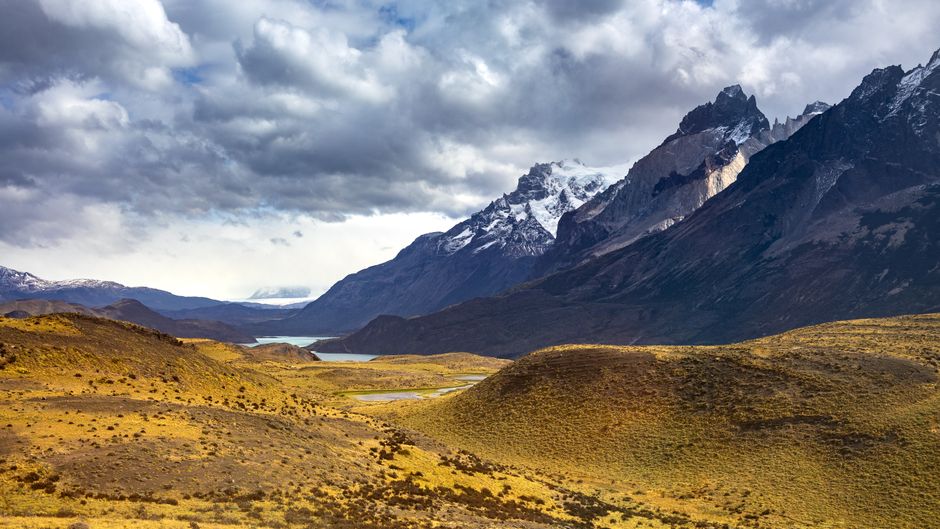
Torres del Paine National Park, in the Magallanes region at the southern end of Chilean Patagonia, is one of the great mountain landscapes of the world. The Paine massif, a range separate from the main Andes, rises straight out of the windswept steppe in granite towers and dark-capped “horns,” with glaciers spilling from the Southern Patagonian Ice Field into lakes of turquoise, milky green and deep blue. Created in 1959 and a UNESCO Biosphere Reserve since 1978, the park covers about 2,270 km² (880 square miles). Hikers come for the multi-day W trek and the longer O circuit; others stay in lodges and see the highlights by car, boat and day hike. The season runs from about October to April, overnight stays must be booked ahead, and the weather can bring four seasons in a day.
Right now in Torres del Paine National Park (Torres del Paine)
- Wed -9–1°C 17–34°F Clear
- Thu -7–3°C 20–37°F Partly cloudy
- Fri -5–5°C 24–40°F Clear
- Mon 12 Oct Columbus Day (Día del Descubrimiento de Dos Mundos)
Weather: MET Norway (CC BY 4.0) · Holidays: Nager.Date
Top tours in Torres del Paine National Park
See all tours for Torres del Paine National Park →
From local operators, with prices and reviews; you check availability and book on Viator, our partner. We may earn a commission at no extra cost to you. How we earn money
Torres del Paine at a glance
- Best for: multi-day trekking, day hikes to the Base of the Towers and the French Valley, glacier boat trips, wildlife and landscape photography, and luxury lodges with guided excursions.
- How long: 2–3 days for the highlights by car and boat; 4–5 days for the W trek; 7–9 days for the full O circuit.
- Best time: November to March for long days and all services; October and April are quieter, colder and cheaper. Expect strong wind in spring and summer.
- Getting there: fly to Punta Arenas or, in season, Puerto Natales, then travel to the park by bus or car; Puerto Natales is the base town, about 2 hours away.
- Fees to know: as of October 2026, foreign adults pay CLP 32,400 (about US$33) for one day or CLP 48,500 (about US$49) for more than one day, bought online at Pases Parques.
- Before you go: entry rules, money and general safety are in our Chile travel guide.
Fees, tickets and rules (as of October 2026)
The park is run by Chile’s National Forest Corporation (CONAF), which sells passes through the official site Pases Parques (pasesparques.cl). According to the park’s ticket page:
| Ticket | Price | Good to know |
|---|---|---|
| Foreign adult (18–59), one day | CLP 32,400 (about US$33) | Seniors 60+ and visitors with a disability pay the same foreign rate |
| Foreign adult, more than one day | CLP 48,500 (about US$49) | The pass to buy for treks and multi-day stays |
| Foreign youth (13–17), one day | CLP 16,600 (about US$17) | |
| Children 0–12 | Free | A ticket is still issued |
| Chilean adult, one day / more than one day | CLP 9,400 / CLP 14,200 | Nationals buy separately |
Opening hours, according to the same page, are 7 a.m. to 9 p.m. from October to April (last entry 9 p.m.) and 8 a.m. to 6:30 p.m. from May to September, and can change with weather or safety conditions. Buy passes for national and foreign visitors in separate steps; tickets are for a set date, and you can change it up to 24 hours before.
Booking campsites and refuges
All overnight stays in the park, in refuges (refugios), domes or campsites, must be booked in advance with the companies that run them, and camping is allowed only at authorized, signposted sites. When CONAF lifted its temporary guide requirement for the O circuit from January 1, 2026, it stressed that hikers must meet all the park’s safety, registration and booking requirements. Rangers check reservations along the trails, and in January and February the refuges sell out months ahead. The refuges and campsites on the west side (Paine Grande, Grey, Dickson and Los Perros) and those on the east side, on the private land of the Estancia Cerro Paine (Central, Chileno, Los Cuernos, Francés and Serón), are run by different companies, so you may need two bookings for one trek.
The park’s key rules
- No fires: lighting any source of heat outside designated areas, including gas stoves, barbecues and cigarettes, is a crime under Law 20,653, punishable by fines of up to CLP 2,000,000, up to three years in prison, or expulsion from the country for foreigners.
- Cook only in designated shelters: camping stoves may be used only in the cooking areas of each campsite.
- No walking in the dark: trails must be walked in daylight only; CONAF points out that pumas are most active at night and most fatal accidents have involved solo hikers leaving the trail.
- Stay on marked trails, don’t feed or approach animals, take all your trash out of the park, and don’t fly drones without CONAF’s permission.
- Winter rules: from May to September, some sections of the W may be walked only with an accredited guide, and microspikes and trekking poles are recommended or required.
- The O circuit: the Macizo Paine circuit was closed for winter until October 31, 2026, with reopening subject to weather and safety checks.
The W trek
The W, named for its shape on the map, is the park’s classic trek: about 70–80 km (43–50 miles) over four or five days, linking three valleys on the southern side of the massif. You can walk it east to west or west to east. CONAF’s trail data for the main sections:
| Section | Distance | Time |
|---|---|---|
| Hotel Las Torres to Refugio Chileno | 5 km (3.1 miles) | about 2 hours |
| Refugio Chileno to the Torres ranger post | 3 km (1.9 miles) | about 1.5 hours |
| Torres ranger post to the Base of the Towers lookout | 1.4 km (0.9 miles) | about 1 hour, steep boulders |
| Refugio Los Cuernos to Hotel Las Torres | 11.6 km (7.2 miles) | about 4.5 hours |
| Italiano ranger post to Refugio Los Cuernos | 5 km (3.1 miles) | about 2.5 hours |
| Italiano to the Británico lookout (French Valley) | 5.4 km (3.4 miles) | about 3 hours, demanding |
| Paine Grande to Italiano | 7.5 km (4.7 miles) | about 2.5 hours |
| Grey ranger post to Paine Grande | 11 km (6.8 miles) | about 3.5 hours |
Base of the Towers (Mirador Las Torres)
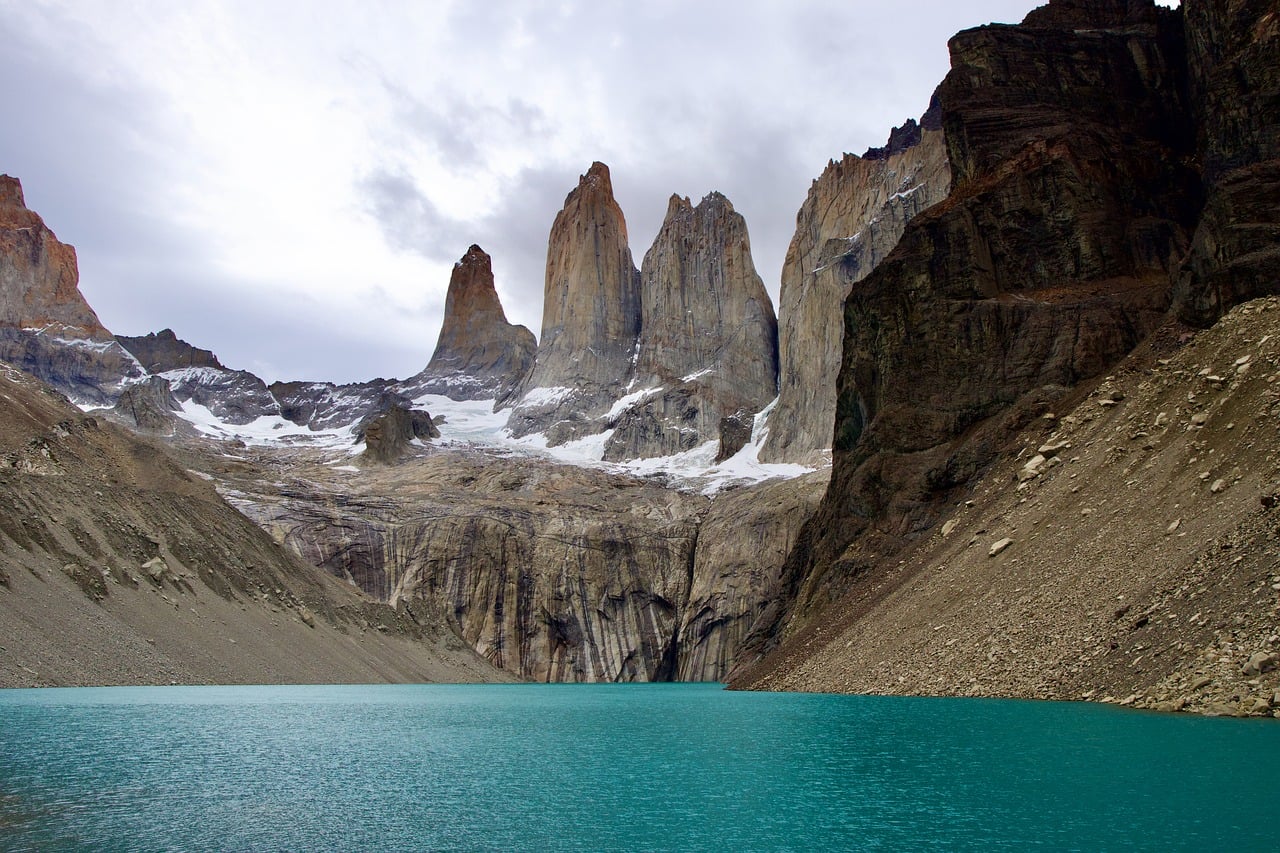
The hike to the foot of the three granite towers is the park’s most famous day walk: about 19 km (12 miles) round trip from the Welcome Center and Hotel Las Torres area, 8–9 hours, climbing the Ascencio Valley past Refugio Chileno to a final steep scramble over a glacial moraine to a green lake beneath the towers. Start early, carry water and layers, and turn back if the wind is too strong. Walking in the dark is not allowed.
The French Valley
From the Italiano ranger post, the trail climbs the Valle del Francés between hanging glaciers on Paine Grande, where avalanches thunder down in summer, and the jagged Cuernos to the Británico lookout, a natural amphitheater of granite walls. Allow most of a day.
Grey Glacier
The western arm of the W follows Lake Grey, dotted with icebergs, to Refugio Grey and suspension bridges with views of the glacier’s blue front. You can also see the glacier by boat from the Hotel Lago Grey area or on kayak trips in season.
The O circuit
The O (officially the Macizo Paine circuit) adds the wild back side of the massif to the W: about 110–130 km (68–81 miles) in 7 to 9 days. According to CONAF, the toughest day is the climb over the John Gardner Pass from Los Perros to the Paso ranger post, 8 km (5 miles) in about 6 hours, followed by a demanding descent to Grey. The pass is exposed and can close in bad weather. The circuit is walked counterclockwise only and is closed in winter.
Other things to do in Torres del Paine
- Lake Pehoé catamaran: boats cross Lake Pehoé between Pudeto and Paine Grande, the usual start or end of the W, with stunning views of the Cuernos; Pudeto also has a short walk to the Salto Grande waterfall and the Cuernos lookout.
- Short walks: the Mirador Cuernos and Salto Grande trail from Pudeto, Laguna Azul, and the walk to the Grey Glacier beach lookout are easy half days.
- Wildlife watching: guanacos everywhere, rheas (ñandú), Andean condors, foxes and black-necked swans; pumas are increasingly seen on guided tracking tours on the eastern side.
- Horseback riding and kayaking: only with operators authorized by CONAF; boats and kayaks brought into the park need a disinfection certificate against the invasive didymo algae.
See our guide to hiking and boat trips.
Getting there
- By air: Punta Arenas (PUQ) has year-round flights from Santiago, about 3.5 hours; Puerto Natales (PNT) has seasonal flights in the main summer months.
- Punta Arenas to Puerto Natales: about 250 km (155 miles) on a paved road, around 3 hours by bus or car; buses also run directly from Punta Arenas airport.
- Puerto Natales to the park: according to CONAF, four regular bus companies run from Puerto Natales twice a day, at about 7:30 a.m. and 2:30 p.m., stopping at Laguna Amarga (for Las Torres), Pudeto (for the Lake Pehoé catamaran) and the park administration. The trip to Laguna Amarga takes about 2 hours.
- By car: the main road runs north from Puerto Natales via Cerro Castillo to the Sarmiento and Laguna Amarga entrances; the Y-290 gravel road via Lago Porteño, about 80 km (50 miles), reaches the south of the park. There is no fuel in or around the park, so fill up in Puerto Natales.
- From Argentina: the Río Don Guillermo border crossing at Cerro Castillo, 52 km (32 miles) from the Sarmiento gate, links the park with El Calafate; buses take 5–6 hours. See our Los Glaciares National Park travel guide.
Getting around: practical details
Inside the park, the shuttle buses from Puerto Natales double as transport between entrances, and minibuses link the Laguna Amarga entrance with the Welcome Center at the start of the Base of the Towers trail. The Pudeto–Paine Grande catamaran runs several times a day in summer, fewer in the shoulder seasons and rarely in winter, and can be canceled by wind. A rental car gives freedom for viewpoints and short hikes; drive slowly on the gravel roads, where guanacos wander.
Around Torres del Paine
- Puerto Natales: the base town on the Última Esperanza Sound, with hostels, outfitters that rent camping gear, restaurants and supermarkets for trail food.
- Cueva del Milodón: a huge cave where remains of a giant ground sloth were found, a natural monument about 25 km (16 miles) north of Puerto Natales.
- Balmaceda and Serrano glaciers: boat trips from Puerto Natales up the sound into Bernardo O’Higgins National Park.
- El Calafate and the Perito Moreno Glacier: across the border in Argentina, an easy add-on by bus.
Nearby destinations
When to go and how long to stay
Weather in Torres del Paine is famously changeable: sun, rain, snow and gales can all come in one day, and the wind, often above 60 km/h (37 mph) and sometimes far stronger, is the defining feature in spring and summer. No official long-term climate normals are published for the park itself, so the table uses the nearest station with official 1991–2020 normals, Punta Arenas airport, about 250 km (155 miles) to the south-east, from Chile’s Meteorological Directorate via the World Meteorological Organization. The park’s sheltered valleys are often a few degrees warmer on summer afternoons, and the western side near the ice field is much wetter.
| Season | Average high / low (Punta Arenas) | What it’s like in the park |
|---|---|---|
| Summer (Dec–Feb) | 14–15 °C (58–60 °F) / 6–7 °C (42–44 °F) | Up to about 17 hours of daylight, the strongest winds, all services open, busiest and most expensive |
| Fall (Mar–May) | 13 °C falling to 7 °C (55 to 44 °F) / 5 °C falling to 2 °C (42 to 35 °F) | Red and gold lenga forests in April, calmer days, services start closing |
| Winter (Jun–Aug) | 4–6 °C (40–42 °F) / −1 to 0 °C (31–32 °F) | Short days, snow, often calm and clear; few services, guide rules on parts of the W |
| Spring (Sep–Nov) | 8 °C rising to 13 °C (47 to 55 °F) / 1 °C rising to 5 °C (35 to 40 °F) | Windy and bright; refuges and boats reopen from October |
Torres del Paine month by month
Average daily highs and lows and precipitation at Punta Arenas airport (DMC 1991–2020 normals, via the WMO); the park varies a lot by valley.
| Month | High / low | Rain | What to expect |
|---|---|---|---|
| January | 15 °C (60 °F) / 7 °C (44 °F) | 38 mm (1.5 in) | Peak season; long days and strong winds; book everything ahead |
| February | 15 °C (59 °F) / 7 °C (44 °F) | 32 mm (1.2 in) | Busy and windy; best chance of warm hiking days |
| March | 13 °C (55 °F) / 5 °C (42 °F) | 43 mm (1.7 in) | Fewer crowds; calmer winds; cooler nights |
| April | 10 °C (50 °F) / 4 °C (38 °F) | 45 mm (1.8 in) | Fall colors; many refuges close at the end of the month |
| May | 7 °C (44 °F) / 2 °C (35 °F) | 37 mm (1.5 in) | Quiet; snow possible on trails; limited services |
| June | 4 °C (40 °F) / 0 °C (31 °F) | 31 mm (1.2 in) | Winter; short days; guide rules on parts of the W |
| July | 4 °C (40 °F) / −1 °C (31 °F) | 31 mm (1.2 in) | Coldest month; often clear and calm; few visitors |
| August | 6 °C (42 °F) / 0 °C (32 °F) | 30 mm (1.2 in) | Cold; snow on trails; some services reopen late in the month |
| September | 8 °C (47 °F) / 1 °C (35 °F) | 24 mm (1.0 in) | Spring; winds pick up; still limited services |
| October | 11 °C (51 °F) / 3 °C (37 °F) | 25 mm (1.0 in) | Refuges and boats reopen; O circuit reopening after inspection |
| November | 13 °C (55 °F) / 4 °C (40 °F) | 23 mm (0.9 in) | Long days, wildflowers, fewer crowds than summer |
| December | 14 °C (58 °F) / 6 °C (42 °F) | 32 mm (1.3 in) | Summer starts; busy from mid-month |
Crowds: December to February are the peak, especially January; refuges and campsites must be booked months ahead. October, November, March and April are quieter and good value but colder, and some services start late or close early. The park uses Magallanes time, UTC−3 all year.
Two or three days
Day one, drive or bus in via Laguna Amarga, then the Pudeto catamaran or the Salto Grande and Cuernos lookout walks. Day two, the Base of the Towers hike. Day three, Grey Glacier by boat or on foot from Lake Grey.
Four to five days: the W
Base of the Towers, the French Valley and Grey Glacier, sleeping in refuges or campsites along the way, with a spare half day for weather; or base yourself in a lodge and do the three main day hikes with transfers.
Where to stay
- Refuges (refugios): dormitory beds or domes with shared bathrooms, optional meals and box lunches, at Chileno, Central, Los Cuernos, Francés, Paine Grande, Grey, Dickson and Los Perros. The most comfortable way to walk the W without carrying camping gear.
- Campsites: paid campsites run by the concession companies, with tents for rent at most, and a few basic campsites managed by the park. Book ahead.
- Hotels and lodges: hotels with road access, such as Hostería Pehoé, Hotel Lago Grey and Explora, plus Hotel Las Torres and lodges just outside the park; many all-inclusive lodges include guided excursions.
- Puerto Natales: by far the widest choice and lowest prices, but about 2 hours from the trails each way.
Food and drink
Patagonian lamb (cordero magallánico) roasted on a cross over a fire is the regional specialty, along with king crab (centolla), hearty stews and calafate berries in jams, ice cream and the famous calafate sour. In the park, refuges sell full board, dinners and box lunches, and campsites have small shops with high prices; restaurants operate at Pehoé and the Serrano camp, and there’s a café at Pudeto. Stock up on trail food in Puerto Natales supermarkets. Stream water in the park is widely drunk by hikers, but treating it is the safer choice; the park provides treated water at Pudeto and Lake Grey.
What a trip to Torres del Paine costs
These are our estimates for October 2026 at about CLP 985 per US dollar, except the park fees, which are official. Many concession prices are quoted in US dollars.
| Item | Typical price |
|---|---|
| Park entry, foreign adult, more than one day | CLP 48,500 (US$49), official |
| Bus Puerto Natales–park, round trip | CLP 25,000–40,000 (US$25–40) |
| Pudeto–Paine Grande catamaran, one way | CLP 30,000–45,000 (US$30–45) |
| Campsite pitch, own tent | CLP 15,000–30,000 (US$15–30) per person |
| Refuge bed without meals | CLP 60,000–110,000 (US$60–110) |
| Refuge full board (dinner, breakfast, box lunch) | CLP 70,000–100,000 (US$70–100) on top of the bed |
| Lodge, all-inclusive, per person per night | CLP 500,000+ (US$500+) |
| Hostel in Puerto Natales | CLP 20,000–35,000 (US$20–35) |
Cash machines are found only in Puerto Natales.
Practical tips for Torres del Paine
- Wind: gusts can knock hikers over on exposed sections and near Lake Pehoé; crouch and wait for gusts to pass, and keep a firm grip on car doors.
- Layers: even in summer, carry a windproof and waterproof jacket, a warm layer, a hat and gloves every day.
- No signal: according to CONAF, the only cell coverage is at the park administration (Villa Monzino). In an emergency, go to the nearest ranger post or refuge; the park’s emergency radio frequency is VHF 143.800 MHz.
- Medical care: CONAF lists a year-round health post at Cerro Castillo, a summer paramedic at the administration and the hospital in Puerto Natales, so help can take hours to arrive.
- Bird flu: CONAF has warned of an outbreak of highly pathogenic avian influenza in Chile; don’t touch dead or sick birds or animals.
- Emergencies: 133 for the police and 131 for an ambulance, where there is signal.
What to pack for Torres del Paine
A waterproof and windproof shell jacket and pants (see our guide to rain jackets), warm fleece or down layers, a hat, gloves and a buff, broken-in waterproof hiking boots (see hiking shoes), trekking poles for the moraine, sunglasses, high-factor sunscreen and lip balm (the UV is strong), a headlamp for the refuges, a water bottle and filter, a dry bag or pack liner, and microspikes from April to October. Campers need a tent rated for strong wind and a three-season sleeping bag. Chile uses 220 V with type C and L sockets.
Torres del Paine travel FAQ
How much does it cost to enter Torres del Paine?
As of October 2026, foreign adults pay CLP 32,400 (about US$33) for one day or CLP 48,500 (about US$49) for more than one day; children up to 12 go free. Buy online at Pases Parques.
Do I need to book campsites and refuges in advance?
Yes. Every overnight stay must be booked ahead with the operator, and rangers check reservations. In January and February, book months in advance.
Do I need a guide to hike the W trek?
Not from October to April: the W and, since January 1, 2026, the O circuit can be walked independently if you meet the park’s registration and booking rules. In winter, some W sections require an accredited guide.
How long is the hike to the Base of the Towers?
About 19 km (12 miles) round trip and 8–9 hours, with a steep final hour over a boulder moraine.
What are the park’s opening hours?
According to the official ticket page, 7 a.m. to 9 p.m. from October to April and 8 a.m. to 6:30 p.m. from May to September, subject to weather and safety conditions.
When is the best time to visit Torres del Paine?
November to March, for long days and all services. December to February is the busiest and windiest time; October, November, March and April are quieter.
How do I get from Puerto Natales to Torres del Paine?
By regular bus, leaving twice a day at about 7:30 a.m. and 2:30 p.m., about 2 hours to Laguna Amarga, or by rental car. There is no fuel in the park.
Is there phone signal in Torres del Paine?
Hardly any. According to CONAF, cell coverage is available only at the park administration area, so plan for being offline.
Can I cook or make a fire in the park?
Fires are banned, and lighting any heat source outside designated cooking areas can bring heavy fines, prison or expulsion. Use stoves only in campsite cooking shelters.
Can I visit Torres del Paine and the Perito Moreno Glacier on the same trip?
Yes. Buses link Puerto Natales and El Calafate in 5–6 hours via the Cerro Castillo border crossing.
Sources and last review
Researched and last reviewed on 4 October 2026. Fees, ticket categories and opening hours: CONAF’s official ticket site, Pases Parques; trails, distances, times, services, access roads, buses, medical posts, radio frequency, rules and penalties, the O circuit closure and the bird flu notice: CONAF’s Torres del Paine page; the lifting of the O circuit guide requirement and the booking rules: CONAF; exchange rate: the Central Bank of Chile; climate: the Meteorological Directorate’s 1991–2020 normals for Punta Arenas airport, as published by the World Meteorological Organization. Total W and O distances, the Base of the Towers round trip, refuge and campsite operators, catamaran and flight details, fire history, wildlife tours, nearby sights and typical costs come from general references and are flagged for checking; costs are our estimates. Fees and rules change, so check the official sites before you go. For entry rules and money, see our Chile travel guide.
Plan your trip
Partner links: TravelerCenter may earn a commission if you book, at no extra cost to you.
🇪🇸 Useful Spanish phrases for Torres del Paine National Park
All 38 Spanish phrases: restaurant, hotel, emergencies, romance (printable) →