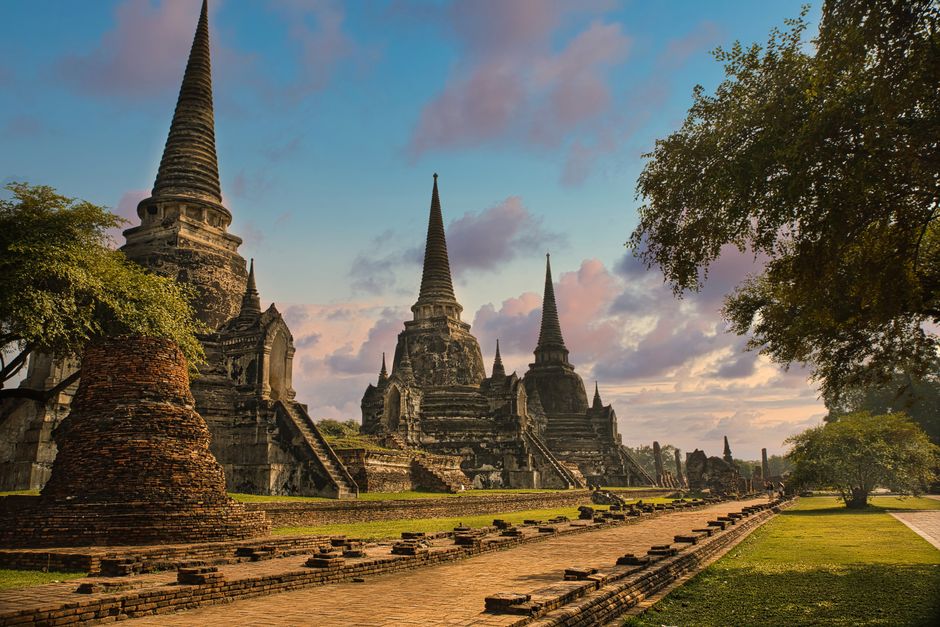
Ayutthaya was the capital of Siam for more than four centuries, from 1350 until it was sacked by a Burmese army in 1767, and in its heyday it was one of the largest and richest cities in Asia, trading with China, Japan, Persia and Europe. Today its ruined palaces and temples, scattered across an island formed by three rivers about 80 km (50 miles) north of Bangkok, are protected as the Historic City of Ayutthaya, a UNESCO World Heritage site since 1991. Come for the towering brick prangs and chedis of Wat Mahathat, Wat Phra Si Sanphet and Wat Chaiwatthanaram, the Buddha head entwined in the roots of a tree, giant reclining and seated Buddhas still worshipped today, boat trips around the island at sunset, the riverside settlements of the old foreign traders, and the river prawns and boat noodles. Ayutthaya is an easy day trip from Bangkok, but staying a night lets you see the ruins lit up and enjoy the cool of the morning. The best months are November to February; March to May is very hot, and the rainy season runs from May to October.
Right now in Ayutthaya
- Wed24–32°C75–89°FMostly clear
- Thu24–32°C75–90°FMostly clear
- Fri25–32°C76–89°F1 mm rain
Top tours in Ayutthaya
See all tours for Ayutthaya →
From local operators, with prices and reviews; you check availability and book on Viator, our partner. We may earn a commission at no extra cost to you. How we earn money
Ayutthaya at a glance
- Best for: history and archaeology, temple ruins, photography, cycling, river trips and an easy escape from Bangkok.
- How long: a long day trip from Bangkok; one or two nights to see the ruins at their best and add Bang Pa-In Palace.
- Best time: November to February, with highs of about 32–34 °C (90–92 °F) and little rain; go early in the morning at any time of year.
- Getting there: about 1.5 to 2 hours from Bangkok by train, minivan or car; about 45 minutes from Don Mueang Airport.
- Getting around: bicycle, tuk-tuk by the hour, Grab and Bolt, or a boat around the island.
- Fees to know: the main ruined temples, run by the Fine Arts Department, each charge foreign visitors a small entry fee; active temples such as Wihan Phra Mongkhon Bophit are free.
- Before you go: entry rules, the Thailand Digital Arrival Card, money and general safety are in our Thailand travel guide.
Ayutthaya’s areas and where to stay
The old city sits on an island about 4 km (2.5 miles) across, ringed by the Chao Phraya, Pa Sak and Lopburi rivers. The modern town spreads along its eastern edge and across the river to the east, around the train station.
The historical park (central island)
The center of the island holds the greatest ruins, Wat Mahathat, Wat Ratchaburana, Wat Phra Si Sanphet and the old royal palace, set in parkland with lakes. A few small hotels and guesthouses stand nearby, within cycling distance of everything.
Naresuan Road and the eastern island
The modern town’s center, with guesthouses, cafés, bike rental shops and the night markets; convenient for visitors without a car.
The riverside
Boutique hotels and resorts line the rivers around the island, some in restored teak houses with views of the ruins; Wat Chaiwatthanaram and the foreign settlements are on the far banks.
Around the train station
Across the Pa Sak River from the island, simple guesthouses and the ferry crossing to the old city; practical if you arrive by train.
Top things to see in Ayutthaya
Most ruined temples open from about 8 a.m. to 6 p.m. Dress modestly, with shoulders and knees covered, don’t climb on the ruins or on Buddha images, and never pose with your head above a Buddha’s head.
Wat Mahathat
Once the city’s spiritual center, with a great central prang that collapsed long ago, Wat Mahathat is now a field of brick chedis and headless Buddhas, and home to Ayutthaya’s most famous image: a sandstone Buddha head cradled in the roots of a fig tree. Photograph it from a crouching position, keeping your head lower than the Buddha’s, as a guard will remind you.
Wat Phra Si Sanphet and Wihan Phra Mongkhon Bophit
The royal temple inside the grounds of the old palace, with three tall bell-shaped chedis holding the ashes of kings, is the classic image of Ayutthaya. Next door, the Wihan Phra Mongkhon Bophit houses one of the largest bronze Buddhas in Thailand, restored in the 20th century and still a place of active worship; entry is free.
Wat Ratchaburana
Built in 1424 by a king on the cremation site of his two elder brothers, who died fighting each other for the throne, its well-preserved central prang can be climbed to a crypt with faded murals. The crypt’s treasure of gold objects is now in the Chao Sam Phraya National Museum.
Wat Chaiwatthanaram
On the west bank of the Chao Phraya, this huge temple built in 1630 in a Khmer style, with a central prang surrounded by smaller towers and rows of Buddhas, is the most photogenic of the ruins, especially at sunset and when it is lit at night. Reach it by bicycle across the bridge or by boat.
Wat Yai Chai Mongkhon and Wat Phanan Choeng
Southeast of the island, Wat Yai Chai Mongkhon has a massive chedi raised to celebrate a victory over the Burmese, rows of saffron-draped Buddhas and a reclining Buddha. Nearby Wat Phanan Choeng, on the riverbank, predates the city itself and houses a 19 m (62 ft) seated golden Buddha revered by the Thai Chinese community; it is busy with worshippers and incense.
More classic sights
- Wat Lokayasutharam: a 42 m (138 ft) reclining Buddha lying in the open in the west of the island.
- Wat Na Phra Men: one of the few temples that survived the sack of 1767, with a richly decorated hall and a crowned Buddha in royal attire.
- Chao Sam Phraya National Museum: gold treasures, Buddha images and sculptures from the temples.
- The foreign settlements: the Japanese village, the Portuguese settlement with excavated graves and St. Joseph’s Church, and Baan Hollanda, a museum of the Dutch trading post, along the rivers south of the island.
- Wat Phu Khao Thong: a white chedi rising from the rice fields north of the city, with views from its terraces.
Museums
- Chao Sam Phraya National Museum
Churches and cathedrals
- Wat Na Phra Men
- Wat Phanan Choeng
- Wat Yai Chai Mongkhon
- Wihan Phra Mongkhon Bophit
Parks and gardens
- Ayutthaya Historical Park
Archaeological sites
- Wat Chaiwatthanaram
- Wat Lokaya Sutharam
- Wat Phra Si Sanphet
Other things to do in Ayutthaya
Cycling and boat trips
The best way to explore the island is by bicycle: the roads are flat, the main ruins are a few minutes apart, and rental shops near Naresuan Road rent bikes by the day. Ride early, when it is cool, and rest in the shade at midday. In the late afternoon, take a long-tail boat around the island, stopping at Wat Phanan Choeng, Wat Chaiwatthanaram and the riverside temples as the sun goes down. See our guides to cycling and boat trips.
Ruins by night
Several major ruins, including Wat Mahathat, Wat Ratchaburana, Wat Phra Ram and Wat Chaiwatthanaram, are floodlit in the evening; you can see them from the roadside or join a night tour by tuk-tuk or boat. It is one of the best reasons to stay overnight.
Food and drink
Ayutthaya is famous for boat noodles (kuay teow reua), small bowls of rich, spiced broth once sold from boats on the canals, and for giant river prawns (goong mae nam) grilled at riverside restaurants. Try roti sai mai, thin flatbreads wrapped around strands of spun-sugar candy, a local specialty sold in shops along the main road near the hospital. The evening markets, such as the Bang Ian night market, have cheap Thai street food.
Festivals
At Songkran in mid-April, Ayutthaya’s elephants join the water-splashing at the historical park. At Loy Krathong (November 24 in 2026), the city hosts large celebrations with krathongs floated on the rivers and light-and-sound shows among the ruins. Each December, a World Heritage festival with light shows and cultural performances is held in the historical park.
Day trips from Ayutthaya
- Bang Pa-In Palace: a 19th-century royal summer palace of Thai, Chinese and European pavilions in gardens around a lake, about 20 km (12 miles) south; dress modestly and check opening days.
- Lopburi: Khmer temples, King Narai’s palace and the monkeys of Phra Prang Sam Yot, about an hour north.
- Bangkok: about 1.5 to 2 hours by train or road. See our Bangkok guide.
- Ang Thong: the giant seated Buddha of Wat Muang, one of the largest in the world, about 45 minutes north.
- Sukhothai: Thailand’s first capital and another UNESCO World Heritage site, about 5 hours north by road or train, worth a separate trip of at least a night.
Nearby destinations
- Bangkok68 km
- Khao Yai National Park93 km
- Kanchanaburi119 km
- Pattaya160 km
- Hua Hin210 km
- Ko Samet221 km
Getting there and getting around
From Bangkok
Trains of the State Railway of Thailand (SRT) run frequently from Bangkok’s Krung Thep Aphiwat Central Terminal and from the old Hua Lamphong station to Ayutthaya, taking about 1.5 to 2 hours; tickets are cheap, and the station is across the river from the island, a short ferry ride or tuk-tuk away. Minivans leave from Bangkok’s Mo Chit area and take about 1.5 hours. A private car or Grab is the quickest door to door, and from Don Mueang Airport (DMK) it takes about 45 minutes. Some cruise boats sail up the Chao Phraya from Bangkok, returning by road. Northbound trains to Chiang Mai also stop at Ayutthaya, so you can break the journey here.
Around Ayutthaya
Rent a bicycle or a scooter, hire a tuk-tuk by the hour (agree the price and route first), or use Grab and Bolt, which work in town. Long-tail boats from the piers near the night market circle the island. Riding elephants among the ruins is still offered, but many visitors now choose to skip it for welfare reasons.
When to go and how long to stay
Ayutthaya shares Bangkok’s tropical climate, but it can feel hotter among the open ruins. There is no international climate-normals station in Ayutthaya; the table uses the 1991–2020 normals of the Thai Meteorological Department (TMD) for its Don Mueang Airport station, about 50 km (31 miles) to the south, as submitted to the World Meteorological Organization (WMO): average daily highs and lows, total rain, and days with at least 1 mm of rain.
| Month | Average high / low | Rain (days with 1 mm or more) | What to expect |
|---|---|---|---|
| January | 32 °C (90 °F) / 23 °C (73 °F) | 16 mm (0.6 in), 1 day | Dry and the most comfortable; clear sunsets |
| February | 34 °C (92 °F) / 24 °C (75 °F) | 12 mm (0.5 in), 1 day | Dry and warming; good for cycling in the morning |
| March | 35 °C (95 °F) / 26 °C (78 °F) | 50 mm (2.0 in), 3 days | Hot; start very early |
| April | 36 °C (96 °F) / 27 °C (80 °F) | 92 mm (3.6 in), 6 days | The hottest month; Songkran with elephants |
| May | 35 °C (95 °F) / 27 °C (80 °F) | 214 mm (8.4 in), 12 days | Rains begin; afternoon storms |
| June | 34 °C (93 °F) / 26 °C (80 °F) | 191 mm (7.5 in), 12 days | Showers; green and quiet |
| July | 34 °C (92 °F) / 26 °C (79 °F) | 180 mm (7.1 in), 13 days | Humid with afternoon rain |
| August | 33 °C (92 °F) / 26 °C (79 °F) | 183 mm (7.2 in), 14 days | Wet; few visitors |
| September | 33 °C (92 °F) / 26 °C (78 °F) | 300 mm (11.8 in), 17 days | The wettest month; rivers run high |
| October | 33 °C (91 °F) / 25 °C (78 °F) | 192 mm (7.6 in), 12 days | Rains ease; flood risk along the rivers |
| November | 32 °C (90 °F) / 24 °C (76 °F) | 33 mm (1.3 in), 3 days | Dry season returns; Loy Krathong |
| December | 32 °C (89 °F) / 23 °C (73 °F) | 12 mm (0.5 in), 1 day | Dry and pleasant; World Heritage festival |
The area gets about 1,470 mm (58 in) of rain a year, mostly from May to October. At the end of the rainy season, in September and October, the rivers around the island can burst their banks; Ayutthaya was badly flooded in 2011. The open ruins have little shade, so from March to May sightseeing is best before 10 a.m. and after 4 p.m.
Weather month by month
One day in Ayutthaya
Arrive by mid-morning, rent a bicycle and visit Wat Mahathat, Wat Ratchaburana, Wat Phra Si Sanphet and Wihan Phra Mongkhon Bophit; have boat noodles for lunch; then take a boat around the island in the late afternoon, ending at Wat Chaiwatthanaram for sunset.
Two days
Add Wat Yai Chai Mongkhon, Wat Lokayasutharam and the foreign settlements, the ruins lit at night, and Bang Pa-In Palace on the way back to Bangkok.
Where to stay in Ayutthaya
- Near the historical park: small hotels and guesthouses within cycling distance of the main ruins.
- Naresuan Road: budget guesthouses, cafés and bike rentals.
- The riverside: boutique hotels in teak houses with river views and sunset terraces.
- Near the train station: simple, convenient guesthouses across the river.
Accommodation is cheaper than in Bangkok, and most visitors are day-trippers, so evenings are quiet. Book ahead for Loy Krathong and the December festival.
What a trip to Ayutthaya costs
Prices are approximate, for October 2026, converted at about 33 baht to the US dollar.
| Item | Typical cost |
|---|---|
| Entry to a major ruined temple, foreign visitors | about 50–100 baht (about US$1.50–3) |
| Train from Bangkok, third class | about 15–30 baht (about US$0.50–1) |
| Minivan from Bangkok | about 70–120 baht (about US$2–3.60) |
| Bicycle rental, per day | 50–100 baht (about US$1.50–3) |
| Tuk-tuk, per hour | 200–300 baht (about US$6–9) |
| Bowl of boat noodles | 20–60 baht (about US$0.60–1.80) |
| Grilled river prawn dinner for two | 800–1,800 baht (about US$24–55) |
| Guesthouse or mid-range hotel double | 600–2,500 baht (about US$18–75) |
Practical tips for Ayutthaya
- Start early: the ruins have little shade; arrive by 8 a.m. or come late in the afternoon.
- Respect the ruins: don’t climb on chedis or Buddha images, and keep your head lower than the Buddha head at Wat Mahathat when you take photos.
- Dress code: cover shoulders and knees at all temples and at Bang Pa-In Palace.
- Bring water and a hat: there are drink stalls at the main sites, but it is a long, hot day.
- Cannabis and vaping: cannabis flower needs a Thai prescription, and e-cigarettes are illegal in Thailand.
- Help: the Tourist Police (1155) speak English, and the TAT Contact Center (1672) answers tourist questions.
Safety
Ayutthaya is a quiet, safe town. The main concerns are heat, traffic and stray dogs.
- Heat: temperatures reach 35–36 °C (95–96 °F) from March to May; drink plenty of water, wear a hat and rest in the shade at midday.
- Road safety: cycling on the main roads around the island can be busy; use the quieter lanes inside the historical park, and wear a helmet on a scooter.
- Dogs: stray dogs live around some ruins and temples; keep your distance and don’t feed them.
- Flooding: in September and October, high rivers can flood low-lying areas and roads; check local conditions before you travel.
- Scams: few, but agree tuk-tuk and boat prices before you set off.
- Emergencies: call 1155 for the Tourist Police (English spoken), 191 for the police and 1669 for an ambulance.
What to pack for Ayutthaya
Light, breathable clothes that cover your shoulders and knees, a hat, sunglasses and sunscreen, comfortable shoes or sandals, a refillable water bottle, insect repellent for the evenings, and an umbrella from May to October. Thailand uses 220 V; sockets take both flat two-pin and round two-pin plugs.
Ayutthaya travel FAQ
Can I visit Ayutthaya as a day trip from Bangkok?
Yes. Trains, minivans and tours make it an easy day trip, though an overnight stay lets you see the ruins lit up and start early.
How do I get from Bangkok to Ayutthaya by train?
Take an SRT train from Krung Thep Aphiwat Central Terminal or Hua Lamphong; the journey takes about 1.5 to 2 hours.
How much does it cost to enter the temples in Ayutthaya?
Each major ruined temple charges foreign visitors a small fee, typically about 50–100 baht; active temples such as Wihan Phra Mongkhon Bophit are free.
Where is the Buddha head in the tree?
At Wat Mahathat, in the center of the historical park; keep your head lower than the Buddha’s when taking photos.
What is the best way to get around Ayutthaya?
By bicycle for the central ruins, and by tuk-tuk or boat for the temples across the rivers.
When is the best time to visit Ayutthaya?
November to February, early in the morning or late in the afternoon, when it is cooler.
Is Ayutthaya a UNESCO World Heritage site?
Yes. The Historic City of Ayutthaya was inscribed on the UNESCO World Heritage list in 1991.
Are the ruins lit at night?
Yes, several of the main ruins, such as Wat Mahathat and Wat Chaiwatthanaram, are floodlit in the evening.
What food is Ayutthaya known for?
Boat noodles, grilled giant river prawns and roti sai mai, flatbread wrapped around spun-sugar candy.
How long should I spend in Ayutthaya?
One full day covers the main ruins; one or two nights lets you see them at their best and add Bang Pa-In Palace.
Plan your trip
Partner links: TravelerCenter may earn a commission if you book, at no extra cost to you.
🇹🇭 Useful Thai phrases for Ayutthaya
All 38 Thai phrases: restaurant, hotel, emergencies, romance (printable) →
Sources · last reviewed 4 October 2026
Researched and last reviewed on 4 October 2026. Songkran and Loy Krathong events in Ayutthaya, cannabis and e-cigarette rules and the Tourist Police: the Tourism Authority of Thailand (TAT); UNESCO inscription: the UNESCO World Heritage Centre; climate normals: the Thai Meteorological Department via the World Meteorological Organization’s 1991–2020 normals for Don Mueang; Loy Krathong date: the 12th-month full moon from the US Naval Observatory; exchange rate: the US Federal Reserve. Temple histories and fees, opening hours, journey times, fares and typical prices are general references or estimates, flagged for checking. Prices and hours change, so check the official sites before you go. For entry rules, money and general safety, see our Thailand travel guide.
Also: TMD normals 1991–2020, Don Mueang Airport (climate)
Data: Weather: MET Norway (CC BY 4.0) · Air quality: OpenAQ · Rates: ECB · Costs: World Bank ICP and price levels · © OpenStreetMap contributors (ODBL) · Wikidata (CC0)