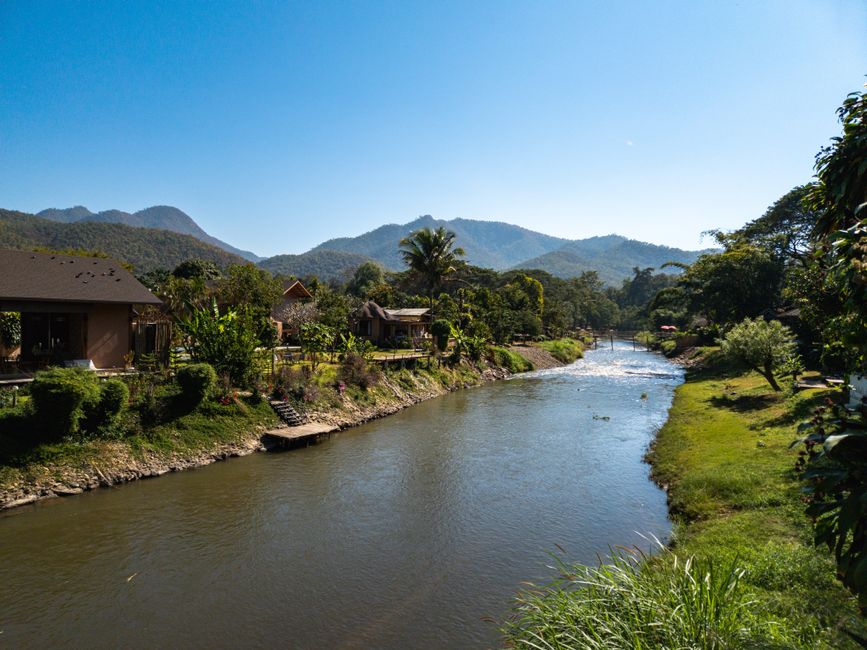
Pai is a small mountain town in Mae Hong Son province, in a wide green valley about 130 km (80 miles) northwest of Chiang Mai, reached by one of Thailand’s most famous winding roads. Once a quiet market town of Shan, Lisu, Lahu, Karen and Chinese Yunnanese communities, it became a backpacker favorite in the 1990s and is now a laid-back hub of guesthouses, cafés, art shops and live music, surrounded by rice fields, hills, hot springs and waterfalls. Pai is the classic first stop on the Mae Hong Son Loop, a roughly 600 km (370-mile) circuit of mountain roads out of Chiang Mai. Come for sunsets at Pai Canyon, the nightly walking street, the hot springs, waterfalls and viewpoints, the Yunnanese village of Santichon, the bamboo bridge across the rice fields, and the cool, misty mornings of the dry season. Pai is at its best from November to February; from February to April smoke from fires often hazes the valley, and from May to October it rains, sometimes heavily.
Right now in Pai
- Wed21–30°C70–87°F3 mm rain
- Thu22–31°C71–87°F2 mm rain
- Fri22–31°C72–88°F1 mm rain
Top tours in Pai
See all tours for Pai →
From local operators, with prices and reviews; you check availability and book on Viator, our partner. We may earn a commission at no extra cost to you. How we earn money
Pai at a glance
- Best for: a relaxed mountain escape, scenic countryside, hot springs and waterfalls, cafés and nightlife, and a stop on the Mae Hong Son Loop.
- How long: 3–4 days for the main sights; longer if you like slow travel.
- Best time: November to February, when it is dry, with warm days and cool nights; the valley often fills with morning mist in December and January.
- Getting there: about 3–4 hours by minibus or car from Chiang Mai on Route 1095, a mountain road with hundreds of bends.
- Getting around: walking in town, scooters and bicycles, and tuk-tuks or songthaews and tours to the outlying sights.
- Fees to know: small entry fees at some viewpoints, the Tha Pai Hot Springs and the national parks around Pai.
- Before you go: entry rules, the Thailand Digital Arrival Card, money and general safety are in our Thailand travel guide.
Pai’s areas and where to stay
Pai town is compact: a grid of a few streets between the Pai River and the main road, Route 1095. The countryside starts within a kilometer or two in every direction.
The town center
Chaisongkhram and Rangsiyanon roads, the heart of town, are lined with guesthouses, cafés, restaurants, bars, travel agents and scooter rentals, and become the walking street every evening. Staying here is convenient but can be noisy at night.
Across the river
Over the Pai River on the east side of town, bamboo bridges lead to bungalows and small resorts set in gardens and rice fields, a few minutes’ walk from the center but much quieter.
The valley and the hills
Out of town, resorts and homestays are scattered across the valley towards the hot springs, Santichon and Mae Yen, many with mountain views. You will need a scooter, a bicycle or taxis.
Where to stay in Pai
- Town center: for walking to everything, including nightlife.
- Across the river: riverside bungalows and quiet gardens close to town.
- The valley: views, peace and boutique resorts, best with transport.
- Near Santichon and the viewpoints: sunrise views and cool nights.
Rates rise sharply from late December to early January and on Thai long weekends, when Pai is very busy; book ahead then.
Top things to see in Pai
Pai Canyon (Kong Lan)
About 8 km (5 miles) south of town on the Chiang Mai road, a set of narrow, eroded sandstone ridges with steep drops on either side and wide views over the forested hills. It is the classic spot for sunset, so arrive early for a place on the ridges. The paths are narrow, crumbly and unfenced; keep to the wider sections and wear shoes with grip.
Wat Phra That Mae Yen (the White Buddha)
A large white seated Buddha on a hill east of town, reached by a staircase of about 350 steps or by road. The view over the valley at sunset is lovely. Dress modestly, covering shoulders and knees.
The Memorial Bridge (Tha Pai Bridge)
An old iron bridge over the Pai River about 9 km (6 miles) south of town, built during World War II on the Japanese army’s route towards Burma and later rebuilt. It is a short stop on the way to or from Pai Canyon.
Tha Pai Hot Springs
In a forest about 8 km (5 miles) southeast of town, hot water bubbles up from the ground at about 80 °C (176 °F) and flows into streams and pools cool enough to bathe in. Go early in the morning for mist rising from the water.
Ban Santichon and the Yun Lai viewpoint
A Chinese Yunnanese village about 5 km (3 miles) west of town, founded by families who came from southern China, with tea tastings, Yunnanese food, a small hilltop park and a replica of a Chinese adobe village. Just above it, the Yun Lai viewpoint is the best place for sunrise over the sea of mist in the cool season.
More classic sights
- Mo Paeng Waterfall: a stepped waterfall west of town with natural rock slides and pools for a swim in the right season.
- Pam Bok Waterfall: a cascade in a narrow gorge, a short walk from the road, good for a cool dip.
- Boon Ko Ku So Bamboo Bridge: a long bamboo walkway across the rice fields to a forest temple, beautiful when the rice is green or golden.
- The Land Split: a crack in a farm field opened by an earth movement, where the farmer serves roselle juice and snacks for a donation.
- Wat Nam Hoo: a temple with a revered Buddha image said to hold water in its head.
- Pai River: gentle tubing and, in the rainy season, white-water rafting trips farther downstream.
- Pai Canyon
Other things to do in Pai
Food and drink
The walking street is a food festival every evening: khao soi (northern curry noodles), sai ua sausages, grilled meat on skewers, Shan dishes, Yunnanese steamed buns and noodles, and every kind of international snack. Ban Santichon serves Yunnanese dishes such as braised pork leg with buns and tea. Pai is also known for coffee shops with views over the valley and for its vegetarian cafés.
The walking street and nightlife
The Pai Walking Street takes over Chaisongkhram and Rangsiyanon roads every evening from about 6 p.m., with food stalls, crafts, clothes and souvenirs; afterwards, small bars play live music, reggae and jazz.
Trekking, cycling and cooking
Guides in town run treks to hill-tribe villages and waterfalls, the hills around Pai are good for mountain biking, and cooking schools teach northern dishes. See our guides to hiking and cycling.
Festivals
Loy Krathong (November 24 in 2026) is celebrated with lanterns and krathongs on the Pai River, and the cool-season weeks around New Year bring crowds and festivals. In the Shan communities of Mae Hong Son, the Poi Sang Long novice-monk ordination festival in March or April is a colorful highlight.
Activities and best months
- LandJanFebNovDecThe Mae Hong Son Loop, about 600 km from Chiang Mai over more than 1,000 curves through Pai, Mae Hong Son and Mae Sariang, takes 3-4 days and is best from November to February.
Day trips from Pai
- Tham Lod (Nam Lod Cave): a huge cave about 1 hour northwest of Pai, toured by lamplight with local guides and on bamboo rafts along an underground river; at dusk, swifts and bats swarm at the entrance.
- Mae Hong Son: the provincial capital, with Burmese-style temples and the hilltop Wat Phra That Doi Kong Mu, about 3 hours farther along the loop.
- Huai Nam Dang National Park: the Doi Kiew Lom viewpoint, famous for sunrise over the mist, on Route 1095 about 1 hour towards Chiang Mai.
- Mae Hong Son Loop: continue to Mae Hong Son and Mae Sariang and back to Chiang Mai over 3–4 days.
- Chiang Mai: temples, markets and food, 3–4 hours away; see our Chiang Mai guide.
Nearby destinations
- Chiang Mai86 km
- Chiang Rai158 km
- Inle Lake207 km
- Sukhothai299 km
Getting there and getting around
The road from Chiang Mai: Route 1095
Pai is reached by Route 1095, which leaves the main road north of Chiang Mai at Mae Malai and climbs over the mountains through forest and hill villages. The road is fully paved but narrow, steep and extremely winding, with hundreds of bends between Mae Malai and Pai, and the drive takes about 3–4 hours. The Tourism Authority of Thailand describes the whole Mae Hong Son Loop as a circuit of about 600 km (370 miles) with more than a thousand curves, and the full road from Chiang Mai to Mae Hong Son is famous for its 1,864 curves.
By minibus
Air-conditioned minibuses (minivans) run several times a day, roughly hourly in the daytime, from Chiang Mai’s Arcade Bus Station (Terminal 2), with some pickups at Chiang Mai Airport and hotels, taking about 3–3.5 hours including a rest stop. Book a seat a day ahead in the high season, sit near the front if you are prone to car sickness, and take a motion-sickness tablet before you leave. Minibuses continue from Pai to Mae Hong Son in about 3 hours.
By car, scooter and air
You can rent a car in Chiang Mai and drive the loop yourself. Riding Route 1095 by scooter is popular, but it is only for experienced riders. The nearest airport with regular flights is Chiang Mai (CNX); Mae Hong Son Airport (HGN) has a small number of flights. Pai’s own airstrip has no regular passenger flights.
Around Pai
The town center is walkable. Scooters are the most common way to reach the sights, but many accidents happen on Pai’s hills and gravel roads; you need a motorcycle license, an International Driving Permit and a helmet. Bicycles, tuk-tuks, songthaews and day tours are good alternatives.
When to go and how long to stay
Pai has three seasons: cool and dry from November to February, hot and often smoky from March to April, and rainy from May to October. There is no long-term weather station in Pai itself, so the table uses the 1991–2020 normals of the Thai Meteorological Department (TMD) for its Mae Hong Son station, about 50 km (31 miles) to the west at 265 m (870 ft), as submitted to the World Meteorological Organization (WMO): average daily highs and lows, total rain, and days with at least 1 mm of rain. Pai lies higher, at about 500 m (1,640 ft), and is a little cooler, with colder nights.
| Month | Average high / low | Rain (days with 1 mm or more) | What to expect |
|---|---|---|---|
| January | 30 °C (86 °F) / 14 °C (58 °F) | 11 mm (0.4 in), 1 day | Dry; cold misty mornings; peak season |
| February | 33 °C (92 °F) / 15 °C (58 °F) | 6 mm (0.2 in), fewer than 1 day | Dry and warm by day; smoke haze begins |
| March | 37 °C (98 °F) / 18 °C (65 °F) | 19 mm (0.8 in), 1 day | Hot; smoke from fires often reduces air quality |
| April | 39 °C (102 °F) / 23 °C (73 °F) | 60 mm (2.3 in), 4 days | The hottest month; smoky; Songkran |
| May | 36 °C (97 °F) / 24 °C (75 °F) | 169 mm (6.6 in), 14 days | Rains begin and clear the air |
| June | 34 °C (92 °F) / 24 °C (75 °F) | 180 mm (7.1 in), 17 days | Green and rainy; quiet |
| July | 32 °C (90 °F) / 24 °C (75 °F) | 226 mm (8.9 in), 20 days | Frequent rain; waterfalls flowing |
| August | 32 °C (90 °F) / 24 °C (74 °F) | 258 mm (10.2 in), 21 days | The wettest month; landslides possible on mountain roads |
| September | 33 °C (91 °F) / 23 °C (74 °F) | 200 mm (7.9 in), 16 days | Rainy; rice fields lush and green |
| October | 33 °C (91 °F) / 22 °C (72 °F) | 117 mm (4.6 in), 10 days | Rains easing; golden rice by month’s end |
| November | 31 °C (88 °F) / 19 °C (67 °F) | 40 mm (1.6 in), 3 days | Cool season begins; clear skies |
| December | 29 °C (84 °F) / 16 °C (61 °F) | 11 mm (0.4 in), 1 day | Cool and dry; sea of mist; very busy at New Year |
The Mae Hong Son station records about 1,300 mm (51 in) of rain a year, almost all from May to October. In December and January, night and early-morning temperatures in Pai can fall below 10 °C (50 °F), and colder still at the viewpoints.
Weather month by month
3 days in Pai
Day one, settle in, walk the town and watch the sunset at Pai Canyon, then dinner at the walking street. Day two, the hot springs early, the Land Split, the Memorial Bridge and the White Buddha at sunset. Day three, sunrise at Yun Lai, breakfast in Santichon, then Mo Paeng or Pam Bok waterfall and the bamboo bridge.
4–5 days
Add a day trip to Tham Lod, a trek or a cooking class, or continue around the Mae Hong Son Loop.
What a trip to Pai costs
Prices are approximate, for October 2026, converted at about 33 baht to the US dollar.
| Item | Typical cost |
|---|---|
| Walking street dish | 40–100 baht (about US$1.20–3) |
| Dinner for two at a café or restaurant | 400–1,000 baht (about US$12–30) |
| Minibus from Chiang Mai | 200–300 baht (about US$6–9) |
| Scooter rental, per day | 150–250 baht (about US$4.50–7.50) |
| Tha Pai Hot Springs entry, foreign visitors | about 300 baht (about US$9) |
| Tham Lod cave tour with guide and raft | 300–500 baht per group (about US$9–15) |
| Bungalow double | 600–1,500 baht (about US$18–45) |
| Boutique resort double | 2,000–5,000 baht (about US$60–150) |
Practical tips for Pai
- Book the minibus ahead in the high season, and the return too around New Year.
- Air quality: from about February to April, check an air-quality index before planning outdoor activities.
- Cash: ATMs are in town, but carry cash for viewpoints, hot springs and small cafés.
- Respect local culture: dress modestly at temples and in villages, and ask before photographing people.
- Cannabis and vaping: cannabis flower needs a Thai prescription, and e-cigarettes are illegal in Thailand.
- Help: the Tourist Police (1155) speak English, and the TAT Contact Center (1672) answers tourist questions.
Safety
Pai is friendly and relaxed; the main risks are on the roads.
- The mountain road (Route 1095): the road from Chiang Mai is steep, narrow and full of hairpin bends, with fog in the cool season and landslides possible in the rainy season. If you drive or ride, go slowly, use low gear on descents, don’t overtake on blind bends, and avoid riding after dark. If you are not an experienced rider, take the minibus.
- Scooters around Pai: scooter crashes are the most common injury, especially on the gravel and steep roads to the waterfalls and viewpoints; wear a helmet and never ride after drinking. Check your insurance covers motorcycles.
- Pai Canyon: the ridges are narrow, crumbly and unfenced, with steep drops; keep back from the edges and avoid them after rain or in the dark.
- Rain and floods: heavy rain from July to September can flood the Pai River and cut roads; follow local information.
- Smoke: fine-dust (PM2.5) pollution can reach unhealthy levels from February to April; limit strenuous outdoor activity on bad days.
- Cold nights: bring warm layers for early mornings in December and January.
- Emergencies: call 1155 for the Tourist Police (English spoken), 191 for the police and 1669 for an ambulance.
What to pack for Pai
A warm fleece or jacket for cool-season mornings and nights, light clothes for the day, comfortable shoes with grip for Pai Canyon and waterfall trails, swimwear for the hot springs, a rain jacket from May to October, motion-sickness tablets for the road, a face mask for smoky days, and something to cover shoulders and knees for temples. Thailand uses 220 V; sockets take both flat two-pin and round two-pin plugs.
Pai travel FAQ
How do I get from Chiang Mai to Pai?
By minibus from Chiang Mai’s Arcade Bus Station (Terminal 2), about 3–3.5 hours, or by car on Route 1095. There are no regular flights to Pai.
How many curves are on the road to Pai?
The road from Chiang Mai to Pai has hundreds of hairpin bends; the full road from Chiang Mai to Mae Hong Son is famous for its 1,864 curves.
Is the road to Pai dangerous?
It is paved but steep and very winding. It is safe by minibus or with a careful driver; riding it by scooter is only for experienced riders.
What is the best time to visit Pai?
November to February, for dry weather, cool nights and morning mist. February to April is often smoky, and May to October is rainy.
How many days do I need in Pai?
Three or four days for the main sights; many people stay longer.
Is Pai cold?
In December and January nights can fall below 10 °C (50 °F); days are warm and sunny.
What is the Mae Hong Son Loop?
A road trip of about 600 km (370 miles) from Chiang Mai through Pai, Mae Hong Son and Mae Sariang and back, usually done over three or four days.
Do I need a scooter in Pai?
It is the usual way to reach the sights, but tours, tuk-tuks and bicycles work well, and the town itself is walkable.
Can I swim at Tha Pai Hot Springs?
Yes, the streams and pools downstream of the source are cool enough for bathing; the source water is close to boiling.
Is Pai good for families?
Yes, with care on the roads: the hot springs, waterfalls, farms and Santichon village appeal to children, but the nightlife center can be noisy.
Plan your trip
Partner links: TravelerCenter may earn a commission if you book, at no extra cost to you.
🇹🇭 Useful Thai phrases for Pai
All 38 Thai phrases: restaurant, hotel, emergencies, romance (printable) →
Sources · last reviewed 4 October 2026
Researched and last reviewed on 4 October 2026. The Mae Hong Son Loop, the walking street, Pai Canyon, Santichon, the hot springs and Tham Lod: the Tourism Authority of Thailand (TAT), along with cannabis and e-cigarette rules and the Tourist Police; climate normals: the Thai Meteorological Department via the World Meteorological Organization’s 1991–2020 normals; Loy Krathong date: the 12th-month full moon from the US Naval Observatory; exchange rate: the US Federal Reserve. Minibus times and fares, flights, entry fees, distances and typical prices are general references or estimates, flagged for checking. Prices and schedules change, so check the official sites before you go. For entry rules, money and general safety, see our Thailand travel guide.
Also: tatnews.org · TMD normals 1991–2020, Mae Hong Son (climate)
Data: Weather: MET Norway (CC BY 4.0) · Air quality: OpenAQ · Rates: ECB · Costs: World Bank ICP and price levels · Wikidata (CC0)