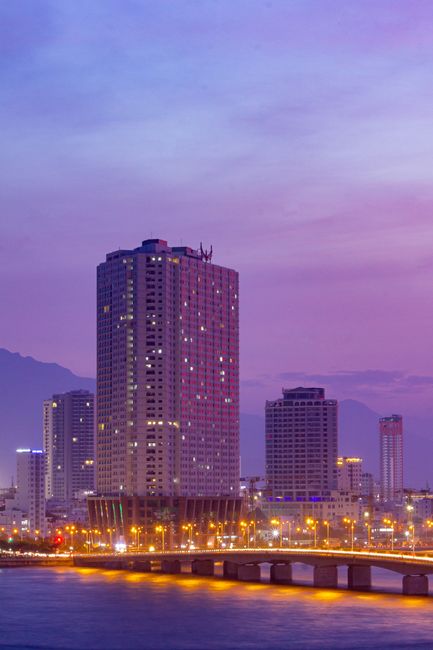
Da Nang is central Vietnam’s big, modern beach city: a clean, easygoing place of river bridges, seafood restaurants and high-rise hotels strung along a long, sandy shore, with green mountains on three sides. It is the most convenient base on the central coast, with an international airport a few minutes from the beach and the old town of Hoi An, the former imperial capital of Hue and the ruined Cham temples of My Son all within a few hours. In town, visitors climb the Marble Mountains, ride the cable car to Ba Na Hills and its Golden Bridge, drive the Son Tra peninsula to see the giant white Lady Buddha, and watch the Dragon Bridge breathe fire on weekend nights. Since July 2025, Da Nang has also included the former province of Quang Nam, so Hoi An and My Son are now part of the same city. The weather divides into a warm, dry season from about February to August and a wet, stormy season from September to December, when typhoons and floods can hit the central coast.
Right now in Da Nang
- Wed23–27°C74–81°F40 mm rain
- Thu24–26°C75–79°F55 mm rain
- Fri24–29°C75–83°F22 mm rain
Top tours in Da Nang
See all tours for Da Nang →
From local operators, with prices and reviews; you check availability and book on Viator, our partner. We may earn a commission at no extra cost to you. How we earn money
Da Nang at a glance
- Best for: beaches, seafood, family holidays, easy day trips to Hoi An, Hue and My Son, and scenic drives over the Hai Van Pass.
- How long: 2 to 3 days for the city and beaches; a week with Hoi An and Hue.
- Best time: February to August, the dry season; swimming is best from April to August, when the sea is calm.
- Getting there: Da Nang International Airport is in the city, 10 minutes from the beach; Reunification Express trains stop at Da Nang Station.
- Getting around: Grab and Xanh SM cars and motorbike taxis, metered taxis, rented bicycles and motorbikes, and hotel shuttles to Hoi An.
- Good to know: September to December is the rainy and typhoon season on the central coast; check NCHMF forecasts before you travel.
- Before you go: the e-visa, visa-free stays, money and general safety are in our Vietnam travel guide.
Da Nang’s areas and where to stay
Da Nang sits on a bay at the mouth of the Han River, with the city center on the west bank and the beaches on a strip of land between the river and the sea.
The city center (Hai Chau)
The west bank of the Han River holds the markets, the Museum of Cham Sculpture, the pink Da Nang Cathedral, local restaurants and many good-value hotels, with views of the illuminated bridges at night. It is 5 to 10 minutes from the airport and the beach.
My Khe and the beachfront
East of the river, Vo Nguyen Giap and Truong Sa streets follow more than 10 km (6 miles) of wide sandy beach, divided into My Khe, Pham Van Dong and Bac My An. This is where most visitors stay, in high-rise hotels and apartments with seafood restaurants, bars and cafés behind the beach.
Son Tra peninsula
The forested peninsula north of the beaches is a nature reserve with winding roads, coves and a few secluded luxury resorts. It is home to the Linh Ung Pagoda and to the endangered red-shanked douc langur.
Non Nuoc and the south
South toward Hoi An, the coast near the Marble Mountains is lined with large beach resorts, golf courses and integrated resort complexes. It suits travelers who want a resort stay with Hoi An 20 to 30 minutes away.
Top things to see in Da Nang
My Khe Beach
The city’s main beach is long, wide and clean, with free public access, showers and lifeguard stations, and fishing boats pulled up on the sand at Man Thai at the northern end. Locals swim at dawn and dusk to avoid the heat. In the dry season, the sea is generally calm; from September to December, waves and rip currents can be strong, so swim only between the flags. See our beaches guide.
Marble Mountains
The Marble Mountains (Ngu Hanh Son) are five limestone and marble outcrops rising from the coastal plain south of the city, each named after one of the five elements. Thuy Son, the largest, is riddled with caves and grottoes containing Buddhist shrines and statues, linked by steep stone stairs and an elevator, with views over the coast from the top. Stone-carving workshops line the road below.
Son Tra and the Lady Buddha
At the Linh Ung Pagoda on the Son Tra peninsula, a 67 m (220 ft) white statue of the Bodhisattva of Mercy looks out over the bay. Continue up the peninsula’s roads to viewpoints, the ancient banyan tree and quiet beaches, ideally by car or with a driver, as the roads are steep.
Dragon Bridge and the Han River
The Dragon Bridge, opened in 2013, is a yellow steel dragon spanning the Han River. On Saturday and Sunday nights, it breathes fire and then water from its head for a few minutes, usually at 9 p.m.; crowds gather on the riverbanks. The Han River swing bridge and the Tran Thi Ly bridge are lit in changing colors every night, and river cruises leave from the west bank.
Ba Na Hills and the Golden Bridge
Ba Na Hills, a former French hill station about 1,487 m (4,880 ft) above sea level and 40 minutes west of the city, is now a large resort and amusement complex run by Sun World, reached by a long cable car. Its best-known sight is the Golden Bridge, a curving walkway held up by two giant stone-look hands. Other parts include a replica French village, gardens, temples and indoor rides. It is often 10 °C (18 °F) cooler than the coast and can be shrouded in cloud; go early on a clear day, and avoid weekends and holidays.
More classic sights
- Museum of Cham Sculpture: the world’s largest collection of Cham sandstone carvings, from the ancient Hindu kingdom of Champa, in a colonial building by the river.
- Da Nang Cathedral: the pink “Rooster Church,” built by the French in 1923.
- Han Market and Con Market: covered markets for food, coffee, dried seafood and souvenirs.
- Asia Park and the Sun Wheel: a riverside amusement park with a big Ferris wheel.
- Hai Van Pass: the mountain road north of the city (see Day trips).
Other things to do in Da Nang
Food and drink
Da Nang’s signature dish is mi Quang, wide turmeric rice noodles with pork, shrimp, quail eggs, peanuts and herbs in a little rich broth, eaten with a sesame rice cracker. Try also bun cha ca, a fish-cake noodle soup; banh trang cuon thit heo, sliced boiled pork rolled in rice paper with herbs; banh xeo crispy pancakes; and che, sweet desserts of beans, jellies and coconut milk. The beachfront seafood restaurants let you pick live fish, crabs, clams and lobsters from tanks and choose how they are cooked; check the price by weight before ordering.
Festivals
The Da Nang International Fireworks Festival (DIFF) brings international teams to the Han River over several weekends in early summer. Tet (February 6, 2027) and the Mid-Autumn Festival are celebrated with lights and lanterns along the river.
Water sports and outdoor activities
Surfing is possible on My Khe from about October to March, when swells arrive; see our surfing guide. Stand-up paddling, kayaking and sea-walking are popular in the calm dry-season months, as are snorkeling and diving trips to the Cham Islands off Hoi An; see our snorkeling guide. Hikers can climb Son Tra or the slopes of Ba Na; see our hiking guide.
Nightlife
The beachfront and the An Thuong area, a grid of streets behind My Khe, are full of bars, craft-beer pubs and restaurants catering to visitors, and rooftop bars in the center overlook the river.
Day trips from Da Nang
- Hoi An: the lantern-lit old town, a UNESCO World Heritage Site, about 30 km (19 miles) south, 40 to 50 minutes by road. Stay for the evening. See our Hoi An guide.
- My Son Sanctuary: the jungle-covered ruins of Cham temples built between the 4th and 13th centuries, a UNESCO World Heritage Site, about 70 km (45 miles) southwest. According to its management board, the ticket for foreign visitors is 150,000 VND, covering entry and on-site services; go early to beat the heat.
- Hue: the former imperial capital, 2.5 to 3 hours by road via the Hai Van tunnel or pass, or by train. See our Hue guide.
- Hai Van Pass: the coastal mountain road between Da Nang and Lang Co, with sweeping views. At the summit, about 496 m (1,630 ft) above sea level, the Hai Van Gate, a fort built in 1826, reopened to visitors on August 1, 2024, after more than two years of restoration, according to Hue’s tourism department. Most traffic uses the tunnel, so the pass road is relatively quiet; it is a popular motorbike ride, best done with a driver if you are inexperienced.
- Ba Na Hills: a full day in itself, 40 minutes from the city.
Nearby destinations
- Hoi An25 km
- Hue80 km
- Phong Nha-Ke Bang National Park273 km
- Sanya279 km
Getting there and getting around
By air
Da Nang International Airport (DAD) is about 3 km (2 miles) from the city center and 10 to 15 minutes from the beachfront hotels. It has frequent domestic flights from Hanoi and Ho Chi Minh City (about 1 hour 20 minutes) and international flights from South Korea, Japan, Taiwan, Hong Kong, China, Singapore, Thailand, Malaysia, India and other Asian countries. Grab and metered taxis wait outside arrivals.
By train and bus
Da Nang Station, in the city center, is on the Reunification Express railway, with daily trains north to Hue and Hanoi and south to Nha Trang and Ho Chi Minh City. The stretch between Da Nang and Hue, around the Hai Van Pass, is one of the most scenic train rides in the country, about 2.5 to 3 hours. Book on Vietnam Railways’ website, dsvn.vn. Sleeper buses and limousine vans connect Da Nang with Hue, Hoi An, Quang Ngai and the Central Highlands.
Around the city
Grab and Xanh SM cars and motorbike taxis are cheap and easy, and metered taxis from the large companies are reliable. Many hotels offer shuttles to Hoi An, and a few public buses run along the coast. Renting a motorbike is common but risky for the inexperienced, and you need a license valid in Vietnam (see Safety below).
When to go and how long to stay
Da Nang has a tropical monsoon climate with a pattern unlike Hanoi or Ho Chi Minh City. The dry season, from about February to August, is sunny and increasingly hot; June to August often tops 34 °C (93 °F). The rainy season, from September to December, brings most of the year’s rain, with October and November the wettest months; this is also when tropical storms and typhoons from the South China Sea most often reach the central coast, bringing strong winds, flooding and landslides. January and February are mild, cloudy and drizzly. The table shows the 1991–2020 climate normals for Da Nang from Vietnam’s National Center for Hydro-Meteorological Forecasting (NCHMF), as published by the World Meteorological Organization (WMO).
| Month | Average high / low | Rain (rainy days) | What to expect |
|---|---|---|---|
| January | 25 °C (77 °F) / 20 °C (67 °F) | 83 mm (3.3 in), 14 days | Mild and cloudy, with drizzle; cool sea |
| February | 26 °C (79 °F) / 20 °C (69 °F) | 22 mm (0.9 in), 7 days | Drying out; Tet on February 6 in 2027 |
| March | 28 °C (83 °F) / 22 °C (72 °F) | 36 mm (1.4 in), 7 days | Dry, sunny and warm; good beach weather begins |
| April | 31 °C (88 °F) / 24 °C (75 °F) | 50 mm (2.0 in), 7 days | Dry and warm; calm sea, great for swimming |
| May | 33 °C (92 °F) / 25 °C (78 °F) | 71 mm (2.8 in), 10 days | Hot and sunny; the sea at its best |
| June | 35 °C (95 °F) / 26 °C (79 °F) | 68 mm (2.7 in), 9 days | Hot and dry; fireworks festival season |
| July | 34 °C (94 °F) / 26 °C (79 °F) | 92 mm (3.6 in), 12 days | Hot; occasional storms |
| August | 34 °C (93 °F) / 26 °C (78 °F) | 167 mm (6.6 in), 14 days | Hot; afternoon storms increase |
| September | 32 °C (90 °F) / 25 °C (77 °F) | 394 mm (15.5 in), 17 days | Rainy season begins; storm risk rises |
| October | 30 °C (85 °F) / 24 °C (75 °F) | 658 mm (25.9 in), 21 days | The wettest month; typhoon and flood risk |
| November | 28 °C (82 °F) / 23 °C (73 °F) | 486 mm (19.1 in), 21 days | Very wet; floods possible on the central coast |
| December | 25 °C (78 °F) / 21 °C (69 °F) | 272 mm (10.7 in), 21 days | Wet and cooler; rough seas |
Da Nang gets about 2,400 mm (94 in) of rain a year, more than half of it from September to November. In late October 2025, prolonged heavy rain caused two rounds of serious flooding across central Vietnam, according to the government; such events can close roads, the Hai Van Pass and flights for a day or more.
3 days in Da Nang
Day one, the beach in the morning, the Museum of Cham Sculpture, then the Han River bridges and a seafood dinner. Day two, the Marble Mountains and an afternoon and evening in Hoi An. Day three, Ba Na Hills or the Son Tra peninsula and the Lady Buddha, with the Dragon Bridge show if it’s the weekend.
A week on the central coast
Spend three nights in Da Nang, two in Hoi An with a morning at My Son, and two in Hue, traveling between them over the Hai Van Pass.
Where to stay in Da Nang
- My Khe beachfront: high-rise hotels and apartments with sea views, close to restaurants and nightlife.
- An Thuong: small hotels, guesthouses and bars on the streets behind the beach; good value.
- City center (Hai Chau): business and budget hotels with river views and local food.
- Son Tra and Non Nuoc: secluded and integrated luxury resorts; best for a resort stay.
Prices peak in the summer holidays, from June to August, when domestic and Korean visitors fill the beach hotels, and over Tet.
What a trip to Da Nang costs
Prices are approximate, for October 2026, converted at about 26,000 dong (VND) to the US dollar.
| Item | Typical cost |
|---|---|
| Bowl of mi Quang | 35,000–60,000 VND (about US$1.35–2.30) |
| Seafood dinner for two at a beachfront restaurant | 600,000–1,500,000 VND (about US$23–58) |
| Grab car from the airport to My Khe | 70,000–120,000 VND (about US$2.70–4.60) |
| Grab car to Hoi An | 300,000–450,000 VND (about US$12–17) |
| My Son Sanctuary, foreign visitor | 150,000 VND (about US$5.80) |
| Ba Na Hills cable car and entry, adult | about 900,000–1,000,000 VND (about US$35–38) |
| Motorbike rental, per day | 120,000–200,000 VND (about US$4.60–7.70) |
| Mid-range beach hotel double, per night | 900,000–2,000,000 VND (about US$35–77) |
| Hostel dorm bed | 150,000–250,000 VND (about US$6–10) |
Practical tips for Da Nang
- Swim between the flags: lifeguards post red flags when currents are dangerous, especially from September to December.
- Check the weather in the wet season: typhoons can cancel flights and close roads for a day or two.
- Go to Ba Na early: the cable car queues and cloud build up by late morning.
- Agree on seafood prices: ask the price per kilo before choosing from the tanks.
- Plan Hoi An for the evening: the lanterns are lit after dark, and it is cooler.
Safety
Da Nang is one of Vietnam’s calmest and safest cities, with little street crime. The main risks are natural and on the road. From September to December, tropical storms and typhoons can bring very heavy rain, strong winds and flooding to the central coast, and landslides can close mountain roads, including the Hai Van Pass; follow the National Center for Hydro-Meteorological Forecasting’s warnings and instructions from local authorities. At the beach, rip currents are strong when the surf is up; swim only at guarded beaches. On the roads, traffic is lighter than in Hanoi or Ho Chi Minh City but still busy. Helmets are compulsory for motorbike drivers and passengers, and a motorbike license valid in Vietnam is required, such as an international driving permit issued under the 1968 Convention together with your home license; without one, insurance will not cover you. Drink sealed, branded spirits only, as methanol-contaminated alcohol has caused poisonings in Vietnam. In an emergency, call 113 for police, 114 for fire and 115 for an ambulance.
What to pack for Da Nang
Swimwear, sunscreen, a hat and light clothes for the dry season; a waterproof jacket and quick-drying shoes from September to December; a light sweater for Ba Na Hills; and clothes that cover shoulders and knees for pagodas. Vietnam uses 220 V, with sockets for flat (type A) and round (type C) two-pin plugs. See our rain jackets, water shoes and travel adapters guides.
Da Nang travel FAQ
How many days do I need in Da Nang?
Two to three days for the city, beaches and Ba Na Hills; a week to add Hoi An, My Son and Hue.
What is the best time to visit Da Nang?
February to August, the dry season; April to August is best for swimming. September to December is wet, with a risk of typhoons and floods.
When is typhoon season in Da Nang?
Tropical storms most often reach the central coast between September and December, with October and November the wettest months.
How do I get from Da Nang to Hoi An?
By Grab or taxi in 40 to 50 minutes for about 300,000–450,000 VND, by hotel shuttle or by local bus. Since 2025, Hoi An has been part of Da Nang city.
What time does the Dragon Bridge breathe fire?
On Saturday and Sunday nights, usually at 9 p.m., for a few minutes of fire followed by water spray; the schedule can change on holidays.
Is Ba Na Hills worth visiting?
It is a busy, theme-park-style resort rather than a natural site, but the cable car ride, the views and the Golden Bridge are spectacular on a clear day. Go early and avoid weekends.
Can you swim at My Khe Beach?
Yes. The sea is calmest from April to August. From September to December, waves and currents can be dangerous, so swim near lifeguards.
How much is the My Son Sanctuary ticket?
150,000 VND for foreign visitors, covering entry and on-site services, according to the My Son management board.
Is the Hai Van Pass worth it?
Yes, for the views and the restored Hai Van Gate at the top. Go by car or with an experienced motorbike driver, and avoid it in heavy rain.
Where should I stay in Da Nang?
On the My Khe beachfront for the beach and restaurants, in the center for value and river views, or at a Son Tra or Non Nuoc resort for a resort holiday.
Plan your trip
Partner links: TravelerCenter may earn a commission if you book, at no extra cost to you.
🇻🇳 Useful Vietnamese phrases for Da Nang
All 38 Vietnamese phrases: restaurant, hotel, emergencies, romance (printable) →
Sources · last reviewed 4 October 2026
Researched and last reviewed on 4 October 2026. The 2025 merger of Da Nang and Quang Nam: the Government of Vietnam’s news portal; the late-October 2025 floods in central Vietnam: the government news portal, citing the Viet Nam Disaster and Dyke Management Authority; climate normals: Vietnam’s National Center for Hydro-Meteorological Forecasting (NCHMF), via the World Meteorological Organization’s World Weather Information Service; My Son ticket price: the My Son Relics and Tourism Management Board; the Hai Van Gate’s reopening, history and altitude: the Hue Department of Tourism (visithue.vn); Ba Na Hills altitude: Sun World; railway booking: Vietnam Railways; exchange rate: Vietcombank. Driving-license and helmet rules and the methanol information are from the UK government’s factual safety pages; the Dragon Bridge show times, the Lady Buddha’s height, the fireworks festival, surf season, distances and typical prices, including the Ba Na Hills ticket, are general references or estimates, flagged for checking. Prices and hours change, so check the official sites before you go. For entry rules, money and general safety, see our Vietnam travel guide.
Data: Weather: MET Norway (CC BY 4.0) · Sea temperature: NOAA CoastWatch · Rates: ECB · Costs: World Bank ICP and price levels · Wikidata (CC0)