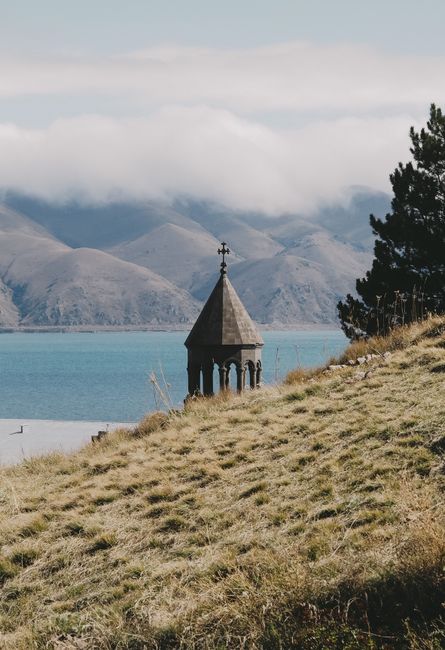
Lake Sevan is Armenia’s inland sea: a vast sheet of water at about 1,900 m above sea level, ringed by bare mountains and changing from turquoise to deep blue with the light. It is one of the largest high-altitude freshwater lakes in the world, covering roughly a twentieth of the country, and Armenians love it as their summer escape from the heat of Yerevan, only an hour away. Climb to the twin stone churches of Sevanavank on their peninsula, stop at the lakeside monastery of Hayravank and the field of carved stone crosses at Noratus, eat fresh fish, and swim in its cool, clear water on a hot July or August day. Combine it with Dilijan’s forests on the way to Georgia, or with the south via the old Selim caravan pass. Give it a day trip or a night or two. Before exploring the far eastern shore, read the border notes below.
Right now in Lake Sevan (Sevan)
- Wed 7–13°C 44–55°F 5 mm Showers
- Thu 7–15°C 44–58°F Clear
- Fri 8–14°C 46–57°F 1 mm Mostly clear
Weather: MET Norway (CC BY 4.0)
Top tours in Lake Sevan
See all tours for Lake Sevan →
From local operators, with prices and reviews; you check availability and book on Viator, our partner. We may earn a commission at no extra cost to you. How we earn money
Lake Sevan at a glance
- Best months: June to September; July and August for swimming, when the lake’s mean air temperature is about 17 °C day and night together and afternoons are warm (official 1991–2020 normals for Sevan).
- Days needed: a day trip from Yerevan for Sevanavank; one or two nights for Noratus, Hayravank and beach time.
- Getting there: about an hour by road from Yerevan, by minibus from the Northern Bus Station, taxi or car, or by the weekend summer train.
- Altitude: about 1,900 m. The sun is strong, the water is cold and the nights are cool even in summer.
- Safety: the western and northern shores are far from the border. The far eastern shore and the area beyond Vardenis are close to the border with Azerbaijan; see the border notes below.
How Lake Sevan works: the lake, the shores and the national park
Lake Sevan is about 74 km long and up to about 32 km wide, fed by 28 rivers and drained by the Hrazdan, though most of its water is lost to evaporation. A narrow strait near the Artanish peninsula divides it into the deeper Small Sevan in the north-west and the wide, shallow Big Sevan in the south-east. In Soviet times its water was drawn off for irrigation and hydropower, and the level fell by about 20 m, turning the island of Sevanavank into a peninsula; since then the level has been slowly raised again to save the lake’s ecology. Sevan National Park protects the lake and its shores, with a recreation zone of public beaches. The main town, Sevan, with about 20,000 people, stands near the north-western shore at about 1,905 m; Gavar, the provincial capital of Gegharkunik, and Martuni lie near the southern and western shores.
Safety: the eastern shore and the border
The mountains along Sevan’s eastern side form the border with Azerbaijan. Because of tensions between Armenia and Azerbaijan, the strip within about 5 km of the border is best avoided, as is Gegharkunik province east of Vardenis. By our map calculation, the lakeshore itself stays just outside the 5 km strip, but the villages at the tip of the Artanish peninsula and on the far south-eastern shore lie only about 6–7 km from the border, and the roads east of Vardenis run closer. Sevan town, Sevanavank, Hayravank, Noratus, Gavar and the beaches of the north-west shore are 25–36 km from the border. Stick to the western and northern shores and the main lakeside roads, do not head up into the mountains on the eastern side, and check current conditions before you go.
Tickets and fees (as of October 2026)
Sevanavank, Hayravank and Noratus are active religious and memorial sites, and we found no entry ticket for any of them; there is usually a small parking charge at Sevanavank, and candle sellers and souvenir stalls by the steps. Some organised beaches charge for entry, loungers or parking in summer, while others are free; prices are set locally. We could not find a published entry fee for Sevan National Park on an official site, so ask at your hotel. Boat trips and jet-ski rentals are priced at the beaches.
Sevanavank monastery
On the rocky peninsula just east of Sevan town, steps lead up to Sevanavank, a monastery founded in the 9th century, with two small dark churches of black stone, the Holy Apostles and the Holy Mother of God, and fine carved stone crosses. When the lake was higher, this was an island and a place of strict monastic retreat. Today it gives the classic view of the lake, with the water on both sides. It is busy at weekends in summer; come early or late in the day. Dress modestly, as it is an active church, and women often cover their hair. Below, a seminary still trains priests.
Hayravank and Noratus
Driving south along the western shore, Hayravank is a small 9th–12th-century monastery right on the water’s edge, quiet and beautiful at sunset. Inland near Gavar, Noratus has one of the largest surviving fields of medieval khachkars, the carved stone crosses unique to Armenian art, with hundreds of them, some from the 10th century, leaning among the graves. Local women sometimes sell knitted socks at the entrance. The two make an easy half-day loop from Sevan town.
Beaches and swimming
Lake Sevan is Armenia’s beach. Since 2011 the government has set up public beaches in the national park’s recreation zone, and private resorts, hotels and cabins line the north-western shore around Sevan town and the road towards Tsovagyugh; some of the quieter beaches lie further round the north-eastern shore towards Shorzha. The water is clean and clear but cold: it is comfortable for most swimmers only in July and August, and even then it feels fresh. Activities include swimming, sunbathing, sailing, windsurfing, pedalos and jet-skis. Don’t swim far out alone; the lake is large, winds can raise waves quickly, and there have been drownings. Wear sunscreen, as the sun at 1,900 m burns fast. See our beaches guide and our boat trips guide.
Fish, food and where to eat
Lakeside restaurants serve grilled and fried fish, crayfish and Armenian barbecue, often with a view. The native Sevan trout, ishkhan (“prince”), is endangered after decades of overfishing and the arrival of introduced species, so choose the whitefish (sig) or crayfish instead, which are what most menus offer. Try fresh lavash, herbs and local cheese, and the summer stalls selling dried fish and berries along the road.
Hiking and viewpoints
The hills around the lake have open, grassy walking with wide views, especially above the north-western shore and towards the Sevan pass, but trails are poorly marked. Walkers often head over the pass to Dilijan National Park, with beech and oak forests and the monasteries of Haghartsin and Goshavank, which has a better trail network. In the south, the road over the Selim pass (Vardenyats pass, about 2,400 m) to Vayots Dzor passes the 14th-century Selim (Orbelian) caravanserai, a stone inn of the Silk Road. Remember to keep away from the mountains on the eastern side of the lake, along the border. See our hiking guide.
Getting there and getting around
By minibus or taxi
Minibuses to Sevan leave Yerevan’s Northern Bus Station several times a day and take about an hour; minibuses to Dilijan, Ijevan and Vardenis also pass the lake, and you can ask to be dropped off. Taxis from Yerevan are inexpensive by European standards; agree a price for a return trip with waiting time, or use an app such as GG for the outward leg.
By train in summer
From June to September, South Caucasus Railway runs a weekend train from Yerevan via Hrazdan to Sevan and along the north-eastern shore to Shorzha, on Fridays, Saturdays and Sundays. In 2026 it left Yerevan at 08:30, reached Sevan at 10:43 and Shorzha at 11:43, and returned from Shorzha at 17:00. The 2026 season ended on 13 September; check the railway’s timetable for 2027.
By car
The M4 highway from Yerevan reaches Sevan town in about an hour and continues through a tunnel under the Sevan pass to Dilijan. Other roads run along the western and southern shores to Gavar, Martuni and Vardenis. A car lets you combine Sevanavank, Hayravank and Noratus easily. Roads can be icy from November to March, and it is best not to drive outside towns after dark.
Around Lake Sevan: Dilijan, Tsaghkadzor and the south
Thirty kilometres north of the lake, Dilijan is a green spa town with restored old craft streets and forest monasteries, and the natural next stop on the way to Georgia via Vanadzor (avoid the Ijevan–Noyemberyan road, which runs along the border with Azerbaijan). West of the lake, Tsaghkadzor is Armenia’s ski resort, with a summer chairlift and the Kecharis monastery. To the south, the Selim pass leads to Yeghegnadzor, Areni’s wineries and Noravank.
When to go and how long to stay
Sevan has a cool mountain climate: short, pleasant summers, long, cold winters, and a lake that sometimes partly freezes. The table shows mean temperatures (day and night together) and rainfall from the official 1991–2020 climate normals for the Sevan Lake weather station at 1,917 m. Daytime highs in summer are several degrees above the means, typically in the low to mid-20s °C.
| Season | Mean temperature | Rain | What it’s like |
|---|---|---|---|
| Spring (Mar–May) | −1 to 9 °C | 45–95 mm a month | Late, chilly spring; May is the wettest month. |
| Summer (Jun–Aug) | 14–17 °C | 40–80 mm a month | Warm, sunny days and cool nights; beach season in July and August. |
| Autumn (Sep–Nov) | 14 °C falling to 2 °C | 35–50 mm a month | Clear, crisp September; cold by November. |
| Winter (Dec–Feb) | −5 to −2 °C | 20–27 mm a month | Freezing, snowy and very quiet; stark beauty. |
Sevan gets about 584 mm of rain and snow a year, on about 96 days. Mid-summer weekends are busy with day-trippers from Yerevan, and many beach businesses close from October to May.
Lake Sevan in one day
Leave Yerevan in the morning, climb to Sevanavank, have a fish lunch by the water, then drive down the western shore to Hayravank and Noratus before heading back, or carry on to Dilijan for the night.
Two days
Day 1: Sevanavank and an afternoon on a north-western beach. Day 2: Hayravank and Noratus in the morning light, then over the Sevan pass to Dilijan, or south over the Selim pass towards Areni and the south.
Where to stay at Lake Sevan
- Sevan peninsula and the north-western shore: hotels and resorts close to Sevanavank and the beaches; the most convenient base.
- Sevan town: simple guesthouses and the best transport links.
- Tsovagyugh and the north-eastern shore: quieter resorts and cabins; summer only.
- Dilijan: if you prefer forests and a town with more restaurants, 30 minutes away.
Practical tips for Lake Sevan
- Sun: at 1,900 m, use high-factor sunscreen and a hat even on cool days.
- Layers: it is often 8–10 °C cooler than Yerevan; bring a jacket for the evenings.
- Water: swim near the shore and with others; winds can raise waves suddenly.
- Border: stay away from the far eastern shore and the mountains beyond Vardenis.
- Cash: carry dram for parking, beaches, stalls and minibuses.
- Emergencies: call 911.
What to pack for Lake Sevan
Pack swimwear, a towel, high-factor sunscreen, sunglasses and a hat, plus a warm fleece for cool evenings. Water shoes help on the stony beaches, and hiking shoes are useful for the hills and the steps to Sevanavank. Bring a rain jacket in May and June, and a scarf or wrap for the churches.
Lake Sevan travel FAQ
How do I get from Yerevan to Lake Sevan?
By minibus from the Northern Bus Station in about an hour, by taxi or car on the M4, or on the weekend summer train from June to September.
Can you swim in Lake Sevan?
Yes, in July and August, though the water is cold. Use the organised beaches near Sevan town, stay close to shore and don’t swim alone.
Is there an entrance fee for Sevanavank?
We found no entry ticket for the monastery; expect a small parking charge. Dress modestly, as it is an active church.
How high is Lake Sevan?
About 1,900 m above sea level, which makes it one of the largest high-altitude freshwater lakes in the world.
Is it safe to visit Lake Sevan?
Yes, for the western and northern shores, where the main sights and beaches are. The far eastern shore and the area beyond Vardenis lie close to the border with Azerbaijan, so avoid them.
When is the best time to visit Lake Sevan?
June to September, with July and August for swimming. September is quieter and still mild by day.
Can I visit Lake Sevan as a day trip from Yerevan?
Easily. Sevanavank is about an hour away. Add Hayravank and Noratus by car, or continue to Dilijan for the night.
Can I eat Sevan trout?
The native Sevan trout (ishkhan) is endangered, so choose whitefish (sig) or crayfish, which most lakeside restaurants serve.
How cold is Lake Sevan in winter?
Very cold: the mean temperature from December to February is between −5 and −2 °C, with snow, and parts of the lake can freeze.
What is Noratus?
A medieval cemetery near Gavar with one of the largest surviving collections of khachkars, Armenian carved stone crosses, some from the 10th century.
Sources and last review
Researched and last reviewed on 4 October 2026. Safety information comes from GOV.UK foreign travel information and the US State Department’s country information; the summer train from South Caucasus Railway; climate from the official 1991–2020 WMO normals for the Sevan Lake station; Sevan town’s population from the Statistical Committee of Armenia. Lake dimensions, the water-level history, beaches, Noratus, the Sevan trout and minibus details come from Wikipedia, Wikivoyage and other secondary sources, and distances to the border are our own map calculation; all are flagged for checking. We found no official fee schedule for Sevan National Park. Check locally before you travel.
Plan your trip
Partner links: TravelerCenter may earn a commission if you book, at no extra cost to you.
🇦🇲 Useful Armenian phrases for Lake Sevan
All 38 Armenian phrases: restaurant, hotel, emergencies, romance (printable) →