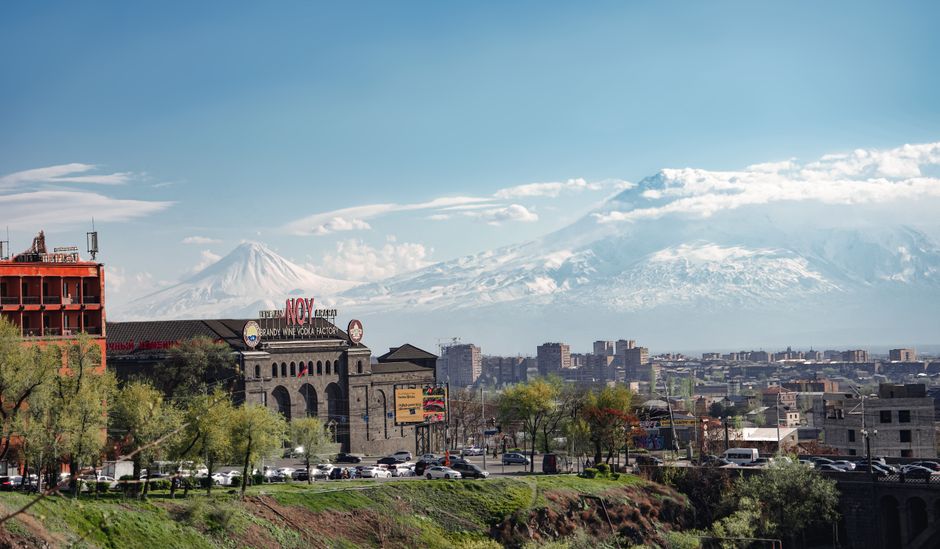
Yerevan is Armenia’s warm-hearted capital: a city of rosy volcanic stone, shady boulevards, fountains and cafés, where people stroll late on summer evenings and Mount Ararat rises white on the horizon on clear days. It is one of the world’s oldest continuously inhabited cities, founded as the Urartian fortress of Erebuni in 782 BC, yet most of what you see dates from a grand 20th-century plan, with sweeping Soviet-era squares and an ambitious modern art scene. Climb the Cascade for the view, see illuminated manuscripts at the Matenadaran, pay your respects at the Genocide Memorial, browse the Vernissage market, and eat and drink very well for little money. Yerevan is also the base for Armenia’s best day trips: Garni and Geghard, Etchmiadzin, Khor Virap and Lake Sevan. Give it three or four days. Spring and autumn are the most pleasant seasons; summer is hot.
Right now in Yerevan
- Wed 11–19°C 52–67°F 1 mm Mostly clear
- Thu 10–22°C 50–71°F Clear
- Fri 12–21°C 53–71°F Clear
Weather: MET Norway (CC BY 4.0) · Air quality: OpenAQ
Top tours in Yerevan
See all tours for Yerevan →
From local operators, with prices and reviews; you check availability and book on Viator, our partner. We may earn a commission at no extra cost to you. How we earn money
Yerevan at a glance
- Best months: May–June and September–October. July and August average about 26 °C day and night together, with afternoons often well above 35 °C (official 1991–2020 normals for Yerevan).
- Days needed: 2 for the city; 3–4 with day trips.
- Getting there: Zvartnots International Airport (EVN) is just west of the city; bus N100 runs to the centre around the clock for 500 dram.
- Getting around: the centre is compact and walkable; a single metro line, buses and cheap taxi apps cover the rest.
- Safety: Yerevan is far from the border areas and is generally safe. See our Armenia guide for safety notes and entry rules.
Yerevan’s neighbourhoods and who each one suits
- Kentron (the centre): everything inside the green Ring Park, from Republic Square to the Opera and the Cascade. Best for a first visit.
- Around the Cascade and Northern Avenue: pedestrian streets with cafés, wine bars and boutique hotels. Lively and central.
- Kond and the old quarter: a maze of old houses near the centre, rough around the edges but full of character.
- Arabkir: a leafy residential district north of the centre, good for apartments and longer stays.
- Near Republic Square and the Vernissage: handy for the metro, the museums and the weekend market.
Top things to see in Yerevan
Prices and hours are as of October 2026, in Armenian dram (about 407 dram to the euro on 2 October 2026). Many museums close on Mondays, public holidays and remembrance days, so plan around them.
The Cascade and the Cafesjian Center for the Arts
The Cascade is a giant limestone stairway climbing the hill north of the centre, with terraces, fountains and sculptures and, from the top, a view over the city to Ararat. Inside runs a series of escalators lined with art, and at the bottom lies the Cafesjian Sculpture Garden, with works by Botero and others. It is all part of the Cafesjian Center for the Arts, and admission is free. According to the centre, the escalator gallery is open every day from 08:00 to 20:00, the exhibition galleries from Friday to Sunday, 10:00 to 20:00, and the sculpture garden is always open. Look out for the “Music Cascade” evening concerts. Come at sunset, then walk down to the cafés of Tamanyan Street.
The Matenadaran
At the top of Mashtots Avenue, the Matenadaran, guarded by a statue of Mesrop Mashtots, inventor of the Armenian alphabet, is one of the world’s great manuscript libraries, with thousands of illuminated gospels, scientific treatises and historical documents. Its museum is open Tuesday to Saturday, 10:00 to 17:50, and closed on Sundays, Mondays, public holidays and remembrance days, according to the Matenadaran. Adult tickets cost 2,000 dram (1,000 dram for ages 6–18); a guided tour in English costs 5,000 dram for up to ten people and is worth booking.
The Armenian Genocide Memorial and Museum
On the hill of Tsitsernakaberd, west of the centre, twelve inward-leaning slabs circle an eternal flame beside a tall, split spire, commemorating the victims of the Armenian Genocide that began in 1915. The museum below tells the story through documents and photographs. Admission is free, with donations welcome. According to the museum, it is open Tuesday to Saturday from 10:00 to 17:00 between 15 February and 15 November (11:00 to 16:45 in winter) and on Sundays from 11:00 to 15:00, and closed on Mondays and on official holidays. Each 24 April, huge crowds walk up to lay flowers. Allow at least two hours, and dress respectfully.
Republic Square and the History Museum of Armenia
The oval Republic Square is framed by grand pink and yellow tuff buildings, government offices and the History Museum of Armenia, which traces the country from prehistory to modern times, including finds from the Areni cave. The museum is open Tuesday to Saturday, 11:00 to 18:00, and Sunday, 11:00 to 17:00, and closed on Mondays and national holidays; tickets cost 2,500 dram, according to the museum. In the warmer months, the square’s fountains are lit up in the evenings, often with music.
The Vernissage, the Blue Mosque, Erebuni and Mother Armenia
The open-air Vernissage market, in a park near Republic Square, fills on Saturdays and Sundays with carpets, woodwork, jewellery, paintings, Soviet souvenirs and backgammon boards. Nearby on Mashtots Avenue, the 18th-century Blue Mosque has a peaceful courtyard. In the south-east of the city, the Erebuni Fortress and its museum mark the city’s founding in 782 BC, with Urartian inscriptions and wall paintings; tickets are reported at about 1,000 dram. North of the Cascade, the huge statue of Mother Armenia, put up in 1967 in place of a statue of Stalin, stands in Victory Park with a small military museum.
Food, wine and nightlife
Eat khorovats (barbecued meat and vegetables), dolma, lahmajo flatbreads, ghapama (stuffed pumpkin) in autumn, and fresh lavash with herbs and cheese. Yerevan has a big café culture and a thriving wine scene, with wine bars pouring Armenian wines from native grapes such as Areni. Armenian brandy is the classic souvenir; both the Yerevan Brandy Company (the Ararat brand) and the Noy factory near the river run tours with tastings, booked in advance. Summer evenings are long and lively, with people out late around Northern Avenue, the Cascade and Saryan Street. Many restaurants add a 10% service charge. See our wine tasting guide.
Day trips from Yerevan
- Garni and Geghard: about 45 minutes east, the 1st-century temple of Garni above the Azat gorge, and, a few kilometres further, Geghard monastery, partly carved into the rock, a UNESCO World Heritage Site.
- Etchmiadzin and Zvartnots: about 30 minutes west, the Mother Cathedral and seat of the Armenian Apostolic Church, founded in the early 4th century, and the ruins of Zvartnots cathedral, together a UNESCO site.
- Khor Virap: about an hour south, the monastery with the best view of Mount Ararat, close to the Turkish border.
- Lake Sevan: about an hour north-east, for the Sevanavank monastery and a swim in summer. See our Lake Sevan guide.
- Areni and Noravank: about two hours south, for wineries and a red-rock canyon monastery; close to the border with Azerbaijan’s Nakhchivan exclave, so stay on the main roads.
For more ideas, see our city sightseeing guide and our hiking guide.
Nearby destinations
- Lake Sevan72 km
- Tbilisi173 km
- Sheki251 km
- Kazbegi276 km
- Batumi291 km
Getting there and getting around
From the airport
Zvartnots International Airport (EVN) is about 12 km west of the centre. According to the airport, municipal bus N100 runs to the city centre for 500 dram, every 30 minutes from 06:50 to 22:00 and then every hour through the night; pay by Visa or Mastercard on board or with a TelCell QR ticket from the machines in the terminal. The N201 express costs 300 dram, cash in dram only, every 30 minutes from 07:00 to 22:00. Taxi desks in arrivals are open 24 hours, or use a taxi app such as GG or Yandex Go; the ride takes about 20 minutes.
Metro, buses and taxis
Yerevan’s single metro line has ten stations, from Barekamutyun in the north through Marshal Baghramyan, Yeritasardakan and Republic Square to the south-west, and runs from 07:00 to midnight, according to the operator. Buses, trolleybuses and the metro share one ticket system: tap a bank card on the reader, or buy an e-ticket or a TelCell QR ticket. The city’s transport site lists a 180-minute ticket at 300 dram, a one-day pass at 900 dram and a seven-day pass at 5,000 dram. Taxis are cheap; use a reputable app such as GG rather than hailing cars in the street.
Trains and minibuses
Trains leave the Sasuntsi David station (metro of the same name) for Gyumri, three times a day, plus an express at weekends, and overnight for Tbilisi on even-numbered dates at 21:00 this winter. Minibuses to Sevan, Dilijan and the north leave from the Northern Bus Station, and those to Garni and Geghard from the Gai bus station on the eastern edge of town.
When to go and how long to stay
Yerevan has a dry, sunny, continental climate at about 1,000 m: hot summers, cold winters with some snow, and short, lovely springs and autumns. It gets only about 340 mm of rain a year, mostly in April and May.
| Season | Mean temperature | Days with rain a month | What it’s like |
|---|---|---|---|
| Spring (Mar–May) | 7–17 °C | 6–9 | Blossom, green hills and the occasional shower; Ararat often clear. |
| Summer (Jun–Aug) | 22–26 °C | 2–5 | Hot and dry, with afternoon highs often above 35 °C; lively evenings. |
| Autumn (Sep–Nov) | 21 °C falling to 7 °C | 2–5 | Warm, golden September and October; harvest season. |
| Winter (Dec–Feb) | −2 to 1 °C | 5–6 | Cold, often below freezing at night, with some snow; festive at New Year. |
Figures are from the official 1991–2020 climate normals for the Yerevan/Arabkir weather station, showing the mean of day and night temperatures and days with at least 1 mm of rain. Daytime highs are several degrees above the means. In early July, the water festival of Vardavar sees friendly water fights in the streets (4 July in 2027).
2 days in Yerevan
Day 1: the Matenadaran (not on Sunday or Monday), the Cascade at sunset and dinner near Northern Avenue. Day 2: the Genocide Memorial and Museum in the morning, Republic Square and the History Museum, the Vernissage if it is the weekend, and a brandy tasting.
4 days in Yerevan
Add a day for Garni and Geghard, and another for Etchmiadzin, Zvartnots and Khor Virap. Then continue to Lake Sevan and Dilijan, or south to Areni and Tatev.
Where to stay in Yerevan
- First visit: Kentron, between Republic Square and the Cascade.
- Cafés and nightlife: near Northern Avenue, Saryan Street or the Cascade.
- Budget: hostels and guesthouses around the Ring Park.
- Longer stays: apartments in Arabkir.
Practical tips for Yerevan
- Mondays: most museums, including the Matenadaran, the History Museum and the Genocide Museum, are closed.
- Heat: in July and August, sightsee in the morning and evening, and drink from the city’s pulpulak fountains.
- Ararat: the mountain is clearest in the morning, especially in autumn and winter.
- Money: cards work almost everywhere in the centre; the N201 airport bus and minibuses need cash.
- Protests: demonstrations sometimes take place in the centre; they are usually peaceful, but keep away.
- Emergencies: call 911.
What to pack for Yerevan
Light, breathable clothes, a sun hat, sunglasses and sunscreen for summer; a warm coat, hat and gloves from December to February. Comfortable walking shoes are essential, and hiking shoes help on day trips to Geghard and the gorges. Carry a scarf or wrap for churches, a rain jacket in spring, and your passport for trains and hotels. Plugs are the European two-pin type; bring a travel adapter if you need one.
Yerevan travel FAQ
How do I get from Zvartnots airport to Yerevan?
Take bus N100 for 500 dram, paying by card on board, every 30 minutes by day and hourly at night, or the N201 express for 300 dram in cash. A taxi app ride takes about 20 minutes.
Is the Cascade in Yerevan free?
Yes. The Cafesjian Center for the Arts is free. The escalator gallery opens daily from 08:00 to 20:00, and the exhibition galleries from Friday to Sunday.
When is the Matenadaran open?
Tuesday to Saturday, 10:00–17:50. It is closed on Sundays, Mondays and holidays. Adult tickets cost 2,000 dram.
Is the Genocide Museum free?
Yes, admission is free. It is closed on Mondays and official holidays, and open Tuesday to Saturday and on Sunday mornings to mid-afternoon.
How many days do you need in Yerevan?
Two days for the city’s main sights, and three or four with day trips to Garni, Geghard, Etchmiadzin and Khor Virap.
Where can I see Mount Ararat from Yerevan?
From the top of the Cascade, Mother Armenia and many high-rise rooftops, and best of all from Khor Virap monastery, an hour south. Mornings are clearest.
Is Yerevan safe?
Yes. Crime is low; watch for pickpockets, use a taxi app and avoid demonstrations. The areas that need care are along the border with Azerbaijan, far from Yerevan.
How do I get from Yerevan to Garni and Geghard?
By taxi or with a driver, the easiest way to see both, or by minibus to Garni from the Gai bus station and a taxi on to Geghard.
Can I pay by card in Yerevan?
Mostly, yes, including on the metro and the N100 airport bus. Carry some dram for markets, small cafés, the N201 bus and minibuses.
Can you drink the tap water in Yerevan?
Most locals do: the city’s water comes from mountain springs, and the small pulpulak drinking fountains on street corners run with it. If you have a sensitive stomach, bottled water is cheap.
Sources and last review
Researched and last reviewed on 4 October 2026. Hours and prices come from the Cafesjian Center for the Arts, the Matenadaran, the Armenian Genocide Museum-Institute and the History Museum of Armenia; airport buses from Zvartnots Airport; metro hours from Yerevan Metro; fares from the city’s transport service; trains from South Caucasus Railway; climate from the official 1991–2020 WMO normals; the exchange rate from the Central Bank of Armenia; safety from GOV.UK foreign travel information. The Erebuni ticket price, minibus stations, tour details for the brandy factories and the evening fountain shows come from travel guides and are flagged for checking. Prices and hours change, so check the official sites before you visit.
Plan your trip
Partner links: TravelerCenter may earn a commission if you book, at no extra cost to you.
🇦🇲 Useful Armenian phrases for Yerevan
All 38 Armenian phrases: restaurant, hotel, emergencies, romance (printable) →