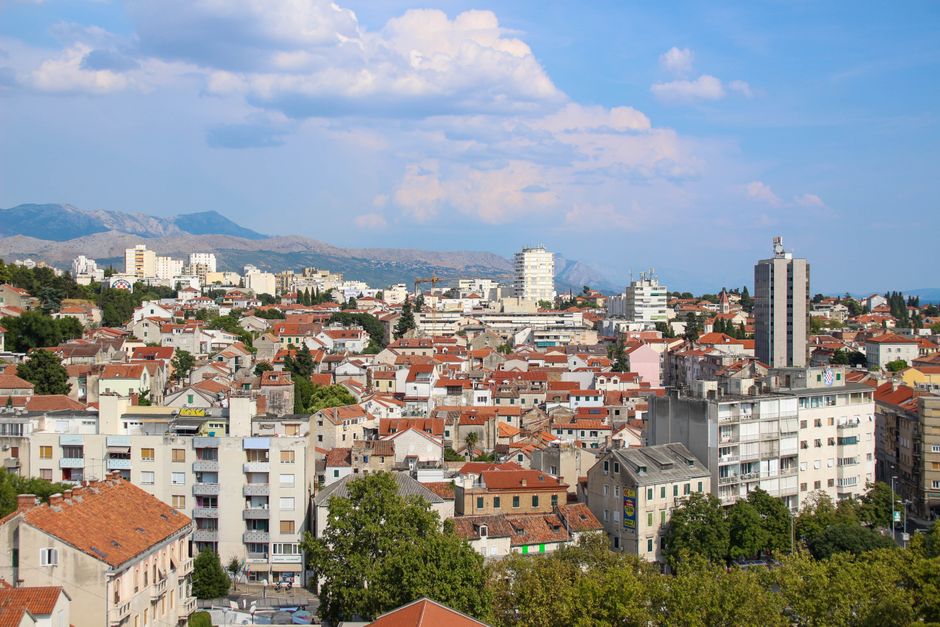
Split is Croatia’s second city and the gateway to the Dalmatian islands, built inside and around the retirement palace of a Roman emperor. Diocletian’s Palace, finished around 305 AD, is not a ruin but a living neighbourhood: some 1,700 years later people still live, drink coffee and hang out washing between its Roman walls, and the cathedral is the emperor’s own mausoleum. Add the palm-lined Riva promenade, the wooded Marjan hill, a city beach where locals play the ball game picigin, and ferries and catamarans to Brač, Hvar, Vis and beyond, and Split makes a lively base for two or three days and the obvious start for island hopping. Late May to June and September are the best months.
Right now in Split
- Wed 18–24°C 65–75°F Mostly clear
- Thu 20–23°C 67–73°F 9 mm Cloudy
- Fri 18–19°C 64–67°F 19 mm Showers
Weather: MET Norway (CC BY 4.0) · Sea temperature: NOAA CoastWatch · Rates: ECB
Top tours in Split
See all tours for Split →
From local operators, with prices and reviews; you check availability and book on Viator, our partner. We may earn a commission at no extra cost to you. How we earn money
Split at a glance
- Best months: late May–June and September to early October. Mean temperatures run from about 19 °C in May to 26 °C in July (DHMZ, Split-Marjan station). July and August are hot and very busy.
- Days needed: 1–2 for the palace and Marjan; 3–4 with Trogir, Klis, Krka or an island day trip.
- Getting there: Split airport (SPU) is about 20 km west, near Trogir; trains from Zagreb, buses from all over Croatia and ferries from Ancona in Italy.
- Getting around: on foot in the centre; Promet Split city buses for Marjan’s edges, Solin and the airport; ferries and catamarans leave from the city harbour next to the old town.
- Budget level: cheaper than Dubrovnik or Hvar, though the old town is pricey in summer. See our Croatia guide for money, entry rules and costs.
Split’s areas and who each one suits
- The old town (Diocletian’s Palace and the medieval town to its west): the heart of everything, with rooms, bars and restaurants in Roman and medieval buildings. Atmospheric and central, but loud at night in summer.
- Varoš: the old fishermen’s and farmers’ quarter on the slopes towards Marjan; quieter lanes, small guesthouses and good konobas, five minutes from the Riva.
- Bačvice and Firule: east of the port, with the sandy city beach and the bars around it. Good for beach lovers and night owls.
- Meje and Zvončac: villas and pine trees on the south side of Marjan, near the Meštrović Gallery and small rocky coves. Calm and leafy.
- Near the harbour and the bus and train stations: practical for early ferries, though less charming.
Top things to see in Split
The palace is free to walk around at any hour. A few parts charge for entry: the cathedral complex, the bell tower, the western part of the cellars and some museums. Prices and hours change each season; the figures below were current in 2026 and are flagged in our sources.
Diocletian’s Palace
The Roman emperor Diocletian, born near Salona, built this fortified palace by the sea to retire in after he gave up the throne in 305 AD. It is about 215 m by 180 m, with a gate in each wall: the Golden Gate to the north, where a giant bronze statue of the bishop Grgur Ninski stands outside (rub his toe for luck), the Silver Gate to the east by the market, the Iron Gate to the west and the small Bronze Gate to the south, which leads through the cellars to the Riva. When Salona was sacked in the 7th century, its people took refuge inside the walls, and the town of Split grew within them. The palace became a UNESCO World Heritage Site, together with the medieval town, in 1979.
At its centre is the Peristyle, a colonnaded courtyard where the emperor appeared to his subjects; in summer you will find costumed “Roman soldiers” and people sitting on the steps with a drink. South of it, the domed Vestibule, open to the sky, has superb acoustics, and a cappella klapa groups often sing there.
The cellars (substructures)
The vaulted halls under the palace mirror the layout of the emperor’s apartments above. The central passage from the Bronze Gate to the Peristyle is free and full of souvenir stalls; the larger western and eastern halls, which show the palace’s original plan and served as a set for Game of Thrones, need a ticket from the City Museum, reported at about €6–10 in 2026. Allow 30–45 minutes.
The Cathedral of St Domnius and the bell tower
Split’s cathedral is the emperor’s octagonal mausoleum, turned into a church in the 7th century, the oldest building in the world used as a Catholic cathedral. Look for the carved walnut doors by Andrija Buvina (1214), with 28 scenes from the life of Christ, and the 13th-century pulpit. The 57 m Romanesque bell tower has steep, open steps to the top and the best view of the old town and the islands. Tickets come in combinations of the cathedral, the crypt, the treasury, the Temple of Jupiter (the emperor’s private temple, later the baptistery) and the bell tower; in 2026 a single site was reported at about €5–10 and the full combination at about €15–20. Dress modestly to go inside.
The Riva, the market and the medieval town
The Riva is the palm-lined waterfront in front of the palace’s south wall, Split’s living room, where everyone meets for coffee. West of the palace, the People’s Square (Pjaca), with the Venetian-Gothic old town hall, and the Fruit Square (Voćni trg) are the hubs of the medieval town. The open-air green market by the Silver Gate and the fish market on the west side are busiest in the morning.
Marjan hill
Marjan, a hilly forest park on the peninsula west of the centre, is where locals run, walk and swim. Climb the steps from Varoš to the first viewpoint, Vidilica (about 15 minutes), then continue to the summit, Telegrin (178 m), for the view of the islands, or follow the paths to the small hermitage chapels and down to rocky coves such as Kašjuni, Bene and Prva Vala.
The Meštrović Gallery
Ivan Meštrović, Croatia’s greatest sculptor, built a villa on the Marjan seafront in the 1930s; it is now a gallery of his work, with a garden of bronzes. Nearby, the Kaštilac holds his cycle of wooden reliefs of the life of Christ.
Museums
- Archaeological Museum Split
- Meštrović Gallery
- Museum of Fine Arts, Split
Monuments
- Diocletian's Palace
Churches and cathedrals
- Cathedral of St Domnius
Protected areas
- Marjan
Other sights
- Diocletian's Aqueduct
Beaches in Split
Bačvice, a ten-minute walk east of the old town, is the city beach: a shallow, sandy bay where locals play picigin, keeping a small ball in the air while diving into knee-deep water. It is crowded and fun rather than beautiful. Further east are Firule, Ježinac and Žnjan, a long pebble beach with bars. Around Marjan, Kašjuni has the clearest water close to town, and the coves on the north side are calmer. For better beaches, take a ferry to Brač or Šolta, or head to the Makarska Riviera south of the city.
Island hopping from Split
Split’s harbour, right next to the old town, is the hub for the central Dalmatian islands. Two kinds of boat leave from it:
- Car ferries (trajekt), run by Jadrolinija, the state ferry company, go to the main island ports: Supetar on Brač (about 50 minutes, many sailings a day), Stari Grad on Hvar (about 2 hours), Vis (about 2.5 hours), Rogač on Šolta and Vela Luka on Korčula. They take cars and are cheap for foot passengers.
- Catamarans (katamaran), for foot passengers only, are faster and stop in the island towns: Hvar town (about 1 hour), Milna and Bol on Brač, Jelsa, Vis, Korčula, Mljet and Dubrovnik. Jadrolinija runs lines such as Split–Hvar and Split–Bol–Jelsa; Krilo (Kapetan Luka) runs fast boats from Split to Hvar, Korčula, Mljet and Dubrovnik; and TP Line runs routes such as Split–Milna–Hvar–Korčula–Dubrovnik. Timetables are fullest from June to September and thin out in winter.
Tips: buy catamaran tickets online or at the harbour kiosks a day or two ahead in July and August, as the most popular departures sell out. For car ferries in summer, arrive at least an hour early, or two in peak season, even with a ticket, because vehicles board in order of arrival on many routes. Check the operator’s site on the day: strong winds (the bura from the north-east or the jugo from the south) can cancel catamarans. A classic route: Split – Hvar (2–3 nights) – Korčula (2 nights) – Dubrovnik, with a detour to Vis or Brač if you have time. See our Hvar guide and our Dubrovnik guide for the next stops.
Activities and best months
- Beaches and swimmingBačvice is the sandy city beach next to the harbour, where the ball game picigin was born (now protected cultural heritage); about 20 minutes' walk west along the sea are pebble beaches below the Meštrović Gallery and the southern slopes of Marjan. · source
- Boat tripsSplit is the ferry hub for the central Dalmatian islands: Jadrolinija's car ferry to Stari Grad on Hvar takes about 2 hours, and its catamaran line 641 runs from Split port to Hvar town. · source
- City sightseeingSplit's tourist board names Diocletian's Palace and the old town around it as the most important sights; the palace substructures (cellars), once its storerooms, are one of the city's main attractions. Its one-day plan adds Marjan hill and a swim. · source
Day trips from Split
- Trogir: a tiny UNESCO-listed medieval island town 30 km west, with a superb Romanesque cathedral portal by Master Radovan. Buses run every 20–30 minutes, and boats sail from the Riva in summer.
- Klis Fortress: a medieval fortress on a rock pass above the city, another Game of Thrones location, with huge views. About 20 minutes by car or city bus.
- Salona: the ruins of the Roman provincial capital in Solin, where Diocletian was born: amphitheatre, basilicas and city walls.
- Krka National Park: waterfalls and walkways about an hour north by road. See our Krka guide.
- Brač: Supetar is 50 minutes away by ferry; the famous Zlatni Rat beach at Bol is easiest by direct catamaran.
- Vis and the Blue Cave: fast-boat tours combine the Blue Cave on Biševo, Vis and the Pakleni islands in one long day; the cave can close in rough seas.
- Omiš and the Cetina river: rafting, canyoning and ziplining 25 km south.
Nearby destinations
- Hvar47 km
- Krka National Park50 km
- Makarska Riviera64 km
- Međugorje106 km
- Mostar112 km
- Zadar118 km
- Sarajevo163 km
- Plitvice Lakes166 km
Rules in Split’s old town
Split has tightened its rules to curb rowdy tourism. Under the city’s Public Order Act, published by the Split Tourist Board, there is a €300 fine for drinking alcohol in public inside the old town (the area within the 17th-century ramparts) and within 100 m of schools and kindergartens, for urinating or vomiting in public, for climbing or sitting on monuments, and for bathing in fountains. Sleeping in parks and other public spaces costs €150. Swimwear and bare chests in the old town are also fined (reported at €150).
In 2026 the city also banned the sale of alcohol in shops, kiosks, petrol stations and other retail outlets between 21:00 and 06:00, from 1 June to 15 September. The rule came into force on 19 August 2026, was lifted for the season on 16 September and is due to apply again from 1 June 2027. Bars, restaurants and clubs are not affected.
Getting there and getting around
Flights, trains and buses
Split airport (SPU) is 20 km west of the city, close to Trogir. Airport shuttle buses run to the main bus station by the harbour in about 30–40 minutes, and city bus 37 runs between Split and Trogir via the airport. Trains from Zagreb take about 6–8 hours, including an overnight service in summer; buses from Zagreb are faster, at about 5 hours, and buses run to Zadar (about 3 hours), Plitvice and Dubrovnik (4–5 hours). The bus station, the train station and the ferry port are all next to each other on the harbour.
Ferries to Italy
Jadrolinija and other companies run overnight ferries between Split and Ancona in season, a good way to combine Croatia with Italy.
Driving and parking
The A1 motorway connects Split with Zagreb (about 4.5 hours) and Dubrovnik. The old town is car-free, and parking nearby is scarce and expensive; if you are staying in the centre, you do not need a car until you leave.
When to go and how long to stay
Split is one of the sunniest cities in Europe, with about 2,600 hours of sunshine a year. Summers are hot and dry, and winters mild, with most rain from October to January. The bura, a cold, gusty north-easterly wind, can blow for days in winter and occasionally stops ferries. July and August bring the biggest crowds and the busiest ferries; late May, June and September are best for sightseeing and island hopping. The feast of St Domnius (Sudamja) on 7 May fills the Riva with a big fair.
| Season | Mean temperature | Days with rain a month | What it’s like |
|---|---|---|---|
| Spring (Mar–May) | 11–19 °C | 9–10 | Mild, green and calmer; ferries start their summer timetables in June. |
| Summer (Jun–Aug) | 23–26 °C | 5–8 | Hot, sunny and dry; peak crowds and ferry demand; warm sea. |
| Autumn (Sep–Nov) | 22 °C falling to 13 °C | 8–12 | September is ideal; October is mild; November is wet. |
| Winter (Dec–Feb) | 8–9 °C | 10–12 | Mild with rain and some cold bura days; fewer ferries; local life. |
Figures are DHMZ long-term monthly averages for the Split-Marjan station, 1948–2024. They are means over day and night: afternoon highs in July and August are usually around 30 °C. Split gets about 810 mm of rain a year.
Weather month by month
Averages from DHMZ normals 1991–2020, Split-Marjan · Last reviewed 4 Oct 2026
2 days in Split
Day 1: Diocletian’s Palace, the Peristyle, the cathedral and bell tower, the cellars and the Riva, then dinner in Varoš. Day 2: an early walk on Marjan, a swim at Kašjuni, the Meštrović Gallery, and an evening at Bačvice.
4 days in Split
Add a morning in Trogir and an afternoon at Klis, a day at Krka National Park, and a day trip by ferry to Brač, or start island hopping to Hvar.
Where to stay in Split
- First visit, no car: the old town or Varoš, close to everything and the ferries.
- Quieter nights: Varoš or Meje, near Marjan.
- Beach and nightlife: Bačvice and Firule.
- Early ferries or late buses: near the harbour.
- A calmer alternative: Trogir, near the airport, with buses into Split.
The tourist tax in Split is charged per person per night, with children under 12 exempt and 12- to 18-year-olds paying half; it is set for each town by the county and usually added to the bill.
Practical tips for Split
- Ferries: book catamarans ahead in summer, and check for weather cancellations on the day.
- Noise: rooms inside the palace can be loud until late; ask for a quiet room or stay in Varoš.
- Rules: no drinking in the street, no swimwear in town, and no climbing on monuments.
- Markets: go to the fish and green markets in the morning for picnic supplies.
- Cash and cards: cards are widely accepted, but carry some euros for kiosks and small cafés.
- Emergencies: call 112.
What to pack for Split
Pack light summer clothes, a sun hat, sunglasses and high-factor sunscreen. Bring a swimsuit, a towel and water shoes for the pebbly and rocky beaches, and a snorkel mask for Marjan’s coves and island trips. Good walking shoes help on the polished stone and Marjan’s paths. Carry a light layer for evening ferries, where the wind can be cool, and a scarf to cover your shoulders in the cathedral. In spring, autumn and winter, add a windproof jacket for the bura and an umbrella.
What to pack
- City walking shoesLisbon and Porto are steep, with polished limestone cobbles that get slippery, so grippy soles matter.
- Day packs and anti-theft bagsCarries water, towel and sunscreen down the long stairways to Algarve coves.
- Dry bags and phone pouchesProtects phones and cameras from sand and spray on beaches reached by ferry or steep paths.
- Fleeces and warm layersIt is cooler at sea than on land, especially on morning whale-watching trips.
- Quick-dry beach towelsA sand-shedding quick-dry towel packs small for beach days and lido visits.
- Rain jacketsA windproof, waterproof shell keeps you warm on open boats, where wind and spray cool you quickly.
- Reef-friendly sunscreenSummer UV is strong on Portuguese beaches and there is little shade below the cliffs.
- Travel adapters and convertersPortugal uses Type C and F sockets at 230 V, so most visitors from outside Europe need an adapter.
- Water shoesRocky coves, lava pools and weever fish in shallow sand make water shoes useful.
- WetsuitsOn the west and north coasts the sea stays around 16–18 °C even in summer, so a thin suit helps for long swims.
Split travel FAQ
Is Diocletian’s Palace free?
Yes. The palace is a living part of the town, so you can walk through its streets, the Peristyle and the central cellar passage for free at any hour. The cathedral, bell tower, Temple of Jupiter, the main cellar halls and some museums charge for entry.
How long do you need in Split?
One full day for the palace, the Riva and Marjan; two or three days with Trogir, Klis, Krka or an island day trip.
How do I get from Split to Hvar?
By catamaran to Hvar town in about 1 hour (Jadrolinija, Krilo and TP Line), or by car ferry to Stari Grad in about 2 hours, then a 20-minute drive or bus to Hvar town.
Do I need to book ferries from Split in advance?
For catamarans in July and August, yes, a day or two ahead. Car ferries also sell tickets online, but you still need to arrive early in summer because vehicles often board in order of arrival.
Can you drink alcohol in the street in Split?
No. Drinking in public in the old town is fined €300. In summer 2026 the city also banned alcohol sales in shops from 21:00 to 06:00; the ban returns on 1 June 2027.
What is the best beach in Split?
Bačvice is the lively city beach, famous for picigin; Kašjuni below Marjan has the clearest water. For bigger beaches, take a ferry to Brač or Šolta.
Is Split a good base for Krka and Plitvice?
Krka is an easy day trip, about an hour away. Plitvice is about 3 hours each way by road, so it is better visited on the way between Split and Zagreb or from Zadar.
What is the best island hopping route from Split?
Split – Hvar – Korčula – Dubrovnik is the classic one-way route. With more time, add Vis or Brač. Catamarans link all of them from June to September.
Is Split worth visiting in winter?
Yes, for the palace without crowds and real local life, but ferries are fewer, some restaurants close, and the bura wind can be cold.
Where was Game of Thrones filmed in Split?
In the cellars of Diocletian’s Palace, where Daenerys kept her dragons, and at Klis Fortress above the city.
Sources
- © OpenStreetMap contributors · ODbL · fetched 4 Oct 2026
- Wikidata · CC0 · fetched 4 Oct 2026
Sources and last review
Researched and last reviewed on 4 October 2026. Public order fines come from the Split Tourist Board’s official summary of the city’s Public Order Act; ferry and catamaran routes from Jadrolinija, Krilo and TP Line; palace history from the Split Tourist Board; climate from the Croatian Meteorological and Hydrological Service (DHMZ). The 2026 shop alcohol ban dates and the palace ticket prices come from press reports and are flagged for checking. Prices, timetables and rules change, so check the official sites and operators before you travel.
Plan your trip
Partner links: TravelerCenter may earn a commission if you book, at no extra cost to you.
🇭🇷 Useful Croatian phrases for Split
All 38 Croatian phrases: restaurant, hotel, emergencies, romance (printable) →