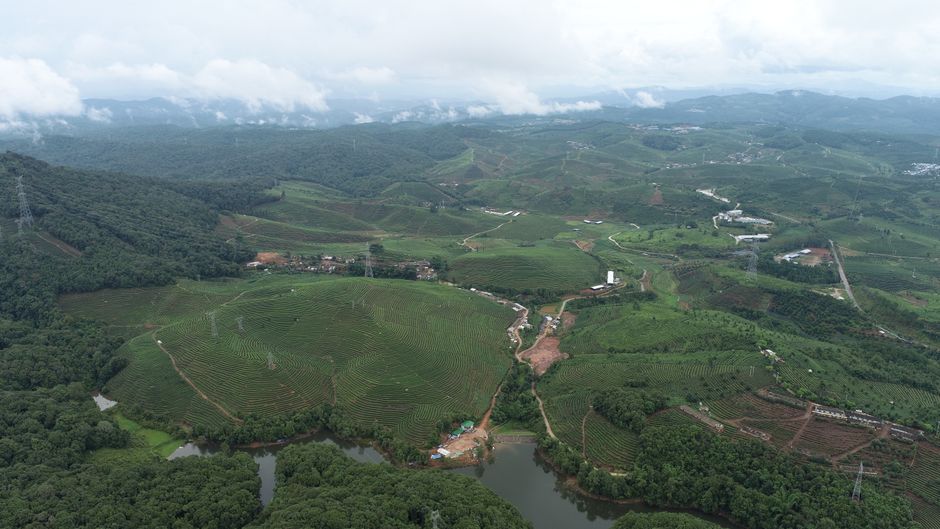
Xishuangbanna, the Dai Autonomous Prefecture in the far south of Yunnan province, is tropical China: a land of rainforest-covered hills, rubber and tea plantations, golden Buddhist temples and stilt-house villages along the Mekong River, which the Chinese call the Lancang, on the borders of Laos and Myanmar. It is the homeland of the Dai people, related to the Thai and Lao, who follow Theravada Buddhism and celebrate their New Year in April with the joyful Water-Splashing Festival, along with Hani, Bulang, Jinuo, Yao and other peoples in the hills. The prefecture’s capital, Jinghong, is a relaxed riverside city of palms, night markets and temples; beyond it lie the Xishuangbanna Tropical Botanical Garden at Menglun, one of the largest in the world, the Wild Elephant Valley, where Asian elephants live in the forest, the canopy walkway among giant trees at Wangtianshu, and the tea mountains of Menghai, the heartland of Pu’er tea. Since 2021 the China–Laos Railway has linked Xishuangbanna with Kunming in about three hours, and international trains continue across the border at Mohan to Luang Prabang and Vientiane. The dry season from November to April is the most comfortable; the rainy season, from June to September, is hot, humid and green.
Right now in Xishuangbanna (Jinghong)
- Wed 20–29°C 67–84°F 1 mm Clear
- Thu 21–30°C 69–86°F Clear
- Fri 22–31°C 71–88°F Clear
Weather: MET Norway (CC BY 4.0)
Top tours in Xishuangbanna
See all tours for Xishuangbanna →
From local operators, with prices and reviews; you check availability and book on Viator, our partner. We may earn a commission at no extra cost to you. How we earn money
Xishuangbanna at a glance
- Best for: tropical forest and botanical gardens, Dai culture and Buddhist temples, the Water-Splashing Festival, Pu’er tea, Asian elephants and the train to Laos.
- How long: 3–5 days.
- Best time: November to April, dry and warm; mid-April for the Water-Splashing Festival; June to September is the rainy season.
- Getting there: by train from Kunming on the China–Laos Railway (about 3 hours), by international train from Vientiane or Luang Prabang, or by air to Xishuangbanna Gasa (JHG).
- Getting around: by bus, taxi, DiDi and hired car with driver; distances between the main sights are 30–100 km (20–60 miles).
- Good to know: Mohan Railway Port is a designated port for the 240-hour visa-free transit, and all of Xishuangbanna is in the Yunnan permitted area.
- Before you go: visa-free entry, the 240-hour transit, the arrival card, payments and general safety are in our China travel guide.
The region and the towns: where things are
Xishuangbanna covers about 19,000 km² (7,300 sq miles) of hills and valleys, divided into the city of Jinghong and the counties of Menghai, to the west, and Mengla, to the southeast, which borders Laos.
Jinghong
Jinghong, on the Mekong, is the capital and the main base, with the airport, the railway station, hotels, restaurants and the riverside night market. Its center has palm-lined avenues, Dai-style buildings, Manting Park with its temple and the Gaozhuang Xishuangjing complex of gilded temple-style buildings and a famous night market.
Menglun and the botanical garden
Menglun, about 80 km (50 miles) southeast of Jinghong in Mengla county, is a small town beside a loop of the Luosuo River, home to the Xishuangbanna Tropical Botanical Garden. Staying a night here lets you see the garden early and late.
Ganlanba (Menghan)
Ganlanba, about 30 km (19 miles) southeast of Jinghong on the Mekong, has the Dai Ethnic Garden, a group of real Dai villages with temples and stilt houses, and quieter riverside guesthouses.
Menghai and the tea mountains
Menghai, about 50 km (31 miles) west of Jinghong, sits on a high plain at about 1,200 m (3,940 ft), cooler than the valley, surrounded by tea mountains such as Nannuo, Bulang and Lao Banzhang, with Hani and Bulang villages.
Mengla and Mohan
Mengla, in the southeast, is a quieter rainforest county with the Wangtianshu canopy walk; Mohan, on its southern edge, is the border town with Laos and the railway border crossing.
Where to stay in Xishuangbanna
- Jinghong: the best base for first visits, with river-view hotels, resorts and guesthouses near the night markets.
- Ganlanba: Dai villages and homestays near the Mekong.
- Menglun: simple hotels by the botanical garden.
- Menghai and the tea mountains: tea farms and guesthouses for tea lovers.
Rooms fill and prices rise during Chinese New Year, the Water-Splashing Festival in April and the winter high season, when visitors from the cold north arrive.
Top things to see in Xishuangbanna
Xishuangbanna Tropical Botanical Garden
The Xishuangbanna Tropical Botanical Garden, run by the Chinese Academy of Sciences at Menglun, covers about 1,100 hectares (2,700 acres) on a river peninsula, with more than 13,000 plant species in themed gardens: palms, bamboos, figs, orchids, medicinal plants, giant water lilies and a preserved patch of tropical rainforest. Electric carts link the sections; allow a full day, and stay for the evening if you can.
Wild Elephant Valley
Wild Elephant Valley, about 45 km (28 miles) north of Jinghong in the Mengyang nature reserve, has forest walkways and a cable car over the valley where wild Asian elephants sometimes come to drink and feed, and an elephant care and research center. Sightings of wild elephants are never guaranteed.
Gaozhuang Xishuangjing and Jinghong’s night markets
Gaozhuang Xishuangjing, on the Mekong in Jinghong, is a large complex built in Dai and Southeast Asian temple style, with a towering golden pagoda, shops, bars and the busy Star Night Market, where stalls sell grilled food, fruit, crafts and Burmese and Lao goods. The riverside is lit up after dark.
Manting Park and the Dai temples
Manting Park, once a garden of the Dai kings, has the Wat Pajie Buddhist temple, a Theravada monastery where young monks study. Across the region, golden temples (wats) and white stupas appear in nearly every Dai village; the Manfeilong White Pagoda near Damenglong and the Jingzhen Octagonal Pavilion near Menghai are among the most famous.
Dai Ethnic Garden
The Dai Ethnic Garden in Ganlanba is a set of five living Dai villages with stilt houses, temples and gardens, where a daily water-splashing show recreates the festival for visitors.
Wangtianshu canopy walkway
At Wangtianshu, in the rainforest of Mengla county, a suspension walkway hangs high among the crowns of the towering Parashorea trees, some over 60 m (200 ft) tall, giving a monkey’s-eye view of the forest.
More classic sights
- Primeval Forest Park: forest trails near Jinghong, with ethnic culture performances.
- Mekong cruises: boat trips on the river from Jinghong.
- Menghai tea mountains: tea villages, ancient tea trees and Pu’er tea tastings.
- Mengjinglai: a Dai village on the Myanmar border in Menghai county.
- Xishuangbanna Tropical Flower and Plant Garden: a garden in Jinghong, close to the center.
Other things to do in Xishuangbanna
The Water-Splashing Festival
The Water-Splashing Festival (Songkran, or Poshui Jie), the Dai New Year, usually falls around 13–15 April. Over three days, Jinghong hosts dragon-boat races on the Mekong, fireworks, markets and, on the main day, a citywide water fight, as people splash each other with buckets and water guns to wash away the old year and bring blessings. Expect to get soaked, and keep phones in waterproof bags. Hotels sell out weeks ahead.
Tea and hiking
Xishuangbanna is one of the birthplaces of tea. In the hills of Menghai and Mengla, visit tea villages where Hani and Bulang farmers pick leaves from centuries-old tea trees, see Pu’er tea being processed and pressed into cakes, and walk through tea gardens and forest. See our hiking guide.
Food and drink
Dai food is fresh, sour, spicy and fragrant with herbs, closer to Thai and Lao cooking than to the rest of China. Try pineapple rice cooked in a hollowed pineapple, lemongrass grilled fish, bamboo-tube rice, crispy fried river moss, sour bamboo shoots, grilled meats with dipping sauces, and Dai barbecue at the night markets. Tropical fruit, such as mangoes, mangosteens, jackfruit and durian, is abundant, and Pu’er tea is everywhere.
Day trips and onward to Laos
- Wild Elephant Valley: a half-day trip north of Jinghong.
- Menglun Botanical Garden: a full day, about 1.5 hours by road, or by bus.
- Ganlanba and the Dai villages: a half-day by the Mekong.
- Menghai tea mountains: a day among tea villages and temples, with a car and driver.
- Luang Prabang: the temple town on the Mekong in Laos, about 3–4 hours from Xishuangbanna by international train, with border formalities at Mohan and Boten.
- Vientiane: the Lao capital, at the end of the line.
Nearby destinations
- Chiang Rai253 km
- Luang Prabang273 km
Getting there and getting around
By train: the China–Laos Railway
The China–Laos Railway, opened in December 2021, runs from Kunming south through Yuxi and Pu’er to Xishuangbanna station, near Jinghong, and on to Mohan on the border. Domestic high-speed trains from Kunming South reach Xishuangbanna in about 3 hours. International passenger trains cross into Laos and continue to Boten, Muang Xai, Luang Prabang, Vang Vieng and Vientiane. According to China Railway, four international trains a day run between Kunming and Vientiane, two in each direction, all stopping at Xishuangbanna and Mohan; the fastest journey from Kunming South to Vientiane takes about 9 hours 36 minutes, and border clearance at Mohan about 50 minutes. On the newer pair, for example, the D86/83 leaves Kunming at 10:55 and reaches Vientiane at 20:59 (Beijing time, one hour ahead of Laos); trains use Fuxing units with announcements in Chinese, Lao and English. A weekend train between Xishuangbanna and Luang Prabang, introduced in April 2024, was extended in 2025 to become this second daily Kunming–Vientiane pair.
Cross-border tickets for trains leaving China are sold on the 12306 website and app and at international ticket windows at Kunming, Kunming South, Yuxi, Pu’er, Xishuangbanna and Mohan stations; for trains leaving Laos, use the LCR Ticket app or the stations in Laos. Several stations on the Chinese side accept foreign bank cards and a range of foreign identity documents. Book early for holidays, as the 420 cross-border seats per train sell out. For entry rules in Laos, see our Laos travel guide.
Visa-free entry
Mohan Railway Port is a designated port for the 240-hour visa-free transit, and the Yunnan permitted area includes Xishuangbanna, Kunming, Pu’er, Dali, Lijiang and four other cities and prefectures, so travelers coming from Laos and continuing to a third country can visit. Tour groups from ASEAN countries, organized by Chinese travel agencies, may also enter visa-free through Xishuangbanna Gasa airport or the Mohan ports and stay up to six days within the prefecture.
By air
Xishuangbanna Gasa International Airport (JHG), on the southwestern edge of Jinghong, has flights from Kunming and cities across China and some routes to Southeast Asia. Taxis to the center take about 15 minutes.
Around the region
Jinghong has buses, taxis and DiDi. Long-distance buses link Jinghong with Menglun, Mengla, Menghai and other towns, but for the scattered sights a car with driver is the easiest option. Check road conditions after heavy rain in the rainy season.
When to go and how long to stay
Xishuangbanna has a tropical monsoon climate, warm all year, with a dry season and a rainy season. The cool dry season (November–February) is sunny and pleasant, with highs around 25–28 °C (77–82 °F), cool, foggy mornings in the valleys and the most visitors. The hot season (March–May) is the hottest and driest part of the year, with highs above 30 °C (86 °F) and the Water-Splashing Festival in April. The rainy season (June–October) brings heavy afternoon and night downpours, high humidity and lush green forest, with fewer visitors. The table uses the 1991–2020 climate normals for the Mengla station of the China Meteorological Administration (CMA), at about 630 m (2,070 ft) in the southeast of the prefecture, as submitted to the World Meteorological Organization (WMO): average daily highs and lows, total precipitation, and days with at least 1 mm of rain. Jinghong, at a similar altitude in the Mekong valley, is somewhat drier.
| Month | Average high / low | Rain (days with 1 mm or more) | What to expect |
|---|---|---|---|
| January | 26 °C (78 °F) / 12 °C (54 °F) | 25 mm (1.0 in), 2 days | Warm, dry and sunny; foggy mornings; high season |
| February | 28 °C (83 °F) / 12 °C (54 °F) | 19 mm (0.8 in), 2 days | Warm and dry; Chinese New Year |
| March | 31 °C (87 °F) / 15 °C (58 °F) | 54 mm (2.1 in), 5 days | Hot and dry |
| April | 32 °C (90 °F) / 18 °C (65 °F) | 101 mm (4.0 in), 10 days | Hot; Water-Splashing Festival |
| May | 32 °C (90 °F) / 21 °C (70 °F) | 157 mm (6.2 in), 14 days | Hot and humid; rains begin |
| June | 31 °C (88 °F) / 23 °C (73 °F) | 196 mm (7.7 in), 16 days | Rainy and humid |
| July | 30 °C (86 °F) / 23 °C (73 °F) | 323 mm (12.7 in), 20 days | The wettest month; heavy downpours |
| August | 30 °C (87 °F) / 22 °C (72 °F) | 314 mm (12.4 in), 19 days | Very wet; lush forest |
| September | 31 °C (87 °F) / 22 °C (71 °F) | 158 mm (6.2 in), 12 days | Rainy; showers ease late |
| October | 29 °C (85 °F) / 20 °C (67 °F) | 79 mm (3.1 in), 7 days | Warm; rains ending |
| November | 27 °C (81 °F) / 16 °C (61 °F) | 44 mm (1.7 in), 4 days | Pleasant and drier; season starts |
| December | 25 °C (76 °F) / 13 °C (56 °F) | 32 mm (1.2 in), 3 days | Warm, dry and sunny; foggy mornings |
Mengla receives about 1,500 mm (59 in) of rain a year, more than 80 percent of it from May to October.
Three days in Xishuangbanna
Day one: Jinghong, Manting Park and Wat Pajie, then Gaozhuang Xishuangjing and the night market. Day two: the Tropical Botanical Garden at Menglun, staying overnight or returning in the evening. Day three: Wild Elephant Valley in the morning and the Dai villages of Ganlanba in the afternoon.
Five days or more
Add the Menghai tea mountains and temples, the Wangtianshu canopy walkway, and then take the international train to Luang Prabang and Vang Vieng, or return north to Kunming, Dali and Lijiang.
What a trip to Xishuangbanna costs
Prices are approximate, for October 2026, converted at about 6.74 yuan to the US dollar.
| Item | Typical cost |
|---|---|
| Tropical Botanical Garden | about 80–100 CNY (about US$12–15) |
| Wild Elephant Valley | about 65 CNY (about US$9.60), cable car extra |
| Dai Ethnic Garden | about 65 CNY (about US$9.60) |
| Train, Kunming South–Xishuangbanna, second class | about 200–230 CNY (about US$30–34) |
| International train, Xishuangbanna–Vientiane, second class | about 400–500 CNY (about US$59–74) |
| Pineapple rice | 20–40 CNY (about US$3–6) |
| Car with driver, per day | 400–700 CNY (about US$59–104) |
| Mid-range hotel double in Jinghong, per night | 200–500 CNY (about US$30–74), much more at the Water-Splashing Festival |
Practical tips for Xishuangbanna
- Book festival and winter stays early: April and the winter months are busy.
- Book the train to Laos ahead: cross-border seats are limited; buy on 12306 or at the international windows with your passport.
- Hire a driver for the countryside: the botanical garden, tea mountains and canopy walk are far apart.
- Visit temples respectfully: dress modestly, take off shoes where asked and do not touch monks.
- Protect against mosquitoes: use repellent, especially at dusk and in the rainy season.
- Carry your passport: for trains, hotels and checks in the border area.
Safety
Xishuangbanna is a relaxed region; the main things to plan for are heat, rain and wildlife. Days are hot and humid much of the year, and the sun is strong; drink plenty of water and rest in the shade. In the rainy season, from June to October, heavy downpours can cause flooding and landslides on mountain roads, so check conditions before long drives. Mosquito-borne diseases such as dengue fever occur in southern Yunnan; use repellent and cover up at dusk. Wild Asian elephants roam forests near some villages and roads, especially in Jinghong and Mengla; follow local warnings and signs, never approach or feed elephants, and keep well back if you see them. The Mekong has strong currents, so swim only where it is permitted. The border areas have checkpoints, so carry your passport. In an emergency, call 110 for police, 120 for an ambulance and 119 for fire.
What to pack for Xishuangbanna
Light, breathable clothing, a hat, sunglasses and sunscreen, insect repellent, a light rain jacket or umbrella for the rainy season, sandals and comfortable walking shoes, modest clothing for temples, and a waterproof phone pouch for the Water-Splashing Festival. China uses 220 V, with flat two-pin, round two-pin and angled three-pin sockets. See our rain jackets, water shoes and travel adapters guides.
Xishuangbanna travel FAQ
How do I get from Kunming to Xishuangbanna?
By train on the China–Laos Railway from Kunming South to Xishuangbanna station in about 3 hours, or by air in about 1 hour.
Can I take the train from Xishuangbanna to Laos?
Yes. International trains between Kunming and Vientiane stop at Xishuangbanna and cross the border at Mohan, continuing to Luang Prabang, Vang Vieng and Vientiane.
How long is the train from Kunming to Vientiane?
The fastest trains take about 9 hours 36 minutes from Kunming South, including border formalities at Mohan, which take about 50 minutes.
Where do I buy China–Laos international train tickets?
For trains leaving China, on the 12306 website or app, or at the international windows at Kunming, Kunming South, Yuxi, Pu’er, Xishuangbanna and Mohan stations; for trains leaving Laos, on the LCR Ticket app or at Lao stations.
Can I use the 240-hour visa-free transit in Xishuangbanna?
Yes. Mohan Railway Port is a designated port, and Xishuangbanna is in the Yunnan permitted area.
When is the Water-Splashing Festival?
Usually around 13–15 April each year, celebrated across Xishuangbanna and especially in Jinghong.
What is the best time to visit Xishuangbanna?
November to April, the dry season; April for the festival.
How many days do I need in Xishuangbanna?
Three to five days for Jinghong, the botanical garden, Wild Elephant Valley, Dai villages and the tea mountains.
Will I see wild elephants?
Possibly. Wild Asian elephants live in the forests, and Wild Elephant Valley has walkways where they sometimes appear, but sightings are not guaranteed; never approach them.
Is Xishuangbanna hot all year?
Yes, it is warm all year, with highs of about 25–32 °C (77–90 °F); winter nights are cooler, around 12–13 °C (54–55 °F).
Sources and last review
Researched and last reviewed on 5 October 2026. International trains on the China–Laos Railway, the four daily trains between Kunming and Vientiane and their stops, the D86/83 and D84/85 timings, Fuxing units, trilingual services and ticket sales channels: China Railway (July 2025); the fastest Kunming South–Vientiane time, 50-minute border clearance, 420 cross-border seats per train, the April 2024 weekend Xishuangbanna–Luang Prabang train and its 2025 extension to Kunming–Vientiane, and foreign bank cards at stations: China Railway (April 2026) and China Railway Kunming, relayed by the Chinese Consulate General in Luang Prabang (April 2026); visa-free transit, Mohan Railway Port and the Yunnan permitted area: the National Immigration Administration; the ASEAN tour group policy for Xishuangbanna: the National Immigration Administration; train booking with a passport: China Railway’s official 12306 site; climate normals: the China Meteorological Administration via the World Meteorological Organization’s 1991–2020 normals (Mengla station, within the prefecture); the exchange rate: the CFETS central parity rate. The railway’s opening date, domestic train times, the area of the prefecture, garden and canopy walk details, festival dates, ticket prices, distances and typical prices are general references or estimates, flagged for checking. Prices and rules change, so check locally before you go. For entry rules, money and general safety, see our China travel guide.
Plan your trip
Partner links: TravelerCenter may earn a commission if you book, at no extra cost to you.
🇨🇳 Useful Mandarin Chinese phrases for Xishuangbanna
All 38 Mandarin Chinese phrases: restaurant, hotel, emergencies, romance (printable) →