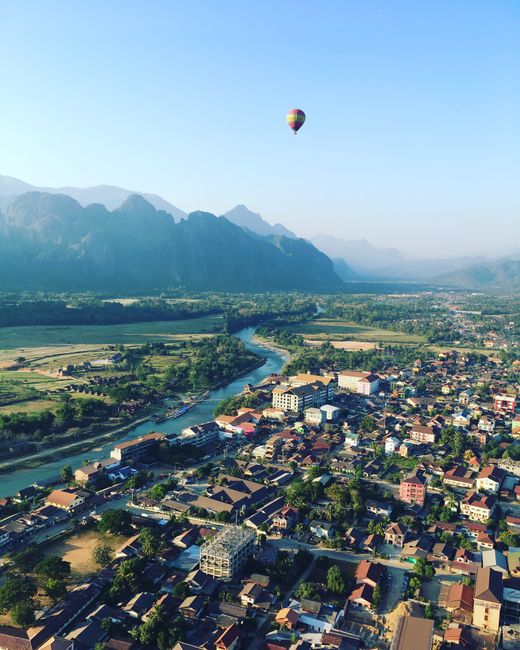
Vang Vieng is a small town on the Nam Song river in Vientiane province, about halfway between the Lao capital and Luang Prabang, set in one of the most spectacular landscapes in Southeast Asia: jagged limestone karsts, riddled with caves, rising straight out of rice fields and forest along the river. Once notorious as a backpacker party town, it was cleaned up after a government crackdown in 2012 and has reinvented itself as Laos’s capital of outdoor adventure, popular with families and young travelers from across Asia and beyond. Days here mean tubing or kayaking down the river, swimming in the “blue lagoons”, exploring caves by headlamp or inner tube, climbing to viewpoints over the karsts, cycling and riding buggies through the countryside, and floating over it all in a hot-air balloon at sunrise. Since the Laos–China Railway opened in 2021, Vang Vieng has been only about an hour by train from Vientiane and from Luang Prabang. The best months are November to February; the wet season, from May to October, brings high, fast rivers that make some activities unsafe.
Right now in Vang Vieng
- Wed21–30°C69–85°FClear
- Thu22–30°C71–86°F1 mm rain
- Fri23–31°C73–87°FPartly cloudy
Top tours in Vang Vieng
See all tours for Vang Vieng →
From local operators, with prices and reviews; you check availability and book on Viator, our partner. We may earn a commission at no extra cost to you. How we earn money
Vang Vieng at a glance
- Best for: limestone scenery, kayaking and tubing, caves and blue lagoons, viewpoint hikes, hot-air balloons and cycling.
- How long: 2–3 days for the main activities.
- Best time: November to February, when it is dry and the river is calm; March to May is hot and often hazy; May to October is the wet season, with high water.
- Getting there: about an hour by train from Vientiane or Luang Prabang, or about 1.5–2 hours by road from Vientiane on the expressway.
- Getting around: on foot in town; bicycles, scooters, buggies, tuk-tuks and organized tours for the countryside.
- Good to know: methanol-contaminated drinks killed several foreign tourists in Vang Vieng in November 2024; drink only sealed, branded alcohol.
- Before you go: the e-visa, the digital immigration form, money and general safety are in our Laos travel guide.
Vang Vieng’s areas and where to stay
Vang Vieng is compact: a grid of streets on the east bank of the Nam Song, with the old airstrip running through the middle, and countryside, villages and resorts across the river to the west.
The town center
Around the main street and the market, guesthouses, hotels, restaurants, cafés, tour agencies and bars stand side by side. It is convenient for tours and nightlife, but some streets are noisy.
The riverside
Along the east bank of the Nam Song, hotels and bungalows face the karsts across the water, with the classic view of the mountains at sunset; this is the most popular area to stay, still within walking distance of the center.
Across the river
Over the bridges on the west bank, resorts, homestays and bungalows sit among rice fields and gardens beneath the cliffs, quiet and scenic, with the blue lagoons and caves a short ride away.
Where to stay in Vang Vieng
- Riverside: hotels with karst views, close to restaurants.
- Town center: budget guesthouses and hostels near the tour agencies.
- West bank: resorts and bungalows in the countryside.
- Upscale resorts: a few pool hotels with mountain views along the river.
Rooms fill on Lao and Thai holidays and during the dry-season peak from December to February; book ahead.
Top things to see in Vang Vieng
The Nam Song river
The river is the heart of Vang Vieng. Tubing, floating downstream on an inflatable inner tube from about 4 km (2.5 miles) north of town, is the classic activity, now quieter than in the party years; kayaking trips combine paddling with cave visits, and sunset is the time to watch from the riverside or float past in a longtail boat. Water levels and currents change sharply with the seasons, so tubing and kayaking are safest from November to April.
The blue lagoons and Tham Phu Kham
West of town, several turquoise swimming holes fed by springs, known as the Blue Lagoons, are popular for swimming and jumping from trees. Blue Lagoon 1, about 7 km (4 miles) away, is the busiest, with a rope swing, a zipline nearby and the large Tham Phu Kham cave above it, reached by a steep scramble and containing a reclining bronze Buddha; bring a flashlight. Lagoons 2 and 3, farther out, are quieter. Each charges a small entry fee.
The caves
The karsts around Vang Vieng are honeycombed with caves. Tham Chang, just south of town, is reached by a bridge and stairs and was used as a refuge from invaders in the 19th century; it has a viewpoint and a spring-fed pool at its base. Tham Nam, about 13 km (8 miles) north, is a water cave that you enter on an inner tube, pulling yourself along a rope by headlamp, and Tham Sang (Elephant Cave) holds a rock formation shaped like an elephant. Visit the deeper caves only with a guide.
Viewpoints
Several steep trails climb the karsts to platforms with sweeping views over the river, town and mountains. Nam Xay viewpoint, west of town, is the most popular, topped by a flag and a motorbike sculpture; the Pha Ngern viewpoint is longer and quieter. Allow 30–60 minutes to climb, wear shoes with grip, and go early or late to avoid the heat.
Hot-air balloons
Several operators fly hot-air balloons over the karsts and river at sunrise and in the late afternoon in the dry season, one of Vang Vieng’s most memorable experiences.
More classic sights
- The old airstrip: a former military runway in the town center, a reminder of the area’s role during the war.
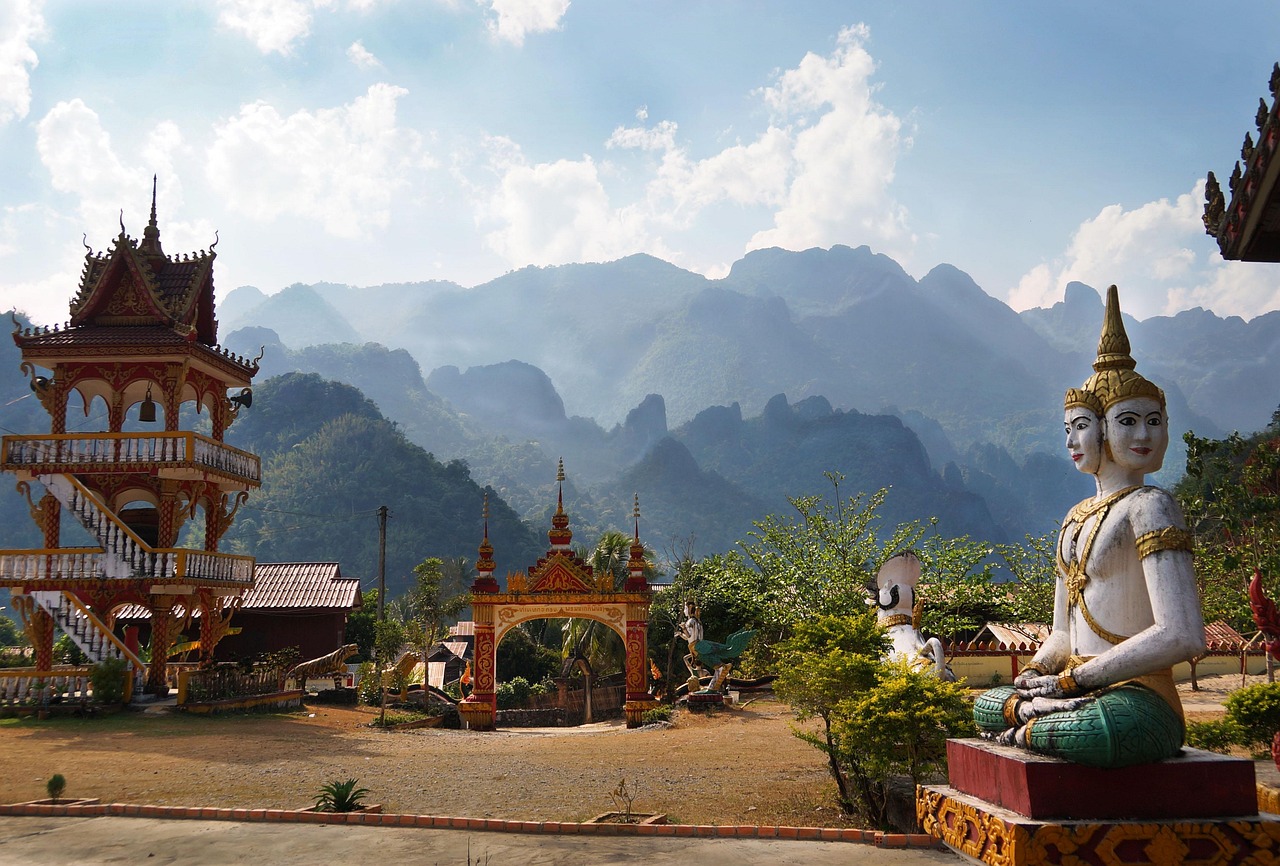
- Wat Si Vieng Song and other temples: small, peaceful temples in town.
- Rice fields and villages: cycling routes on the west bank lead through Hmong and Lao villages.
- The bamboo and wooden bridges: across the Nam Song, some rebuilt after each rainy season.
Other things to do in Vang Vieng
Adventure activities
Beyond tubing and kayaking, Vang Vieng offers ziplines through the forest, rock climbing on the limestone cliffs, with courses for beginners, paramotor and paragliding flights, and buggy and quad tours along dirt roads to the lagoons and caves. Choose established operators with good equipment and insurance, and check that your travel insurance covers adventure activities. See our hiking and boat trips guides.
Cycling
The flat valley floor is ideal for cycling; rent a bicycle or e-bike in town and follow the roads on the west bank to the blue lagoons and villages. See our cycling guide.
Food and drink
Vang Vieng’s restaurants serve Lao dishes such as larb, tam mak hoong and grilled river fish with sticky rice, along with Korean, Thai, Western and Indian food for its international visitors. Riverside restaurants with cushions and views are popular at sunset, and the night market sells grilled meat, noodles and fruit shakes. Bars are quieter than in the town’s party years. Drink only sealed, branded alcohol.
Day trips from Vang Vieng
- Tham Nam and Tham Sang: the water cave and elephant cave north of town, often combined with kayaking back to Vang Vieng.
- Kaeng Yui waterfall: a forest waterfall and swimming pools east of town, best from July to December.
- Nam Ngum reservoir: a large lake with islands and fish restaurants, about 1.5 hours south.
- Vientiane: temples and riverside sunsets, about an hour by train. See our Vientiane guide.
- Luang Prabang: the UNESCO-listed royal town, about an hour by train; better with several nights. See our Luang Prabang guide.
Nearby destinations
- Vientiane107 km
- Luang Prabang112 km
- Chiang Rai296 km
Getting there and getting around
By train
Vang Vieng’s station on the Laos–China Railway lies a few kilometers outside town; tuk-tuks and minivans meet the trains. Fast trains take about an hour to Vientiane and to Luang Prabang, and continue north toward Boten and China. Fares rose by about 9% on all routes on April 1, 2026, according to fares in the operator’s official LCR Ticket app reported by the Laotian Times; the full Vientiane–Luang Prabang trip now costs 360,000 kip in second class, and the shorter hops from Vang Vieng cost less. Buy tickets through the app or at stations and ticket offices with your passport, and book early in the high season.
By road
The Vientiane–Vang Vieng Expressway, opened in 2020, cuts the drive from the capital to about 1.5–2 hours by car or minivan; posted speed limits are 80–120 km/h (50–75 mph). The old mountain road north to Luang Prabang is slow and winding, about 5–6 hours by minivan, though most travelers now take the train. Minivans also run to Phonsavan for the Plain of Jars.
Around Vang Vieng
The town is walkable. Bicycles, e-bikes and scooters are easy to rent; agree on the condition of the vehicle, use your own helmet if possible, and never leave your passport as a deposit. Tuk-tuks wait in the center for trips to the lagoons and caves, and most activities include transport.
When to go and how long to stay
Vang Vieng is warm all year, with highs of about 29–35 °C (84–95 °F). The cool, dry season from November to February is the best time, with sunny days, cool mornings and a calm river. March to May is hot, and smoke from crop burning can haze the karsts. The wet season, from May to October, brings heavy rain, especially from July to September, when the Nam Song runs high and fast, tubing and kayaking may be suspended, and caves can flood. There is no long-term official weather station in Vang Vieng in the World Meteorological Organization’s records, so the table uses the 1991–2020 climate normals for the Vientiane Capital station of the Lao Department of Meteorology and Hydrology, about 110 km (70 miles) south, as submitted to the WMO: average daily highs and lows, total rain, and days with at least 1 mm of rain. Vang Vieng, surrounded by mountains, is generally a little cooler at night and wetter in the rainy season.
| Month | Average high / low | Rain (days with 1 mm or more) | What to expect |
|---|---|---|---|
| January | 29 °C (84 °F) / 18 °C (65 °F) | 7 mm (0.3 in), 2 days | Dry; misty mornings; calm river |
| February | 31 °C (88 °F) / 19 °C (67 °F) | 17 mm (0.7 in), 2 days | Dry and sunny; peak season |
| March | 33 °C (92 °F) / 22 °C (71 °F) | 44 mm (1.7 in), 5 days | Hot; haze from burning |
| April | 35 °C (95 °F) / 24 °C (76 °F) | 89 mm (3.5 in), 7 days | The hottest month; Pi Mai Lao |
| May | 34 °C (92 °F) / 25 °C (77 °F) | 226 mm (8.9 in), 15 days | Rains begin; river rising |
| June | 33 °C (91 °F) / 25 °C (78 °F) | 264 mm (10.4 in), 18 days | Wet; green landscapes |
| July | 32 °C (89 °F) / 25 °C (78 °F) | 300 mm (11.8 in), 20 days | High water; tubing may stop |
| August | 31 °C (89 °F) / 25 °C (77 °F) | 341 mm (13.4 in), 21 days | The wettest month |
| September | 32 °C (89 °F) / 25 °C (76 °F) | 265 mm (10.4 in), 17 days | Wet; floods possible |
| October | 32 °C (89 °F) / 24 °C (75 °F) | 87 mm (3.4 in), 8 days | Drying out; river still fast |
| November | 31 °C (87 °F) / 22 °C (71 °F) | 18 mm (0.7 in), 2 days | Dry; a beautiful month |
| December | 29 °C (84 °F) / 19 °C (67 °F) | 5 mm (0.2 in), 1 day | Cool mornings; busy |
Vientiane receives about 1,660 mm (65 in) of rain a year; Vang Vieng, in the mountains, receives more.
Two days in Vang Vieng
Day one, a sunrise balloon flight, then cycle to Blue Lagoon 1 and Tham Phu Kham, back for sunset on the riverside. Day two, a kayaking and cave trip, including Tham Nam by inner tube, and an evening climb to Nam Xay viewpoint.
Three days
Add a rock-climbing lesson, a zipline, Tham Chang or the quieter Blue Lagoons 2 and 3.
What a trip to Vang Vieng costs
Prices are approximate, for October 2026, converted at about 22,400 kip to the US dollar.
| Item | Typical cost |
|---|---|
| Kayaking and cave day tour | 250,000–450,000 LAK (about US$11–20) |
| Tubing, with tube rental and transport | 100,000–200,000 LAK (about US$4.50–9) |
| Hot-air balloon flight | 1,800,000–2,500,000 LAK (about US$80–110) |
| Blue Lagoon or viewpoint entry | 10,000–40,000 LAK (about US$0.45–1.80) |
| Bicycle rental, per day | 30,000–60,000 LAK (about US$1.35–2.70) |
| Lao meal at a local restaurant | 40,000–80,000 LAK (about US$1.80–3.60) |
| Train to Vientiane or Luang Prabang, second class | about 150,000–250,000 LAK (about US$6.70–11) |
| Guesthouse double | 250,000–600,000 LAK (about US$11–27) |
| Riverside hotel double | 700,000–2,000,000 LAK (about US$31–89) |
Practical tips for Vang Vieng
- Drink only sealed, branded alcohol: and never accept free shots or drinks from strangers.
- Wear a life jacket on the river: even if you are a strong swimmer.
- Check the river level: in the wet season, ask locally whether tubing and kayaking are safe.
- Keep your passport: don’t leave it as a deposit for rentals.
- Cover up in town: don’t walk around in swimwear away from the river.
- Carry cash: many operators and lagoons take only kip.
Safety
Vang Vieng’s adventures carry real risks, and safety standards vary. The river: currents can be strong and water levels change within hours in the rainy season; tourists have drowned while tubing and swimming, especially after drinking. Wear a life jacket, never mix alcohol and water activities, and avoid the river when it is high. Caves: use a guide and headlamp, and avoid caves after heavy rain, when they can flood. Viewpoint trails are steep and slippery. Road traffic: scooter and buggy accidents are common on rough roads; wear a helmet and avoid riding after dark. Methanol: in November 2024, several foreign tourists died after drinking methanol-contaminated alcohol in Vang Vieng, and the authorities later banned the sale of Tiger Vodka and Tiger Whisky; drink sealed, branded bottles from reputable outlets, and seek urgent medical help if you feel unwell after drinking. Drugs: possession of any drugs, including cannabis and so-called “happy” menu items, can lead to arrest and heavy penalties, and police raid venues. Unexploded ordnance remains in parts of rural Laos; keep to paths. In an emergency, call 1191 for police and 1195 for an ambulance; serious injuries usually require transfer to Vientiane.
What to pack for Vang Vieng
Swimwear and a cover-up, water shoes or sandals with straps, a dry bag for phones and cash on the river, a headlamp for caves, shoes with grip for viewpoint climbs, sunscreen and a hat, insect repellent, and a rain jacket from May to October. Laos uses 230 V, with sockets for flat two-pin and round two-pin plugs. See our water shoes, hiking shoes and travel adapters guides.
Vang Vieng travel FAQ
How do I get from Vientiane to Vang Vieng?
By the Laos–China Railway in about an hour, or by minivan or car on the expressway in about 1.5–2 hours.
How do I get from Vang Vieng to Luang Prabang?
By train in about an hour; the mountain road takes about 5–6 hours by minivan.
Is tubing in Vang Vieng safe?
It can be, in the dry season with a life jacket and no alcohol. In the wet season, the river can be high and fast, and tubing may be suspended.
What is the best time to visit Vang Vieng?
November to February, when it is dry and the river calm. The wet season, from May to October, brings high water.
How many days do I need in Vang Vieng?
Two to three days for kayaking, tubing, caves, lagoons and a viewpoint.
Which Blue Lagoon is best?
Blue Lagoon 1 has the Tham Phu Kham cave and the most facilities but the biggest crowds; Lagoons 2 and 3 are quieter and farther out.
Is Vang Vieng still a party town?
Much less so since a crackdown in 2012; there are bars, but most visitors come for outdoor activities and scenery.
Is it safe to drink alcohol in Vang Vieng?
Stick to sealed, branded drinks from reputable places. Methanol-contaminated alcohol killed several tourists in November 2024, and some brands have been banned.
Can I take a hot-air balloon in Vang Vieng?
Yes. Several operators fly at sunrise and late afternoon in the dry season.
Where is the Vang Vieng train station?
A few kilometers outside town, with tuk-tuks and minivans meeting each train.
Plan your trip
Partner links: TravelerCenter may earn a commission if you book, at no extra cost to you.
🇱🇦 Useful Lao phrases for Vang Vieng
All 38 Lao phrases: restaurant, hotel, emergencies, romance (printable) →
Sources · last reviewed 4 October 2026
Researched and last reviewed on 4 October 2026. The Lao Digital Immigration Form, river and adventure-sport risks, the methanol deaths and the Tiger Vodka and Tiger Whisky ban, drug penalties, motorbike rental risks, the Vientiane–Vang Vieng Expressway and its speed limits, and unexploded ordnance: the UK government’s factual entry and safety pages; the April 2026 railway fare increase: the operator’s LCR Ticket app as reported by the Laotian Times; climate normals for Vientiane: the Lao Department of Meteorology and Hydrology via the World Meteorological Organization’s 1991–2020 normals; exchange rate: the Bank of the Lao PDR. The 2012 crackdown, the November 2024 incident date, cave and lagoon details, distances, the station location, journey times, the Vientiane–Vang Vieng train fare and other typical prices are general references or estimates, flagged for checking. Prices and conditions change, so check locally before you go. For entry rules, money and general safety, see our Laos travel guide.
Data: Weather: MET Norway (CC BY 4.0) · Air quality: OpenAQ · Rates: ECB · Costs: World Bank ICP and price levels · Wikidata (CC0)