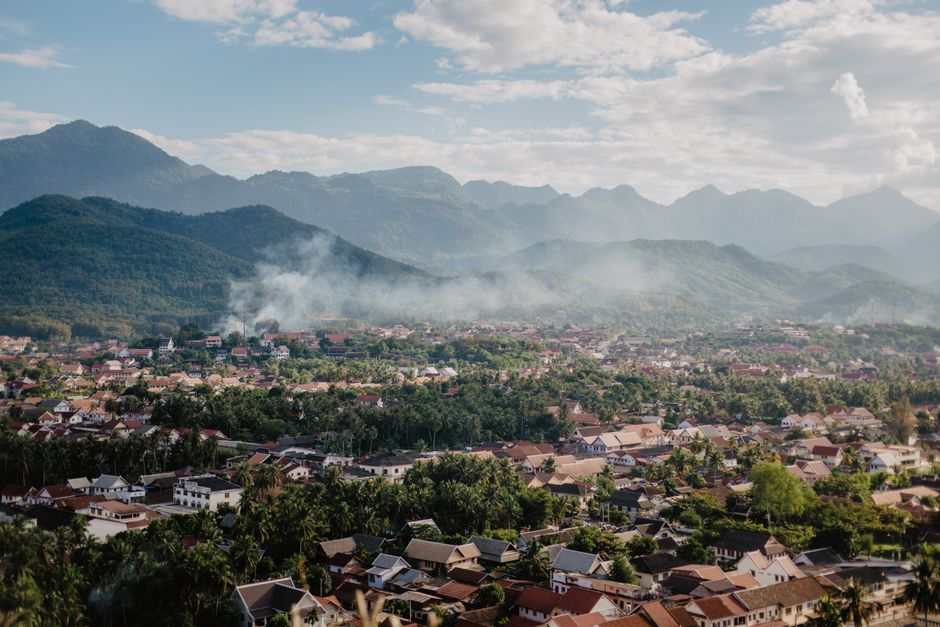
Luang Prabang, the former royal capital of Laos, sits on a narrow peninsula where the Nam Khan river flows into the Mekong, ringed by forested mountains in the north of the country. It is one of the best-preserved traditional towns in Southeast Asia: dozens of gilded Buddhist monasteries stand among teak houses on stilts and two-story French colonial villas with shuttered windows, and every dawn hundreds of monks in saffron robes walk barefoot through the streets to receive offerings of sticky rice. UNESCO inscribed the Town of Luang Prabang as a World Heritage Site in 1995, and strict rules on building and traffic protect its character. Come for the temples of Wat Xieng Thong and the Royal Palace, sunset from Mount Phousi, the night market, the turquoise pools of Kuang Si Falls, boat trips to the Buddha-filled Pak Ou Caves, weaving and cooking classes, and a slow pace of life by the rivers. Since 2021, the Laos–China Railway has linked Luang Prabang with Vang Vieng and Vientiane in about two hours. The best months are November to February; from February to April smoke from crop burning often hazes the valley.
Right now in Luang Prabang
- Wed 21–29°C 70–84°F Clear
- Thu 21–30°C 69–85°F Clear
- Fri 22–30°C 72–86°F Mostly clear
Weather: MET Norway (CC BY 4.0) · Air quality: OpenAQ
Top tours in Luang Prabang
See all tours for Luang Prabang →
From local operators, with prices and reviews; you check availability and book on Viator, our partner. We may earn a commission at no extra cost to you. How we earn money
Luang Prabang at a glance
- Best for: temples and heritage architecture, the morning alms round, river trips, waterfalls, crafts, food and a relaxed pace.
- How long: 3–4 days for the town, Kuang Si Falls and the Pak Ou Caves.
- Best time: November to February, when it is dry, with warm days and cool nights; February to April is hot and often smoky; May to October is the wet season.
- Getting there: by train from Vientiane (about 2 hours) or Vang Vieng (about 1 hour); by air to Luang Prabang International Airport, about 4 km (2.5 miles) from town; or by the two-day slow boat from the Thai border.
- Getting around: on foot or by bicycle in the old town; tuk-tuks and minivans for the waterfalls and station; boats on the Mekong.
- Good to know: observe the alms round respectfully, and dress modestly in the heritage town.
- Before you go: the e-visa, the digital immigration form, money and general safety are in our Laos travel guide.
Luang Prabang’s areas and where to stay
The heritage town fills the peninsula between the two rivers, with Mount Phousi at its center; newer districts spread south and east, and resorts lie along the rivers and in the hills outside town.
The peninsula (old town)
Between the night market on Sisavangvong Road and the tip of the peninsula, where the rivers meet near Wat Xieng Thong, the old town’s lanes are lined with temples, colonial villas, guesthouses, boutique hotels, cafés and restaurants. It is the most atmospheric place to stay, and everything is within walking distance, but rooms are small and prices high.
Along the Mekong and the Nam Khan
Guesthouses and hotels along the riverbanks on both sides of the peninsula have river views and terraces for sunset; the Nam Khan side, with its seasonal bamboo bridges, is quieter.
South of Mount Phousi
Around the morning market, the Dara Market and the streets south of Phousi, mid-range hotels and guesthouses are a little cheaper and still within a 10- to 15-minute walk of the center.
Outside town
Resorts and eco-lodges along the rivers, in the hills and on the road to Kuang Si offer pools, gardens and space, with shuttles into town.
Where to stay in Luang Prabang
- Old town: boutique hotels and guesthouses in heritage houses.
- Riversides: sunset views and quieter lanes.
- South of Phousi: good-value guesthouses near the markets.
- Outside town: resorts and eco-lodges with pools.
Rooms fill from December to February and around Pi Mai Lao (Lao New Year) in mid-April; book ahead.
Top things to see in Luang Prabang
The morning alms round (tak bat)
Before sunrise, at about 5:30–6:30 a.m., monks from the town’s monasteries walk in long lines through the streets, especially along Sakkaline and Sisavangvong roads, to receive sticky rice and food from residents kneeling on mats. It is a daily religious ceremony, not a performance, and the crowds of tourists, flash photography and people blocking the monks’ path have become a concern for the monks and the town. Watch quietly from across the street or a few meters back; never touch the monks or step into their path; don’t use flash; dress modestly, covering shoulders and knees; and if you wish to take part, kneel, with your head lower than the monks’, and offer sticky rice you bought from a trusted shop or prepared yourself, not from street vendors. Since March 2026, under the town’s traffic rules, tour vans dropping visitors at temples along the riverside roads for the alms round have had to leave before 7 a.m.
Wat Xieng Thong
Near the tip of the peninsula, Wat Xieng Thong, founded in 1560, is the most magnificent of Luang Prabang’s temples, with sweeping, multi-tiered roofs that almost touch the ground, a “tree of life” mosaic of colored glass on the back wall of the main hall (sim), a red chapel with a rare reclining Buddha and a carriage house holding the king’s gilded funeral carriage. Cover shoulders and knees; a small fee is charged.
The Royal Palace Museum (Haw Kham)
Built from 1904 for King Sisavang Vong, the Royal Palace blends Lao and French Beaux-Arts styles; inside, the throne hall glitters with mirror mosaics, and the royal apartments are kept much as they were in 1975. In the grounds, the Haw Pha Bang temple houses the Phra Bang, the gold Buddha image that gives the city its name. Shoulders and knees must be covered, shoes and bags are left outside, and photography is not allowed inside; the museum closes at lunchtime.
Mount Phousi
A steep climb of more than 300 steps leads up the 100 m (330 ft) hill at the heart of town to That Chomsi, a gilded stupa with views over the rooftops, the rivers and the mountains. It is the classic sunset spot, and very crowded then; come at sunrise for a quieter view. A small entry fee is charged at the top.
Luang Prabang’s heritage rules
Within the World Heritage zone, building heights, materials and colors are controlled by the town’s heritage office, so new buildings follow traditional styles, and many temples and houses are restored with traditional techniques. In 2026, the city also tightened traffic rules: tour vans were banned from the central route between the Night Market and the tip of the peninsula in February, and from March vans, cars and tuk-tuks without permits were barred from the central stretch of Sisavangvong Road, with fines for violators, according to local tourism news. Bars and restaurants close relatively early, usually by about 11:30 p.m. Drones require permission.
More classic sights
- Wat Mai Suwannaphumaham: a temple next to the palace with a five-tiered roof and gilded reliefs of the Ramayana.
- Wat Visounnarath (Wat Visoun): one of the oldest temples, with the watermelon-shaped That Pathum stupa.
- Traditional Arts and Ethnology Center: a small museum on the cultures and crafts of Laos’s ethnic groups.
- Night market: handicrafts, textiles and souvenirs on Sisavangvong Road every evening.
- Morning market: fresh produce, river fish and local snacks in the lanes near the palace at dawn.
- UXO Lao Visitor Center: explains the legacy of the bombing and clearance work.
Other things to do in Luang Prabang
Food and drink
Luang Prabang has a cuisine of its own. Try or lam, a herby, slightly bitter stew with chili wood; khai paen, crispy sheets of river weed with sesame, served with jeow bong, a sweet chili paste; Luang Prabang sausage, flavored with lemongrass and galangal; larb with sticky rice; and khao soi, the local noodle soup with pork and tomato sauce. The night market’s food alley offers cheap buffets, and riverside restaurants serve Lao and French dishes at sunset. Many cafés serve Lao coffee and French pastries. Cooking classes start with a visit to the morning market.
Crafts and classes
Weaving centers just outside town teach natural dyeing and silk weaving and sell textiles directly from the makers, and workshops offer paper-making and silversmithing. Monks’ “chat” programs at some temples let visitors talk with novices practicing English.
Festivals
Pi Mai Lao in mid-April is celebrated with water throwing, processions of the Phra Bang and sand stupas on the Mekong banks. At the end of Buddhist Lent, in October, Boun Ok Phansa brings boat races and Lai Heua Fai, when residents float illuminated boats and banana-leaf offerings on the Mekong. See our city sightseeing guide.
Day trips from Luang Prabang
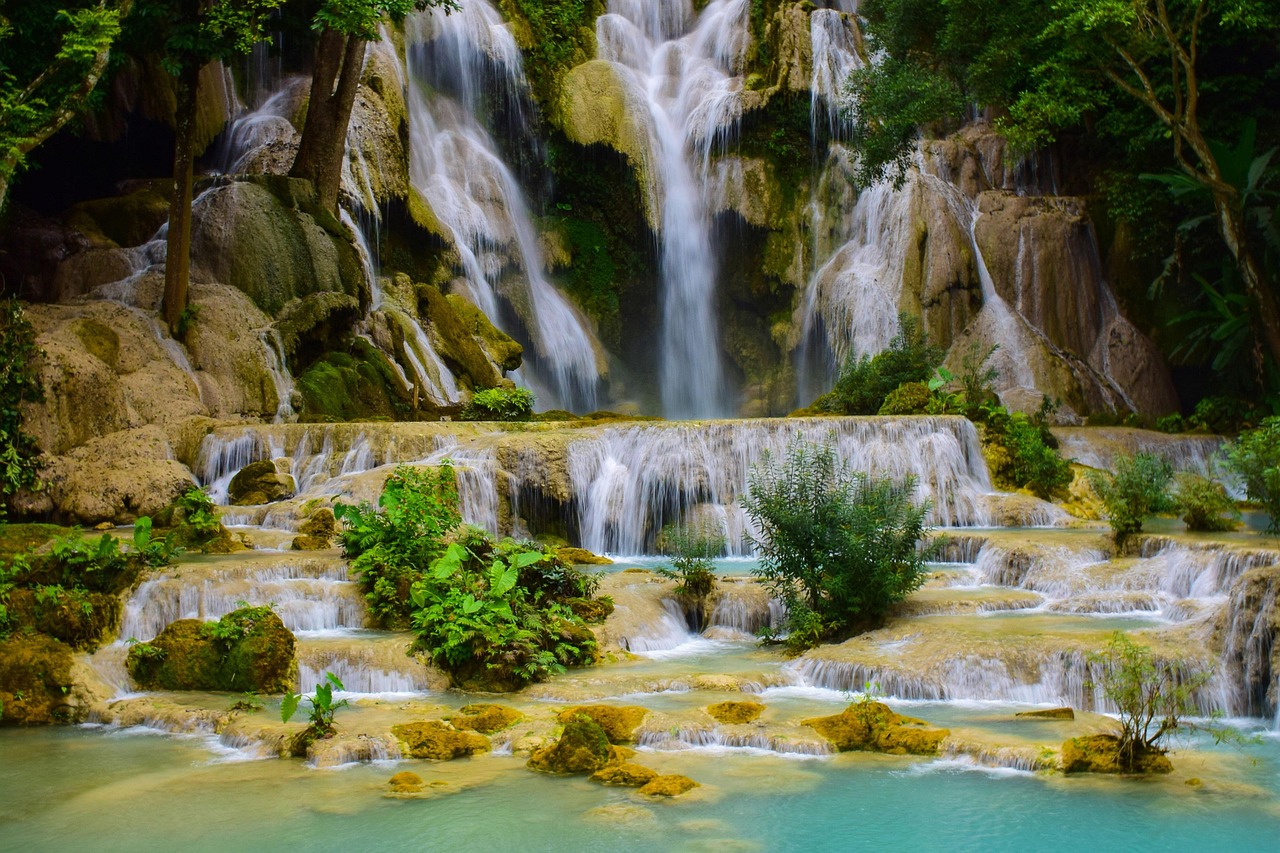
- Kuang Si Falls: a series of turquoise limestone pools and a 50 m (160 ft) waterfall in the forest, about 30 km (19 miles) south, with a bear rescue center at the entrance; swim in the designated pools.
- Pak Ou Caves: two caves in a cliff above the Mekong filled with thousands of Buddha images, about 2 hours upstream by boat, often combined with a stop at a weaving or rice-whisky village.
- Tad Sae Falls: cascading pools on a river east of town, best from August to December.
- Nong Khiaw: limestone cliffs and viewpoints on the Nam Ou river, about 3–4 hours by road; better with a night or two.
- Vang Vieng: about an hour by train; better with a few nights. See our Vang Vieng guide.
Nearby destinations
- Vang Vieng112 km
- Vientiane219 km
- Chiang Rai241 km
- Xishuangbanna273 km
Getting there and getting around
By train
Luang Prabang’s station on the Laos–China Railway lies about 15 km (9 miles) outside town; minivans and tuk-tuks wait for arrivals, taking about 20–30 minutes. Fast trains run to Vientiane in about two hours and Vang Vieng in about an hour, and north toward Boten and China. Since April 1, 2026, the fares shown in the operator’s official LCR Ticket app for Vientiane–Luang Prabang have been 360,000 kip in second class and 569,000 kip in first class. Buy tickets through the app or at stations and ticket offices, with your passport, and book early in the high season.
By air
Luang Prabang International Airport (LPQ), about 4 km (2.5 miles) from the old town, has flights from Vientiane, Bangkok, Chiang Mai, Hanoi, Siem Reap, Kunming and other cities; see our Thailand and Vietnam guides. It is one of the designated points for the Lao e-visa, and arriving passengers must complete the Lao Digital Immigration Form before arrival.
By boat and bus
The classic slow boat down the Mekong from Houay Xai, on the Thai border, takes two days, with a night in Pak Beng. Buses and minivans link Luang Prabang with Nong Khiaw, Phonsavan (for the Plain of Jars) and Luang Namtha on winding mountain roads.
Around town
The old town is best explored on foot or by bicycle, which many guesthouses lend or rent. Tuk-tuks wait near the night market for the station, the airport and the waterfalls; agree on the price first. Boats for the Pak Ou Caves and sunset cruises leave from the Mekong landing below the Royal Palace.
When to go and how long to stay
Luang Prabang has three seasons. The cool, dry season from November to February brings sunny days around 27–32 °C (81–89 °F) and cool nights, with morning mist over the rivers; this is the most popular time. From February to April, it is hot and dry, and smoke from crop burning often hazes the valley, sometimes severely; April is the hottest month. The wet season, from May to October, brings heavy showers, peaking in July and August, when the rivers run high and the waterfalls are at their fullest. The table uses the 1991–2020 climate normals for the Luang Prabang station of the Lao Department of Meteorology and Hydrology, as submitted to the World Meteorological Organization (WMO): average daily highs and lows, total rain, and days with at least 1 mm of rain.
| Month | Average high / low | Rain (days with 1 mm or more) | What to expect |
|---|---|---|---|
| January | 28 °C (83 °F) / 15 °C (58 °F) | 17 mm (0.7 in), 2 days | Dry; cool, misty mornings; peak season |
| February | 32 °C (89 °F) / 15 °C (60 °F) | 12 mm (0.5 in), 1 day | Dry; haze begins |
| March | 34 °C (93 °F) / 18 °C (65 °F) | 52 mm (2.0 in), 5 days | Hot and often smoky |
| April | 35 °C (95 °F) / 22 °C (71 °F) | 102 mm (4.0 in), 9 days | The hottest month; Pi Mai Lao |
| May | 35 °C (94 °F) / 23 °C (74 °F) | 161 mm (6.3 in), 14 days | Rains begin and clear the air |
| June | 34 °C (92 °F) / 24 °C (75 °F) | 200 mm (7.9 in), 15 days | Green and showery |
| July | 32 °C (90 °F) / 24 °C (75 °F) | 283 mm (11.1 in), 20 days | Wet; rivers rising |
| August | 32 °C (90 °F) / 24 °C (75 °F) | 329 mm (13.0 in), 21 days | The wettest month |
| September | 32 °C (90 °F) / 23 °C (74 °F) | 177 mm (7.0 in), 15 days | Rains easing; waterfalls full |
| October | 32 °C (89 °F) / 21 °C (71 °F) | 87 mm (3.4 in), 7 days | Mostly dry; Lai Heua Fai festival |
| November | 30 °C (86 °F) / 18 °C (65 °F) | 27 mm (1.1 in), 3 days | Cool and dry; a lovely month |
| December | 27 °C (81 °F) / 15 °C (59 °F) | 26 mm (1.0 in), 2 days | Cool nights; busy |
Luang Prabang receives about 1,470 mm (58 in) of rain a year, almost all from May to October.
Three days in Luang Prabang
Day one, the morning market, Wat Xieng Thong, the Royal Palace and the old town’s temples, then sunset on Mount Phousi and the night market. Day two, the alms round at dawn (respectfully), then Kuang Si Falls, back for a riverside dinner. Day three, a boat trip to the Pak Ou Caves and a weaving or cooking class.
Four to five days
Add Tad Sae Falls, a cycling tour of villages across the Mekong, or an overnight trip to Nong Khiaw.
What a trip to Luang Prabang costs
Prices are approximate, for October 2026, converted at about 22,400 kip to the US dollar.
| Item | Typical cost |
|---|---|
| Laos–China Railway to Vientiane, second class | 360,000 LAK (about US$16) |
| Royal Palace Museum or Wat Xieng Thong entry | 30,000–60,000 LAK (about US$1.35–2.70) |
| Mount Phousi entry | about 30,000 LAK (about US$1.35) |
| Kuang Si Falls entry | about 60,000 LAK (about US$2.70) |
| Tuk-tuk or minivan to Kuang Si, return | 100,000–400,000 LAK (about US$4.50–18) per person or vehicle |
| Boat to the Pak Ou Caves, shared | 100,000–200,000 LAK (about US$4.50–9) per person |
| Night-market buffet plate | 25,000–40,000 LAK (about US$1.10–1.80) |
| Dinner at a riverside restaurant | 150,000–350,000 LAK (about US$6.70–15.60) per person |
| Boutique guesthouse double, per night | 600,000–1,500,000 LAK (about US$27–67) |
Practical tips for Luang Prabang
- Respect the alms round: keep your distance, no flash, and take part only if you will do it properly.
- Dress modestly: cover shoulders and knees in temples and the palace, and don’t walk around in swimwear.
- Book train tickets early: in the high season, through the LCR Ticket app or at a station or ticket office.
- Go early to Kuang Si: the pools are quiet before about 10 a.m.
- Carry kip in cash: many guesthouses, tuk-tuks and markets accept only cash.
- Check the air quality: from February to April, smoke can make outdoor activities unpleasant.
Safety
Luang Prabang is very safe, and serious crime is rare. The main risks are on the water and the roads. The Mekong and Nam Khan have strong currents, especially in the wet season; swim only in designated places, such as the pools at Kuang Si, wear life jackets on boats and avoid crossing seasonal bamboo bridges when the river is high. Paths and rocks at the waterfalls are slippery. Motorbike accidents are common on mountain roads; wear a helmet and never leave your passport as a deposit. In the countryside, unexploded ordnance may remain away from cleared areas; stay on paths, and visit the UXO Lao Visitor Center to understand the risk. From February to April, smoke can cause poor air quality. Stick to sealed, branded drinks because of the risk of methanol poisoning. Keep valuables secure at the night market. In an emergency, call 1191 for police and 1195 for an ambulance.
What to pack for Luang Prabang
Light clothes that cover shoulders and knees for temples, a sweater for cool mornings from December to February, sandals that slip off easily for temples, swimwear for Kuang Si, a hat and sunscreen, insect repellent, a face mask for smoky days, and a rain jacket from May to October. Laos uses 230 V, with sockets for flat two-pin and round two-pin plugs. See our rain jackets, water shoes and travel adapters guides.
Luang Prabang travel FAQ
What time is the alms giving in Luang Prabang?
At dawn, usually about 5:30–6:30 a.m., along Sakkaline and Sisavangvong roads and other streets in the old town.
How should I behave at the alms giving?
Watch silently from a distance, don’t use flash or block the monks, dress modestly, and if you take part, kneel and offer rice you bought from a trusted shop or prepared yourself.
How do I get from Vientiane to Luang Prabang?
By the Laos–China Railway in about two hours, from 360,000 kip in second class since April 2026; by domestic flight; or by bus in about 9–10 hours.
How far is the train station from Luang Prabang?
About 15 km (9 miles); minivans and tuk-tuks take about 20–30 minutes to the old town.
Can you swim at Kuang Si Falls?
Yes, in the designated pools below the main waterfall; some areas are roped off for safety.
What is the best time to visit Luang Prabang?
November to February, when it is dry and cool. February to April is often smoky, and May to October is the wet season.
How many days do I need in Luang Prabang?
Three to four days for the old town, the alms round, Kuang Si Falls and the Pak Ou Caves.
Is Luang Prabang a UNESCO World Heritage Site?
Yes. The Town of Luang Prabang was inscribed in 1995 for its temples, traditional and colonial architecture and its setting between two rivers.
What is the slow boat to Luang Prabang?
A two-day boat journey down the Mekong from Houay Xai on the Thai border, with an overnight stop in Pak Beng.
Is Luang Prabang expensive?
It is pricier than the rest of Laos for accommodation, but food, transport and entry fees are still inexpensive.
Sources and last review
Researched and last reviewed on 4 October 2026. E-visa entry points: the official Lao e-visa portal; the Lao Digital Immigration Form, river and road safety, methanol and unexploded ordnance: the UK government’s factual entry and safety pages; the 2026 traffic rules for the heritage zone and the alms-round van rule: local tourism news reporting the Luang Prabang City Administrative Committee and the provincial Department of Public Works and Transport; Laos–China Railway fares from April 1, 2026: the operator’s LCR Ticket app as reported by the Laotian Times; climate normals: the Lao Department of Meteorology and Hydrology via the World Meteorological Organization’s 1991–2020 normals; exchange rate: the Bank of the Lao PDR. Alms-round etiquette follows widely published local guidance and is flagged as general reference; the UNESCO inscription, temple and palace history and dates, the station and airport distances, closing times, entry fees, journey times and typical prices are general references or estimates, flagged for checking. Prices and rules change, so check locally before you go. For entry rules, money and general safety, see our Laos travel guide.
Plan your trip
Partner links: TravelerCenter may earn a commission if you book, at no extra cost to you.
🇱🇦 Useful Lao phrases for Luang Prabang
All 38 Lao phrases: restaurant, hotel, emergencies, romance (printable) →