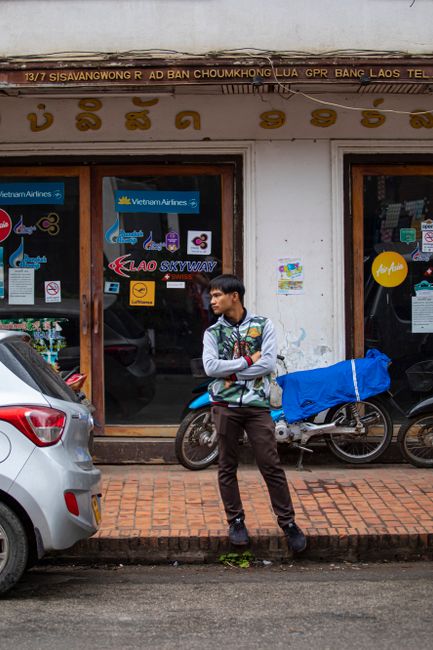
Vientiane, the capital of Laos, is one of the most relaxed capitals in Asia: a low-rise city of tree-lined boulevards, Buddhist monasteries, French colonial villas and riverside promenades spread along a bend of the Mekong, with Thailand on the opposite bank. It has been the capital of Lan Xang and of modern Laos for most of the past five centuries, and its landmarks tell that story, from the golden stupa of Pha That Luang, the national symbol, and the cloisters of Wat Si Saket, filled with thousands of Buddha images, to the Patuxai victory monument and the sobering COPE Visitor Center, which shows how unexploded bombs still affect Lao lives. Vientiane is also the hub of the country’s transport: the Laos–China Railway starts here, linking the capital with Vang Vieng and Luang Prabang, trains run across the Mekong to Bangkok, and the international airport is just outside the center. Spend a day or two exploring the temples, eating in its French bakeries and night markets, and watching the sunset over the river. The best months are November to February, when it is dry and warm.
Right now in Vientiane
- Wed 22–30°C 71–85°F 1 mm Light showers
- Thu 23–30°C 73–86°F Mostly clear
- Fri 24–31°C 76–88°F 2 mm Cloudy
Weather: MET Norway (CC BY 4.0)
Top tours in Vientiane
See all tours for Vientiane →
From local operators, with prices and reviews; you check availability and book on Viator, our partner. We may earn a commission at no extra cost to you. How we earn money
Vientiane at a glance
- Best for: temples and stupas, Lao history and the UXO legacy, French colonial architecture, cafés and bakeries, riverside sunsets and night markets.
- How long: 1–2 days for the main sights; add a day for the Buddha Park or Phou Khao Khouay.
- Best time: November to February, when it is dry and less hot; March to May is very hot, and May to October is the wet season.
- Getting there: Wattay International Airport is about 3 km (2 miles) west of the center; trains from Vientiane station reach Vang Vieng in about an hour and Luang Prabang in about two; trains from Khamsavath station run to Bangkok.
- Getting around: on foot or by bicycle in the center, and by tuk-tuk or the ride-hailing app loca.
- Good to know: Pha That Luang hosts the Boun That Luang festival at the November full moon.
- Before you go: the e-visa, the digital immigration form, money and general safety are in our Laos travel guide.
Vientiane’s areas and where to stay
The compact center lies along the Mekong in Chanthabouly district, between the riverside and Lane Xang Avenue, which runs north to Patuxai and Pha That Luang.
The riverside
Along Fa Ngum Road and the riverside park named after King Chao Anouvong, hotels and guesthouses face the Mekong, with the evening night market, food stalls and exercise classes on the promenade. It is the most popular area for visitors.
Nam Phu and the old center
Around the Nam Phu fountain and the streets of Setthathirath and Samsenthai roads, colonial buildings hold cafés, French bakeries, restaurants, bars and boutique hotels, close to Wat Si Saket and Haw Phra Kaew.
Around That Luang and Sisattanak
North and east of the center, the area around Pha That Luang and the leafy embassy district of Sisattanak have larger hotels, local restaurants and quieter streets, a short tuk-tuk ride from the riverside.
Where to stay in Vientiane
- Riverside: hotels with Mekong views, close to the night market.
- Old center: boutique hotels and guesthouses in colonial buildings, near cafés and temples.
- Sisattanak and That Luang: larger hotels and serviced apartments.
- Near the airport: convenient business hotels for early flights.
Rooms fill during the That Luang festival in November and around Pi Mai Lao in April.
Top things to see in Vientiane
Pha That Luang
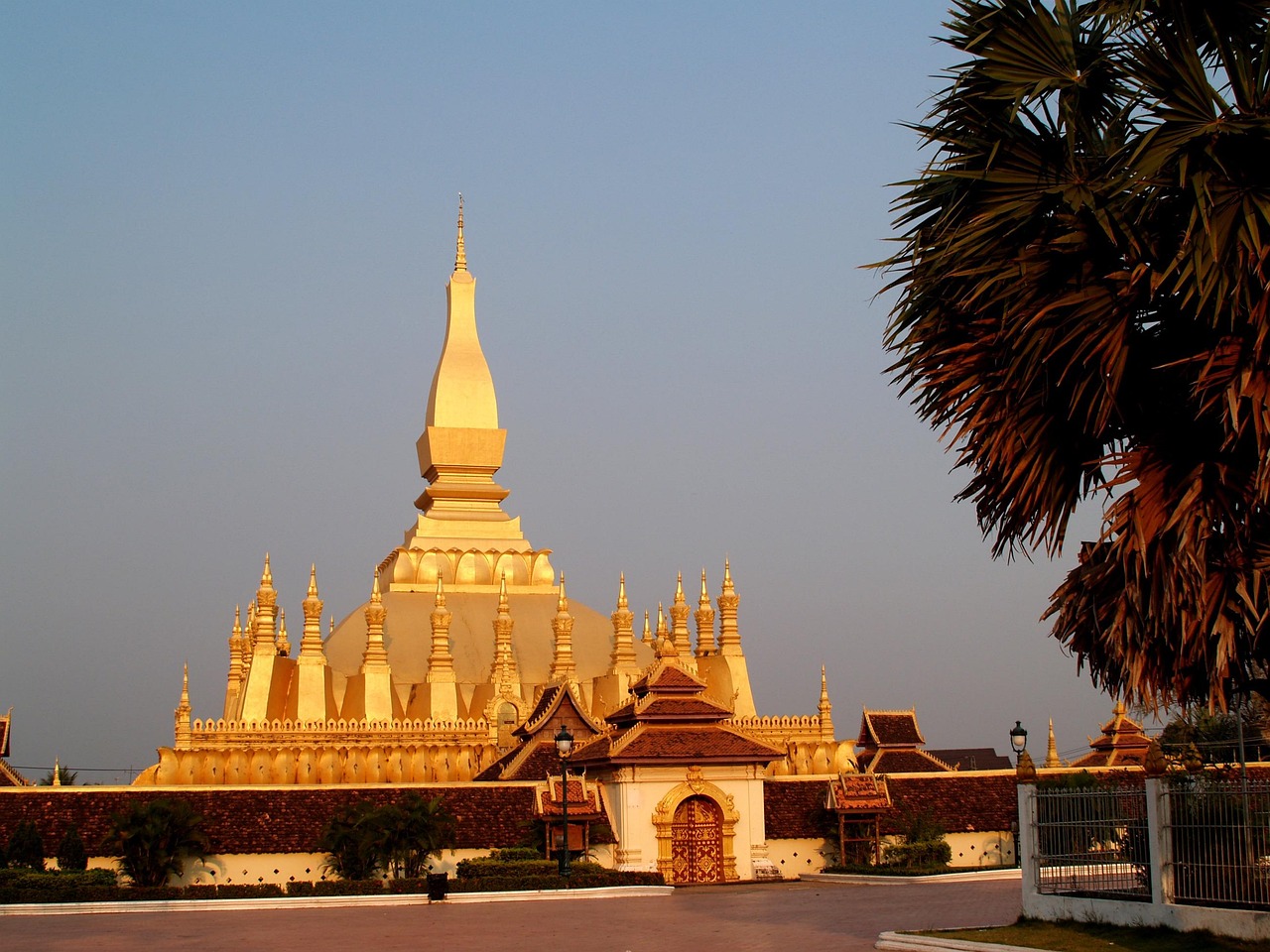
The great golden stupa of Pha That Luang, the national symbol shown on the Lao coat of arms, rises about 45 m (148 ft) from a walled cloister on the city’s northeastern side. A stupa is said to have stood here since ancient times; the present structure dates from King Setthathirath’s rebuilding in 1566, restored after damage in the 19th century and rebuilt in the 1930s. Gold-roofed temples stand on either side, and the surrounding plaza is the setting for the Boun That Luang festival, with processions, a merit-making ceremony with hundreds of monks and a fair, at the November full moon. Cover shoulders and knees; a small entry fee is charged.
Wat Si Saket
Built in 1818 by King Anouvong, Wat Si Saket is the oldest temple in Vientiane still standing in its original form, having survived the Siamese sacking of the city in 1827. Its cloister walls are lined with more than 2,000 small Buddha images in niches, and hundreds of larger statues sit on shelves; the main hall has faded murals. A small entry fee is charged.
Haw Phra Kaew
Across the road, the former royal temple of Haw Phra Kaew was built in the 16th century to house the Emerald Buddha, which the Siamese took to Bangkok in 1779. Rebuilt in the 20th century, it is now a museum of religious art, with Buddha images and carvings on its terrace and inside.
Patuxai
Vientiane’s Patuxai (Victory Gate), an arch on Lane Xang Avenue built in the 1960s and modeled on Paris’s Arc de Triomphe, is decorated with Lao motifs and Hindu-Buddhist figures. Climb its stairs, through floors of souvenir stalls, for a view over the city; the surrounding park has fountains and is busy in the evening.
COPE Visitor Center
The COPE Visitor Center, run by a national organization that provides prosthetics and rehabilitation, tells the story of the unexploded ordnance left from the bombing of Laos during the Vietnam War and of its survivors, with films, displays of cluster bombs and artificial limbs; entry is by donation. It is essential to understanding modern Laos.
More classic sights
- That Dam (the Black Stupa): an old, weathered stupa in the center, surrounded by legends of a seven-headed serpent.
- Wat Si Muang: a busy temple where locals pray for good luck, built around the city pillar.
- Lao National Museum: archaeology, history and the revolution, in a new building.
- Kaysone Phomvihane Museum: a museum dedicated to the revolutionary leader.
- Talat Sao (Morning Market): a large market of textiles, gold and electronics next to a modern shopping mall.
- Chao Anouvong Park and the night market: the riverside park, its statue of the king and the evening market of clothes, crafts and food.
Other things to do in Vientiane
Food and drink
Vientiane is Laos’s best city for eating out. Start the day with khao jee pâté, a baguette filled with pâté, herbs and chili sauce, or coffee and croissants in a French-style bakery; at lunch, have larb with sticky rice, tam mak hoong papaya salad and grilled chicken or fish; and in the evening, join locals at a riverside barbecue or a sindad grill-and-hot-pot restaurant. The riverside night market and the streets around Nam Phu have food stalls, cafés and bars, and Beerlao is everywhere. Vientiane also has excellent French, Vietnamese and international restaurants.
Shopping and crafts
Look for handwoven silk and cotton textiles, silverware, baskets and coffee in the shops of the old center and at Talat Sao, and buy from fair-trade shops supporting weavers and artisans in the provinces.
Festivals
Boun That Luang, at the November full moon, is Vientiane’s biggest festival, and at the end of Buddhist Lent, in October, boat races fill the Mekong. Pi Mai Lao in mid-April brings water throwing to the streets. See our city sightseeing guide.
Cycling and the riverside
The center is flat and compact, ideal for a bicycle, which many guesthouses rent; the riverside promenade is lovely at sunset, when locals jog, play sport and gather at food stalls. See our cycling guide.
Day trips from Vientiane
- Buddha Park (Xieng Khuan): a garden of more than 200 concrete Buddhist and Hindu sculptures, built from 1958, beside the Mekong about 25 km (16 miles) southeast.
- Phou Khao Khouay National Park: forest, waterfalls and community-based treks about 1.5–2 hours northeast. See our hiking guide.
- Nam Ngum reservoir: a large lake with islands and fish restaurants, about 1.5 hours north.
- Vang Vieng: limestone karsts and river adventures, about 1 hour by train; better with a few nights. See our Vang Vieng guide.
- Nong Khai: the Thai riverside town across the Friendship Bridge, with its own sculpture park; you need to be eligible to enter Thailand. See our Thailand guide.
Nearby destinations
- Vang Vieng107 km
- Luang Prabang219 km
Getting there and getting around
By air
Wattay International Airport (VTE), about 3 km (2 miles) west of the center, has flights from Bangkok, Chiang Mai, Hanoi, Ho Chi Minh City, Kunming and other Chinese cities, Seoul, Singapore and Kuala Lumpur, and domestic flights to Luang Prabang and Pakse; see our Vietnam, Singapore, Malaysia and South Korea guides. It is a designated port for the Lao e-visa, and arriving passengers must complete the Lao Digital Immigration Form before arrival. Taxis and the loca app take about 15 minutes to the center.
By train
Vientiane station on the Laos–China Railway lies well outside the center, about 15 km (9 miles) to the northeast; minibuses and taxis meet trains. Fast trains reach Vang Vieng in about an hour and Luang Prabang in about two hours; since April 1, 2026, the fare to Luang Prabang shown in the operator’s official LCR Ticket app has been 360,000 kip in second class. Buy tickets through the app or at stations and ticket offices with your passport. Separately, Khamsavath Station, near the Friendship Bridge east of the city, has had passenger trains to Nong Khai, Udon Thani and Bangkok since July 2024, according to the Lao News Agency, with sleeper berths to Bangkok from about 523,000 kip; it is also a designated e-visa port.
By road
The Lao–Thai Friendship Bridge I, about 20 km (12 miles) southeast, links Vientiane with Nong Khai in Thailand; international buses run to Nong Khai, Udon Thani and Bangkok. Long-distance buses leave from the northern and southern bus terminals for Vang Vieng, Luang Prabang, Pakse and Vietnam; the Vientiane–Vang Vieng Expressway cuts the drive to Vang Vieng to about 1.5 hours.
Around the city
The center is small enough to walk or cycle. Tuk-tuks wait around Nam Phu and the riverside; agree on the price first, or use loca, the local ride-hailing app, which shows fares in advance. City buses run on a few routes.
When to go and how long to stay
Vientiane is warm all year. The cool, dry season from November to February brings sunny days around 29–31 °C (84–88 °F) and pleasant evenings. March to May is the hot season, with highs of about 35 °C (95 °F) in April. The wet season, from May to October, brings heavy afternoon storms, with the most rain from June to September; the Mekong rises, and some streets flood briefly. The table uses the 1991–2020 climate normals for the Vientiane Capital station of the Lao Department of Meteorology and Hydrology, as submitted to the World Meteorological Organization (WMO): average daily highs and lows, total rain, and days with at least 1 mm of rain.
| Month | Average high / low | Rain (days with 1 mm or more) | What to expect |
|---|---|---|---|
| January | 29 °C (84 °F) / 18 °C (65 °F) | 7 mm (0.3 in), 2 days | Dry and pleasant; peak season |
| February | 31 °C (88 °F) / 19 °C (67 °F) | 17 mm (0.7 in), 2 days | Dry and warming |
| March | 33 °C (92 °F) / 22 °C (71 °F) | 44 mm (1.7 in), 5 days | Hot; hazy |
| April | 35 °C (95 °F) / 24 °C (76 °F) | 89 mm (3.5 in), 7 days | The hottest month; Pi Mai Lao |
| May | 34 °C (92 °F) / 25 °C (77 °F) | 226 mm (8.9 in), 15 days | Rains begin |
| June | 33 °C (91 °F) / 25 °C (78 °F) | 264 mm (10.4 in), 18 days | Afternoon storms |
| July | 32 °C (89 °F) / 25 °C (78 °F) | 300 mm (11.8 in), 20 days | Wet; Mekong rising |
| August | 31 °C (89 °F) / 25 °C (77 °F) | 341 mm (13.4 in), 21 days | The wettest month |
| September | 32 °C (89 °F) / 25 °C (76 °F) | 265 mm (10.4 in), 17 days | Wet; flooding possible |
| October | 32 °C (89 °F) / 24 °C (75 °F) | 87 mm (3.4 in), 8 days | Drying out; boat races |
| November | 31 °C (87 °F) / 22 °C (71 °F) | 18 mm (0.7 in), 2 days | Dry; That Luang festival |
| December | 29 °C (84 °F) / 19 °C (67 °F) | 5 mm (0.2 in), 1 day | Dry and pleasant |
Vientiane receives about 1,660 mm (65 in) of rain a year, almost all from May to October.
One day in Vientiane
Morning at Pha That Luang and Patuxai, then Wat Si Saket and Haw Phra Kaew; lunch on larb and sticky rice; the COPE Visitor Center in the afternoon; and sunset on the riverside with dinner at the night market.
Two days
Add the Buddha Park, the Lao National Museum and Talat Sao, or a day trip to Phou Khao Khouay before taking the train north.
What a trip to Vientiane costs
Prices are approximate, for October 2026, converted at about 22,400 kip to the US dollar.
| Item | Typical cost |
|---|---|
| Pha That Luang, Wat Si Saket or Haw Phra Kaew entry | 10,000–30,000 LAK (about US$0.45–1.35) each |
| Buddha Park entry | 15,000–40,000 LAK (about US$0.70–1.80) |
| Laos–China Railway to Luang Prabang, second class | 360,000 LAK (about US$16) |
| Train to Bangkok, sleeper berth | 523,000–583,000 LAK (about US$23–26) |
| Khao jee pâté baguette | 20,000–40,000 LAK (about US$0.90–1.80) |
| Dinner at a mid-range restaurant | 150,000–350,000 LAK (about US$6.70–15.60) per person |
| Tuk-tuk across the center | 30,000–60,000 LAK (about US$1.35–2.70) |
| Taxi from the train station to the center | 150,000–250,000 LAK (about US$6.70–11) |
| Mid-range hotel double, per night | 600,000–1,500,000 LAK (about US$27–67) |
Practical tips for Vientiane
- Allow time for the train station: it is far from the center, and boarding involves security checks.
- Dress for temples: cover shoulders and knees at That Luang and Wat Si Saket.
- Use loca or agree tuk-tuk fares: prices vary widely.
- Visit temples early or late: midday heat is intense from March to May.
- Carry cash: kip is needed for markets, tuk-tuks and small restaurants.
- Check visa rules before crossing to Thailand: for day trips to Nong Khai.
Safety
Vientiane is safe and calm. Watch for bag snatching by thieves on motorbikes, especially at night along the riverside and on quiet streets; carry bags away from the road. Traffic has grown quickly, and motorbike accidents are common; wear a helmet and avoid riding after dark. Do not swim in the Mekong, which has strong currents and changing levels. Heavy rain from June to September can flood streets briefly. Stick to sealed, branded drinks, as methanol-contaminated alcohol has caused deaths in Laos, and remember that e-cigarettes and vapes are illegal. Police may stop vehicles to check documents; carry your passport or a copy. In an emergency, call 1191 for police and 1195 for an ambulance.
What to pack for Vientiane
Light, breathable clothes and at least one outfit that covers shoulders and knees for temples, comfortable walking shoes, a hat, sunscreen, insect repellent, an umbrella or rain jacket from May to October, and a light sweater for air-conditioned trains. Laos uses 230 V, with sockets for flat two-pin and round two-pin plugs. See our rain jackets and travel adapters guides.
Vientiane travel FAQ
Is Vientiane worth visiting?
Yes, for a day or two: Pha That Luang, Wat Si Saket, the COPE Visitor Center, the riverside and the food make it a pleasant introduction to Laos.
How do I get from Vientiane to Luang Prabang?
By the Laos–China Railway in about two hours, from 360,000 kip in second class since April 2026; by domestic flight; or by bus in about 9–10 hours.
How do I get from Vientiane to Vang Vieng?
By train in about an hour, or by bus or minivan on the expressway in about 1.5–2 hours.
Can I take the train from Bangkok to Vientiane?
Yes. Since July 2024, trains have run from Bangkok’s Krung Thep Aphiwat station to Khamsavath Station in Vientiane, according to the Lao News Agency.
How far is the train station from central Vientiane?
The Laos–China Railway’s Vientiane station is about 15 km (9 miles) northeast of the center, 30–40 minutes by taxi or minibus.
How many days do I need in Vientiane?
One or two days for the main temples, museums and the riverside.
What is the best time to visit Vientiane?
November to February, when it is dry and warm. April is the hottest month, and August the wettest.
What is Pha That Luang?
Laos’s national symbol, a great golden stupa rebuilt in 1566 and restored in the 20th century, and the focus of the Boun That Luang festival in November.
Can I use the Lao e-visa at Vientiane?
Yes. Wattay International Airport, the Friendship Bridge I and Khamsavath railway station are among the nine designated e-visa ports.
Is Vientiane safe at night?
Generally yes, but watch for bag snatching by thieves on motorbikes, and take tuk-tuks or loca cars late at night.
Sources and last review
Researched and last reviewed on 4 October 2026. E-visa ports: the official Lao e-visa portal; the Vientiane–Bangkok trains and their fares: the Lao News Agency; the Lao Digital Immigration Form, methanol, e-cigarettes, bag snatching and river safety: the UK government’s factual entry and safety pages; Laos–China Railway fares from April 1, 2026: the operator’s LCR Ticket app as reported by the Laotian Times; climate normals: the Lao Department of Meteorology and Hydrology via the World Meteorological Organization’s 1991–2020 normals; exchange rate: the Bank of the Lao PDR. Monument history and dates, heights, distances, the station locations, travel times, entry fees and typical prices are general references or estimates, flagged for checking. Prices and schedules change, so check locally before you go. For entry rules, money and general safety, see our Laos travel guide.
Plan your trip
Partner links: TravelerCenter may earn a commission if you book, at no extra cost to you.
🇱🇦 Useful Lao phrases for Vientiane
All 38 Lao phrases: restaurant, hotel, emergencies, romance (printable) →