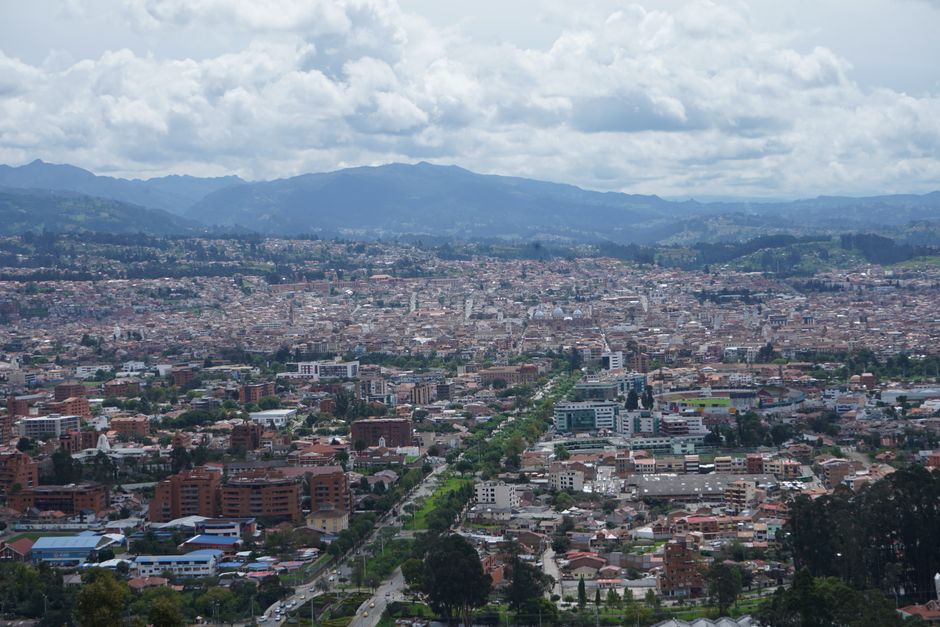
Cuenca, in the southern Andes of Ecuador, is one of the most beautiful and livable cities in South America. Its historic center, a UNESCO World Heritage Site, is a grid of colonial and republican houses with wrought-iron balconies, flower markets and dozens of churches, crowned by the three sky-blue domes of the New Cathedral. Four rivers cross the city, according to Ecuador’s Ministry of Tourism, and the Tomebamba, lined with willows and old houses perched on its banks, is the scenic heart of town. Cuenca is also one of the most famous places to buy toquilla straw hats, known abroad as “Panama hats” but woven in Ecuador. At about 2,550 m (8,370 ft) in a spring-like valley, it enjoys mild days all year, and it makes a calm base for Cajas National Park’s lakes and the Inca site of Ingapirca. Its pleasant pace and moderate costs have also made it a favorite with retirees from North America.
Right now in Cuenca
- Tue 9–23°C 47–73°F Partly cloudy
- Wed 9–22°C 47–72°F 1 mm Light showers
- Thu 10–22°C 50–72°F 7 mm Light showers
- Fri 9 Oct Independence of Guayaquil (Independencia de Guayaquil)
Weather: MET Norway (CC BY 4.0) · Holidays: Nager.Date
Top tours in Cuenca
See all tours for Cuenca →
From local operators, with prices and reviews; you check availability and book on Viator, our partner. We may earn a commission at no extra cost to you. How we earn money
Cuenca at a glance
- Best for: colonial architecture, Panama hats and crafts, museums, food markets, riverside walks and hiking in Cajas.
- How long: two days for the city; three or four with Cajas National Park and Ingapirca.
- Best time: June to September tends to be drier; Cuenca’s independence festivities are around November 3.
- Altitude: about 2,550 m (8,370 ft); take it easy on arrival.
- Getting there: a 50-minute flight from Quito, or about three to four hours by road from Guayaquil.
- Before you go: entry rules and money are in our Ecuador travel guide.
Cuenca’s layout: where things are
The historic center sits on a terrace above the Tomebamba River. Its heart is Parque Calderón, the main square, with the New Cathedral on one side and the Old Cathedral (El Sagrario) on the other. Most sights, hotels and restaurants are within a few blocks. Steps known as escalinatas lead down from the center to the riverbank and the Barranco, the cliff of hanging houses, and across the river is the more modern El Ejido district with its parks and avenues. The Pumapungo museum and ruins are at the eastern end of the old town.
Top things to see in Cuenca
Parque Calderón and the cathedrals
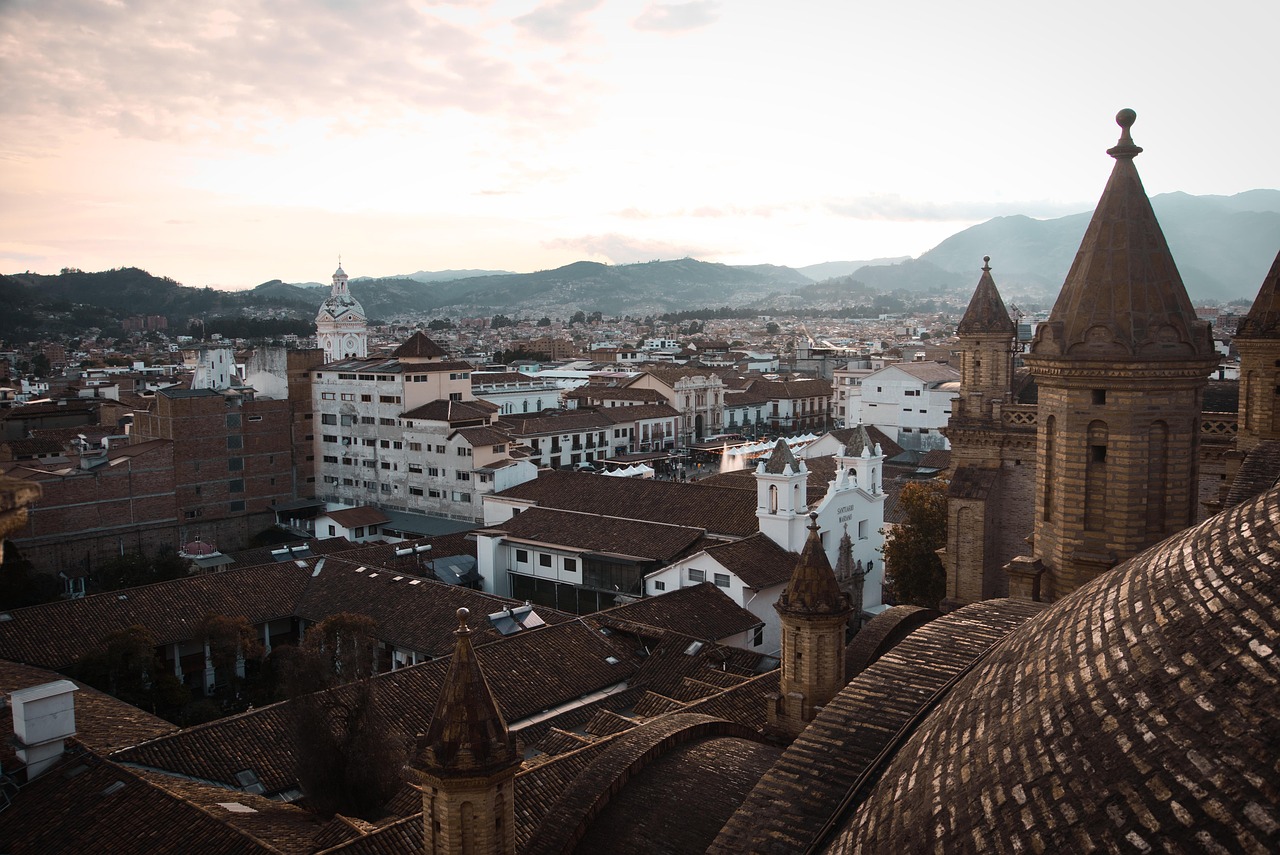
The New Cathedral (Catedral de la Inmaculada Concepción), begun in 1885, is a vast brick building whose blue-tiled domes are the city’s symbol; it is possible to climb to the roof terrace for views. Across the square, the smaller Old Cathedral, dating from the 16th century, is now a museum and concert venue.
The Tomebamba River and the Barranco
Walk the riverside path along the Tomebamba, below the historic houses that cling to the cliff (El Barranco), and cross the Puente Roto, a broken colonial bridge. Weekends bring families, picnics and cyclists.
Panama hat workshops
Toquilla straw hats are one of Ecuador’s heritage crafts, and Cuenca is one of the most famous places to buy them, according to the Ministry of Tourism. Visit a hat factory and museum to see the straw being treated, woven, bleached and shaped, and to try on hats from simple everyday styles to ultra-fine weaves that take months to make. The weaving of the traditional toquilla straw hat is on UNESCO’s list of intangible cultural heritage.
Pumapungo and the Museo Pumapungo
Cuenca was an important Inca city, Tomebamba, before the Spanish arrived, and the Pumapungo archaeological park preserves the foundations of Inca buildings, terraces and gardens with llamas. The adjoining museum covers Ecuador’s Indigenous cultures and archaeology.
Churches, plazas and the flower market
Cuenca is said to have a church for every Sunday of the year. Beyond the cathedrals, look for the church of San Francisco and its craft market, the white church of San Sebastián on its quiet square at the west end of the old town, and the small church of El Carmen de la Asunción, in front of which the colorful flower market has been held for generations. The Plaza de San Francisco is also the place to find textiles and Otavalo-style crafts.
Calle Larga and the riverside museums
Calle Larga, which runs along the top of the riverbank, links several small museums with the Barranco’s restaurants and bars. Look for the museums of history and archaeology in the restored riverside houses, and the staircases (escalinatas) that drop to the river path. On the far bank, El Ejido’s parks and the Museum of Modern Art, in a former house of temperance, are a short walk away.
A hat workshop visit in detail
In a toquilla straw workshop, guides show the raw palm fiber from the coast, the boiling, drying and bleaching of the straw, the weaving done by hand by artisans in nearby villages, and the final steps of trimming, ironing and shaping on wooden molds. The finest hats, with hundreds of weaves per square inch, can take months to make. Try on several styles; most workshops sell at fixed prices and can pack your hat in a box for the journey home.
Other things to do in Cuenca
- Markets: the flower market by the El Carmen church and the Mercado 10 de Agosto for fruit, juices and hornado (roast pork).
- Museums: the Museum of Modern Art and the Museo de las Conceptas, in a working convent.
- Mirador de Turi: a hilltop church south of the city with a panoramic view, best at sunset.
- Crafts: ceramics, silver and embroidery from nearby towns such as Chordeleg and Gualaceo.
- Food: try mote pillo, locro and Cuenca’s sweets, and coffee from southern Ecuador.
- Walking tours: see our city sightseeing guide.
Food and drink in Cuenca
Cuenca’s cooking is rooted in the southern Andes, with corn, pork and potatoes at its heart, and its markets are among the best places in Ecuador to try traditional food.
- Mote pillo: hominy scrambled with eggs, onions and achiote, a Cuenca breakfast classic, often with coffee.
- Hornado: whole roast pork, carved to order at the Mercado 10 de Agosto and other markets, with mote, llapingachos and salad.
- Cuy: roasted guinea pig, a traditional highland dish for special occasions, served at specialist restaurants on the road to Ricaurte and in the markets.
- Tamales and humitas: steamed corn dough wrapped in leaves, eaten with coffee in the afternoon.
- Chocolate and coffee: cafés along the river and in the historic center serve coffee from southern Ecuador and local chocolate.
- Sweets: the colorful candies and pastries of the Pase del Niño season, and dulce de higos (figs in syrup) with cheese.
- Craft beer and canelazo: small breweries and bars around Calle Larga, the main nightlife street above the river.
Almuerzos (set lunches) of soup, a main dish and juice are the cheapest way to eat, and Calle Larga has restaurants for every budget in the evening.
Day trips from Cuenca
Cajas National Park
About 30–45 minutes west of the city, Cajas is a high, rugged páramo dotted with hundreds of glacial lakes, polylepis forests and wildlife such as llamas and Andean birds, at altitudes of about 3,100–4,450 m (10,200–14,600 ft). Trails range from short lake walks to full-day hikes; the weather changes quickly, with cold, fog and rain, so go prepared. Register at the visitor center. See our hiking guide.
Ingapirca
Ecuador’s most important Inca site, about two hours north of Cuenca, with a stone Temple of the Sun built on an earlier Cañari site.
Gualaceo and Chordeleg
Craft towns about an hour east of the city, known for ikat-dyed shawls (paños), filigree silver jewelry and Sunday markets.
Paute and the orchid farms
East of the city, the valleys around Paute and Gualaceo are warmer and greener, with fruit orchards, and orchid growers near Gualaceo open their greenhouses to visitors. It combines easily with the craft towns of Gualaceo and Chordeleg on a day trip.
Baños de Cuenca
About 15 minutes southwest of the center, the village of Baños has hot springs fed by geothermal water, with public pools and spa hotels, a relaxing end to a day of sightseeing or hiking in Cajas.
Girón waterfalls and the road south
About an hour south, near the town of Girón, a trail leads to a series of waterfalls in a green valley. The road continues toward Loja and Vilcabamba, known as the “valley of longevity”, according to Ecuador’s Ministry of Tourism, a longer trip of four to five hours.
Getting there and getting around
By air
Mariscal Lamar Airport (CUE) is inside the city, a few minutes by taxi from the center, with flights from Quito of about 50 minutes. Many international travelers fly into Quito or Guayaquil; see our Quito travel guide.
By road
Buses run from Guayaquil, about three to four hours, through Cajas National Park, and from Quito, about nine to ten hours. Landslides can close mountain roads in the rainy season, and buses can be targeted by thieves: keep valuables on you and travel by day, according to the UK government. Shared vans (vans compartidas) also run to Guayaquil.
Getting around Cuenca
The historic center is easy to explore on foot. Cuenca’s tram runs east–west through the city, including along streets of the historic center; taxis are cheap and plentiful, but agree the fare first or check that the meter is on, and book through your hotel at night.
Areas at a glance
- The historic center: the grid of streets around Parque Calderón, with churches, museums, markets and most hotels.
- Calle Larga and the Barranco: the street along the top of the riverbank, with bars, restaurants and views of the Tomebamba.
- San Sebastián and San Roque: quieter traditional neighborhoods west of the center, with small squares and craft workshops.
- El Ejido and Avenida Solano: the modern district south of the river, with parks, apartments and the Museum of Pumapungo nearby.
Getting around in detail
- Walking: the center is compact and flat, with steps down to the river.
- The tram: runs east–west across the city, including through parts of the historic center, connecting the bus terminal area, the center and the outskirts; buy a card or pay at the station.
- Taxis: cheap and plentiful; use the meter or agree the fare.
- City buses: serve all neighborhoods and Baños; pay with a card.
- Tours: agencies run day trips to Cajas, Ingapirca and the craft towns; the double-decker tourist bus is an easy introduction to the city.
When to go and how long to stay
Cuenca has a mild, spring-like climate, with days of about 15–21 °C (59–70 °F) and cool nights around 7–10 °C (45–50 °F). June to September is usually drier, though cool and windy, and rain is more frequent from October to May, typically in the afternoon. A red alert has been issued for the forecast 2026–2027 El Niño, which may bring unusually heavy rain and landslides, according to the UK government. The biggest celebrations are Cuenca’s independence day, November 3, and the Pase del Niño Viajero parade on December 24, one of Ecuador’s largest Christmas processions.
| Season | What it’s like | Good for |
|---|---|---|
| June–September | Drier, cool and breezy | Cajas hikes, Ingapirca, walking the city |
| October–December | Showers; festivities on November 3 and December 24 | Festivals, museums and markets |
| January–May | Wetter afternoons | Hat workshops, cafés, fewer visitors |
Cuenca month by month
- January: mild, with afternoon showers; quiet after the holidays.
- February: showery; Carnival (February 8–9, 2027) brings water fights.
- March: one of the wetter months; Holy Week processions.
- April: often the wettest month; Cuenca’s founding anniversary (April 12) brings festivities.
- May: rains ease; green countryside.
- June: drier, cool and breezy; Corpus Christi sweets sold around the main square.
- July: one of the driest months; good for Cajas, though cold at altitude.
- August: dry and windy; the clearest skies.
- September: mostly dry and sunny.
- October: showers return; the Festival of Independence approaches.
- November: independence festivities around November 3, with concerts, fairs and parades.
- December: the Pase del Niño Viajero parade on December 24 fills the streets with costumed children and decorated floats.
2 days in Cuenca
Day one, Parque Calderón, the New Cathedral and its roof, the flower market, the Barranco and the riverside walk, and a hat workshop. Day two, Pumapungo and its museum, the markets, and sunset at the Mirador de Turi.
4 days in Cuenca
Add a day hiking in Cajas National Park and a day trip to Ingapirca, or a Sunday in the craft towns of Gualaceo and Chordeleg.
Where to stay in Cuenca and the taxes
- The historic center: restored colonial houses turned boutique hotels and guesthouses, close to everything.
- Along the Tomebamba: riverside hotels with views of the Barranco.
- El Ejido: quieter streets south of the river, with modern apartments and hotels.
Hotel prices include Ecuador’s 15% value-added tax, and many add a 10% service charge; check whether quoted rates include both.
Costs in Cuenca
Cuenca is one of the best-value cities in Ecuador. These per-person estimates are a planning guide as of October 2026, in US dollars:
| Item | Typical price |
|---|---|
| Hostel dorm bed | about US$10–18 |
| Mid-range hotel double room in the historic center | about US$60–120 |
| Boutique hotel in a restored house | about US$130–250 |
| Set lunch (almuerzo) | about US$3–6 |
| Plate of hornado at the market | about US$4–7 |
| Tram or bus ride | under US$1 |
| Taxi within the city | about US$2–5 |
| Genuine toquilla straw hat | from about US$30 to several hundred dollars, depending on the fineness of the weave |
| Day tour to Cajas or Ingapirca | about US$45–90 |
The figures are our estimates, not official statistics.
Practical tips for Cuenca
- Altitude: at about 2,550 m (8,370 ft), altitude sickness is possible on arrival, and Cajas goes much higher; rest, drink water and limit alcohol on your first day.
- Safety: Cuenca is one of Ecuador’s calmer cities, with a tourism police unit, according to the UK government, but keep an eye on your belongings and use booked taxis at night. Emergencies: 911.
- Weather: carry a light rain jacket and a warm layer; the sun is strong between showers.
- Water: drink filtered or bottled water.
- Money: Ecuador uses the US dollar; bring small bills for markets and taxis.
What to pack for Cuenca
Bring layers, including a warm sweater or fleece, a waterproof jacket, comfortable walking shoes for cobbles and steps, and sunscreen and sunglasses for the high-altitude sun. For Cajas, add waterproof hiking boots, a warm hat, gloves and a windproof jacket. Leave room in your luggage for a Panama hat. Plugs are the US type.
Cuenca travel FAQ
Are Panama hats really from Ecuador?
Yes. Toquilla straw hats are woven in Ecuador, and Cuenca is one of the most famous places to buy them, according to Ecuador’s Ministry of Tourism. They got the “Panama” name because they were shipped and sold through Panama.
How do I get to Cuenca?
By a 50-minute flight from Quito to Cuenca’s airport, which is in the city, or by bus from Guayaquil in about three to four hours.
How high is Cuenca?
About 2,550 m (8,370 ft). Most visitors adjust within a day or two; Cajas National Park reaches about 4,450 m (14,600 ft).
Is Cuenca a UNESCO World Heritage Site?
Yes. Its historic center is a World Heritage Site, according to Ecuador’s Ministry of Tourism.
Can I visit Cajas National Park from Cuenca?
Yes. It is about 30–45 minutes west by bus, taxi or tour; register at the visitor center and dress for cold, wet weather.
What is the weather like in Cuenca?
Mild all year, with days of about 15–21 °C (59–70 °F), cool nights and frequent afternoon showers from October to May.
Is Cuenca safe?
It is one of Ecuador’s calmer cities. Keep an eye on your belongings and use booked taxis at night.
What food should I try in Cuenca?
Mote pillo for breakfast, hornado at the Mercado 10 de Agosto, tamales and humitas, and cuy if you are curious.
How much does a Panama hat cost in Cuenca?
From about US$30 for a simple hat to several hundred dollars for the finest weaves, by our estimates. Visit a workshop to see how they are made.
How much does Cuenca cost per day?
Roughly US$35–50 on a budget and US$100–170 for a mid-range trip, by our estimates.
Sources and last review
Researched and last reviewed on 4 October 2026. The UNESCO listing, the four rivers, the colonial and republican center and the toquilla straw hats: Ecuador’s Ministry of Tourism; tourism police in Cuenca, bus theft, landslides, El Niño and the emergency number: the UK government; altitude: Wikidata. The cathedral dates, the Barranco, Pumapungo and its museum, the UNESCO intangible heritage listing of the hat, Cajas’ altitude and distance, Ingapirca, Gualaceo and Chordeleg, airport and bus times, the tram, temperatures, festivals and the 15% IVA and service charge come from secondary sources or general knowledge and are flagged for checking. The food, neighborhood, getting-around, month-by-month and cost sections draw on secondary sources, general knowledge and our own estimates, except where an official source is named, and are flagged for checking. Prices and rules change, so check before you go. For entry rules and money, see our Ecuador travel guide.
Plan your trip
Partner links: TravelerCenter may earn a commission if you book, at no extra cost to you.
🇪🇸 Useful Spanish phrases for Cuenca
All 38 Spanish phrases: restaurant, hotel, emergencies, romance (printable) →