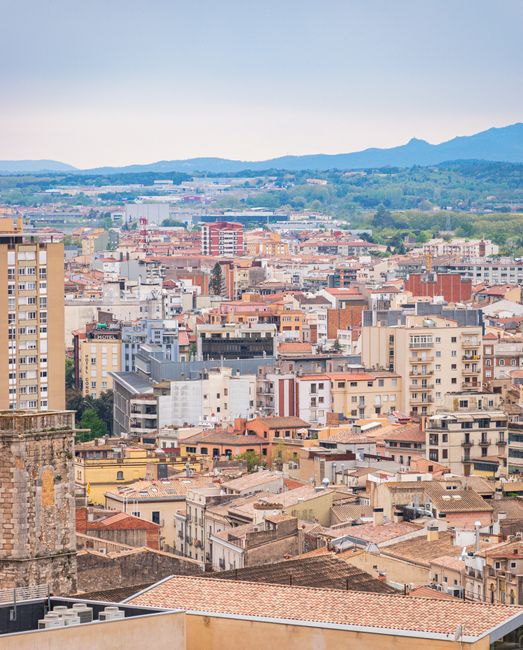
Girona is one of Catalonia’s most beautiful cities: a walled medieval town on a hillside above the river Onyar, with a cathedral reached by a sweeping Baroque staircase, a maze of stepped lanes that were home to one of Europe’s best-preserved Jewish quarters, and a walk along the top of its old walls with views to the Pyrenees. The colourful houses hanging over the river are its postcard, and its restaurants are among the best in Spain. Girona is small, walkable and easy to reach: under 40 minutes by high-speed train from Barcelona, with its own airport just south of town and the coves and villages of the Costa Brava 30–60 minutes away. Spring and autumn are the best seasons; in May the whole old town fills with flowers.
Right now in Girona
- Wed 15–24°C 60–75°F 4 mm Showers
- Thu 14–20°C 56–67°F 16 mm Heavy showers
- Fri 10–19°C 50–66°F Mostly clear
- Mon 12 Oct National Day of Spain (Fiesta Nacional de España)
Weather: MET Norway (CC BY 4.0) · Rates: ECB · Holidays: Nager.Date
Top tours in Girona
See all tours for Girona →
From local operators, with prices and reviews; you check availability and book on Viator, our partner. We may earn a commission at no extra cost to you. How we earn money
Girona at a glance
- Best for: medieval streets and Jewish heritage, the cathedral and the city walls, food lovers, cyclists, and a base for the Costa Brava, Dalí’s Figueres and the Garrotxa volcanoes.
- How long: 1 full day for the old town; 2–3 days to add museums and a day trip; 4 days with the coast or the volcanoes.
- Best time: April to June and September to October. July and August are hot inland, with average highs of about 31 °C; winter nights are cold.
- Getting there: high-speed trains from Barcelona in under 40 minutes; Girona–Costa Brava airport (GRO) about 12 km south, with Sagalés buses; regional trains and coaches from Barcelona.
- Getting around: on foot. The old town is steep and stepped, and the station is a 15–20 minute walk from the cathedral.
- Before you go: entry rules, money, trains and general safety are on our Spain travel guide.
Girona’s neighbourhoods and who each one suits
Girona grew up on the east bank of the Onyar, where the old town climbs the hill to the cathedral, and spread across the river onto flat ground in the 19th and 20th centuries. A string of footbridges links the two halves.
Barri Vell (the old town) and the Call
The historic quarter inside the walls: the Roman Força Vella around the cathedral, the medieval streets below it, and the Call, the old Jewish quarter of narrow lanes and steps. Here are almost all the sights, the arcaded Rambla de la Llibertat and the Plaça del Vi with the town hall. It is atmospheric and quiet at night, but full of steps and mostly closed to traffic, so travel light. Best for first-timers and couples.
Mercadal and the Eixample
Across the river, the Mercadal is the busy shopping district around the Plaça de la Independència, an arcaded 19th-century square lined with restaurant terraces, and the market. Beyond it, the Eixample is the modern grid around the railway and bus stations. Flat and well connected. The most practical base if you arrive by train or plan day trips.
Sant Pere de Galligants and the Sant Daniel valley
North of the cathedral, the old town ends at the Romanesque monastery of Sant Pere de Galligants, where a green valley follows a stream up to the convent of Sant Daniel. Quiet, almost rural, and ideal for walkers and families who want calm with the old town on the doorstep.
La Devesa
Girona’s biggest park, a vast grove of tall plane trees west of the river, hosts markets, concerts and the autumn fair. The streets around it are residential and calm, a short walk from the old town and the station. Good for runners, cyclists and longer stays in an apartment.
Top things to see in Girona
Prices and hours below were checked on the official sites in October 2026, unless we say otherwise; check again before you go. The city museums, including the Museum of Jewish History, are free on the morning of the first Sunday of each month.
Girona Cathedral
Girona’s cathedral stands at the top of the old town, reached by a grand Baroque staircase of about 90 steps that is one of the city’s great sights in itself (and a Game of Thrones filming location). Built between the 11th and 18th centuries, its glory is the single Gothic nave, which according to the city’s tourist office is the widest Gothic vault in the world, at 23 m. The Treasury holds the famous Romanesque Tapestry of Creation. As of October 2026 the city’s tourist office lists a ticket for the cathedral and the Basilica of Sant Feliu at €7.50 (€5 reduced), with an audio guide, or €12 (€8 reduced) including the Girona Art Museum next door; under-7s go free. From 16 September to 31 October it opens Monday to Friday 10:00–18:00, Saturday 10:00–19:00 and Sundays and holidays 12:00–18:00; from November to mid-March, Monday to Saturday 10:00–17:00 and Sundays 12:00–17:00. It closes on 25 December, 1 January and Good Friday; confirm prices on the cathedral’s own site.
The city walls (Passeig de la Muralla)
Girona kept a long stretch of its medieval walls, built mostly in the 14th and 15th centuries on Roman and Carolingian foundations, and you can walk along the top of them for free. The Passeig de la Muralla runs from the Plaça de Catalunya near the river, behind the old town, up to the gardens behind the cathedral, with towers to climb for views over the rooftops, the cathedral and, on clear days, the snowy Pyrenees. Allow an hour; there are many uneven steps and little shade, and sections may close at night or in bad weather.
The Onyar houses and the Eiffel bridge
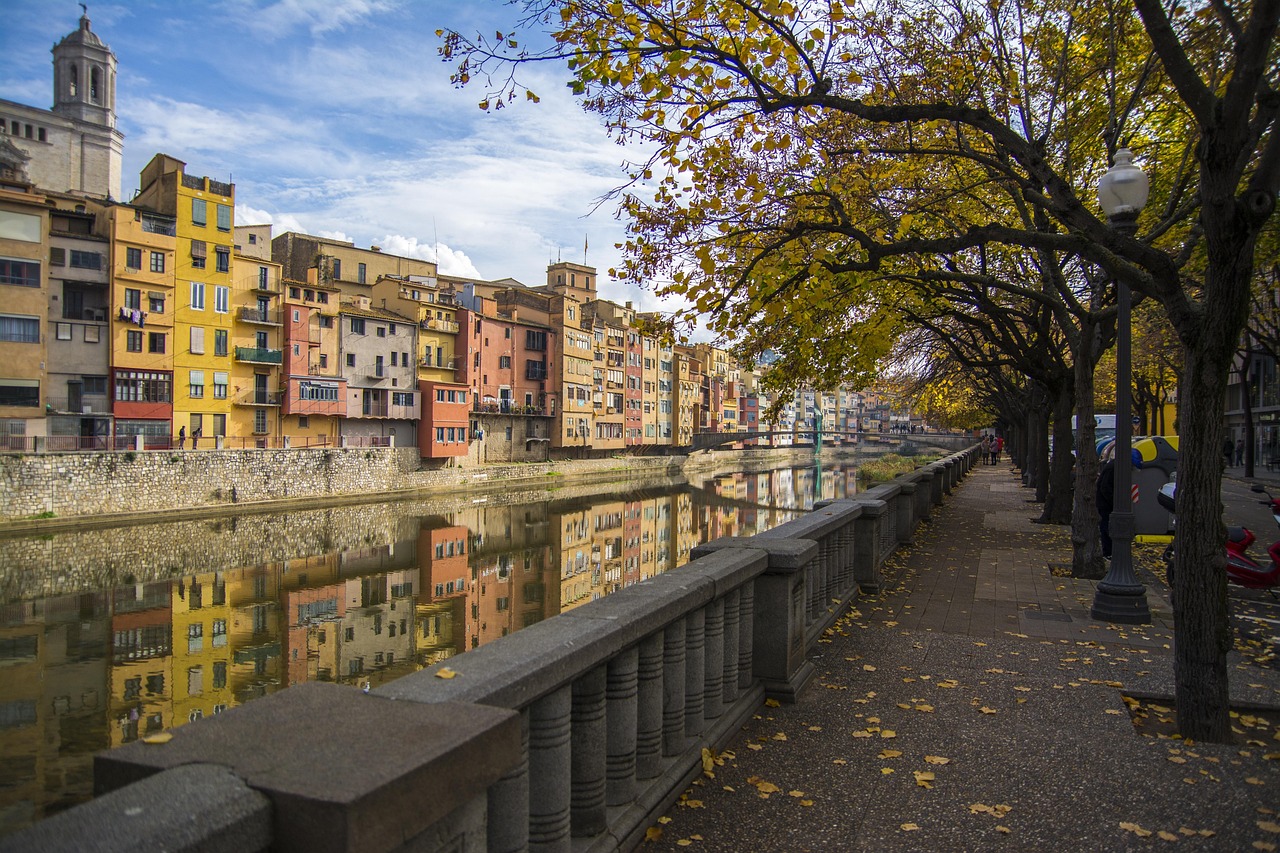
The tall houses painted ochre, red, yellow and blue that line the east bank of the Onyar are Girona’s most photographed view. The best places to see them are the footbridges, above all the red iron Pont de les Peixateries Velles, built in 1877 by the workshop of Gustave Eiffel before he built his Paris tower, and the stone Pont de Pedra. Come at dusk, when the houses are lit and reflected in the water.
The Jewish quarter and the Museum of Jewish History
For some 600 years Girona had a thriving Jewish community, until the expulsion of 1492. Its quarter, the Call, survives as a tangle of narrow lanes, steep steps and arches around the Carrer de la Força. The Museum of Jewish History, in the building that housed the last synagogue, tells the story of the Jews of medieval Catalonia. As of October 2026 entry costs €6 (€3 reduced for students, over-65s and others; free under 16). From September to June it opens Tuesday to Saturday 10:00–18:00 and Sunday, Monday and holidays 10:00–14:00; in July and August, Tuesday to Saturday until 19:00. The entrance is at Carrer de la Força 8.
The Arab Baths and Sant Pere de Galligants
Despite the name, the Arab Baths are a Romanesque public bathhouse of the late 12th century, rebuilt after a French siege in 1285, with a domed changing room ringed by slender columns. The Provincial Council of Girona, which runs them, charges €3 (€2 for over-65s, €1 reduced, free under 8) as of October 2026, and opens them all year, Monday to Saturday 10:00–18:00 and Sundays and holidays 10:00–14:00. A few steps away, the Romanesque monastery of Sant Pere de Galligants, with a lovely carved cloister, houses the Girona branch of the Archaeology Museum of Catalonia. From October to April it opens Tuesday to Saturday 10:00–18:00 and Sundays and holidays 10:00–14:00 (until 19:00 on weekdays from May to September), and it closes on Mondays; we could not read its current ticket price.
More to see
- Basilica of Sant Feliu: the city’s other great church, with a truncated Gothic spire, Roman and early Christian sarcophagi and the tomb of Girona’s patron saint, Saint Narcissus.
- Girona Art Museum: in the former bishop’s palace beside the cathedral, with Romanesque and Gothic altarpieces and Catalan art up to the 20th century.
- Rambla de la Llibertat and Plaça del Vi: the arcaded heart of the old town, with cafés, the town hall and the tourist office.
- Casa Masó: the riverside birthplace of the architect Rafael Masó, one of the coloured Onyar houses, visited on guided tours.
Other things to do in Girona
Eat and drink well
Girona is a serious food city, home to some of Spain’s most celebrated restaurants, but you can eat very well for much less. Try botifarra sausage with beans and finish with a xuixo, Girona’s sugar-coated, cream-filled pastry. Empordà wines from the hills towards the coast are on every list. The Mercat del Lleó, the covered market in the Mercadal, is the place for picnic food. See our wine tasting guide.
Cycling and walking
Girona is one of Europe’s favourite bases for road cyclists, many of them professionals, thanks to quiet roads into the hills and the Pyrenees. Easier options are the greenways on old railway lines: the Ruta del Carrilet runs from Girona to Olot through the volcano country, and another heads to Sant Feliu de Guíxols on the coast. See our cycling, hiking and city sightseeing guides.
Day trips and onward travel
The Costa Brava and Dalí’s Figueres
The Costa Brava is 30–60 minutes from Girona by car or coach: Tossa de Mar’s walled old town, the cliff path and coves around Calella de Palafrugell and Begur, and Cadaqués further north. Figueres, with the Dalí Theatre-Museum, is about 15 minutes on the high-speed train or half an hour on regional trains. As of October 2026 museum tickets start at €18.50, and from October to December it opens Tuesday to Sunday, 10:30–18:00; book online, and see our Costa Brava guide for Dalí’s house at Portlligat and Gala’s castle at Púbol, which is close to Girona.
Besalú and the Garrotxa volcanoes
Besalú, about 35 km north of Girona, is a perfectly preserved medieval village entered over a fortified Romanesque bridge, with the remains of its own Jewish quarter, including a rare medieval ritual bath. Beyond it, around the town of Olot, the Garrotxa Volcanic Zone Natural Park protects some 40 extinct volcano cones covered in woods, among them Santa Margarida, with a Romanesque chapel inside its crater, and the Croscat. Buses run to Besalú and Olot, but a car is easier.
Nearby destinations
- Costa Brava34 km
- Barcelona85 km
- Sitges118 km
- Andorra la Vella121 km
- Carcassonne142 km
- Costa Daurada191 km
- Montpellier201 km
- Toulouse212 km
Getting there and getting around
By air
Girona–Costa Brava airport (GRO), run by Aena, is about 12 km south of the city and handles mainly low-cost and seasonal flights. Aena lists Sagalés buses from the airport to Girona and to Barcelona (Estació del Nord), the Barcelona coaches leaving about 20–25 minutes after each arrival, plus Sagalés and Moventis lines to Costa Brava towns and a Sagalés service to Barcelona-El Prat airport. Barcelona airport has many more flights; from there, connect by train through Barcelona.
By train and coach
Girona station, in the Eixample about 15–20 minutes’ walk from the cathedral, is on the high-speed line from Barcelona to France: the fastest trains from Barcelona Sants take under 40 minutes and continue to Figueres-Vilafant and Perpignan. Cheaper regional trains on the R11 line run from Barcelona Sants and Passeig de Gràcia to Girona about 23 times each way on a working day, according to Rodalies de Catalunya, taking around 1 h 15–1 h 30. Coaches use the bus station beside the railway station. Journey times are approximate and come from secondary sources; check Renfe and Rodalies for your date, as Catalonia’s regional trains had serious disruption in 2026.
Getting around and the low-emission zone
Walk: the old town is compact, steep and mostly closed to cars; city buses cover the rest. Since 15 September 2025 Girona has had a low-emission zone (ZBE) covering the centre, from the Devesa park to the old town. According to the city council, it applies on working days, Monday to Friday 7:00–20:00. Vehicles with a Spanish B, C, ECO or Zero environmental label may enter freely; vehicles without a label that are not authorised may still enter on up to 24 days a calendar year without asking for permission. Foreign-registered vehicles that meet the equivalent emission requirements are allowed.
When to go and how long to stay
Girona lies inland, about 30 km from the sea, so it is hotter in summer and colder on winter nights than the coast. The table uses AEMET’s 1991–2020 climate normals for the Girona–Costa Brava airport weather station, about 9 km south-west of the old town at 143 m: average daily highs and lows, and days with at least 1 mm of rain. The city centre is a little milder at night.
| Season | Average high / low | Rainy days per month | What it’s like | Good for |
|---|---|---|---|---|
| Winter (Dec–Feb) | 14–15 °C / 1–2 °C | 4–5 | Clear, sunny days and frosty nights; quiet streets | Museums, food, low prices |
| Spring (Mar–May) | 18–24 °C / 4–10 °C | 5–7 | Green and fresh, with some showers | Walking the walls, Temps de Flors, day trips |
| Summer (Jun–Aug) | 28–31 °C / 14–17 °C | 4–5 | Hot afternoons and occasional thunderstorms | Early sightseeing, the coast, evenings by the river |
| Autumn (Sep–Nov) | 27 °C falling to 18 °C / 14 °C falling to 5 °C | 5–7 | Warm in September, wettest in October | Walking, cycling, the volcanoes in autumn colours |
The station averages about 700 mm of rain a year on some 65 rainy days, with October the wettest month, and about 2,480 hours of sunshine. These are long-term averages; recent summers have often been hotter.
Events worth planning around
- May: Temps de Flors, when courtyards, churches, the cathedral steps and monuments are decorated with flowers for about a week; the old town is crowded and rooms sell out early.
- Late October: the Fires de Sant Narcís, Girona’s main festival, with a funfair in the Devesa, concerts, giants and fireworks around 29 October.
- First Sunday of each month: free morning entry to the city museums, including the Museum of Jewish History.
How long to stay: 1, 2 and 4 days
1 day: the Onyar houses from the Eiffel bridge, the Call and the Museum of Jewish History, the cathedral and Sant Feliu, then the walk along the walls and dinner in the Plaça de la Independència.
2 days: add the Arab Baths, Sant Pere de Galligants, the Art Museum and the Sant Daniel valley. 4 days: add a day in Figueres and on the Costa Brava, and a day in Besalú and the Garrotxa volcanoes.
Where to stay in Girona and the tourist tax
- Barri Vell: boutique hotels and apartments in old stone houses, steps to the door; the most atmospheric choice.
- Mercadal and the riverside: central, flat, near restaurants and with views of the river houses.
- Eixample, near the station: practical business hotels and easy parking, best for day trips by train.
- Countryside around Girona: farmhouse hotels (masies) in the Empordà, ideal with a car.
Book early for Temps de Flors and the Sant Narcís fair. Catalonia charges a tourist tax on every night in tourist accommodation, collected by the hotel or rental. Since 1 April 2026, outside Barcelona city, the Agència Tributària de Catalunya lists these rates per person per night: €4.50 in 5-star hotels and luxury campsites, €1.80 in 4-star hotels, €1.75 in tourist flats, €0.90 in other hotels and campsites, and €0.80 in youth hostels. It applies from age 17 and for up to 7 nights in the same place, and the rates rise on 1 April 2027. Towns may add a local surcharge of up to €4 from 1 October 2026, but as of October 2026 Girona does not appear on the agency’s list of towns that have approved one; check with your accommodation.
Practical tips for Girona
- Mind the steps: the old town is all slopes and stairs; wheeled suitcases are hard work, so pack light or take a taxi to the door.
- Mondays: Sant Pere de Galligants and several museums close; the cathedral, the Arab Baths and the Museum of Jewish History (mornings) stay open.
- Combined ticket: the cathedral ticket includes the Basilica of Sant Feliu; add the Art Museum for a little more.
- Respect residents: the city council asks visitors to keep noise down in the old town’s narrow streets, especially at night.
- Language: Catalan is the everyday language, and Spanish is understood everywhere; signs are often in Catalan first.
- Emergencies: call 112.
What to pack for Girona
Comfortable shoes with a good grip are the single most important thing: the walls, the cathedral steps and the Call’s polished stone stairs are slippery when wet. In summer bring a sun hat, sunglasses, sunscreen and a refillable water bottle, as the walls have little shade and afternoons are hot. From November to March pack a warm coat, gloves and layers, since nights often drop close to freezing. A light rain jacket or compact umbrella is useful in spring and autumn, especially in October. Add a swimsuit if you are heading to the coast.
Girona travel FAQ
How much does it cost to visit Girona Cathedral?
As of October 2026 the city’s tourist office lists €7.50 (€5 reduced) for the cathedral and the Basilica of Sant Feliu with an audio guide, or €12 including the Girona Art Museum; under-7s are free. Check the cathedral’s own site before you go.
Can you walk on Girona’s city walls?
Yes, for free. The Passeig de la Muralla runs along the top of the medieval walls from near the Plaça de Catalunya to the gardens behind the cathedral, with towers to climb. Allow about an hour and wear good shoes.
Is Girona worth a day trip from Barcelona?
Yes. The high-speed train takes under 40 minutes, and one day covers the river houses, the Jewish quarter, the cathedral and the walls. Stay a night or two to see it quiet in the evening and add a day trip.
How do I get from Girona airport to the city?
Take the Sagalés bus from Girona–Costa Brava airport, about 12 km south of the city, or a taxi. Sagalés also runs coaches to Barcelona’s Estació del Nord, leaving about 20–25 minutes after each flight arrives.
When is Temps de Flors in Girona?
Every May, for about a week, when the old town’s courtyards, steps and monuments are filled with flower displays. It is Girona’s busiest week, so book accommodation well ahead and visit early in the morning.
Is there a tourist tax in Girona?
Yes, the Catalan tax: as of October 2026, from €0.80 in youth hostels to €4.50 in 5-star hotels per person per night, from age 17 and for up to 7 nights. Girona had not added a local surcharge as of October 2026.
Does Girona have a low-emission zone?
Yes, since September 2025, on working days 7:00–20:00. Cars with a Spanish B, C, ECO or Zero label, or a foreign car meeting the equivalent standard, may enter; vehicles without a label get 24 days a year without permission.
Where was Game of Thrones filmed in Girona?
Scenes for season six were shot in the old town, including the cathedral steps, the Call’s lanes, the Arab Baths and the monastery of Sant Pere de Galligants. All are within a ten-minute walk of each other.
What is the best time to visit Girona?
April to June and September to October, when days are warm but not hot. May brings Temps de Flors and crowds; July and August average about 31 °C in the afternoons.
Sources and last review
Researched and last reviewed on 4 October 2026. Cathedral prices and hours: Girona City Council’s tourist office (the cathedral’s own site could not be read); Museum of Jewish History: the Patronat Call de Girona; Arab Baths: the Provincial Council of Girona; Sant Pere de Galligants hours: the Archaeology Museum of Catalonia; free first-Sunday museum entry and the low-emission zone: Girona City Council; tourist tax and local surcharges: the Agència Tributària de Catalunya; airport buses: Aena; R11 train frequencies: Rodalies de Catalunya; Dalí Theatre-Museum: the Fundació Gala-Salvador Dalí; climate: AEMET’s 1991–2020 normals for Girona–Costa Brava airport, as published by the WMO. High-speed and regional train journey times, the cathedral’s number of steps, the walls’ opening times and festival timings are general references and flagged for checking. Prices, hours and timetables change, so check the official sites before you go. For entry rules, money and general safety, see our Spain travel guide.
Plan your trip
Partner links: TravelerCenter may earn a commission if you book, at no extra cost to you.
🇪🇸 Useful Spanish phrases for Girona
All 38 Spanish phrases: restaurant, hotel, emergencies, romance (printable) →