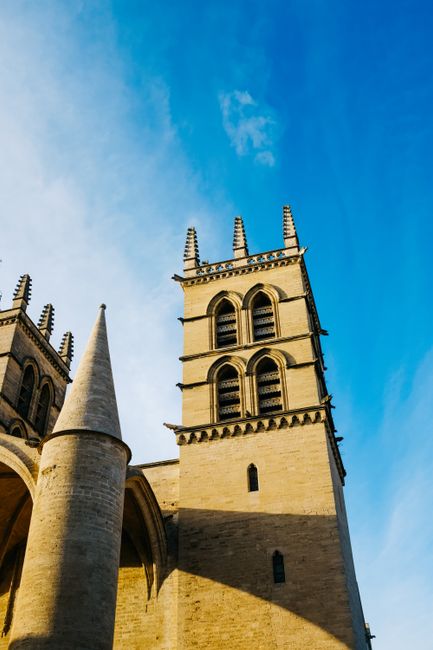
Montpellier is a young, sunny university city about 11 km from the Mediterranean. Its old centre, the Écusson, is a car-free maze of honey-coloured lanes, hidden courtyards and small squares, wrapped around the grand Place de la Comédie. Add one of France’s best art museums, bold modern districts, colourful trams and beaches within reach by public transport, and you have an easy, lively city break. Give it two days for the city, three or four with the beaches, Sète or the Pont du Gard.
Right now in Montpellier
- Wed 17–21°C 62–70°F 29 mm Cloudy
- Thu 16–20°C 60–68°F 6 mm Showers
- Fri 10–19°C 51–67°F Partly cloudy
Weather: MET Norway (CC BY 4.0) · Rates: ECB
Top tours in Montpellier
See all tours for Montpellier →
From local operators, with prices and reviews; you check availability and book on Viator, our partner. We may earn a commission at no extra cost to you. How we earn money
Montpellier at a glance
- Best for: strolling the old town, art, terraces, beaches nearby and day trips across Languedoc and the Camargue.
- How long: 2 days for the city, 3–4 with the beach and a day trip.
- Best time: May, June and September; mid-September to November brings the year’s heaviest rain storms.
- Getting in: about 3½ hours by TGV from Paris and about 3 hours from Barcelona; the airport is 8 km from the centre.
- Getting around: trams and buses are free for local residents only; visitors pay €2.10 for a ticket valid 1½ hours (as of October 2026).
- Before you go: entry rules, money, trains and general safety are on our France travel guide.
Montpellier’s neighbourhoods and who each one suits
The historic centre sits on a low hill, shaped roughly like a shield, which is why locals call it the Écusson. The Comédie square and Saint-Roch station are on its eastern edge; the modern districts of Antigone and Port Marianne stretch east towards the sea.
The Écusson (old town)
Medieval lanes, 17th- and 18th-century mansions with grand staircases in their courtyards, small squares shaded by plane trees and countless cafés. It is mostly pedestrian, lively with students in the evening and full of independent shops. The best base for a short stay, though some streets are noisy at night.
Comédie and Saint-Roch
Place de la Comédie, one of the largest pedestrian squares in Europe, is the city’s living room, with the opera house, the Three Graces fountain and terraces. The Esplanade Charles-de-Gaulle leads north past the Musée Fabre. Saint-Roch station is a few minutes’ walk south: practical for trains and trams.
Antigone and Port Marianne
Antigone is a neoclassical district of grand squares and fountains designed by the Catalan architect Ricardo Bofill in the 1980s, leading down to the River Lez. Further east, Port Marianne has striking contemporary buildings, the new city hall and riverside paths. Modern hotels and easy tram access towards the beaches.
Beaux-Arts and Boutonnet
Just north of the old town, these quieter, village-like districts have local markets, small restaurants and apartments to rent. A good choice for a longer, more local stay.
Top things to see in Montpellier
The best way to see Montpellier is simply to wander. Prices below are as of October 2026.
Place de la Comédie and the Écusson
Start at the Comédie, then lose yourself in the lanes. Look for the hidden courtyards of the hôtels particuliers (some are open during heritage days or on tourist-office tours), the fortress-like Saint-Pierre cathedral, and the Faculty of Medicine next to it, one of the oldest medical schools in the world still in use. The Place de la Canourgue, with its unicorn fountain and view over the rooftops, is a lovely spot for a coffee.
Promenade du Peyrou and the aqueduct
At the western edge of the old town, a triumphal arch opens onto the Promenade du Peyrou, a formal terrace with an equestrian statue of Louis XIV and a water tower. From here, the 18th-century Saint-Clément aqueduct strides away on two tiers of arches. Come at sunset for views towards the Cévennes hills and the sea, and on market mornings, when stalls set up under the arches.
Musée Fabre
One of the great art museums of France, with European painting from the Renaissance to today and a remarkable room of large black canvases by Pierre Soulages. As of October 2026, it opens Tuesday to Sunday from 11:00 to 18:00. The permanent collection costs €9 (€6 reduced), or €12 with the temporary exhibition, and it is free on the first Sunday of each month. The museum’s decorative arts department, in the nearby Hôtel de Cabrières-Sabatier d’Espeyran, shows furnished period rooms.
MO.CO. and contemporary art
MO.CO. Hôtel des collections, near the station, shows big exhibitions of contemporary art drawn from collections around the world; its sister space, MO.CO. Panacée, is in the old town. As of October 2026, entry costs €8 for adults, and it is free on the first Sunday of the month.
Jardin des plantes
Founded in 1593 for the medical faculty, this is France’s oldest botanical garden: shady paths, old trees, a pond and greenhouses, right beside the Peyrou. Free and peaceful on a hot afternoon.
Beaches near Montpellier
Montpellier is not on the sea, but long sandy beaches are 20–40 minutes away. Without a car, take tram line 3 to its terminus at Pérols – Étang de l’Or and change to a bus.
- Palavas-les-Flots: a lively family resort with a canal, a lighthouse and seafood restaurants; bus line 1 of the Transp’Or network from Pérols – Étang de l’Or.
- Carnon: wide beaches by a marina; Transp’Or line 4 towards La Grande Motte, or the regional liO Hérault Transport line 606 from the Place de France tram stop (line 1).
- Grand Travers and Petit Travers: natural dune beaches between Carnon and La Grande Motte, served in summer by the liO beach shuttle (line 633) from Pérols – Étang de l’Or.
- L’Espiguette: a huge wild beach backed by dunes beyond Le Grau-du-Roi, in the Gard; line 606 reaches Le Grau-du-Roi, but a car or bike makes the last stretch easier. Swim near the lifeguard posts.
Bus tickets on these lines are separate from the TaM tram ticket. Buses fill up on summer weekends, so go early, and take water and shade.
Food, markets and evenings out
Montpellier eats like the Mediterranean: oysters and mussels from the Étang de Thau, tielle (a spicy octopus pie from Sète), brandade from Nîmes, olives and olive oil, and local cheeses. The covered market of Les Halles Castellane in the old town and the market at the Arceaux under the aqueduct are good for picnic food. In the evening, head for the terraces of the Écusson’s small squares or a wine bar serving Languedoc wines such as Pic Saint-Loup, Grès de Montpellier and Picpoul de Pinet.
Other things to do in Montpellier
- Walk or cycle along the Lez: riverside paths lead from Antigone towards the sea; on two wheels, see our cycling guide.
- Taste wine: the Pic Saint-Loup vineyards are about 30 minutes north by car; see our wine tasting guide.
- Planet Ocean and the planetarium: an aquarium and planetarium at the Odysseum leisure area, at the end of tram line 1; good on a rainy day.
- Festivals: the Festival Montpellier Danse, a major contemporary dance festival held each summer since 1981; check its official site for the 2027 programme.
Day trips from Montpellier
Montpellier sits between the Cévennes hills, the Camargue and the Provence border. Times are approximate; check the SNCF Connect app for trains.
Saint-Guilhem-le-Désert and the Pont du Diable
About 45 minutes north-west by car, Saint-Guilhem-le-Désert is a stone village around the abbey of Gellone, a stop on the pilgrim road to Santiago. On the way, the medieval Pont du Diable crosses the Hérault gorge, where people swim in summer. Nearby, the Clamouse cave has fine rock formations. Go early in summer, as parking is limited.
Sète
A working fishing port built on canals, about 20 minutes by regional train. Eat oysters and tielle by the water, climb Mont Saint-Clair for the view over the sea and the Thau lagoon, and visit the seaside cemetery where the poet Paul Valéry is buried.
Aigues-Mortes and the Camargue
Aigues-Mortes, about 40 minutes east by car, is a perfectly preserved walled town built by Saint Louis in the 13th century, beside pink salt pans. Beyond it lie the wetlands of the Camargue, with flamingos, white horses and black bulls. Line 606 also runs this way.
Nîmes and the Pont du Gard
Nîmes, about 30 minutes by train, has one of the best-preserved Roman arenas anywhere and the Maison Carrée temple. The Pont du Gard, the three-tiered Roman aqueduct bridge, is about an hour’s drive. As our Provence guide explains, it is free on foot or by bike; drivers pay €9 per car for parking, and the museum costs €8 for adults (as of October 2026). Further east, Avignon is about an hour by train.
Barcelona, Marseille and beyond
Direct high-speed trains reach Barcelona in about 3 hours, so you can combine both cities in one trip. Marseille is under 2 hours by train, and Carcassonne about 1½–2 hours.
Nearby destinations
- Avignon84 km
- Marseille126 km
- Aix-en-Provence127 km
- Carcassonne131 km
- Provence176 km
- Costa Brava184 km
- Toulouse196 km
- Verdon Gorge198 km
Getting there and getting around
By train
Montpellier has two stations. Saint-Roch is right in the centre, beside the Comédie, with trams at the door; Montpellier Sud de France is a newer high-speed station in the south-east, linked to the centre by tram line 1. Check which one is on your ticket. TGV trains from Paris take about 3½ hours, and direct trains also run to Lyon, Marseille and Barcelona (about 3 hours).
From Montpellier airport
Montpellier Méditerranée airport is about 8 km south-east of the centre, around 10 minutes by car. By public transport, take the airport shuttle bus (liO Hérault Transport line 620) to Montpellier Sud de France station, then tram line 1 to the centre; check the current fare and timetable with Hérault Transport. Taxis wait outside the terminal. A tram link to the airport is planned but not yet built.
Trams and buses
The TaM network has five tram lines and many buses. Since December 2023 they have been free for residents of the Montpellier metropolis who hold a personal pass, but visitors must buy a ticket. As of October 2026, a single ticket costs €2.10 and is valid for 1 hour 30 minutes, with changes in the same direction. You must have it before boarding, as no tickets are sold on the trams: buy one at the machines in the main stations, by scanning the QR code at any stop, in the M’Ticket TaM app or at partner shops. Day and multi-trip tickets also exist; check the TaM website. The Écusson is best explored on foot, and Vélomagg shared bikes are useful for longer hops.
Driving and the low-emission zone
The old town is closed to most traffic, so leave the car in a P+Tram park-and-ride on the edge of the city, where a ticket covers parking and tram travel for everyone in the car. Montpellier Méditerranée Métropole has a low-emission zone (ZFE) that applies 24 hours a day, 7 days a week, and since 1 July 2026 it covers all the communes of the metropolis. Every vehicle must display a Crit’Air sticker. The oldest vehicles, including petrol cars registered before 2006 and diesels registered before 2011, are banned, but the metropolis has postponed fines until 2027. Modern rental cars are not affected.
When to go and how long to stay
Montpellier has a Mediterranean climate with plenty of sun, hot dry summers and mild winters, but autumn can bring violent storms, the épisodes cévenols, which drop a month’s rain in a day. The table uses Météo-France’s official 1991–2020 normals for the Montpellier-Aéroport (Fréjorgues) station: average daily highs and lows, and days with at least 1 mm of rain.
| Season | Average high / low | Rainy days per month | What it’s like | Good for |
|---|---|---|---|---|
| Winter (Dec–Feb) | 12–13 °C / 3–4 °C | 4–6 | Mild, sunny days, cold nights, sometimes a strong north wind | Museums, markets, quiet streets |
| Spring (Mar–May) | 16–23 °C / 6–13 °C | 5–6 | Bright and pleasant | Walking, terraces, day trips |
| Summer (Jun–Aug) | 27–30 °C / 17–19 °C | 2–4 | Hot and dry; heatwaves can pass 40 °C | Beaches, festivals, evenings outside |
| Autumn (Sep–Nov) | 25 °C falling to 16 °C / 15 °C falling to 7 °C | 5–7 | Warm, but with the year’s heaviest downpours | Swimming in September, wine harvest |
Montpellier gets about 639 mm of rain a year but only about 58 days with rain; September, October and November together bring around 260 mm, often in a few heavy storms. July is the warmest month, with an average high of about 29.5 °C. If a storm warning is issued, follow local advice and avoid riverbanks and flooded roads.
How long to stay: 2-, 3- and 4-day plans
2 days: Day 1, the Comédie, the Écusson, the cathedral and the Peyrou at sunset. Day 2, the Musée Fabre, the Jardin des plantes and Antigone, with dinner on a small square in the old town.
3 days: add a beach day at Palavas, Carnon or the Grand Travers, or Sète by train. 4 days: add Saint-Guilhem-le-Désert, or Nîmes and the Pont du Gard.
Where to stay in Montpellier
- Écusson: charm and atmosphere, everything on foot; can be noisy at night.
- Comédie and Saint-Roch: central and practical for trains and trams.
- Antigone and Port Marianne: modern hotels, calmer, quick trams towards the beaches.
- Beaux-Arts and Boutonnet: local, relaxed, good for apartments.
- By the sea: Palavas or Carnon in summer, if the beach matters more than the city.
Montpellier Méditerranée Métropole charges a tourist tax (taxe de séjour) per adult per night; under-18s are exempt. As of October 2026, the 2026 rates, including the 10% Hérault department surcharge and the 34% surcharge that funds the new Montpellier–Perpignan rail line, are €1.15 in a 1-star hotel, chambre d’hôtes or hostel, €1.44 in a 2-star, €2.45 in a 3-star, €3.74 in a 4-star, €5.18 in a 5-star and €7.06 in a palace. Unclassified rentals pay a percentage of the nightly price per person, capped. Book early for June and July, when festivals and graduations fill the city.
Practical tips for Montpellier
- Buy your tram ticket first: there are no ticket sales on board, and inspectors check visitors.
- Museums close on Mondays: the Musée Fabre opens Tuesday to Sunday from 11:00.
- First Sundays are free: at the Musée Fabre and MO.CO., but busier.
- Watch for storm warnings: in autumn, check Météo-France’s vigilance map before driving or hiking.
- Mind your belongings: on busy trams and around the Comédie at night.
What to pack for Montpellier
Bring comfortable shoes for the old town’s slopes and cobbles. In summer, pack light clothes, swimwear, a beach towel, a sun hat, sunscreen and a refillable bottle. In spring and autumn, add a light jacket and an umbrella for sudden storms. Winters are mild by day but chilly at night, so bring a warm layer. For Saint-Guilhem and the Pont du Diable, water shoes help on the rocky riverbank.
Montpellier travel FAQ
Is public transport free in Montpellier for tourists?
No. Free travel is for residents of the Montpellier metropolis with a personal pass. As of October 2026, visitors pay €2.10 for a single ticket valid 1 hour 30 minutes, bought before boarding.
How many days do you need in Montpellier?
Two days covers the Écusson, the Comédie, the Peyrou and the Musée Fabre. With three or four days you can add a beach, Sète, Saint-Guilhem-le-Désert or Nîmes.
Can you get to the beach from Montpellier without a car?
Yes. Take tram line 3 to Pérols – Étang de l’Or, then a bus to Palavas or Carnon, or the summer beach shuttle to the Grand Travers. Allow 40–60 minutes each way.
How much is the Musée Fabre?
As of October 2026, €9 for the permanent collection (€6 reduced) or €12 with the temporary exhibition. It opens Tuesday to Sunday, 11:00–18:00, and is free on the first Sunday of each month.
How do I get from Montpellier airport to the city?
Take the airport shuttle bus (line 620) to Montpellier Sud de France station and tram line 1 to the centre, or a taxi, which takes about 10–15 minutes. The airport is about 8 km from the centre.
How long is the train from Paris to Montpellier?
About 3½ hours by TGV. Some trains arrive at Saint-Roch in the centre and others at Montpellier Sud de France, linked to the centre by tram line 1.
Is there a direct train from Montpellier to Barcelona?
Yes. Direct high-speed trains reach Barcelona in about 3 hours. Book early for the best fares, especially in summer.
Does Montpellier have a low-emission zone?
Yes. As of October 2026 it covers the whole metropolis, 24 hours a day, and every vehicle needs a Crit’Air sticker. The oldest vehicles are banned, but fines have been postponed until 2027.
When is the best time to visit Montpellier?
May, June and September, with average highs of about 23–27 °C and few rainy days. Summer is hot (around 29–30 °C in July and August), and autumn storms can be heavy.
Is the Pont du Gard a good day trip from Montpellier?
Yes, about an hour by car, and easy to combine with Nîmes. As of October 2026, it is free on foot or by bike; drivers pay €9 per car for parking, and the museum costs €8 for adults.
How much is the tourist tax in Montpellier?
As of October 2026, from €1.15 per adult per night in a 1-star hotel or B&B to €2.45 in a 3-star and €3.74 in a 4-star, surcharges included. Under-18s don’t pay.
Sources and last review
Researched and last reviewed on 4 October 2026. Tram fares, beach buses and train times: the Montpellier tourist office and the city’s En Commun news site; airport access: Montpellier Méditerranée airport; low-emission zone: Montpellier Méditerranée Métropole; tourist tax: the metropolis’s 2026 rate sheet; museum prices and hours: the Musée Fabre and MO.CO.; Pont du Gard prices: as on our Provence guide, from the Pont du Gard’s official site; climate: Météo-France 1991–2020 normals for Montpellier-Aéroport. Day-trip journey times are general guidance. Prices, hours and timetables change, so check the official links before you go. For entry rules, money and general safety, see our France travel guide.
Plan your trip
Partner links: TravelerCenter may earn a commission if you book, at no extra cost to you.
🇫🇷 Useful French phrases for Montpellier
All 38 French phrases: restaurant, hotel, emergencies, romance (printable) →