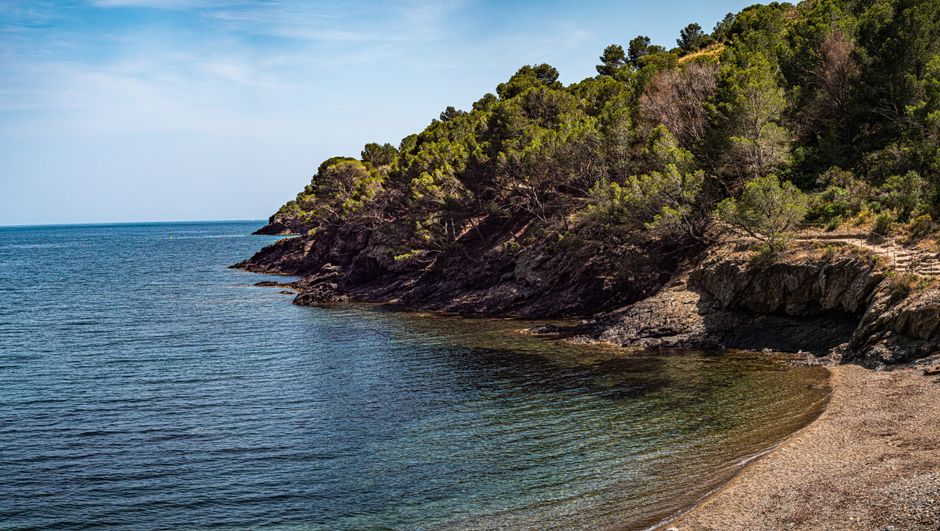
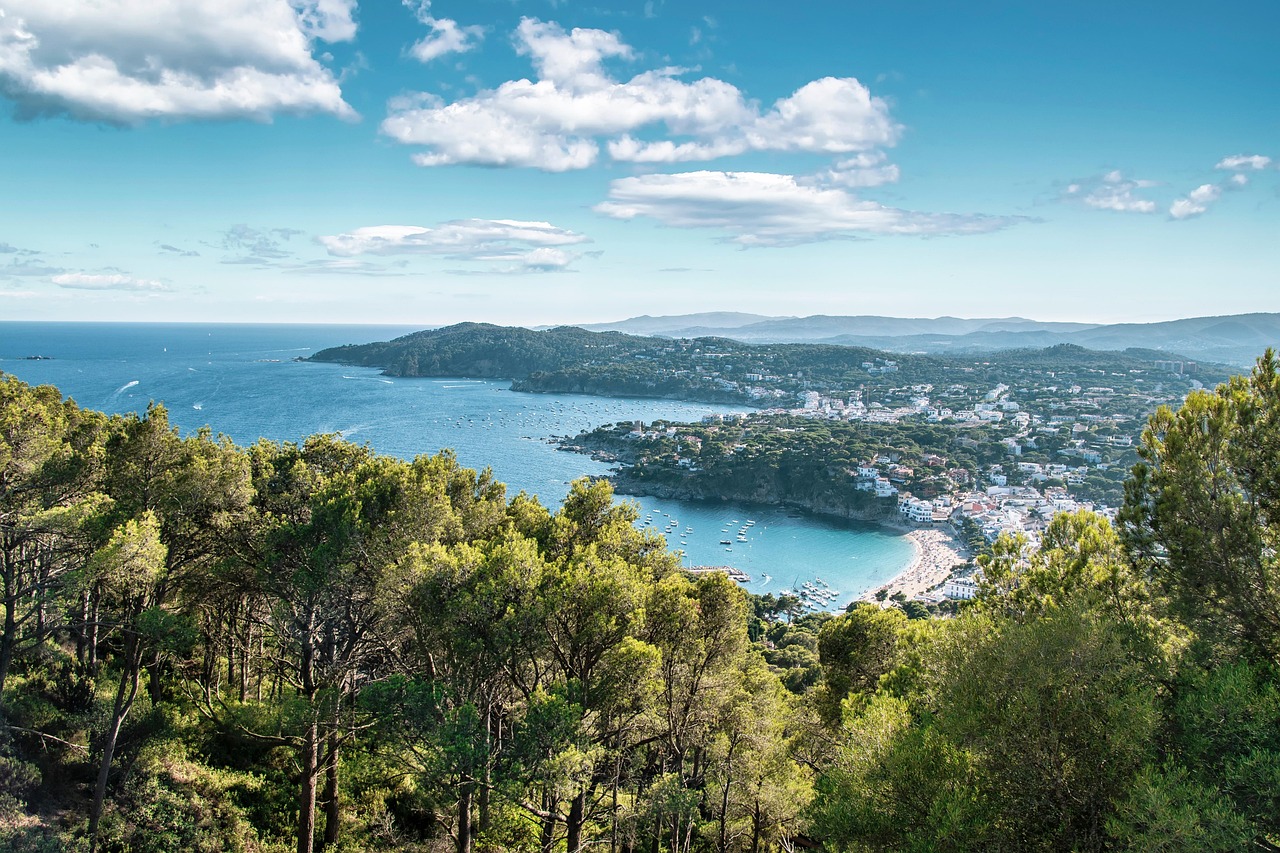
The Costa Brava, the “wild coast”, runs for about 200 km from Blanes, an hour north of Barcelona, to Portbou on the French border. It is Catalonia at its most beautiful: rocky headlands and pine-covered cliffs, small coves of clear green water, whitewashed fishing villages such as Calella de Palafrugell and Cadaqués, and a cliff path, the Camí de Ronda, that links many of them. Inland lie medieval stone villages, the Greek and Roman ruins of Empúries and the strange, wonderful world of Salvador Dalí, with his Theatre-Museum in Figueres, his castle for Gala at Púbol and his house at Portlligat. The south has the big resorts of Lloret and Tossa; the north, around Cap de Creus, is wilder. The best months are June and September; May and October are ideal for walking.
Right now in Costa Brava (Palafrugell)
- Wed 17–25°C 62–76°F 2 mm Showers
- Thu 15–20°C 59–68°F 26 mm Showers
- Fri 12–19°C 54–67°F Mostly clear
- Mon 12 Oct National Day of Spain (Fiesta Nacional de España)
Weather: MET Norway (CC BY 4.0) · Sea temperature: NOAA CoastWatch · Rates: ECB · Holidays: Nager.Date
Top tours in Costa Brava
See all tours for Costa Brava →
From local operators, with prices and reviews; you check availability and book on Viator, our partner. We may earn a commission at no extra cost to you. How we earn money
Costa Brava at a glance
- Best for: coves and coastal walks, fishing villages, Dalí and Roman history, snorkeling and diving, seafood and Empordà wines.
- How long: 3–4 days for one base and the Dalí sights; a week to see both the southern coves and the north around Cadaqués.
- Best time: June and September for swimming; May and October for walking. July and August are crowded, and many beach hotels close from November to Easter.
- Getting there: Girona–Costa Brava airport, Barcelona airport (about 1–2 hours by road), high-speed trains to Girona and Figueres, and coaches from Barcelona.
- Getting around: Sagalés and Moventis coaches link the towns, but a car makes the coves and villages much easier.
- Before you go: entry rules, money, trains and general safety are on our Spain travel guide.
Costa Brava’s towns and who each one suits
The coast falls into three stretches: the busy south (La Selva) from Blanes to Tossa; the middle (Baix Empordà), with Sant Feliu de Guíxols, Palafrugell’s villages and Begur; and the north (Alt Empordà), from the Bay of Roses to Cadaqués and Portbou. Girona, the region’s handsome capital, is about 40 km inland.
Lloret de Mar and Blanes
Lloret is the coast’s biggest resort, with a long sandy beach, big hotels and lively nightlife; it suits young groups and budget package holidays. Blanes, where the Costa Brava begins, is a working town with a fishing port and two fine botanical gardens on the cliffs, Marimurtra and Pinya de Rosa.
Tossa de Mar
Tossa’s Vila Vella, a medieval walled town with towers on a headland above the beach, is one of the most photographed sights on the coast. It is smaller and prettier than Lloret, with coves north and south reached by path or by the winding cliff road to Sant Feliu. Good for couples and families.
Calella de Palafrugell, Llafranc, Tamariu and Begur
The heart of the classic Costa Brava. Calella de Palafrugell is a village of white houses and arches round small beaches with fishing boats; Llafranc and Tamariu are its quieter neighbours, linked by the Camí de Ronda. Begur, a hill town with a ruined castle and colonial “Indianos” houses, looks over a string of beautiful coves: Aiguablava, Fornells, Sa Tuna and Aiguafreda. This is the best base for walkers, snorkelers and anyone who wants the coast at its loveliest, ideally with a car.
L’Escala, Roses and Cadaqués
L’Escala is a fishing town famous for anchovies and for the ruins of Empúries beside its beaches. Roses has a wide sandy bay and a Renaissance citadel and is good for families. Over the mountain, Cadaqués is a whitewashed village on a rocky bay, cut off by a winding road, with a long artistic history; Dalí’s house is in the next bay, Portlligat. Best for art lovers and people who want a slower, more remote feel.
Top things to see on the Costa Brava
Prices and hours below were checked on the official sites in October 2026, unless we say otherwise; check again before you go. The three Dalí museums are run by the Fundació Gala-Salvador Dalí and are best booked online.
Dalí Theatre-Museum, Figueres
Dalí rebuilt the burnt-out theatre of his home town as “the largest surrealist object in the world”, crowned with giant eggs and filled with more than 1,500 works, from paintings and sculptures to holograms, the Mae West room and his crypt. A separate wing shows the jewels he designed. As of October 2026 tickets start at €18.50 (reduced from €15 for students, ages 9–17 and over-65s; free under 9), or €26.50 with a guided visit. From 1 October to 31 December it opens Tuesday to Sunday, 10:30–18:00, with last entry 45 minutes before closing, plus a few holiday Mondays (12 October, 9 November and 7 December). In July and August it opens daily, 9:00–20:00. Large bags and backpacks are not allowed. Allow two hours.
Dalí’s house at Portlligat and Gala’s castle at Púbol
The Casa Salvador Dalí in Portlligat, a bay just north of Cadaqués, is a maze of fishermen’s huts that Dalí joined together as his home and studio, with an olive garden and egg-topped towers. Visits are in small groups and must always be booked in advance. As of October 2026 the house and olive grove cost €15.50 online (€17.50 at the ticket desk; €12 reduced online), and it opens daily 10:30–18:00 from 14 September to 31 October, then Tuesday to Sunday until the end of the year; it is closed on 5 October 2026. The Castell Gala Dalí in Púbol, inland near La Bisbal, is the medieval castle Dalí gave to his wife Gala, with her tomb in the crypt. It costs €10 online or €12 at the door (€7 / €9 reduced), and opens Tuesday to Sunday 10:30–18:00 until 1 November, then 10:30–17:00; it closes from 7 January to late February. Its 2026 temporary exhibition, on Dalí and the photographer Horst, runs until 6 January 2027.
Cadaqués and Cap de Creus
Cadaqués is the most beautiful village on the coast: white houses climbing to the church of Santa Maria, slate beaches, and boats in the bay. Beyond it the Cap de Creus natural park is the easternmost point of the Iberian Peninsula, a lunar landscape of rock sculpted by the tramuntana wind, ending at a lighthouse. On busy days the Generalitat closes the road from Cadaqués to the lighthouse to private vehicles: in October 2026 this applies at weekends, 9:30–19:00, and on 1 November. On those days park free at the Corral d’en Morell car park in Cadaqués and take the shuttle bus (Moventis line 33), or walk. Wear good shoes and keep away from the cliff edges in strong wind.
Empúries
Beside the beaches of L’Escala lie the ruins of Emporion, a Greek trading colony founded around 600 BC, and the Roman town that grew next to it, with mosaics, temples and a forum, all overlooking the sea. The site is run by the Archaeology Museum of Catalonia. As of October 2026 entry costs €7 (€5 reduced; free for under-16s) and it opens daily 10:00–18:00 from 1 October to 14 November, then 10:00–17:00 and closed on Mondays until mid-February. Combine it with a swim on the beach below.
Tossa’s Vila Vella
Walk up from the beach through the gate into the walled old town, along its lanes to the lighthouse at the top, for views along the coast. Entry is free. Come early or at sunset in summer to avoid the crowds.
More to see
- Sant Pere de Rodes: a huge Romanesque monastery high on the mountain above El Port de la Selva, with sweeping views over Cap de Creus.
- Pals and Peratallada: perfectly preserved medieval stone villages in the countryside behind Begur.
- Cap Roig gardens: clifftop botanical gardens near Calella de Palafrugell, home to a big summer music festival.
- Medes Islands: a protected marine reserve off L’Estartit, one of the best diving and snorkeling spots in the western Mediterranean; glass-bottomed boats go round them.
- Sant Feliu de Guíxols: a seaside town with a monastery and a fine promenade, at the start of the corniche road to Tossa.
Other things to do on the Costa Brava
Walk the Camí de Ronda
The old coastguards’ path, now part of the GR 92 long-distance trail, links coves and villages along much of the coast, sometimes as a gentle seafront walk, sometimes as steps and rocky scrambles. The best short stretches are Calella de Palafrugell to Llafranc (about 30 minutes) and on to Tamariu, Begur’s coves from Sa Riera to Aiguablava, and S’Agaró to Platja d’Aro. Take water, swim on the way and come back by bus or taxi. See our hiking guide.
Beaches, snorkeling and diving
Long sandy beaches are at Lloret, Platja d’Aro, Pals and the Bay of Roses; the coves of Begur, Tamariu and Tossa are smaller and clearer. Many coves have limited parking in summer, so arrive early or walk in. The Medes Islands and Cap de Creus offer the best snorkeling and diving, with kayak trips along the cliffs from Begur and L’Escala. See our beaches, snorkeling and diving guides.
Boat trips
From spring to autumn boats run along the coast from Lloret, Tossa and Sant Feliu, glass-bottomed boats circle the Medes Islands from L’Estartit, and from Roses and Cadaqués boats go round Cap de Creus. See our boat trips guide.
Food and wine
Try L’Escala anchovies, Palamós prawns, sea urchins in winter, suquet fish stew and “sea and mountain” dishes. The Empordà wine region behind the coast has wineries to visit around Peralada, Capmany and Espolla. See our wine tasting guide.
Day trips and onward travel
Girona
The provincial capital has one of the best-preserved Jewish quarters in Europe, a walk along its medieval walls, a cathedral with a vast single nave and colourful houses along the river Onyar. In May it fills with flowers for the Temps de Flors festival. It is 30–60 minutes by car from most of the coast, and on the main railway line.
Barcelona and France
Barcelona is about an hour from Blanes and two from Cadaqués by car, and under an hour by high-speed train from Girona or Figueres. In the other direction, Collioure and the rest of the French Catalan coast are just over the border; see our France guide.
Nearby destinations
- Girona34 km
- Barcelona112 km
- Sitges147 km
- Andorra la Vella150 km
- Carcassonne151 km
- Montpellier184 km
- Costa Daurada221 km
- Marseille226 km
Getting there and getting around
By air
Girona–Costa Brava airport (GRO), run by Aena, is about 12 km south of Girona and handles mainly low-cost and seasonal flights. Aena lists Sagalés buses from the airport to Girona and to Barcelona (Estació del Nord), timed about 20–25 minutes after arrivals, and Sagalés and Moventis lines to towns on the coast. Barcelona airport has far more flights and is about 1–2 hours from most of the Costa Brava by road; Sagalés also runs a direct bus between the two airports.
By train
High-speed trains from Barcelona reach Girona in under 40 minutes and Figueres-Vilafant in under an hour, and continue to France. Slower regional trains run from Barcelona through Girona and Figueres to Portbou, and the coastal line from Barcelona ends at Blanes. From Girona and Figueres, buses continue to the coast. Times are approximate and come from secondary sources; check Renfe for your date.
Buses and driving
Sagalés and Moventis coaches link Barcelona and Girona with Lloret, Tossa, Palafrugell, Begur, L’Escala, Roses and Cadaqués, but services between small coastal villages are slow, and fewer outside summer. A car gives you freedom for the coves and inland villages, but parking in Cadaqués, Calella and the coves is tight and mostly paid in summer. Use the car parks at the edge of villages and walk in.
When to go and how long to stay
The Costa Brava has a Mediterranean climate with warm, sunny summers and mild winters, and a strong north wind, the tramuntana, in the north around Cadaqués. The table uses AEMET’s 1991–2020 climate normals for the Girona–Costa Brava airport weather station: average daily highs and lows, and days with at least 1 mm of rain. The station is inland at 143 m, so nights on the coast are noticeably milder than the lows shown, especially in winter.
| Season | Average high / low | Rainy days per month | What it’s like | Good for |
|---|---|---|---|---|
| Winter (Dec–Feb) | 14–15 °C / 1–2 °C inland | 4–5 | Clear, cool and sometimes very windy; resorts closed, villages quiet | Walking, Dalí museums, Girona |
| Spring (Mar–May) | 18–24 °C / 4–10 °C inland | 5–7 | Green and fresh, with spring showers | Camí de Ronda, villages, Temps de Flors in Girona |
| Summer (Jun–Aug) | 28–31 °C / 14–17 °C inland | 4–5 | Hot and sunny with occasional thunderstorms; very busy | Swimming, boat trips, music festivals |
| Autumn (Sep–Nov) | 27 °C falling to 18 °C / 14 °C falling to 5 °C inland | 5–7 | Warm sea in September; October is the wettest month | Swimming in September, walking and wine in October |
The sea is warmest from July to September. These are long-term averages; recent summers have often been hotter.
Events worth planning around
- May: Temps de Flors in Girona.
- July and August: the Cap Roig festival near Calella de Palafrugell and the Castell de Peralada festival, with big-name concerts in garden settings.
- Summer evenings: havaneres, sea shanties sung in Calella de Palafrugell and other ports.
How long to stay: 3, 5 and 7 days
3 days: base yourself around Palafrugell or Begur. Day 1, the Camí de Ronda from Calella to Llafranc and a swim. Day 2, the Dalí Theatre-Museum in Figueres and Empúries on the way back. Day 3, Pals and Peratallada in the morning, Begur’s coves in the afternoon.
5 days: add two nights in Cadaqués for Portlligat, Cap de Creus and Sant Pere de Rodes. 7 days: add Tossa’s Vila Vella, a day in Girona, Púbol, and a boat or snorkel trip to the Medes Islands.
Where to stay on the Costa Brava and the tourist tax
- Calella de Palafrugell, Llafranc or Begur: the most beautiful base for coves and walking; small hotels, book early.
- Cadaqués: remote and atmospheric, for Dalí and Cap de Creus.
- Tossa de Mar: a pretty town with a beach and easy buses to Barcelona.
- Lloret or Platja d’Aro: big hotels, long beaches, nightlife and lower prices.
- Inland Empordà: farmhouse hotels near Pals, Peratallada or Púbol, for a car-based stay.
Catalonia charges a tourist tax on every night in tourist accommodation, collected by the hotel or rental. Since 1 April 2026, outside Barcelona city, the Agència Tributària de Catalunya lists these rates per person per night: €4.50 in 5-star hotels and luxury campsites, €1.80 in 4-star hotels, €1.75 in tourist flats, €0.90 in other hotels and campsites, and €0.80 in youth hostels. It applies from age 17 and for up to 7 nights in the same place, and the rates rise on 1 April 2027. Towns may add a local surcharge of up to €4 from 1 October 2026, but as of October 2026 none of the Costa Brava towns appears on the agency’s list of towns that have approved one; check with your accommodation.
Practical tips for the Costa Brava
- Book Dalí’s house: Portlligat visits are always by reservation and sell out in summer.
- Park once, walk: village and cove car parks fill early in summer; use the Camí de Ronda between coves.
- Check the tramuntana: when the north wind blows, the north coast is rough; head south to sheltered coves.
- Out of season: from November to Easter many beach hotels and restaurants close, but villages and museums stay open.
- Language: Catalan is spoken alongside Spanish; signs are often in Catalan first.
- Emergencies: call 112.
What to pack for the Costa Brava
Pack trainers or walking sandals with a good grip for the Camí de Ronda, which has steps and rocky sections, and water shoes for the pebbly coves. Bring a swimsuit, a quick-dry towel and a snorkel mask: the water in the coves is very clear. In summer add a sun hat, sunglasses and high-factor sunscreen. A windproof jacket is useful all year in the north, where the tramuntana can blow hard, and a warm layer for evenings from October to May. Leave big backpacks in the car or hotel for the Dalí museums, which do not admit them.
Costa Brava travel FAQ
Where is the Costa Brava?
In the province of Girona in north-east Catalonia, from Blanes, about 60 km north of Barcelona, to Portbou on the French border.
What is the prettiest town on the Costa Brava?
Cadaqués and Calella de Palafrugell are the usual favourites, with Tossa de Mar’s walled old town close behind. Inland, Pals and Peratallada are the loveliest villages.
Can I visit the Costa Brava as a day trip from Barcelona?
Yes, to Tossa, Lloret or Figueres by coach or train, but the best of the coast needs at least two or three nights and ideally a car.
How much is the Dalí Museum in Figueres?
As of October 2026 tickets start at €18.50, €15 reduced, and are free for under-9s. From October to December it opens Tuesday to Sunday, 10:30–18:00.
Do I need to book Dalí’s house in Portlligat?
Yes, always: visits are in small groups and must be reserved in advance. As of October 2026 the house and olive grove cost €15.50 online.
Can I drive to the Cap de Creus lighthouse?
Not on regulated days. In October 2026 the road from Cadaqués is closed to private vehicles at weekends, 9:30–19:00; park at Corral d’en Morell in Cadaqués and take the shuttle bus. On other days you can drive, but parking at the cape is limited.
Is there a tourist tax on the Costa Brava?
Yes, the Catalan tax: as of October 2026, from €0.80 in youth hostels to €4.50 in 5-star hotels per person per night, from age 17 and for up to 7 nights. No Costa Brava town had added a local surcharge as of October 2026.
What is the best time to visit the Costa Brava?
June and September for swimming without the August crowds; May and October for walking the Camí de Ronda.
Which airport is closest to the Costa Brava?
Girona–Costa Brava, about 30–60 minutes from most of the coast, with buses to Girona, Barcelona and coastal towns. Barcelona airport has many more flights and is 1–2 hours away by road.
Sources and last review
Researched and last reviewed on 4 October 2026. Dalí museums: the Fundació Gala-Salvador Dalí; Empúries: the Archaeology Museum of Catalonia; Cap de Creus access: the Generalitat’s natural parks service; tourist tax and local surcharges: the Agència Tributària de Catalunya; airport buses: Aena; climate: AEMET 1991–2020 normals for Girona–Costa Brava airport, as published by the WMO. Train journey times and coach routes between coastal towns come from secondary sources and are flagged for checking. Prices, hours and timetables change, so check the official sites before you go. For entry rules, money and general safety, see our Spain travel guide.
Plan your trip
Partner links: TravelerCenter may earn a commission if you book, at no extra cost to you.
🇪🇸 Useful Spanish phrases for Costa Brava
All 38 Spanish phrases: restaurant, hotel, emergencies, romance (printable) →