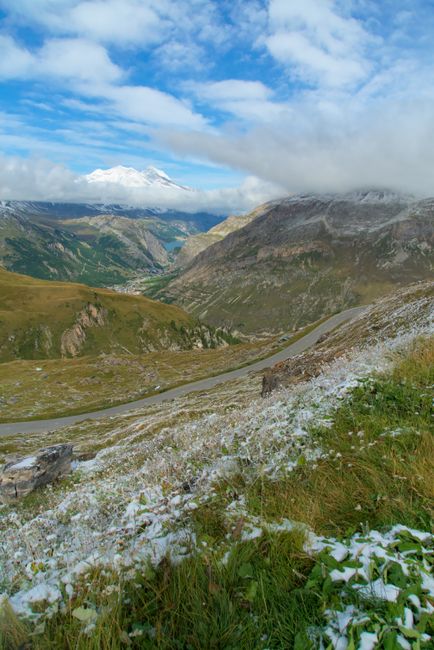
Val d’Isère is a high-altitude ski village at the head of the Tarentaise valley in Savoie, close to the Italian border, linked with neighbouring Tignes to form one of the biggest and most snow-sure ski areas in the Alps. You come for a long season from late November to early May, legendary runs such as the Face de Bellevarde, serious off-piste and a real village with a stone church and lively après-ski. In summer it is a quieter base for hiking in the Vanoise National Park, free lifts and the climb to the Col de l’Iseran, the highest paved pass in the Alps. Give it a week in winter or three or four days in summer.
Right now in Val d'Isère (Val-d'Isère)
- Wed6–9°C43–48°F5 mm rain
- Thu3–7°C38–44°F10 mm rain
- Fri-3–5°C27–41°FClear
Top tours in Val d'Isère
See all tours for Val d'Isère →
From local operators, with prices and reviews; you check availability and book on Viator, our partner. We may earn a commission at no extra cost to you. How we earn money
Val d’Isère at a glance
- Best for: keen intermediate and expert skiers, early- and late-season snow, off-piste with guides, après-ski, and summer hiking, cycling and mountain biking.
- How long: a week for a ski holiday; 3–4 days in summer.
- Best time: January to March for powder and cold snow; April for sunny spring skiing; July and August for free summer lifts.
- Season dates: winter lifts from 28 November 2026 to 2 May 2027; summer lifts ran from 4 July to 30 August in 2026.
- Getting in: train to Bourg-Saint-Maurice, then about 40 minutes by bus; Geneva and Lyon airports are about 3 hours by road.
- Getting around: on foot and by free shuttle buses, which run winter and summer.
- Before you go: entry rules, money and general safety are in our France travel guide; for Mont Blanc, see Chamonix.
Val d’Isère’s neighbourhoods and who each one suits
Val d’Isère stretches for a few kilometres along the valley floor at about 1,850 m, with the slopes of Bellevarde on one side and Solaise on the other. Everything is within walking distance or a short free bus ride, so where you stay is mostly about atmosphere and which lifts you want on your doorstep.
The village centre
The heart of the resort, around the old church and the snow front at the foot of the Face de Bellevarde, with the Solaise gondola, most bars and restaurants, shops and the Aquasportif sports and pool centre. Best for: first visits, nightlife and travellers without a car.
La Daille
At the northern entrance, with large apartment buildings, runs coming down from Bellevarde, the underground funicular up the mountain and the new bus station where coaches from the airports and Bourg-Saint-Maurice now arrive. Best for: good-value apartments and quick access to the Tignes side.
Le Laisinant and Le Fornet
Quiet hamlets up the valley towards the Col de l’Iseran. Le Fornet keeps old stone farmhouses and its own cable car, and the new Vallon de l’Iseran gondola nearby rises to the Pissaillas glacier. Best for: a peaceful chalet stay and early access to the high Pissaillas slopes.
Top things to see and do in Val d’Isère
Prices and dates below come from the lift company and the Val d’Isère tourist office, checked in October 2026. They change, so check before you go.
Skiing Tignes–Val d’Isère
The linked Tignes–Val d’Isère ski area has about 300 km of marked runs (161 pistes: 21 green, 65 blue, 41 red and 32 black) served by 71 lifts, from 1,550 m to over 3,400 m. Its altitude gives some of the most reliable snow in the Alps, from late November or early December into early May. Val d’Isère’s own area has about 150 km, spread over three sectors: Bellevarde, with the steep Face de Bellevarde, built for the 1992 Olympic downhill; Solaise, with gentle “easy skiing” zones on the summit plateau for beginners and families; and Le Fornet and the Pissaillas glacier, high and open. Off-piste is world-famous but serious: hire a guide and carry avalanche gear.
Lift passes 2026/27. In the main winter season (12 December 2026 to 23 April 2027), a Tignes–Val d’Isère pass costs €78 for one day for an adult (19–64) and €63 at the reduced rate for ages 8–18 and 65–74; six days cost €468 and €378, and that price buys a seven-day pass (“6 = 7 days”). In the early and late season (28 November to 11 December 2026 and 24 April to 2 May 2027), a day costs €67 and €54. A Val d’Isère-only day pass costs €70 (reduced €57) in the main season and €60 (€50) early and late. Children under 8 and skiers aged 75 and over ski free with proof of age, and the reusable pass card is free unless you lose it (€10). A family offer takes €330 off four or more passes of 6 = 7 days or longer bought together for at least two adults and two children aged 8–18. Buy online at valdisere.ski or at the resort’s sales points.
The Pissaillas glacier and the Col de l’Iseran
Above Le Fornet, the Pissaillas glacier lies just below the Col de l’Iseran, on the edge of the Vanoise. The new-generation Vallon de l’Iseran gondola now carries skiers up from the Fornet area, and the glacier’s high, open slopes are often among the first to open in late November. In summer, when the road is clear, the Col de l’Iseran at 2,770 m is the highest paved mountain pass in the Alps and a legendary cycling climb; see the road section below.
The Critérium de la Première Neige
Every December Val d’Isère hosts a men’s Alpine Skiing World Cup race, the Critérium de la Première Neige (“first snow”), one of the classic early-season events of the circuit. In 2026 it is a men’s downhill on 12 and 13 December, according to the tourist office. Watching from the finish area at the foot of the Face de Bellevarde is free; parts of the slope are closed to the public during training and racing, so check the ski area’s piste information.
The old village and winter without skis
Behind the modern resort, the old centre keeps its stone church and bell tower and a handful of traditional houses. Non-skiers can buy a pedestrian lift pass to reach viewpoints, walking trails and the cross-country loops around Lac de l’Ouillette: as of October 2026, a single ascent costs €18 (reduced €15), a Val d’Isère pedestrian day pass €25 (€20) and a six-day Tignes–Val d’Isère pedestrian pass €90 (€74). The Village Perdu, a free outdoor play area at about 2,000 m in the forest, is a favourite with families, and the Aquasportif centre has pools, a spa and climbing walls.
Summer in Val d’Isère
In summer 2026, Val d’Isère’s lifts were free for pedestrians from 4 July to 30 August: the Solaise gondola and the Olympique cable car ran from 9:45 to 16:45, and the Borsat chairlift linked to Tignes. Mountain bikers pay for lift access with the Val Pass. Expect similar dates for 2027; check valdisere.com in spring.
- Hiking: trails for every level, from family walks around Lac de l’Ouillette to the high valleys of the Vanoise National Park, such as the Vallon du Manchet. See our hiking guide.
- Road cycling: the Col de l’Iseran, with a steady climb of at most 7% from Val d’Isère; e-bikes can be hired in the village. The Iserane cycle race is on 27 June 2027. See our cycling guide.
- Mountain biking: the Tignes–Val d’Isère bike park, with trails for all levels.
- Water sports: rafting and canyoning on the Isère and its tributaries with local guides.
- Events: the High Trail Vanoise running races (10–11 July 2027), the Vieux Val traditional festival (24–25 July 2027) and the Avaline Savoyard fair (31 July–1 August 2027).
The Col de l’Iseran road: when it opens and closes
The road over the Col de l’Iseran (D902), linking Val d’Isère with Bonneval-sur-Arc and the Maurienne valley, has been open since 1937 and is closed every winter. Snow clearing begins in May and takes several weeks on both sides; drifts can be 8–10 metres deep. The Savoie department aims to reopen it on the second Friday of June, depending on snow; in 2026 it opened on 12 June. It closes again in autumn, between October and early November, as soon as heavy snow falls: in 2025 it closed on 20 October. The road can also close temporarily in summer storms or early snow, so check savoie-route.fr before setting off. In winter, Val d’Isère is a dead end: the only road in is from Bourg-Saint-Maurice.
Day trips from Val d’Isère
Tignes
Reached on skis or by road in about 20 minutes, Tignes has its lake, the Grande Motte glacier and a busy events calendar, including the opening of its season on 21 November 2026 and the Para Alpine Skiing World Championships from 7 to 19 March 2027.
Bonneval-sur-Arc and the Maurienne
In summer, drive or cycle over the Col de l’Iseran to Bonneval-sur-Arc, one of the best-preserved stone villages in the Alps, and back. The round trip makes a spectacular half day.
Annecy and Chamonix
Both are long drives, best as stops on the way in or out: Annecy, with its lake and old town, is about 2½ hours away, and Chamonix and Mont Blanc around 2½–3 hours, depending on the season and route.
Nearby destinations
- Courchevel27 km
- Chamonix53 km
- Turin68 km
- Annecy83 km
- Zermatt87 km
- Geneva105 km
- Montreux110 km
- Lake Maggiore153 km
Getting there and getting around
By train to Bourg-Saint-Maurice
The nearest station is Bourg-Saint-Maurice, about 30 km and 40 minutes below the resort, served by TGV INOUI trains and regional trains; book on SNCF Connect. From London, the Eurostar Snow train runs to Bourg-Saint-Maurice on Saturdays from 19 December 2026 to 20 February 2027, via Lille Europe, in just under 8 hours, with returns from 27 December 2026 to 28 February 2027. From the station, Altibus coaches run to Val d’Isère throughout the day in about 40 minutes; book ahead in winter.
From the airports
The tourist office lists four airports: Chambéry (about 2 hours by car), Grenoble (2½ hours), and Geneva and Lyon (about 3 hours each). In winter, Altibus, Ben’s Bus and Alpine Fleet run coaches from Geneva and Lyon airports, and taxis and private transfers can be booked. Coaches now arrive at the bus station in La Daille, which has an Altibus ticket machine and luggage lockers (€8 or €12 a day).
Driving and winter equipment
Val d’Isère is 86 km from Albertville and 135 km from Chambéry. From 1 November to 31 March, every vehicle in Savoie must have four winter tyres marked “3PMSF” or carry snow chains or socks for the drive wheels, under the mountain law (Loi Montagne); carry chains anyway for the last climb, which can be snowy. Winter Saturdays bring long queues up the valley, so the tourist office suggests arriving on another day, for example a Sunday-to-Sunday stay. In the village, use the car parks and leave the car: free shuttles run at regular intervals from La Daille to Le Fornet, in winter and summer.
When to go and how long to stay
Val d’Isère has a long, cold, snowy winter and a short, fresh summer with afternoon storms. Météo-France has a station in the resort itself, at 1,850 m, and the table uses its normals (temperatures 1992–2020). Up on the slopes, which rise to over 3,400 m, it is much colder, especially in the wind; daytime highs stay below freezing for weeks in midwinter.
| Season | Average high / low | Rainy or snowy days per month | What it’s like | Good for |
|---|---|---|---|---|
| Winter (Dec–Feb) | 0 °C / −9 °C | 8–10 | Very cold, snowy, frost every night | Skiing, powder, Christmas and New Year |
| Spring (Mar–May) | 3–12 °C / −6 to 2 °C | 9–12 | Long sunny spring skiing until early May, then snowmelt | Spring skiing, ski touring |
| Summer (Jun–Aug) | 16–19 °C / 5–7 °C | 11–12 | Fresh days, cold nights, frequent storms | Hiking, cycling the Iseran, free lifts |
| Autumn (Sep–Nov) | 14 °C falling to 5 °C / 4 °C falling to −4 °C | 9 | Clear, quiet September; resort mostly closed in October; first snow | Walking, cycling until the pass closes |
The station records about 910 mm of precipitation a year and more than 180 nights a year below freezing. For skiing, January and March are usually quieter than the Christmas, February and Easter holidays; late November and April bring cheaper “early and late season” passes.
A ski week, and 3 days in summer
Ski week: warm up on Solaise, then spend a day on Bellevarde and, if you are confident, the Face. Cross to Tignes for a day or two, ride the Vallon de l’Iseran gondola to the Pissaillas glacier, book a guide for a morning off-piste, and keep a final day for your favourite runs and a long lunch. Summer, 3 days: day 1, free lifts to Solaise and Bellevarde and a high walk; day 2, cycle or drive over the Col de l’Iseran to Bonneval-sur-Arc; day 3, a hike into the Vanoise, such as the Vallon du Manchet.
Where to stay in Val d’Isère
- Village centre: hotels, catered chalets and apartments near the snow front; best for nightlife and car-free stays.
- La Daille: large apartment residences, close to the funicular and the bus station; good value.
- Le Laisinant and Le Fornet: quiet chalets in hamlets up the valley, linked by free shuttle.
- Bourg-Saint-Maurice: cheaper hotels down in the valley, by the station; best for summer or a car-based trip.
Many hotels and chalets close between seasons, from early May to late June and from September to late November, and winter stays often run Saturday to Saturday or Sunday to Sunday. The Commune of Val d’Isère adds a nightly tourist tax (taxe de séjour) per adult; under-18s are exempt. Its 2026 rates, including the department’s surcharge, are €1.87 per adult per night in a 3-star hotel or rental, €2.86 in a 4-star, €3.96 in a 5-star and €5.39 in a palace; unclassified rentals pay 5.5% of the nightly price per person, up to a cap.
Practical tips for Val d’Isère
- Book early: Christmas, New Year and February sell out; transfers, ski hire and lessons are best booked with your stay.
- Insurance: check that your policy covers skiing and mountain rescue, or add the Carré Neige option with your pass (€3.50 a day for 1–7 days as of October 2026).
- Off-piste: the terrain is high, glaciated and avalanche-prone; go with a mountain guide, and carry a transceiver, shovel and probe.
- Altitude: the village is at 1,850 m; take the first day gently, drink water and use strong sunscreen.
- Emergencies: call 112; on the slopes, alert the ski patrol or a lift operator.
What to pack for Val d’Isère
In winter: a waterproof ski jacket and trousers, thermal base layers and a warm mid-layer, insulated gloves, a helmet, goggles for flat light and sunglasses, a neck warmer, high-factor sunscreen and lip balm, and snow boots with grip. Drivers need chains or socks. In summer: hiking boots, a waterproof jacket, a warm fleece and hat for the cols, sunscreen and a refillable bottle; cyclists climbing the Iseran need a windproof layer for the descent, even in August.
Val d’Isère travel FAQ
When does the 2026/27 ski season start in Val d’Isère?
The lifts open on 28 November 2026, with the First Tracks opening weekend on 28 and 29 November, and close on 2 May 2027. Tignes opens a week earlier, on 21 November 2026.
How much is a Tignes–Val d’Isère lift pass?
As of October 2026, in the main season (12 December to 23 April) one day costs €78 for an adult and €63 for ages 8–18 and 65–74, and a 6 = 7-day pass €468 and €378. Early and late season, a day costs €67 and €54. Under-8s and over-75s ski free.
Is there a cheaper Val d’Isère-only pass?
Yes. As of October 2026, a Val d’Isère-only day pass costs €70 for an adult (€57 reduced) in the main season and €60 (€50) in the early and late season. It covers about 150 km of runs, enough for many intermediates.
When is the Val d’Isère World Cup race in 2026?
The Critérium de la Première Neige, a men’s World Cup downhill, is on 12 and 13 December 2026, according to the Val d’Isère tourist office. Watching from the finish area is free.
When is the Col de l’Iseran open?
Only in summer. It usually reopens in mid-June after weeks of snow clearing (on 12 June in 2026) and closes between October and early November with the first heavy snow. Check savoie-route.fr for the day’s status.
How do I get from Bourg-Saint-Maurice to Val d’Isère?
By Altibus coach, which runs throughout the day and takes about 40 minutes, or by taxi. The road is about 30 km long.
Can I take a train from London to Val d’Isère?
Yes, to Bourg-Saint-Maurice. In 2026/27 the Eurostar Snow train runs on Saturdays from 19 December 2026 to 20 February 2027 via Lille Europe, taking just under 8 hours, with returns until 28 February 2027. Then take the bus up.
Are the lifts free in summer?
For pedestrians, yes: in summer 2026, the Solaise gondola, the Olympique cable car and the Borsat chairlift were free from 4 July to 30 August. Mountain bikers pay, with the Val Pass.
Do I need winter tyres or chains for Val d’Isère?
Yes, from 1 November to 31 March: four 3PMSF winter tyres or chains or snow socks carried in the car are compulsory throughout Savoie. Carry chains even with winter tyres.
How much is the tourist tax in Val d’Isère?
In 2026, €1.87 per adult per night in a 3-star hotel or rental, €2.86 in a 4-star, €3.96 in a 5-star and €5.39 in a palace; unclassified rentals pay 5.5% of the price per person, up to a cap. Under-18s are exempt.
Is Val d’Isère good for beginners?
It is best for intermediates and experts, but beginners are well looked after: free lifts on the snow front, easy-skiing zones on Solaise and Bellevarde, and many ski schools. Under-8s ski free.
Plan your trip
Partner links: TravelerCenter may earn a commission if you book, at no extra cost to you.
🇫🇷 Useful French phrases for Val d'Isère
All 38 French phrases: restaurant, hotel, emergencies, romance (printable) →
Sources · last reviewed 4 October 2026
Researched and last reviewed on 4 October 2026. Season dates, lift and pedestrian pass prices, ski area figures, events, summer lifts, the Col de l’Iseran and access: the Val d’Isère tourist office (valdisere.com) and the lift company Val d’Isère Téléphériques; ski train: Eurostar; winter equipment rules: the French government and the Savoie prefecture; pass opening and closing dates: the Savoie department’s road information as reported by Savoie tourism and the press; tourist tax: the French tax authority’s open data; climate: Météo-France normals for Val d’Isère. Prices, timetables and road conditions change, so check the official sites before you go. For entry rules, money and general safety, see our France travel guide.
Data: Weather: MET Norway (CC BY 4.0) · Rates: ECB · Costs: World Bank ICP and price levels · Wikidata (CC0)