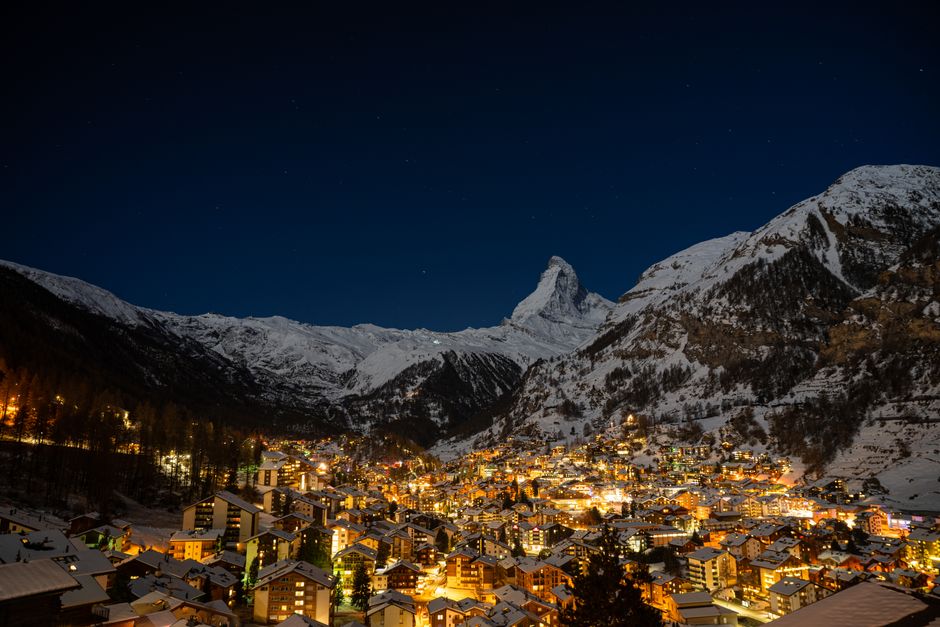
Zermatt is the village at the foot of the Matterhorn, the most famous mountain in the world. At the head of a long valley in the Valais, it is a car-free resort of old larch-wood barns and chalets, electric taxis and luxury hotels, with 38 peaks over 4,000 m around it. From the village, Europe’s highest cable car climbs to the Matterhorn Glacier Paradise at 3,883 m, where you can ski all year and cross into Italy over the glacier; a cogwheel railway from 1898 runs up to the Gornergrat with its wall of glaciers; and in summer, trails lead to lakes that mirror the Matterhorn. It is expensive and busy in high season, but few places in the Alps are as spectacular. Give it two or three days, a week for hiking or skiing.
Right now in Zermatt
- Wed 2–7°C 36–45°F 8 mm Rain
- Thu 4–7°C 38–44°F 7 mm Heavy rain
- Fri -6–5°C 20–41°F Mostly clear
Weather: MET Norway (CC BY 4.0) · Rates: ECB
Top tours in Zermatt
See all tours for Zermatt →
From local operators, with prices and reviews; you check availability and book on Viator, our partner. We may earn a commission at no extra cost to you. How we earn money
Zermatt at a glance
- Best for: the Matterhorn, high-altitude viewpoints, hiking, year-round skiing, mountaineering and a car-free Alpine village.
- How long: 2 days for the Gornergrat and the Matterhorn Glacier Paradise; 4–7 days to hike or ski.
- Best time: July to September for hiking; December to April for skiing; late September and early October for golden larches and quiet trails.
- Getting in: by train via Visp; about 3 hours 30 minutes from Zurich Airport. Drivers park in Täsch and take the shuttle train.
- Getting around: on foot, by electric bus and e-taxi in the village; the Swiss Travel Pass covers the trains to Zermatt and gives 50% off the Gornergrat.
- Before you go: rail passes, money, entry rules and mountain safety are in our Switzerland travel guide.
Zermatt is car-free: arriving by train or via Täsch
Private cars are not allowed in Zermatt. The road up the Matter valley ends for visitors at Täsch, 5 km before the village, and driving on without a permit brings heavy fines. At the Matterhorn Terminal Täsch, a covered car park with about 2,100 spaces (some with electric chargers), you leave the car and take the Zermatt Shuttle train, which runs every 20 minutes from early morning until about 22:00 (then hourly until after midnight) and takes about 12 minutes. As of October 2026, a return cost CHF 17.20 for adults, half price with the Half Fare Card, and free with the Swiss Travel Pass. Parking at the terminal costs roughly CHF 15–17 a day according to the railway’s tariff (check matterhorngotthardbahn.ch). Licensed taxis also run from Täsch.
In the village, you get around on foot, by small electric buses (free on two routes), by electric taxi or horse-drawn carriage. Hotels collect guests at the station with electric carts.
Zermatt, area by area
The village stretches about 2 km along the Matter Vispa river. The main street, the Bahnhofstrasse, runs from the station south past shops and hotels to the church square and the old quarter.
Village centre and Hinterdorf
Around the church and the Hinterdorfstrasse are dark larch-wood barns (stadel) on stone stilts, built to keep out mice, and the mountaineers’ cemetery, where climbers who died on the Matterhorn are buried. From the Kirchbrücke bridge you get the classic view of the Matterhorn over the river. Best for: atmosphere and après-ski.
Winkelmatten and the south end
A quieter hamlet near the Matterhorn Express valley station, with chalets and views straight up the valley. Best for: skiers and families.
The mountain hamlets
Above the village, hamlets such as Findeln, Zum See and Furi have old chalets, mountain restaurants famous for their food, and hotels reached only on foot or by lift. Best for: long lunches and peaceful nights.
Top things to see in Zermatt
Prices below are the 2026/27 seasonal fares from the official price lists, checked in October 2026. They change with the season, so check before you go, and look at the summit webcams in the morning.
The Matterhorn
The pyramid-shaped Matterhorn, 4,478 m, stands on the Swiss-Italian border. It was first climbed on 14 July 1865 by Edward Whymper’s party via the Hörnli ridge; four of the seven men died on the descent, and the tragedy made the mountain famous. Today experienced climbers still need a mountain guide and excellent fitness; for everyone else, the Matterhorn is a mountain to admire, at its most magical in the pink light of sunrise.
Gornergrat
The Gornergrat Bahn, opened in 1898 as Switzerland’s first electric rack railway, climbs 9.3 km from Zermatt station to the Gornergrat at 3,089 m in about 33 minutes. At the top, a viewing platform faces the Matterhorn, the Monte Rosa massif (with Switzerland’s highest peak, the Dufourspitze) and the Gorner Glacier, with 28 peaks over 4,000 m in sight; the Kulmhotel Gornergrat has an observatory and rooms. Get off at Rotenboden on the way down and walk 15 minutes to the Riffelsee, a small lake with a perfect Matterhorn reflection on calm mornings, then on to Riffelberg.
Prices. As of October 2026, the adult return from Zermatt cost CHF 132 from May to October 2026 and CHF 102 from November 2026 to April 2027 (one way CHF 66 / 51). The Half Fare Card, the GA and the Swiss Travel Pass give 50% off, and children with a Swiss Junior Card travel free. Sit on the right going up for the Matterhorn.
Matterhorn Glacier Paradise
A chain of gondolas and cable cars climbs from the south end of the village via Furi and Trockener Steg to the Klein Matterhorn, where a lift and a tunnel lead to a viewing platform at 3,883 m, the highest in Europe reachable by cable car. On a clear day you see from Mont Blanc to the Gran Paradiso and the Italian plain. Inside the glacier, the Glacier Palace has ice sculptures and a crevasse slide; the ticket includes it and a cinema lounge. Ski and snowboard all year on the Theodul glacier: in 2026 summer glacier skiing ran from 4 May to 31 October.
Prices. As of October 2026, a return from Zermatt cost CHF 120 in May–June and September–October 2026, CHF 132 in July–August 2026 and CHF 104 from November 2026 to April 2027. The Peak2Peak ticket combines the Matterhorn Glacier Paradise and the Gornergrat (CHF 212 in July–August 2026, CHF 165 in winter 2026/27). It is much colder at the top than in the village, often below freezing even in August, and the altitude affects some people; move slowly.
Matterhorn Alpine Crossing to Cervinia
Since July 2023, the Matterhorn Glacier Ride II, a three-rope cableway with no support towers, links the Matterhorn Glacier Paradise with Testa Grigia on the Italian side, making it possible to cross the Alps from Zermatt to Breuil-Cervinia by cable car in about 1 hour 30 minutes. As of October 2026, the return cost CHF 264 in July and August 2026, CHF 240 in the shoulder seasons and CHF 208 in winter; a single cost from CHF 127.50. Single tickets are valid for two days and returns for ten, so you can stay a night in Italy. You cross a Schengen internal border, so carry a passport or ID card. The crossing depends on weather and season, so check the operating days.
Sunnegga and Rothorn
An underground funicular, the Sunnegga Express, climbs in a few minutes from the village to Sunnegga (2,288 m), a sunny terrace with the Leisee lake, a playground and a beautiful Matterhorn view; gondolas and a cable car continue to Blauherd and the Rothorn (3,103 m). It is the start of the Five Lakes Walk and the best area for families.
Matterhorn Museum and the Gorner Gorge
The Matterhorn Museum – Zermatlantis, built underground in the village centre, tells the story of the first ascent (including the broken rope), the village and early tourism. As of October 2026, entry cost CHF 12 for adults and was free with the Swiss Travel Pass; it opens in the afternoons, closes from 1 to 19 November and reopens daily from 18 December. A short walk south, the Gorner Gorge has wooden walkways over a roaring glacial stream (adults CHF 5.50, open in summer until 31 October 2026).
Museums
- Matterhorn Museum
Other sights
- Gornergrat railway
Viewpoints
- Gornergrat
Nature
- Gorner Glacier
Peaks and mountains
- Dufourspitze
- Klein Matterhorn
- Matterhorn
Hiking in Zermatt
Zermatt has about 400 km of marked trails. Most high routes are free of snow from late June or July to early October. A few classics:
- Five Lakes Walk (5-Seenweg, route 11): from Blauherd (2,571 m) to Sunnegga past the Stellisee, Grindjisee, Grünsee, Moosjisee and Leisee, about 11 km and 3 hours 30 minutes, mostly downhill. The Matterhorn reflects in three of the lakes; you can swim in the Leisee and Grünsee. Suitable for children from about 6.
- Riffelsee and the Gornergrat: ride up and walk down from Rotenboden past the Riffelsee to Riffelberg, about an hour.
- Hörnli Hut: from the Schwarzsee lift station, a steep mountain trail (T4, with ropes, chains and steel stairs) climbs about 700 m in about 2 hours to the hut at 3,260 m, the base for climbs of the Matterhorn. For sure-footed hikers only, and not with snow. The hut’s 2027 season runs from 25 June to 18 September.
- Gourmet hikes: walk between the mountain restaurants of Findeln, Zum See and Furi, with Matterhorn views and long lunches.
For several days of lifts, the Zermatt Peak Pass covers the main excursion lifts (Matterhorn Glacier Paradise, Rothorn, Gornergrat and Furi–Riffelberg) and the Glacier Palace; as of October 2026, it started at CHF 212 for one day in summer 2026. See our hiking guide.
Skiing in Zermatt
Zermatt and Breuil-Cervinia in Italy share one of the highest ski areas in the Alps, with long, reliable runs and the option to ski into Italy for lunch. The 2026/27 winter season runs from 1 November 2026 to 3 May 2027, with the Sunnegga–Rothorn and Gornergrat areas open from 28 November 2026; on the glacier you can ski all year. Ski passes use dynamic pricing: as of October 2026, a one-day Zermatt pass started from about CHF 89 and an international Zermatt–Cervinia pass from CHF 104, with the lowest prices early and late in the season. New for 2026/27 is a six-seat bubble chairlift at Patrullarve, in the Sunnegga–Blauherd area. Zermatt suits intermediates and experts best; beginners have gentle slopes at Sunnegga and on the glacier.
More things to do
Eat on the mountain. Zermatt has some of the best mountain restaurants in the Alps, many in old wooden hamlets above the village: long lunches on a sun terrace at Findeln, Zum See or Furi are part of the experience, in summer on foot and in winter on skis. Book a table on busy days. In the village, try raclette and fondue, Valais dried meat and rye bread, and Valais wines such as Fendant, Petite Arvine and Cornalin. Eating out is expensive; picnic supplies from the village supermarkets and a packed lunch on the trail save money.
Sunrise and stargazing. On some summer mornings the Gornergrat Bahn runs a special early train for sunrise over the Matterhorn, with breakfast at the top; the Kulmhotel’s observatory and the clear, dry air make Zermatt a fine place to watch the stars.
Events and guides. In April, Zermatt Unplugged brings more than 130 concerts on 17 stages, from the village to the slopes; the 2027 festival runs from 6 to 10 April. Mountain guides from the Zermatt guides’ office lead glacier walks, first 4,000 m peaks such as the Breithorn and climbing courses. Paragliding flights land in the village.
Activities and best months
- CyclingZermatt promotes flowing trails, scenic rides and technical singletracks with the Matterhorn as backdrop, for every skill level from relaxed e-bike tours to hard mountain-bike trails, with bike tickets for the mountain railways, rental shops and guides.
- HikingZermatt offers everything from easy trails to demanding alpine tours, with Matterhorn views; favourites include the 5-Lakes route, the Larch Trail and the Furi suspension-bridge trail, shown on the summer panoramic map. Spring opens the paths, summer brings panoramic mountain hikes, and prepared winter trails stay open in the snow.
Getting to Zermatt
By train. Fast trains from Zurich, Bern, Basel and Geneva reach Visp, where the Matterhorn Gotthard Bahn’s red narrow-gauge trains climb the valley to Zermatt in about an hour, every 30 minutes. From Zurich Airport the whole trip takes about 3 hours 30 minutes, and about 4 hours from Geneva or Basel airports. The Glacier Express runs from St. Moritz to Zermatt in about 8 hours in season; see our St. Moritz guide.
By car. Drive to Täsch (vignette required on Swiss motorways) and take the shuttle train. From Bern and the Bernese Oberland, the Lötschberg car train from Kandersteg to Goppenstein saves a long detour.
When to go and how long to stay
Weather for your datesSunrise and sunset
Zermatt has a dry, sunny mountain climate, sheltered by high peaks on all sides. Summer days are warm and nights cool; winter is cold and bright. Even in July and August, the Matterhorn Glacier Paradise and Gornergrat can be below freezing, with strong wind. The table shows 1991–2020 averages for Zermatt village, calculated from MeteoSwiss data.
| Month | Average daily high | Average nightly low | What it’s like |
|---|---|---|---|
| January | 0.8 °C | −7.4 °C | Cold, sunny and snowy; peak ski season |
| April | 9.8 °C | −0.7 °C | Spring skiing high up, slushy in the village |
| July | 20.0 °C | 8.3 °C | Warm days, cool nights, hiking season; freezing on the summits |
| October | 11.2 °C | 1.4 °C | Golden larches, clear days, quiet between seasons |
Zermatt, at 1,620 m in a sheltered valley, is one of the driest places in the Alps, with only about 640 mm of precipitation a year. On the Klein Matterhorn at 3,883 m it is far colder: expect sub-zero temperatures even in summer.
Zermatt in 2 days
Day one: the Gornergrat early, walking down via the Riffelsee, then an afternoon in the village, the Hinterdorf and the Matterhorn Museum. Day two: the Matterhorn Glacier Paradise on the clearest morning, with lunch at Furi or Zum See on the way down.
Zermatt in 5 days (summer)
Add the Five Lakes Walk, the Hörnli Hut trail or a guided glacier walk, the Gorner Gorge, and a day crossing to Cervinia in Italy.
Weather month by month
Where to stay in Zermatt
- Near the station: practical for arrival and the Gornergrat, with many mid-range hotels.
- Village centre: historic hotels, restaurants and après-ski, with Matterhorn views from upper floors.
- Winkelmatten and the south end: close to the Matterhorn Express for skiers, quieter at night.
- On the mountain: the Kulmhotel Gornergrat, Riffelalp or Riffelberg for sunrise and sunset above the crowds.
- Täsch: cheaper rooms, 12 minutes away by shuttle train.
Ask for a “Matterhorn view” room if the view matters to you; many rooms face the other way. Book early for Christmas, February, Easter and July–August.
Practical tips and mountain safety
- Watch the clouds: the Matterhorn hides often; check the webcams and go up on the clearest morning.
- Take altitude seriously: at 3,883 m, walk slowly, drink water and come down if you feel unwell.
- Dress for winter on top: even in August, bring a warm jacket, hat and gloves.
- Never go onto the glacier alone: crevasses are hidden under snow; hire a mountain guide.
- Save the numbers: 112 for emergencies, 144 for an ambulance and 1414 for Rega air rescue.
- Don’t drive to Zermatt: park in Täsch and take the shuttle.
What to pack for Zermatt
Warm layers and a windproof jacket for the summits all year, sunglasses with full UV protection and high-factor sun cream for the glacier, hiking boots with good grip, a small backpack and a water bottle. In winter, add ski clothing and boots with grip for icy village lanes. Bring a Type J plug adapter.
What to pack
- Day packs and anti-theft bagsA 20–30 litre pack carries layers, water, a head torch and snacks on full-day levada walks.
- Fleeces and warm layersSummits like Pico do Areeiro averaged about 11 °C over 2024, so a fleece is needed even in summer.
- HeadlampsLevada routes such as PR1 and PR9 pass through long, dark, wet tunnels.
- Hiking shoes and bootsMadeira's levadas and the Azores' crater rims are wet, rocky and slippery, so grippy shoes matter more than anywhere else in Portugal.
- Rain jacketsA packable shell covers showers and wind on coastal routes outside summer.
- Trekking polesLong stone staircases and steep descents on Madeira's peaks and the Azores' crater rims are easier on the knees with poles.
- Water bottles and hydration packsRiding in the Algarve and Alentejo heat needs more water than you expect.
Zermatt travel FAQ
Can you drive to Zermatt?
No. Zermatt is car-free. Drive to Täsch, park at the Matterhorn Terminal and take the shuttle train (every 20 minutes, about 12 minutes; CHF 17.20 return as of October 2026) or a licensed taxi.
How much is the Gornergrat train?
As of October 2026, an adult return cost CHF 132 from May to October 2026 and CHF 102 from November 2026 to April 2027. The Swiss Travel Pass and Half Fare Card give 50% off.
Gornergrat or Matterhorn Glacier Paradise?
The Gornergrat has the classic Matterhorn and glacier view and is cheaper with the Swiss Travel Pass; the Matterhorn Glacier Paradise is higher, with snow all year and views into Italy. With time, do both, or buy the Peak2Peak ticket.
Can you go from Zermatt to Italy by cable car?
Yes, on the Matterhorn Alpine Crossing to Breuil-Cervinia, open since 2023. As of October 2026, returns cost CHF 208–264 depending on the season. Bring a passport or ID card, and check the operating days.
Can you ski in Zermatt in summer?
Yes. The glacier ski area at the Matterhorn Glacier Paradise is open all year; in 2026, summer glacier skiing ran from 4 May to 31 October.
When does the 2026/27 ski season start in Zermatt?
The winter season runs from 1 November 2026 to 3 May 2027, with the Sunnegga and Gornergrat areas opening on 28 November 2026.
How long is the Five Lakes Walk?
About 11 km and 3 hours 30 minutes from Blauherd to Sunnegga, mostly downhill. It is usually snow-free from late June to October.
Where is the best view of the Matterhorn?
From the Gornergrat, the Riffelsee and the Stellisee for reflections, the Kirchbrücke bridge in the village for sunrise, and Sunnegga for families.
How many days do you need in Zermatt?
Two days for the Gornergrat and the Matterhorn Glacier Paradise; four to seven for hiking, skiing or a crossing to Italy, with spare days for cloudy weather.
Is Zermatt expensive?
Yes, even by Swiss standards. Save with the Swiss Travel Pass or Half Fare Card (50% off the Gornergrat), a Peak Pass if you plan several lifts, supermarket picnics, and a cheaper room in Täsch, 12 minutes away by shuttle train.
When is the best time to visit Zermatt?
July to September for hiking, December to April for skiing, and late September to early October for autumn colour and fewer people. Many hotels and lifts close for a few weeks in May and November.
Nearby destinations
- Chamonix69 km
- Interlaken75 km
- Lake Maggiore75 km
- Montreux79 km
- Val d'Isère87 km
- Lugano94 km
- Turin105 km
- Bern106 km
Plan your trip
Partner links: TravelerCenter may earn a commission if you book, at no extra cost to you.
🇩🇪 Useful German phrases for Zermatt
All 38 German phrases: restaurant, hotel, emergencies, romance (printable) →
Sources · last reviewed 4 October 2026
Researched and last reviewed on 4 October 2026. Car-free rules, Täsch terminal, the Five Lakes Walk, the museum, the Gorner Gorge and Zermatt Unplugged: Zermatt Tourism (zermatt.swiss); shuttle fares: Matterhorn Gotthard Bahn; Gornergrat fares: the Gornergrat Bahn 2026–27 price list; Matterhorn Glacier Paradise, Alpine Crossing, Peak Pass and ski season: Zermatt Bergbahnen (matterhornparadise.ch); Hörnli Hut: hoernlihuette.ch; climate: averages calculated from MeteoSwiss open data for Zermatt. Täsch parking prices, the passport rule for the Alpine Crossing, its operating days and the Matterhorn history come partly from secondary sources and are flagged for checking. Prices, timetables and rules change, so check the official links before you go. For rail passes, money and entry rules, see our Switzerland travel guide; for Mont Blanc across the border, see our Chamonix guide.
Also: zermatt.swiss · MeteoSwiss normals 1991–2020, Zermatt (climate)
Place data: © OpenStreetMap contributors (ODBL) · Wikidata (CC0)