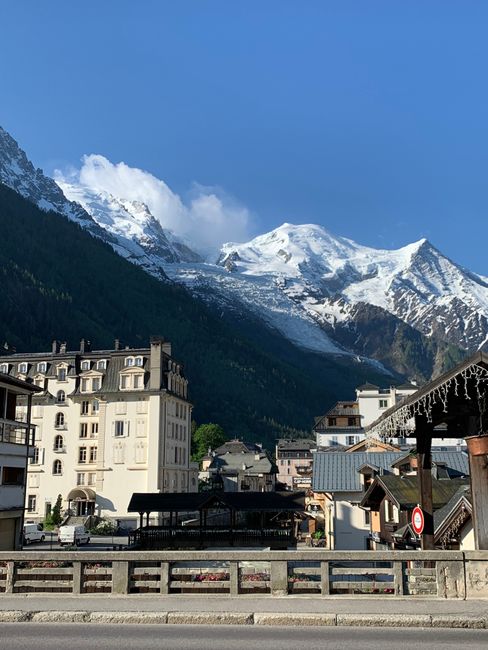
Chamonix is the mountain town at the foot of Mont Blanc, the highest peak in western Europe, in a deep Alpine valley close to the Swiss and Italian borders. You come to ride the cable car to the Aiguille du Midi at 3,842 metres, take the little red train to the Mer de Glace glacier, hike balcony trails facing a wall of glaciers, ski some of the most famous slopes in the Alps, and, for mountaineers, to climb Mont Blanc itself. The town is lively, international and easy to reach from Geneva. Give it three days in summer, or a week to hike or ski.
Right now in Chamonix
- Wed 8–13°C 46–56°F 6 mm Rain
- Thu 6–10°C 43–49°F 18 mm Heavy rain
- Fri -1–9°C 31–47°F Mostly clear
Weather: MET Norway (CC BY 4.0) · Rates: ECB
Top tours in Chamonix
See all tours for Chamonix →
From local operators, with prices and reviews; you check availability and book on Viator, our partner. We may earn a commission at no extra cost to you. How we earn money
Chamonix at a glance
- Best for: high-mountain views, glaciers, hiking, skiing and off-piste, climbing and mountaineering, paragliding and Alpine food.
- How long: 2–3 days for the Aiguille du Midi and Montenvers, a week for hiking or skiing.
- Best time: late June to mid-September for hiking and lifts; mid-December to April for skiing. Spring and autumn are quiet, with many lifts closed.
- Getting in: Geneva airport is the nearest big airport, with transfers by road; trains arrive via Saint-Gervais-Le Fayet in France or Martigny in Switzerland.
- Guest card: staying in the valley gets you a guest card with free trains between Servoz and Vallorcine and cheaper bus passes.
- Before you go: entry rules, money and general safety are in our France travel guide.
The Chamonix valley, village by village
The valley runs about 20 km from Servoz and Les Houches in the south-west to Vallorcine and the Swiss border in the north-east, with Mont Blanc’s glaciers on one side and the Aiguilles Rouges on the other. The town of Chamonix sits at about 1,035 metres.
Chamonix town
The busy centre, with a pedestrian main street, the river Arve, bars, restaurants and outdoor shops, the Aiguille du Midi cable car, the Montenvers station and the Brévent gondola. Best for: first visits, nightlife and travellers without a car.
Les Houches
A quieter, family-friendly village at the valley’s southern entrance, with wooded ski slopes and the Bellevue cable car, a start for the Tour du Mont Blanc. Best for: families and good-value stays.
Argentière
A mountain village 9 km up the valley, below the Argentière glacier and the Grands Montets ski area, known for steep, high skiing. Best for: serious skiers and hikers who want a village feel.
Le Tour and Vallorcine
At the head of the valley, Le Tour has gentle, open slopes of the Balme area, great for beginners, and Vallorcine is a peaceful hamlet on the far side of the Col des Montets, near Switzerland. Best for: beginners, families and quiet nature.
Top things to see in Chamonix
Prices and hours below were checked on the official sites in October 2026. They change, so check before you go.
Aiguille du Midi
The most famous cable car in the Alps climbs in two stages from Chamonix (1,035 m) via the Plan de l’Aiguille mid-station to the rock needle of the Aiguille du Midi at 3,842 m, one of the highest points in the Alps you can reach by cable car without climbing gear. A lift takes you to the summit terrace for a close view of Mont Blanc, the glaciers and peaks across France, Italy and Switzerland. Step into the Void, a glass box over a 1,000-metre drop, and the “Pipe”, a walkway around the central peak, add thrills. In summer, the Panoramic Mont-Blanc gondola continues across the glaciers towards Italy (separate ticket, not in the multi-day pass).
Tickets and booking. The operator, the Compagnie du Mont-Blanc, uses dynamic prices: as of October 2026 a return ticket to the top costs from €60.20 to €83.00 for an adult, cheaper the earlier you book, and a return to the Plan de l’Aiguille mid-station is €43. A departure time (“boarding number”) is required to board. Book online; new tickets are also released the day before, and the box office sells remaining places on the day. Holders of the MONT BLANC MultiPass (adult passes from €95.60) must reserve their time slot. Arrive at the boarding area 10 minutes early. On 4 October 2026 the cable car ran from 8:10 to 15:00; check the live opening page, as hours and winter maintenance closures vary.
Altitude advice. You rise about 2,800 metres in 20–40 minutes, depending on queues, and the air at the top is thin and often below freezing even in summer. The operator does not allow children under 3 and does not recommend the trip for under-5s; older visitors and anyone with heart problems should take medical advice first. Move slowly at the top, drink water, and tell staff if you feel dizzy, breathless or sick; going back down is the cure. Bring a warm jacket, hat, gloves and sunglasses. Go early on a clear morning: clouds often build by midday, and you can check the summit webcam before you buy.
Montenvers and the Mer de Glace
The little red rack railway climbs in 20 minutes from Chamonix (1,035 m) to Montenvers (1,913 m), with a view down onto the Mer de Glace, France’s longest glacier, and up to the granite spire of the Drus. As of October 2026 the train closes for maintenance from 2 November to 4 December. The glacier has shrunk dramatically: stations and signs on the way down show where the ice stood in past decades, a powerful lesson in climate change.
What’s open in 2026. The site has been transformed. A new 10-seat gondola now carries visitors from Montenvers down towards the glacier and the ice cave, carved fresh into the ice each year (about 170 steps below the gondola, so not accessible for wheelchairs). At the top, the new Glaciorium is an exhibition space on glaciology and climate, and the Temple de la Nature shows the history of one of the first Alpine refuges. As of October 2026, a return ticket including the train, gondola, ice cave and Glaciorium costs €49.70 for an adult. On 4 October 2026 the train was running (8:30–16:00), the ice cave was closed for the season, and the gondola, Glaciorium and Temple de la Nature were due to reopen from 17 October to 1 November. Dogs on a lead are allowed, and children from 12 months. Check the live opening page before you go, as dates change with maintenance and conditions.
Brévent and Flégère: the balcony on Mont Blanc
On the sunny side of the valley, the Brévent gondola and cable car rise to 2,525 m, and Flégère to about 1,900 m, facing the whole Mont Blanc range. They are the best viewpoints for photos of the massif, and the starting points for the classic hikes to Lac Blanc and along the Grand Balcon Sud.
The town
Chamonix hosted the first Winter Olympics in 1924 and is the cradle of mountaineering: Mont Blanc was first climbed from here in 1786. In the centre, the statue of Balmat and de Saussure points up at the summit. Wander the riverside, watch paragliders land in the fields, and finish with a fondue or tartiflette.
Other sights
- Montenvers Railway
Peaks and mountains
- Aiguille du Midi
- Mont Blanc
- Aiguille d'Argentière
- Aiguille Verte
- Dôme du Goûter
- Mont Maudit
Protected areas
- Aiguilles Rouges National Nature Reserve
Nature
Hiking in Chamonix
The valley has hundreds of kilometres of marked trails, from easy riverside walks to high-mountain routes. The hiking season runs from about mid-June to late September, when most lifts are open and the high paths are clear of snow; above 2,000 m snow can linger into July. The main summer lifts typically run from mid-June to mid-September, and some reopen for the autumn school holidays (17 October to 1 November in 2026).
- Lac Blanc: the classic. From the Flégère lift, about 1 hour 30 minutes up to a lake reflecting Mont Blanc. Rocky, with ladders on some variants; start early to beat the crowds.
- Grand Balcon Nord: from the Plan de l’Aiguille mid-station, a balcony trail winds above the valley to Montenvers, with views of the Mer de Glace. Ride down on the train.
- Grand Balcon Sud: a mostly level trail between Planpraz and Flégère facing the Mont Blanc range, easy and family-friendly.
- Tour du Mont Blanc: the famous long-distance trek of about 170 km around the massif through France, Italy and Switzerland, usually done in 10–12 days with nights in mountain huts, which must be booked months ahead.
Mountain weather changes fast, with afternoon thunderstorms common in summer. Check the forecast and trail conditions at the Office de Haute Montagne in Chamonix, carry water, layers and a rain jacket, and turn back if the weather turns. See our hiking guide.
Skiing in Chamonix
Chamonix is a collection of separate ski areas rather than one linked resort, connected by buses and the valley train. The season usually runs from mid-December to April, depending on snow. For winter 2026–27 the Compagnie du Mont-Blanc lists a partial opening at Flégère from 28 November (snow permitting), the Grands Montets from 5 December, Brévent and Balme from 12 December, and Les Houches from 19 December.
- Brévent-Flégère: sunny slopes above town with big views; intermediate.
- Grands Montets (Argentière): high, steep and snow-sure, with famous off-piste.
- Balme (Le Tour–Vallorcine): wide, gentle slopes, ideal for beginners and families.
- Les Houches: tree-lined runs, good on snowy or cloudy days.
- Vallée Blanche: a legendary 20 km off-piste descent from the Aiguille du Midi across the glaciers, only with a qualified mountain guide; it involves a tricky ridge walk, crevasses and avalanche risk.
Lift passes valid in the valley also count as bus tickets on the Chamonix Mobilité network. Off-piste and ski touring here are true high-mountain terrain; go with a guide and carry avalanche equipment.
Climbing Mont Blanc: permits and rules
Mont Blanc, at about 4,805 metres, is a serious high-altitude climb, not a hike. There is no “permit” to buy, but on the most popular route the rules are strict.
- The normal (Goûter) route starts from the Mont Blanc Tramway at Saint-Gervais and the Nid d’Aigle, and climbs via the Tête Rousse and Goûter huts. It crosses the Grand Couloir, a gully known for deadly rockfall.
- Compulsory hut reservation. Under a Haute-Savoie prefectural order of 15 June 2020, nights in the Nid d’Aigle, Tête Rousse and Goûter huts must be booked through a single reservation system with the names of every climber. The prefecture requires you to carry proof of your booking, on paper or on your phone, with valid ID, and to show it at any check and on arrival at the hut. The FFCAM (French Alpine Club), which runs Tête Rousse and Goûter, does not allow reservations to be resold.
- Season. In 2026 the Goûter hut was staffed from 30 May to 4 October and Tête Rousse from 29 May to 3 October. In summer 2026 both huts were closed for a time because of dangerous conditions on the route, and reopened on 26 August under a municipal order. Outside the guarded season, places in the winter rooms must still be reserved.
- Hire a guide. Unless you are an experienced alpinist, climb with a certified high-mountain guide (the Compagnie des Guides de Chamonix and other guiding offices), after acclimatising for several days on lower peaks. Guides book months ahead.
- Check conditions. Before any climb, visit the Office de Haute Montagne in Chamonix for route conditions, and respect closures. The huts’ reopening “does not mean the route is free of risk”, as the FFCAM puts it.
If you just want to see Mont Blanc up close, the Aiguille du Midi or a scenic flight are the safe options.
More things to do
- Paragliding: tandem flights from Planpraz or the Plan de l’Aiguille, with landings in town.
- Mountain biking and road cycling: lift-served trails in summer and the climbs to the Col des Montets and Switzerland. See our cycling guide.
- Climbing and via ferrata: crags all over the valley and guided via ferrata routes for beginners.
- Rafting: on the Arve in summer.
- Day trips: through the Mont Blanc Tunnel to Courmayeur in Italy, the Skyway cable car on the Italian side, or by train to Martigny and Switzerland.
Activities and best months
Getting to Chamonix
Via Geneva airport. Geneva is the nearest big international airport, about 90 km away and roughly an hour and a quarter by road in normal traffic (longer on winter Saturdays). Shared and private shuttle companies run transfers all day, and the tourist office’s website has an airport shuttle booking service; book ahead in ski season. Hire cars from the French side of the airport save cross-border fees. Lyon airport is about three hours away.
By train. The Mont Blanc Express line runs from Saint-Gervais-Le Fayet, where it connects with TGVs, other SNCF trains and the Léman Express from Geneva, up through Les Houches and Chamonix to Vallorcine and on to Martigny in Switzerland. From Paris, take a train to Saint-Gervais-Le Fayet (seasonal direct TGVs, otherwise via Annecy or Geneva) and change. Note that works on the line from 28 September to 6 November 2026 change the timetable; check before travelling.
By car. The A40 motorway (the “Autoroute Blanche”) from Geneva continues as a mountain road into the valley. In winter, carry snow chains or socks and winter tyres, which are compulsory in mountain areas. From Lyon, follow the A40 via Geneva or Annecy.
Getting around: the guest card, buses and trains
The guest card (carte d’hôte). Every visitor staying in paid accommodation in the valley receives a guest card from their host on arrival; ask for it at check-in. It gives free travel on the Mont Blanc Express trains between Servoz and Vallorcine, which stop at Les Houches, Chamonix, Argentière and Le Tour (Montroc), plus discounts at sports facilities and museums.
Buses are no longer free. Many older guides say the guest card gives free buses, but since a new ticketing system in 2026 you need a ticket, validated each time you board. On fares valid from 1 July 2026, guest-card holders pay much less: €5 for a 2-day pass, €6 for 3 days, up to €10 for a week and €20 for 14 days, bought online, on the Chamonix Mobilité app or at a ticket machine with your guest card number. Without the card, a single ticket costs €1.70 online or at machines, €2.20 at the bus station or by bank card on the validator, and €2.70 in cash, and a day ticket is €5. Children under 4 travel free, and valley lift passes count as bus tickets. The late-evening Chamo’nuit buses cost €4.50 by card.
- Walking: the town centre is compact; the Aiguille du Midi and Montenvers stations are a short walk apart.
- Car: handy for the side valleys and Italy, but parking near the lifts is paid and fills early; you can do without one.
- Bikes: a cycle route is being built between Chamonix and Argentière; e-bikes are popular for the valley floor.
When to go and how long to stay
Chamonix has a mountain climate: cold, snowy winters, warm summer days with cool nights, and rain or thunderstorms in any season. The table uses Météo-France’s normals for Chamonix town (1,042 m); Météo-France publishes the 1981–2010 period for this station. Up high it is far colder: at the Aiguille du Midi temperatures are often below freezing even in July.
| Season | Average high / low | Rainy or snowy days per month | What it’s like |
|---|---|---|---|
| Spring (Mar–May) | 9–18 °C / −3 to 5 °C | 10–14 | Spring skiing up high, snowmelt and mud lower down; many lifts close in May |
| Summer (Jun–Aug) | 21–24 °C / 8–9 °C | 12–13 | Warm days, cool nights, afternoon storms; hiking and climbing season; busiest in July–August |
| Autumn (Sep–Nov) | 19 °C falling to 7 °C / 6 °C falling to −2 °C | 10 | Clear, golden September; lifts close mid-September, short autumn reopenings; first snow |
| Winter (Dec–Feb) | 3–5 °C / −7 to −6 °C | 8–11 | Cold and snowy, frost almost every night; ski season from mid-December |
Chamonix gets about 1,280 mm of precipitation a year, and summer is actually the wettest season, mostly in short storms. September is often the most settled month for hiking.
Chamonix in 3 days (summer)
Day 1: the Aiguille du Midi on the first clear morning, then the Grand Balcon Nord walk down to Montenvers. Day 2: Flégère and the hike to Lac Blanc, then a fondue in town. Day 3: Brévent for the view, a paragliding flight or a day trip to Courmayeur.
Chamonix in a week
In summer, add a few days of the Tour du Mont Blanc, a via ferrata and Vallorcine. In winter, ski a different area each day, with a guided Vallée Blanche if conditions allow.
Weather month by month
Averages from Météo-France normals 1991–2020, Bourg-Saint-Maurice · Last reviewed 4 Oct 2026
Where to stay in Chamonix
- Chamonix centre: the most hotels, restaurants and nightlife, and walking distance to the main lifts.
- Les Praz: quieter, next to the Flégère lift and the golf course, a short ride from town.
- Argentière: village atmosphere, for the Grands Montets.
- Les Houches: good value for families.
- Mountain huts: for hikers and climbers; book months ahead for the summer.
Whatever you choose, make sure your accommodation gives you a guest card. Book early for school holidays, Christmas, February and July–August.
Practical tips for Chamonix
- Watch the weather: check the live opening status and summit webcams before buying lift tickets; high lifts close in strong wind.
- Respect the mountains: never walk onto a glacier without a guide and equipment; crevasses hide under snow.
- Mountain rescue: in an emergency call 112; rescue in the French Alps is run by the PGHM gendarmerie unit.
- Travel insurance: make sure it covers hiking, skiing and mountain rescue at altitude.
- Shoulder seasons: from mid-September to mid-December and from late April to mid-June, many lifts, huts and some restaurants close.
- Sun: UV is strong at altitude, even on cloudy days.
What to pack for Chamonix
In summer: sturdy hiking shoes or boots with good grip, a waterproof jacket, a warm fleece or down layer, a hat and gloves for the Aiguille du Midi, sunglasses, high-factor sunscreen, a day pack and a refillable bottle. Trekking poles help on steep descents. In winter: ski clothing, thermal base layers, a warm hat and gloves, goggles, and snow boots with grip for icy streets. Bring a small first-aid kit and blister plasters for long hikes.
What to pack
- Day packs and anti-theft bagsA 20–30 litre pack carries layers, water, a head torch and snacks on full-day levada walks.
- Fleeces and warm layersSummits like Pico do Areeiro averaged about 11 °C over 2024, so a fleece is needed even in summer.
- HeadlampsLevada routes such as PR1 and PR9 pass through long, dark, wet tunnels.
- Hiking shoes and bootsMadeira's levadas and the Azores' crater rims are wet, rocky and slippery, so grippy shoes matter more than anywhere else in Portugal.
- Rain jacketsMountain and island weather changes fast; a real shell beats an umbrella in the wind.
- Trekking polesLong stone staircases and steep descents on Madeira's peaks and the Azores' crater rims are easier on the knees with poles.
- Water bottles and hydration packsAlgarve and Alentejo trails are hot and exposed with few refill points.
Chamonix travel FAQ
How much is the Aiguille du Midi cable car?
As of October 2026, an adult return to the top costs from €60.20 to €83.00 depending on the date and how early you book, and €43 to the Plan de l’Aiguille mid-station. A departure time is required.
Do I need to book the Aiguille du Midi in advance?
It is strongly advised. You need a boarding time, and summer slots sell out. Book online, look for new tickets released the day before, or arrive at opening for remaining places.
Is the Aiguille du Midi safe for children and older people?
Children under 3 are not allowed and the trip is not recommended under 5. Older visitors and anyone with heart problems should take medical advice, because of the altitude of 3,842 m and the cold.
Can you still visit the Mer de Glace?
Yes. The Montenvers train runs to the viewpoint, and a new gondola takes you down towards the ice cave. As of October 2026 a return ticket with the gondola, ice cave and Glaciorium costs €49.70; the ice cave was closed for the season in early October.
Does the Chamonix guest card give free buses?
Not any more. It gives free trains between Servoz and Vallorcine and cheap bus passes, from €5 for 2 days to €10 for a week on fares valid from 1 July 2026.
How do I get from Geneva airport to Chamonix?
By shared or private shuttle, or a hire car, in about an hour and a quarter in normal traffic. By train, go via Geneva to Saint-Gervais-Le Fayet on the Léman Express and change to the Mont Blanc Express.
Do I need a permit to climb Mont Blanc?
There is no climbing permit, but on the normal Goûter route a prefectural order requires a named reservation in the Nid d’Aigle, Tête Rousse or Goûter huts, with proof of booking and ID carried on the climb.
When is the best time to hike in Chamonix?
From late June to mid-September, when lifts run and high trails are clear. July and August are busiest; September is often the most settled.
When does the ski season start in Chamonix?
For winter 2026–27, Flégère plans a partial opening from 28 November (snow permitting), the Grands Montets from 5 December and Brévent and Balme from 12 December. The season usually runs into April.
Is Chamonix good for beginners?
Yes, at Le Tour (Balme) and Les Houches, with ski schools in every village. Much of Chamonix’s fame, though, comes from steep and off-piste terrain best left to experts with guides.
How many days do you need in Chamonix?
Two or three days for the Aiguille du Midi, Montenvers and one good hike. A week for serious hiking, the Tour du Mont Blanc stages or a ski holiday.
Nearby destinations
- Val d'Isère53 km
- Montreux57 km
- Annecy57 km
- Courchevel59 km
- Geneva63 km
- Zermatt69 km
- Turin113 km
- Interlaken114 km
Sources
- © OpenStreetMap contributors · ODbL · fetched 3 Oct 2026
- Wikidata · CC0 · fetched 3 Oct 2026
Sources and last review
Researched and last reviewed on 3 October 2026. Lifts, prices, opening dates and altitude advice: the Compagnie du Mont-Blanc; Mont Blanc huts and the prefectural order: the FFCAM and the Haute-Savoie prefecture; guest card, trains and buses: the Chamonix-Mont-Blanc tourist office and Chamonix Mobilité’s fares; climate: Météo-France normals for Chamonix. Prices, timetables and rules change, and mountain conditions change daily, so check the official links before you go. For entry rules, money and general safety, see our France travel guide.
Plan your trip
Partner links: TravelerCenter may earn a commission if you book, at no extra cost to you.
🇫🇷 Useful French phrases for Chamonix
All 38 French phrases: restaurant, hotel, emergencies, romance (printable) →