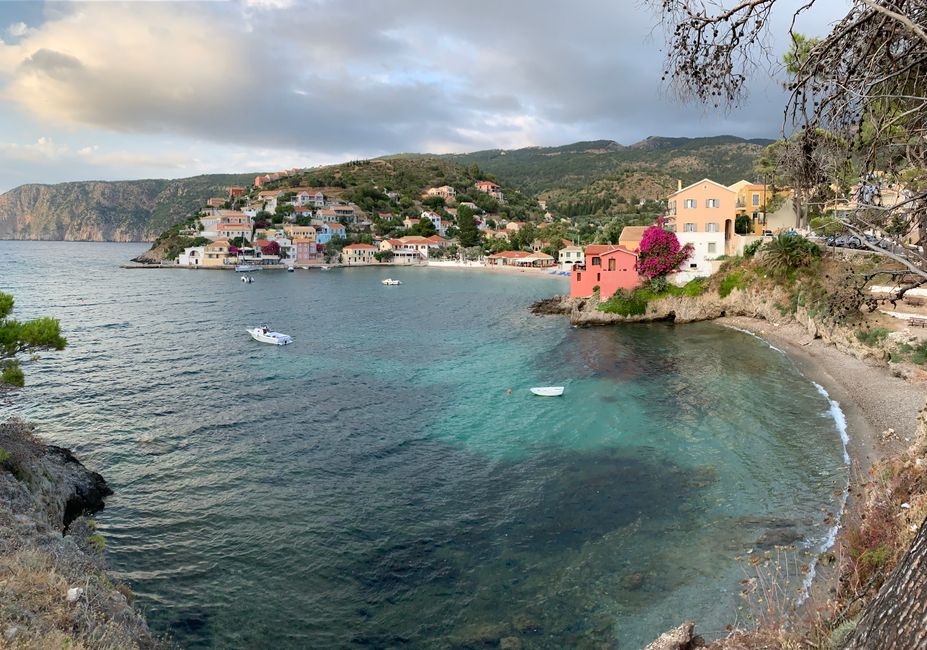
Kefalonia is the largest of the Ionian islands and one of the most beautiful: a mountainous island of fir forests, vineyards and limestone cliffs, with beaches of dazzling white pebbles and water in every shade of blue. Myrtos beach is its famous postcard; the underground lake of Melissani, the pastel harbour of Fiskardo and the little Venetian village of Assos are close behind. The island was shaken almost flat by the earthquake of 1953 and rebuilt, so its towns are newer than they look, but its landscapes, wine and slow pace are timeless, and Ithaca, Odysseus’s home, is just across the strait. The best months are June and September. Give it a week.
Right now in Kefalonia (Argostoli)
- Wed 15–26°C 59–78°F Clear
- Thu 17–22°C 62–71°F 13 mm Rain
- Fri 19–24°C 67–76°F 7 mm Rain
Weather: MET Norway (CC BY 4.0) · Sea temperature: NOAA CoastWatch · Rates: ECB
Top tours in Kefalonia
See all tours for Kefalonia →
From local operators, with prices and reviews; you check availability and book on Viator, our partner. We may earn a commission at no extra cost to you. How we earn money
Kefalonia at a glance
- Best months: late May–June and September. Average highs run from about 23 °C in May to 30 °C in August, and it hardly rains from June to August (Hellenic National Meteorological Service normals, Argostoli). Rain returns in October.
- Days needed: 4–5 for the highlights; 7–10 to add Ithaca, the Paliki peninsula and lazy beach days. The island is big and the roads are slow.
- Getting there: fly into Kefalonia airport (EFL), near Argostoli, with direct flights from Europe in summer and from Athens all year; or take a ferry from Kyllini in the Peloponnese.
- Getting around: a hire car is almost essential; buses are limited.
- Budget level: mid-range, with pricier villas and harbour restaurants in Fiskardo and Assos. A per-room climate fee is added to every hotel bill. See our Greece guide for money, entry rules and daily costs.
Kefalonia’s areas and who each one suits
- Argostoli and the south-west: the island’s capital and lively harbour town, with sandy beaches nearby at Makris Gialos and Platis Gialos, the lighthouse and the resort of Lassi. The handiest base, close to the airport.
- Sami and the east: the ferry port for Ithaca, close to Melissani, Drogarati and the beach of Antisamos, with the pretty harbour of Agia Efimia to the north. Good for sightseeing and boat trips.
- The north (Assos, Fiskardo, Myrtos): the island’s most dramatic coast and its two most charming villages, with clear coves for swimming and boats to Ithaca and Lefkada. Romantic and upmarket.
- The south-east (Skala, Poros, Lourdas): long sandy and pebble beaches, family resorts, the Kyllini ferry at Poros and the slopes of Mount Ainos above. For families and beach holidays.
- The Paliki peninsula (Lixouri): a quieter, rural peninsula across the bay from Argostoli, with red-sand Xi beach, the cliffs of Petani and sleepy villages. For people who want to slow down.
Top things to see in Kefalonia
Cave prices and hours come from the Municipality of Sami, which runs Melissani and Drogarati, and other prices from the Greek Ministry of Culture, as of October 2026.
Myrtos beach
Seen from the road above, Myrtos is unforgettable: a long arc of white pebbles at the foot of steep cliffs, with water that shades from milky turquoise to deep blue. A road of tight hairpin bends, about 2 km long, drops from the village of Divarata to a free car park at beach level, which fills by mid-morning in July and August. In summer there is a canteen, toilets, sunbeds and lifeguards. The beach shelves steeply and the waves can be strong, so keep children close. As of October 2026: after a rockfall from the cliff on 10 July 2026, in which nobody was hurt, the Municipality of Sami closed off the eastern end of the beach near the sea cave, and put up nets, barriers and warning signs. The rest of the beach stays open. Keep out of the marked zone and away from the foot of the cliffs. Works to upgrade the access road are due to start after the 2026 summer season. For the classic photo, stop at the viewpoint on the main road above the beach.
Melissani Cave
Near Sami, a short tunnel leads down to an underground lake whose cave roof collapsed long ago, leaving it open to the sky. Boatmen row you across the brackish water, so clear the boats seem to float, and into a second chamber, in a ride of about 15 minutes. Around midday, sunlight falls straight through the opening and lights the water an intense blue. How to visit: a ticket is €10, €5 reduced (ages 6–18, students, over-65s and large families), and free for under-6s. As of October 2026, the Municipality lists both caves as open every day 09:00–16:00; summer hours are usually longer. Arrive before 11:00 or after 14:00 to avoid the longest queues, which can reach two hours at midday in July and August. The water that fills the lake has travelled underground from sinkholes near Argostoli, on the other side of the island, as a dye test in 1963 showed.
Drogarati Cave
A few kilometres from Melissani, Drogarati is a large cave full of stalactites and stalagmites, with a great chamber so big and with such good acoustics that it has hosted concerts. Steps lead down into it, and the visit takes about 20 minutes; it is cool inside all year. Status and how to visit: Drogarati is open in 2026, run by the Municipality of Sami with the same hours as Melissani. A ticket is €6, €3 reduced, or €4 if you show a Melissani ticket, so both caves together cost €14.
Assos
Assos is a tiny village of pastel houses on a narrow isthmus, with a pebble beach, a few tavernas on the harbour and a pine-covered peninsula behind it crowned by a Venetian castle, built from 1593. A path climbs to the castle walls in about 30–40 minutes; go early or late in summer. The views of Assos from the road above, on the way north from Myrtos, are among the best on the island.
Fiskardo
At the northern tip of the island, Fiskardo is the one village that came through the 1953 earthquake largely intact, so its harbour is still lined with old Venetian-era houses painted in soft colours. Today it is full of yachts, cafés and seafood restaurants, and boats leave from here for Ithaca, Lefkada and secluded coves such as Emblisi and Foki, which are lovely for snorkelling. Park at the top of the village, as cars cannot reach the waterfront.
Argostoli
The capital was rebuilt after 1953 around a big central square and the pedestrian street of Lithostroto, lined with shops and cafés. In the mornings, walk along the harbour to the fish market, where loggerhead sea turtles often come up to feed on scraps by the fishing boats; watch them from the quay, and do not feed or touch them. The long stone De Bosset bridge, built in 1813, crosses the Koutavos lagoon. On the headland west of town are the Katavothres, sinkholes where the sea pours into the ground, once used to drive sea mills, and the round, columned lighthouse of Agioi Theodoroi, a lovely spot for sunset. The Korgialenio museum shows island life before the earthquake. The town’s Archaeological Museum is closed while the Ministry of Culture builds a new one.
Agios Georgios Castle and Agios Gerasimos
Above the village of Peratata, south-east of Argostoli, the Venetian Castle of Agios Georgios was the island’s capital until the 18th century, with views over the south of the island (€5, €3 reduced; 08:30–15:30, closed on Tuesdays). Nearby, in the green Omala valley, the monastery of Agios Gerasimos, the island’s patron saint, is a major pilgrimage site, crowded on his feast days, 16 August and 20 October. Dress modestly.
Caves
- Drogarati Cave
- Melissani Cave
Beaches
- Myrtos Beach
Museums
- Archaeological Museum of Argostoli
Archaeological sites
- Ancient Krani
Castles and forts
- Assos Castle
Protected areas
- Ainos National Park
Beaches in Kefalonia
Kefalonia’s beaches range from white-pebble coves under cliffs to long sandy bays. In 2026, 13 of them flew the Blue Flag, including Myrtos, Antisamos, Makris Gialos, Platis Gialos and Skala. For more ideas, see our beach guide.
| Beach | Area | Type | Good for |
|---|---|---|---|
| Myrtos | North-west | White pebbles under cliffs | The view, swimming in calm weather |
| Antisamos | East, near Sami | Pebbles in a green, wooded bay | Clear water, snorkelling |
| Makris Gialos and Platis Gialos | Near Argostoli | Sandy, shallow bays | Families, easy access |
| Skala | South-east | Long sand and shingle | Families, space, water sports |
| Xi | Paliki peninsula | Red sand, shallow water | Children, sunsets |
| Petani | Paliki peninsula | Pebbles under white cliffs | Quiet, views, sunsets |
| Emblisi and Foki | Near Fiskardo | Small pebble coves | Snorkelling, calm water |
Many of the most beautiful coves, especially in the north, are best reached by boat. Licence-free motorboats can be rented in Fiskardo, Agia Efimia and Sami for a day of exploring. See our boat trips guide, snorkeling guide and diving guide.
Mount Ainos and hiking
Mount Ainos, at 1,628 m the highest point in the Ionian islands, has been a national park since 1962. Its upper slopes are covered in a forest of the dark Kefalonian fir, a tree found only in Greece, and semi-wild horses roam the high ground. A road climbs close to the summit, and marked trails lead through the fir forest; the views stretch over Zakynthos, Ithaca and the mainland. It is much cooler than the coast, so bring a layer. Other good walks include the coastal paths around Fiskardo, the path to the Assos castle and the old trails of the Paliki peninsula. Spring and autumn are best. From 1 May to 31 October, Greece’s fire-season rules apply: no fires outdoors, and forests, including national parks, can be closed on very-high-risk days. See our hiking guide and cycling guide.
Activities and best months
- Beaches and swimmingMyrtos, one of the most photographed beaches in Greece, Petani, Antisamos near Sami, the red clay of Xi, and Makrys and Platis Gialos near Argostoli; Skala for families and water sports. · source
- Boat tripsVisitors cross the underground lake of Melissani Cave by boat, under its collapsed roof (ticket €10, reduced €5). · source
- CyclingCycling routes and mountain biking among olive groves, gorges and green slopes. · source
- HikingWalks from easy valley paths to demanding inland trails, the ascent of Mount Ainos (highest peak of the Ionian Islands) and footpaths down to Fteri and Koutsoupia beaches. · source
- Scuba divingScuba divers head to Agia Efimia and Skala, where they can see the wreck of the British submarine Perseus. · source
- Wine tastingRobola, the island's PDO white, grows on stony mountain soils around Omala and Troianata up to 800 m; the wineries there can be visited for tastings. · source
Wine and food in Kefalonia
Kefalonia is one of Greece’s most interesting wine islands, with three protected wines: Robola of Kefalonia, a dry, mineral white grown on the slopes of Mount Ainos; the sweet red Mavrodaphne of Kefalonia; and the sweet white Muscat of Kefalonia. The Robola Cooperative, founded in 1982 in the Omala valley next to the Agios Gerasimos monastery, makes most of the island’s Robola and welcomes visitors, and several family wineries offer tastings, best combined with the monastery and the castle. See our wine tasting guide. At the table, try kreatopita, Kefalonia’s meat pie, cod with aliada (a garlic and potato dip), local feta and thyme honey, and the almond sweets of the island.
A day trip to Ithaca
Ithaca, the small, rugged island said to be the home of Odysseus, lies just east of Kefalonia across a narrow strait. Ferries run all year from Sami to Pisaetos, on Ithaca’s west coast, in about 20–30 minutes; in summer, boats also cross from Fiskardo to Frikes in the north of Ithaca in about 45 minutes. Fares are low, but Pisaetos is just a ramp with no town, so take a car or book a taxi ahead. Visit the main town of Vathy, on a deep, sheltered bay; the fishing villages of Kioni and Frikes; the monastery of Kathara for its views; and swim at Gidaki or Filiatro. The easiest option is an organised boat trip from Fiskardo or Agia Efimia, which visits several coves and villages in one day.
The 1953 earthquake and Captain Corelli
On 12 August 1953, a powerful earthquake struck the southern Ionian islands, destroying almost every building on Kefalonia apart from Fiskardo in the north and raising parts of the island by around 60 cm. Hundreds of people died and most of the population left the island. That is why Argostoli and most villages look modern, and why you will see the ruins of abandoned old villages, such as Old Vlachata and Old Farsa, on the hillsides. The island’s history during the Second World War inspired the novel Captain Corelli’s Mandolin, filmed here in 2000, with scenes shot at Sami, Antisamos, Argostoli and Fiskardo.
Nearby destinations
Getting there and getting around
Flights
Kefalonia International Airport “Anna Pollatou” (EFL), run by Fraport Greece, is about 8 km south of Argostoli, around 15 minutes by car. It has direct flights from much of Europe in summer and from Athens all year. A KTEL bus links the airport with Argostoli about every 90 minutes in season; the stop is to the left of the departures entrance. Taxis wait outside the terminal.
By ferry and bus
- From the mainland: Levante Ferries runs all year from Kyllini, in the western Peloponnese, to Poros in the south-east of Kefalonia, in about 1 hour 30, from about €14 per passenger. In summer there are also a few sailings from Kyllini to Sami, and ferries from Astakos and Patras to Sami.
- From Athens by bus: KTEL Kefalonia runs coaches between Athens and Argostoli, either via Kyllini and the Poros ferry or via Patras and Sami, in about six and a half hours.
- To other islands: Sami–Ithaca (Pisaetos) all year; Fiskardo–Ithaca (Frikes) and Fiskardo–Vasiliki (Lefkada) from April to October; and Pessada–Agios Nikolaos (Zakynthos), which in 2026 ran from mid-June to about 20 September.
- Across the bay: a shuttle ferry crosses between Argostoli and Lixouri in about 20–30 minutes, every half hour during the day from Monday to Saturday and hourly on Sundays.
Cars and buses
Kefalonia is big and mountainous: Argostoli to Fiskardo is about 50 km but takes well over an hour on winding roads. A hire car is the only practical way to see the island in a week. Drive carefully on hairpin bends, watch for goats, and allow time for parking at Myrtos, Assos and Fiskardo in summer. KTEL buses link Argostoli with Sami, Poros, Skala, Fiskardo and other villages, but services are few, especially outside summer.
When to go and how long to stay
Kefalonia has hot, dry summers and mild, wet winters. July and August are hot and busy, with the warmest sea and the most crowded beaches and caves. Late May, June and September are ideal for swimming and touring; October is often warm but brings the first storms. In winter, many hotels and tavernas close, and snow can fall on Mount Ainos.
| Season | Average high / low | Days with rain a month | What it’s like |
|---|---|---|---|
| Spring (Mar–May) | 16–23 °C / 9–15 °C | 5–11 | Green and flowery; great for walking; the sea is cool until late May. |
| Summer (Jun–Aug) | 27–30 °C / 18–21 °C | 1–2 | Hot, dry and sunny; peak season for beaches, caves and boats. |
| Autumn (Sep–Nov) | 19–27 °C / 13–19 °C | 5–13 | September is perfect; rain and storms grow from October; harvest time for wine. |
| Winter (Dec–Feb) | 14–16 °C / 8–10 °C | 13–15 | Mild and rainy, with snow on Ainos; quiet, many places closed. |
Figures are the Hellenic National Meteorological Service’s 1970–2010 averages for the Argostoli station, the latest official normals published for the island; “days with rain” counts all days with measurable rain. Argostoli gets about 810 mm of rain a year, almost all between October and March.
4–5 days in Kefalonia
Stay near Argostoli or Sami. One day for Melissani, Drogarati and Antisamos; one day for Myrtos, Assos and Fiskardo; one day for Argostoli, the lighthouse and the beaches nearby; and one day for Mount Ainos, the Robola winery, Agios Gerasimos and the castle.
7–10 days in Kefalonia
Split your stay between Argostoli or the south (three or four nights) and Fiskardo or Assos in the north (three or four nights). Add a day on Ithaca, a day on the Paliki peninsula and a boat day from Fiskardo. In summer, continue by ferry to Zakynthos, or head north to Corfu.
Where to stay in Kefalonia
- Convenience and evenings out: Argostoli or Lassi, close to the airport and sandy beaches.
- Romance: Assos or Fiskardo, with harbour-front dinners.
- Sightseeing and Ithaca: Sami or Agia Efimia.
- Families: Skala, Lourdas or the beaches near Argostoli.
- Peace and quiet: a village house on the Paliki peninsula.
Greece adds a climate resilience fee per room per night, set by type of accommodation. As of October 2026, from April to October it is €2 for 1–2 star hotels and rented rooms, €5 for 3 stars, €10 for 4 stars, €15 for 5 stars and €8 for short-term holiday rentals (€15 for houses over 80 m²); it is much lower from November to March.
Practical tips for Kefalonia
- Melissani timing: go before 11:00 or after 14:00 to skip the queue, or at noon for the light if you can wait.
- Myrtos safety: respect the closed zone at the eastern end and stay away from the foot of the cliffs.
- Allow driving time: distances look short on the map but roads wind over mountains.
- Turtles in Argostoli: watch from the quay; do not feed, touch or swim after them.
- Fire season: from May to October, check the daily fire-risk map before hiking on Ainos, and never light a fire outdoors.
- Earthquakes: small tremors are common in the Ionian; if you feel one, drop, cover and hold on, then move away from buildings and cliffs.
- Emergencies: call 112.
Weather month by month
Averages from HNMS normals 1991–2020, Kefalonia (Argostoli airport) (rain: 1970–2010 averages) · Last reviewed 4 Oct 2026
What to pack for Kefalonia
Pack swimwear, a sun hat, sunglasses and high-factor sunscreen, and water shoes: many of Kefalonia’s best beaches, Myrtos included, are pebbly and shelve steeply. A snorkel mask is worth bringing for Antisamos and the coves around Fiskardo, and a dry bag for boat days. Bring comfortable shoes for the steps at Drogarati and the climb to Assos castle, hiking shoes and a warm layer for Mount Ainos, which is much cooler than the coast, and a light jacket for the cave, which stays cool all year. A scarf or shirt covers shoulders at Agios Gerasimos. From October, add a rain jacket.
What to pack
- City walking shoesQuinta visits and harvest days mean steep terraces, gravel and cellar floors.
- Day packs and anti-theft bagsCarries water, towel and sunscreen down the long stairways to Algarve coves.
- Dry bags and phone pouchesProtects phones and cameras from sand and spray on beaches reached by ferry or steep paths.
- Fleeces and warm layersIt is cooler at sea than on land, especially on morning whale-watching trips.
- HeadlampsLevada routes such as PR1 and PR9 pass through long, dark, wet tunnels.
- Hiking shoes and bootsMadeira's levadas and the Azores' crater rims are wet, rocky and slippery, so grippy shoes matter more than anywhere else in Portugal.
- Quick-dry beach towelsA sand-shedding quick-dry towel packs small for beach days and lido visits.
- Rain jacketsA windproof, waterproof shell keeps you warm on open boats, where wind and spray cool you quickly.
- Reef-friendly sunscreenSummer UV is strong on Portuguese beaches and there is little shade below the cliffs.
- Trekking polesLong stone staircases and steep descents on Madeira's peaks and the Azores' crater rims are easier on the knees with poles.
- Water bottles and hydration packsRiding in the Algarve and Alentejo heat needs more water than you expect.
- Water shoesRocky coves, lava pools and weever fish in shallow sand make water shoes useful.
- WetsuitsOn the west and north coasts the sea stays around 16–18 °C even in summer, so a thin suit helps for long swims.
- Wine bottle travel protectorsPort and Douro wines bought at the quintas travel home safely in checked luggage with padded bottle protectors.
Kefalonia travel FAQ
How many days do you need in Kefalonia?
Four or five days for Myrtos, Assos, Fiskardo, the caves and Argostoli; a week or more to add Ithaca, Mount Ainos, the Paliki peninsula and beach days.
Is Myrtos beach open after the 2026 rockfall?
Yes. After the rockfall of 10 July 2026, only the eastern end near the sea cave was closed off, with nets, barriers and signs. The rest of the beach is open, with lifeguards in summer.
How much does Melissani Cave cost?
€10, or €5 reduced, as of October 2026. With a Melissani ticket, Drogarati costs €4 instead of €6, so both caves cost €14.
What is the best time to visit Melissani Cave?
Around midday, roughly 11:30–14:00, when sunlight falls through the opening and lights the water. That is also when queues are longest, so arrive early.
Is Drogarati Cave open?
Yes. It is open in 2026, run by the Municipality of Sami with the same daily hours as Melissani. A ticket costs €6, or €3 reduced.
How do you get from Kefalonia to Ithaca?
By ferry from Sami to Pisaetos in about 20–30 minutes, all year, or in summer from Fiskardo to Frikes in about 45 minutes. Boat tours from Fiskardo and Agia Efimia also visit Ithaca.
What is Robola wine?
A dry, mineral white wine with protected status, grown on the slopes of Mount Ainos. Taste it at the Robola Cooperative in the Omala valley or at the island’s family wineries.
Do I need a car in Kefalonia?
Yes, in practice. Buses are infrequent, and the island’s highlights are spread out along slow mountain roads.
How do you get to Kefalonia?
Fly into Kefalonia airport, near Argostoli, from Athens or, in summer, directly from Europe; or take the ferry from Kyllini to Poros, about an hour and a half.
Is Kefalonia or Zakynthos better?
Kefalonia is bigger, greener and calmer, with more varied scenery and villages; Zakynthos is smaller, with the Blue Caves, the turtles and livelier resorts. In summer, you can combine them by ferry.
When is the best time to visit Kefalonia?
Late May, June and September: warm, sunny and less crowded than July and August, with a warm sea in September.
Sources
- © OpenStreetMap contributors · ODbL · fetched 4 Oct 2026
- Wikidata · CC0 · fetched 4 Oct 2026
Sources and last review
Researched and last reviewed on 4 October 2026. Cave prices and hours come from the Municipality of Sami; the Castle of Agios Georgios and the Archaeological Museum from the Greek Ministry of Culture; Blue Flag beaches from the Blue Flag programme in Greece; Mount Ainos from Visit Greece; airport and bus information from Kefalonia airport and KTEL Kefalonia; the Lixouri ferry from its operator; and climate figures from the Hellenic National Meteorological Service. Myrtos rockfall news comes from the Greek press quoting the Municipality of Sami, and ferry times and fares from booking sites. Check the operators and the official sites before you travel.
Plan your trip
Partner links: TravelerCenter may earn a commission if you book, at no extra cost to you.
🇬🇷 Useful Greek phrases for Kefalonia
All 38 Greek phrases: restaurant, hotel, emergencies, romance (printable) →