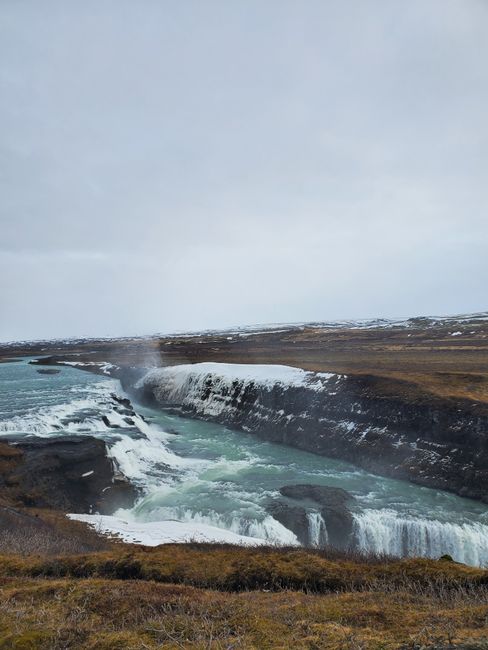
The Golden Circle is Iceland’s most famous day trip: a loop of roughly 230–300 km east of Reykjavík that links three great sights. At Þingvellir National Park, the old Icelandic parliament met in the open air from 930, in a rift valley where the North American and Eurasian plates are pulling apart. At Geysir, the hot spring that gave its name to every geyser in the world, its neighbour Strokkur shoots boiling water into the air every few minutes. And at Gullfoss, the glacial river Hvítá thunders down two steps into a deep canyon. Along the way are the red crater lake of Kerið, geothermal baths at Laugarvatn and Flúðir, tomato greenhouses at Friðheimar and the crystal-clear Silfra fissure for snorkellers. You can do it in one long day from Reykjavík, but a night in the area lets you see the sights early or late, without the tour buses.
Right now in Golden Circle (Geysir)
- Wed 2–6°C 35–43°F 2 mm Light rain
- Thu 3–7°C 37–44°F 11 mm Rain
- Fri 5–7°C 40–45°F Cloudy
Weather: MET Norway (CC BY 4.0) · Rates: ECB
Top tours in Golden Circle
See all tours for Golden Circle →
From local operators, with prices and reviews; you check availability and book on Viator, our partner. We may earn a commission at no extra cost to you. How we earn money
The Golden Circle at a glance
- Best for: Iceland’s geology in a day: a rift valley, an erupting geyser, a giant waterfall and a volcanic crater, plus hot springs, Viking-age history and farm food.
- How long: 6–8 hours for the three main sights from Reykjavík; a full day to add Kerið, a bath and lunch at Friðheimar; one or two nights to slow down, snorkel Silfra or see the Northern Lights away from the city.
- Best time: any time of year. Summer has long days and green landscapes; winter has snow, frozen Gullfoss and the aurora, but only four to six hours of daylight from November to January.
- Getting in: Þingvellir is about 45 km (45 minutes) from Reykjavík on Route 36; the whole loop is about 230 km, or nearer 300 km with Kerið and the return via Selfoss and Hveragerði.
- Getting around: by hire car or on a day tour from Reykjavík. Public buses don’t link the main sights in a useful way.
- Budget: Gullfoss and Geysir are free to see; as of October 2026, parking at Þingvellir costs ISK 1,000 a car for the day, Kerið costs ISK 700 a person, and the Geysir car park charges a day fee. Baths and Silfra snorkelling cost extra.
The route and the areas along it
The usual loop runs clockwise from Reykjavík: north-east over the Mosfellsheiði moor to Þingvellir, east past Laugarvatn lake to Geysir in the Haukadalur valley, a few minutes on to Gullfoss, then south through the farming and greenhouse villages of Reykholt and Flúðir, past Kerið in the Grímsnes area, and back west via Selfoss and Hveragerði over the Hellisheiði plateau. The area lies in the southern lowlands of South Iceland, in the municipalities of Bláskógabyggð and Grímsnes- og Grafningshreppur.
- Þingvellir and Lake Þingvallavatn: the national park, Iceland’s largest natural lake, the rift valley and Silfra.
- Laugarvatn: a small lakeside village with the Fontana geothermal baths, a good stop between Þingvellir and Geysir.
- Haukadalur (Geysir) and Gullfoss: the geothermal field and the waterfall, 10 km apart, with hotels, cafés and shops at Geysir.
- Reykholt, Flúðir and Skálholt: greenhouse villages heated by hot springs, the Secret Lagoon at Flúðir, the Friðheimar tomato farm and the old bishop’s seat at Skálholt.
- Grímsnes, Selfoss and Hveragerði: Kerið crater, the market town of Selfoss on the river Ölfusá, and Hveragerði, the start of the Reykjadalur hot river walk.
Top things to see on the Golden Circle
Þingvellir National Park
Þingvellir (“Parliament Plains”) is where the Alþingi, one of the world’s oldest parliaments, met each summer from 930 until 1798, and where Iceland declared independence in 1944. It is a UNESCO World Heritage Site for both its history and its geology: here the Mid-Atlantic Ridge rises above the sea, and the land is pulling apart by about 2 cm a year. Start at the Hakið visitor centre at the top of the Almannagjá gorge, then walk down the gorge past the Law Rock (Lögberg) to the Öxarárfoss waterfall, the little Þingvellir church and the old farmhouses. Allow at least an hour or two.
As of October 2026, parking at the three main car parks, P1 at Hakið, P2 below Öxarárfoss and P5 at Valhöll near the church and Silfra, costs ISK 1,000 for a car with up to five seats (ISK 1,200 for six to nine seats, ISK 400 for a motorbike). One payment covers all three for the day of payment. Pay at the machines at the visitor centre, P2 and P5, or online. The service centre at Leirar, at the junction of Routes 36, 361 and 52, has a café, shop and information desk, and sells camping, fishing and diving permits; it opens daily 9:00–18:00 until 31 October and 9:00–17:00 from 1 November to 31 March.
Silfra fissure
Silfra is a water-filled crack in the rift at Þingvellir, fed by glacial meltwater that has filtered for decades through lava. The water is about 2–4 °C all year and so clear that you can often see more than 100 m. Snorkelling and diving are allowed only with licensed operators, who supply dry suits and guides, and the national park sets requirements for age, health and, for divers, dry-suit experience. Trips run all year and last two to three hours including dressing. It is cold but unforgettable; see our snorkelling and diving pages for what to expect.
Geysir and Strokkur
The Geysir geothermal area in the Haukadalur valley has steaming vents, bubbling pools and two famous geysers. The Great Geysir, recorded since the Middle Ages and once able to throw water 70 m or more, is mostly quiet now. Its neighbour Strokkur erupts reliably every five to ten minutes, a dome of blue water bursting into a column usually 15–20 m high, sometimes more. Stay behind the ropes and stand upwind: the water is boiling, and the ground around the pools is fragile. Entry to the area is free. The car park opposite charges a day fee, and the hotel, cafés and big souvenir shop across the road are open all year.
Gullfoss
Gullfoss, the “Golden Falls”, is 10 km beyond Geysir. The Hvítá river, fed by the Langjökull glacier, drops about 32 m in two steps, of roughly 11 and 21 m, then turns into a narrow canyon 2.5 km long. A lower path leads close to the falls, where the spray soaks you, and an upper path and café sit above. In the early 20th century, Sigríður Tómasdóttir, the daughter of the farmer who owned the land, fought plans to dam the falls for power; a memorial to her stands by the path. Gullfoss is free to visit and has free parking. In winter, the lower path is often closed because of ice; respect the chains.
Kerið crater
Kerið is a volcanic crater about 55 m deep, with steep red and black scoria walls and a turquoise lake at the bottom. It formed about 3,000 years ago. A path runs around the rim (about 15 minutes) and steps lead down to the water. Kerið is privately owned: as of October 2026 entry costs ISK 700 per person, which includes parking and toilets, paid at the hut by the car park. It is on Route 35, about 15 minutes north of Selfoss, so it fits at the start or end of the loop.
Laugarvatn Fontana and the Secret Lagoon
Laugarvatn Fontana, by the lake at Laugarvatn, has steam rooms built over natural hot springs, hot pools and the chance to run into the cold lake. It reopened in 2026 after a major renovation. As of October 2026, it opens daily 11:00–21:00 in the winter season (1 October to 31 May), and entry costs ISK 7,490 for adults, ISK 6,490 for seniors and ISK 4,990 for ages 6–15; under-6s are free. Book ahead for the popular geothermal rye-bread tour, where bread is dug out of the hot ground. At Flúðir, the Secret Lagoon (Gamla laugin) is a natural hot pool from 1891, with a small geyser beside it, simpler and more rustic.
Friðheimar and the greenhouse villages
Geothermal heat and long summer days make the Reykholt and Flúðir area Iceland’s market garden. Friðheimar, in Reykholt, grows tomatoes all year under grow lights in large greenhouses, with bumblebees for pollination. Its restaurant inside the greenhouse serves tomato soup with fresh bread, tomato pasta and even tomato desserts and drinks; book a lunch table in advance, as it is very popular with tour groups. The farm also breeds Icelandic horses. Nearby, Efstidalur farm sells ice cream from its own cows, and Skálholt, a bishop’s seat from the 11th century to 1785, has a modern church and an underground passage.
Protected areas
- Þingvellir National Park
Nature
- Geysir
- Gullfoss
- Kerið
- Silfra
- Strokkur
Churches and cathedrals
- Skálholt Church
More experiences around the Golden Circle
- Hiking: trails through the rift valley at Þingvellir; the 3 km walk to the Reykjadalur hot river near Hveragerði, where you can bathe in a warm stream; and short walks along the Gullfoss canyon. Brúarfoss, a small, very blue waterfall near Laugarvatn, is reached by a 3.5 km path from a paid car park.
- Horse riding: farms around the Golden Circle offer one- and two-hour rides on Icelandic horses, with their smooth extra gait, the tölt.
- Snowmobiles and glacier tours: super-jeep trips from Gullfoss climb to the Langjökull ice cap for snowmobiling, and the Into the Glacier tunnel is on the west side of Langjökull.
- Rafting: in summer, operators near Reykholt run family-friendly rafting trips on the Hvítá river below Gullfoss.
- Northern Lights: the Golden Circle is dark and close to Reykjavík, so many aurora tours head here; staying overnight lets you step outside your hotel at midnight.
Activities and best months
- HikingÞingvellir National Park (established 1930, UNESCO World Heritage Site since 2004 for its cultural value) has numerous hiking trails across the park; outside the ancient assembly site most paths lead to the abandoned farms of Hrauntún, Skógarkot and Vatnskot. The visitor centre at Hakið sits by the viewing platform where you walk down into the Almannagjá gorge; in winter the path to Öxarárfoss is slippery and crampons are recommended. Parking costs ISK 1,000 a day for a car, valid at P1, P2 and P5. · source
- Scuba divingDivers in Silfra need a licence equivalent to Autonomous Diver (e.g. Open Water) plus a dry-suit certificate, full exposure protection, and a buddy; the maximum depth is 18 m and caves and other overhead environments are off limits. The fissure reaches 60 m deep, the water is 2-4 °C and visibility about 100 m; the park calls Silfra one of the best dive spots in Iceland. · source
- SnorkelingSnorkelling and diving are allowed in Silfra, a water-filled fissure in Þingvellir National Park, with visibility of about 100 m and water at 2-4 °C, glacial meltwater from Langjökull filtered through lava for about 30 years. A dry suit with hood, gloves and neoprene socks is required, nobody may enter alone (always with a buddy), and operators require a medical screening form. · source
Seasons, fees and the proposed nature pass
- Summer (June to August): the busiest time, with tour buses from about 10:00 to 16:00. Visit Þingvellir early in the morning and Gullfoss and Geysir in the evening, when the light is soft and the car parks quiet.
- Winter (November to March): snow on the lava, a partly frozen Gullfoss and often icy paths, so bring ice grips. Daylight is short (about four hours around the winter solstice), so start in the dark and do the loop in the order of the light. Route 36 over Mosfellsheiði and Route 365 to Laugarvatn can be closed or slippery in storms: check umferdin.is.
- Fees: as of October 2026, Þingvellir parking ISK 1,000 a car, Kerið ISK 700 a person, a day fee at the Geysir car park, and free parking at Gullfoss.
- Proposed nature pass from 2027: in September 2026 the government put a draft law out for public consultation (until 7 October 2026) for a “nature pass” that adults living outside Iceland would need for Þingvellir, Geysir and Gullfoss. The draft sets it at ISK 4,500 for a year (ISK 3,000 from November to May), using QR codes, from 1 May 2027, and would replace the parking fees at these state sites. It is not law as of October 2026 and may change.
Day trips and nearby places
The Golden Circle connects easily with the south coast: from Selfoss it is about an hour and a half east to Seljalandsfoss and Skógafoss, and two hours to Reynisfjara and Vík. Many visitors drive the loop on day one and continue along the south coast towards Skaftafell and Jökulsárlón in Vatnajökull National Park, rather than returning to Reykjavík. In summer, the Kjölur highland road (Route 35) continues north from Gullfoss across the interior between the Langjökull and Hofsjökull glaciers, with the hot springs of Hveravellir; it is open only in summer and best in a 4×4. Hveragerði and the Reykjadalur valley, Eyrarbakki’s old wooden houses and the Raufarhólshellir lava tunnel near Þorlákshöfn are good stops on the way back to Reykjavík.
Nearby destinations
- Reykjavík59 km
- Snæfellsnes131 km
- Vatnajökull National Park182 km
Getting there and getting around
Most people drive the Golden Circle in a hire car from Reykjavík or join a day tour. All the main roads are paved, and a normal car is fine all year in good conditions; in winter it will have winter tyres. Approximate driving distances: Reykjavík to Þingvellir 45 km, Þingvellir to Laugarvatn 25 km, Laugarvatn to Geysir 30 km, Geysir to Gullfoss 10 km, Gullfoss to Reykholt and Friðheimar 25 km, Reykholt to Kerið 40 km, and Kerið back to Reykjavík about 70 km via Selfoss. Fill up in Reykjavík, Selfoss or at the stations at Laugarvatn, Geysir and Flúðir.
Keep to the roads: never drive off-road, and pull fully into car parks to take photos, never onto the verge or a bridge. Since 1 January 2026, hire cars carry Iceland’s kilometre fee of ISK 6.95 per km, so a 300 km loop adds about ISK 2,100 to your bill. Day tours (about eight hours) leave Reykjavík every morning all year, from big buses to small groups and combinations with Silfra, the Secret Lagoon, Friðheimar or a Northern Lights evening.
When to go and how long to stay
The inland part of the Golden Circle has a slightly more continental climate than Reykjavík: warmer on summer afternoons, colder on winter nights, and wetter. The table uses the Icelandic Met Office’s official 1991–2020 climate normals, as submitted to the World Meteorological Organization, for the Hjarðarland station in Biskupstungur, between Laugarvatn and Geysir.
| Season | Average high | Average low | Rain or snow per month | Wet days per month | What it’s like |
|---|---|---|---|---|---|
| Winter (Dec–Feb) | 2 °C | −4 °C | 129–131 mm | 14–15 | Snow and ice, short days, frozen edges on Gullfoss, Northern Lights on clear nights |
| Spring (Mar–May) | 3 °C rising to 11 °C | −4 °C rising to 2 °C | 128 falling to 83 mm | 12–15 | Snow melting, rivers high, long evenings by May |
| Summer (Jun–Aug) | 15–17 °C | 6–8 °C | 78–104 mm | 11–14 | Green and mild, the busiest time, light all night in June |
| Autumn (Sep–Nov) | 12 °C falling to 3 °C | 5 °C falling to −3 °C | 113–147 mm | 13–16 | Autumn colours in September, the wettest month; first snow and aurora |
Hjarðarland gets about 1,340 mm of rain and snow a year, on about 160 days. July is the warmest month, with an average high of 16.5 °C, and January lows average about −4 °C. Wind and rain can change the feel of a day completely, so check vedur.is before you set off.
The Golden Circle in 1 day
Leave Reykjavík by 8:00. Spend 90 minutes at Þingvellir (Almannagjá, the Law Rock, Öxarárfoss), drive past Laugarvatn to Geysir for Strokkur, and continue to Gullfoss for lunch at the café. Head south to Friðheimar (book lunch there instead, if you prefer) and Kerið, then return via Selfoss and Hveragerði. In winter, reverse the order if the light suits, and keep the stops short.
The Golden Circle in 2 days
Day 1: snorkel Silfra in the morning, walk around Þingvellir, and soak at Laugarvatn Fontana before a night near Geysir or Laugarvatn; watch for the Northern Lights in winter. Day 2: see Strokkur and Gullfoss early before the buses, ride Icelandic horses or raft the Hvítá in summer, have lunch at Friðheimar and a dip at the Secret Lagoon, then visit Kerið and either return to Reykjavík or continue east along the south coast.
Weather month by month
Averages from IMO normals 1991–2020, Hjarðarland · Last reviewed 4 Oct 2026
Where to stay on the Golden Circle
- Geysir and Haukadalur: hotels right opposite the geothermal area, so you can see Strokkur at dawn or under the aurora.
- Laugarvatn: a central lakeside village with hotels, a hostel and the Fontana baths.
- Flúðir and Reykholt: guesthouses, farm stays and cabins with hot tubs in the greenhouse country.
- Selfoss and Hveragerði: the largest choice of hotels and restaurants, on the way to the south coast.
- Summer cabins and campsites: hundreds of rental cabins dot the area; Þingvellir and Laugarvatn have campsites, mostly in summer.
Hotels and guesthouses add Iceland’s accommodation tax of ISK 800 per room per night (ISK 400 per campsite pitch). Book well ahead for summer and for the Christmas and New Year period.
Practical tips for the Golden Circle
- Pay parking promptly: number-plate cameras record your car at Þingvellir and other car parks; pay the same day at a machine or online, or the hire company will charge you later with a fee.
- Go early or late: tour buses arrive mid-morning and leave by late afternoon; the light is better at either end of the day anyway.
- Stay on the paths: at Geysir the ground near the pools can be thin over boiling water, and at Gullfoss wet rock and ice are slippery.
- Book the extras: Silfra, Friðheimar lunch, horse riding and baths are often full in summer and at weekends.
- Check the conditions: vedur.is for weather and aurora, umferdin.is for roads, and safetravel.is for alerts. Call 112 in an emergency.
What to pack for the Golden Circle
Bring a waterproof, windproof rain jacket (Gullfoss soaks you even on dry days), warm layers, a hat and gloves, and comfortable waterproof hiking shoes with good grip. Pack a swimsuit and towel for the baths. In winter add thermal layers, warm boots and slip-on ice grips for the paths at Þingvellir, Geysir and Gullfoss. For Silfra, wear thermal underwear and wool socks under the dry suit the operator lends you. Iceland uses type C and F plugs; see our travel adapters guide.
What to pack
- Day packs and anti-theft bagsA 20–30 litre pack carries layers, water, a head torch and snacks on full-day levada walks.
- Dry bags and phone pouchesDive boats are wet; keep phone, documents and a towel dry between dives.
- Fleeces and warm layersSummits like Pico do Areeiro averaged about 11 °C over 2024, so a fleece is needed even in summer.
- HeadlampsLevada routes such as PR1 and PR9 pass through long, dark, wet tunnels.
- Hiking shoes and bootsMadeira's levadas and the Azores' crater rims are wet, rocky and slippery, so grippy shoes matter more than anywhere else in Portugal.
- Rain jacketsMountain and island weather changes fast; a real shell beats an umbrella in the wind.
- Reef-friendly sunscreenSnorkelers burn their backs fast; mineral sunscreen and a rash vest are kinder to marine life.
- Snorkel masks and finsYour own mask fits better than a rental and makes clear-water coves and lava pools more fun.
- Trekking polesLong stone staircases and steep descents on Madeira's peaks and the Azores' crater rims are easier on the knees with poles.
- Water bottles and hydration packsAlgarve and Alentejo trails are hot and exposed with few refill points.
- Water shoesEntries are often over rock, so water shoes protect feet getting in and out.
- WetsuitsEven in summer, 30+ minutes in 19–23 °C water gets cold; a 2–3 mm suit extends sessions.
Golden Circle travel FAQ
What is on the Golden Circle?
Three main sights: Þingvellir National Park, the Geysir geothermal area with the Strokkur geyser, and Gullfoss waterfall. Popular extras are Kerið crater, Laugarvatn Fontana or the Secret Lagoon, Friðheimar’s tomato greenhouse restaurant and snorkelling in Silfra.
How long does the Golden Circle take?
The loop is about 230 km from Reykjavík, or nearer 300 km with Kerið. The three main sights take six to eight hours with stops; a full day lets you add a bath and Kerið. Stay a night to see the sights without crowds or the Northern Lights.
How much does it cost to visit Þingvellir?
Walking in the park is free. As of October 2026, parking at the P1, P2 and P5 car parks costs ISK 1,000 for a car with up to five seats, valid at all three for the day. A proposed nature pass for non-residents could replace this from May 2027, but it is still a draft.
Is there an entrance fee at Geysir and Gullfoss?
No, both are free to enter as of October 2026. Parking at Gullfoss is free; the car park at Geysir charges a day fee. Under the draft nature-pass law, non-resident adults would need a pass for both from 1 May 2027 if it is passed.
How often does Strokkur erupt?
About every five to ten minutes, usually to 15–20 m. Wait by the ropes on the upwind side with your camera ready. The Great Geysir next to it rarely erupts nowadays.
How much is Kerið?
ISK 700 per person as of October 2026, including parking and toilets. The crater is privately owned, and the fee helps maintain the paths around the rim and down to the lake.
Can you snorkel in Silfra in winter?
Yes. The water stays at about 2–4 °C all year and doesn’t freeze. Licensed operators run trips year-round with dry suits; you must meet the age and health requirements, and divers need dry-suit experience.
Can you do the Golden Circle without a car?
Yes, on a day tour from Reykjavík, which runs every day all year and often adds Kerið, Friðheimar or a bath. Public buses don’t link Þingvellir, Geysir and Gullfoss in a practical way.
Is the Golden Circle worth doing in winter?
Yes: snow-covered lava, a partly frozen Gullfoss and steaming Geysir are beautiful, and the roads are kept open. But daylight lasts only about four to six hours from November to January, paths can be icy, and storms sometimes close roads, so check the weather and road conditions and bring ice grips.
How much is Laugarvatn Fontana?
As of October 2026, ISK 7,490 for adults, ISK 6,490 for seniors and ISK 4,990 for children aged 6–15, with under-6s free. From 1 October to 31 May it opens daily from 11:00 to 21:00. Booking ahead is recommended.
Sources and last review
Researched and last reviewed on 4 October 2026. Þingvellir parking fees and service centre hours: Þingvellir National Park (thingvellir.is); Kerið: the crater’s website; Laugarvatn Fontana hours and prices: Fontana; the kilometre fee: island.is; the accommodation tax: Skatturinn; climate: the Icelandic Met Office’s 1991–2020 normals for Hjarðarland (WMO collection). The proposed nature pass comes from Iceland Review’s report on the government’s draft law, the Geysir car park fee from secondary sources, and Strokkur, Gullfoss and Kerið measurements, Silfra requirements, distances and tour details from general knowledge; these are flagged for checking. Prices and rules change, so check the official links before you go.
Plan your trip
Partner links: TravelerCenter may earn a commission if you book, at no extra cost to you.
🇮🇸 Useful Icelandic phrases for Golden Circle
All 38 Icelandic phrases: restaurant, hotel, emergencies, romance (printable) →