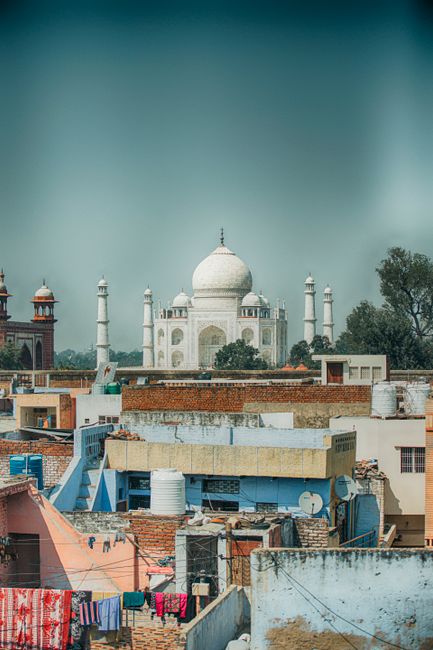
Agra, on the Yamuna River in Uttar Pradesh, about 200 km (125 miles) southeast of Delhi, was the capital of the Mughal emperors for much of the 16th and 17th centuries, and it holds their greatest works. The Taj Mahal, the white marble mausoleum that Shah Jahan built for his wife Mumtaz Mahal, is the most famous building in India and its most visited ticketed monument; the red sandstone Agra Fort, begun by Akbar in 1565, and Akbar’s abandoned capital of Fatehpur Sikri, 40 km (25 miles) to the west, are UNESCO World Heritage Sites too. Beyond them, the city itself is busy, dusty and not especially attractive, but it rewards a slower visit with the jewel-box tomb of Itimad-ud-Daulah, sunset views of the Taj from the Mehtab Bagh gardens across the river, Mughal cooking and the sweet called petha. Agra sits between Delhi and Jaipur on the classic Golden Triangle route. Plan around one rule above all: the Taj Mahal is closed on Fridays.
Right now in Agra
- Wed 23–33°C 74–91°F Mostly clear
- Thu 24–35°C 75–94°F Clear
- Fri 24–31°C 76–88°F Clear
Weather: MET Norway (CC BY 4.0)
Top tours in Agra
See all tours for Agra →
From local operators, with prices and reviews; you check availability and book on Viator, our partner. We may earn a commission at no extra cost to you. How we earn money
Agra at a glance
- Best for: the Taj Mahal at sunrise, Mughal forts and tombs, Fatehpur Sikri, and full-moon night views of the Taj.
- How long: one full day for the Taj and the fort; two days with Fatehpur Sikri, Itimad-ud-Daulah and a sunset at Mehtab Bagh.
- Best time: October to March; the Taj is open from 30 minutes before sunrise to 30 minutes before sunset, every day except Friday.
- Getting there: the fastest trains from Delhi take about 2 hours to Agra Cantonment station; the Yamuna Expressway takes 3 to 4 hours by car.
- Getting around: auto-rickshaws, app cabs and cycle-rickshaws; electric buses and golf carts cover the last stretch to the Taj gates.
- Good to know: foreigners pay ₹1,100 (about US$11.50) at the Taj ticket window, or ₹1,050 online, plus ₹200 to enter the main mausoleum.
- Before you go: the e-Visa, money, trains and general safety are in our India travel guide.
Agra’s areas and where to stay
Most of Agra’s sights lie along the right bank of the Yamuna, with the Taj Mahal at the eastern end of the old city and the Agra Fort about 2.5 km (1.5 miles) upstream.
Taj Ganj
The old quarter immediately south of the Taj Mahal is a maze of lanes with budget guesthouses, rooftop restaurants with Taj views and souvenir shops. It is the best area for an early start at the gates, though it is crowded and touts are persistent.
Fatehabad Road and the Taj East Gate
The broad road leading to the East Gate is lined with mid-range and international hotels, restaurants and shopping arcades, within walking distance or a short battery-bus ride of the Taj. Several luxury hotels here have rooms with views of the monument.
Sadar Bazaar and the Cantonment
The colonial cantonment around Agra Cantt station has quieter, leafier streets, mid-range hotels and the busy Sadar Bazaar for shopping and street food, a short drive from the monuments.
Top things to see in Agra
The Taj Mahal
The Taj Mahal was built by the Mughal emperor Shah Jahan as a tomb for his favorite wife, Mumtaz Mahal, who died in childbirth in 1631; it took more than two decades and some 20,000 workers to complete, and Shah Jahan himself was later buried beside her. Its perfectly balanced design, with a white marble dome on a raised plinth, four minarets, inlay of semiprecious stones and Quranic calligraphy, stands at the end of a formal garden divided by water channels, with a mosque and a matching guesthouse on either side and the river behind. It became a UNESCO World Heritage Site in 1983. Come at sunrise, when the marble glows pink and the crowds are thinnest; the light changes the building’s color through the day.
Tickets and rules. According to Uttar Pradesh Tourism’s official Taj Mahal website, foreigners pay ₹1,100 at the ticket window, including the Archaeological Survey of India (ASI) fee and the Agra Development Authority toll, plus an optional ₹200 to go inside the main mausoleum; buying online through the ASI’s booking site saves ₹50. Citizens of SAARC and BIMSTEC countries pay ₹540 and Indians ₹50, and children under 15 enter free. The foreigner’s ticket includes shoe covers, a half-liter bottle of water and the battery bus or golf cart from the parking areas. The Taj is open from 30 minutes before sunrise to 30 minutes before sunset and closed every Friday. Food, tobacco, tripods, headphones, chargers and large bags are not allowed, drones are banned in and around the monument, and photography is prohibited inside the mausoleum. Entry is through the West Gate or the East Gate, which is usually less crowded; the South Gate is closed for entry.
Night viewing of the Taj Mahal
On the night of the full moon and the two nights before and after it, the ASI opens the Taj for night viewing from 8 p.m. to midnight, in eight half-hour batches of up to 50 people, viewed from the forecourt rather than the mausoleum itself. Tickets cost ₹750 for foreigners and must be booked in advance online or at the ASI office on Mall Road; visitors report to Shilpgram, near the East Gate, half an hour early for security checks. Night viewing does not take place on Fridays or during the month of Ramadan, and phones are not allowed.
Agra Fort
The massive red sandstone walls of the Agra Fort, about 2.5 km (1.5 miles) along the river from the Taj, enclose a palace city begun by Akbar in 1565 and enlarged by Jahangir and Shah Jahan. Highlights include the Diwan-i-Am and Diwan-i-Khas audience halls, Jahangir’s Palace, the Khas Mahal and the octagonal Musamman Burj, where Shah Jahan, imprisoned by his son Aurangzeb, spent his last years looking across the river to the Taj until his death in 1666. It is a UNESCO World Heritage Site. Uttar Pradesh Tourism lists the foreigner’s fee as ₹650, or ₹600 if you have already visited the Taj the same day.
Itimad-ud-Daulah
Nicknamed the “Baby Taj,” this tomb on the left bank of the Yamuna was built by the empress Nur Jahan in the 1620s for her father, a Persian noble. It was the first Mughal building faced entirely with white marble and inlaid with semiprecious stones, and it is a quiet, intimate counterpoint to the crowds at the Taj. Foreigners pay ₹310 at the window.
Mehtab Bagh
The “Moonlight Garden,” a restored Mughal garden directly across the river from the Taj Mahal, is the best place to watch the sunset light on the monument without the crowds. Foreigners pay ₹300 at the gate.
More classic sights
- Akbar’s Tomb, Sikandra: the emperor’s grand tomb in a deer park 10 km (6 miles) northwest of the city, with an unusual mix of Hindu, Islamic and Christian motifs (₹310 for foreigners).
- Chini ka Rauza: the tomb of a 17th-century Persian poet and minister, decorated with glazed tiles.
- Taj Museum: inside the Taj complex, with Mughal miniatures and original architectural drawings; open from 10 a.m. to 5 p.m., entry free.
- Kinari Bazaar: the crowded old market near the Jama Masjid, for wedding finery, spices and sweets.
- Taj Nature Walk: a wooded park near the East Gate with framed views of the dome.
Other things to do in Agra
Food and drink
Agra’s cooking is rich and Mughlai, built on slow-cooked meat curries, kebabs and breads from the tandoor, but its most famous food is vegetarian. The city’s signature sweet is petha, translucent candied ash gourd sold in dozens of flavors around Sadar Bazaar and Noori Darwaza; breakfast is bedai, puffed fried bread stuffed with lentils and served with spicy potato curry, followed by crisp jalebi. Try dalmoth, a spicy lentil snack, and Mughlai biryani and kebabs in the Taj Ganj and Sadar areas. Many rooftop restaurants in Taj Ganj have views of the dome. Drink bottled or filtered water.
Crafts and shopping
Agra is known for marble inlay (pietra dura), the same craft used in the Taj Mahal, still practiced by families descended from the Taj’s craftsmen, as well as leather goods, carpets and zari embroidery. Government emporia and fixed-price showrooms are safer than shops that guides or drivers take you to on commission. Ask for a receipt and be skeptical of “genuine antique” or gem claims.
Mughal heritage walks
Uttar Pradesh Tourism promotes heritage walks in the old city, around the Jama Masjid and Kinari Bazaar, a different view of Agra from the monument circuit. Ask at the government tourist office or your hotel; see our city sightseeing guide.
Festivals
The Taj Mahotsav, a ten-day crafts, food and culture fair at Shilpgram near the East Gate, is held every February. The Urs of Shah Jahan, the anniversary of the emperor’s death, opens the lower tomb chamber to visitors free of charge for three days, usually in January or February. Holi, in March, is celebrated with particular fervor in nearby Mathura and Vrindavan.
Day trips from Agra
- Fatehpur Sikri: Akbar’s red sandstone capital of the 1570s, abandoned within a few decades, about 40 km (25 miles) west. Its palace buildings, the Panch Mahal and Diwan-i-Khas, and the Jama Masjid with the giant Buland Darwaza gate and the white marble tomb of the Sufi saint Salim Chishti, are a UNESCO World Heritage Site. Uttar Pradesh Tourism lists the foreigner’s fee as ₹610 (the mosque and tomb are free). Allow half a day.
- Keoladeo National Park, Bharatpur: a UNESCO-listed wetland bird sanctuary about 55 km (35 miles) west, best from November to February for migratory birds; explore by bicycle or cycle-rickshaw.
- Mathura and Vrindavan: the birthplace of Krishna and its temple town, about 60 km (37 miles) north on the way to Delhi.
- National Chambal Sanctuary: river safaris for gharials, crocodiles and river dolphins on the Chambal, about 70 km (45 miles) southeast.
- Delhi and Jaipur: the other two corners of the Golden Triangle. See our Delhi and Jaipur guides.
Nearby destinations
- Delhi183 km
- Ranthambore National Park199 km
- Jaipur220 km
Getting there and getting around
By train
Agra’s main station is Agra Cantonment (Agra Cantt), about 6 km (4 miles) from the Taj; Agra Fort and Raja ki Mandi stations serve some trains. The fastest services from Delhi, the Gatimaan Express and the Vande Bharat Express, take about 2 hours, and the Shatabdi Express about 2¼ hours; express trains also run to Jaipur, Varanasi and Mumbai. Book early for weekend and holiday departures. Indian Railways runs a tourist booking office for foreigners at Agra Cantt station.
By road and air
The six-lane Yamuna Expressway links Greater Noida, on the edge of Delhi, with Agra; the drive from central Delhi takes 3 to 4 hours, and many visitors hire a car and driver for the Golden Triangle. The road to Jaipur takes about 4 to 5 hours, passing Fatehpur Sikri. Agra’s small airport, about 7 km (4 miles) from the center, has a few domestic flights; most international visitors arrive through Delhi.
Around the city
Auto-rickshaws, cycle-rickshaws, app-based cabs and prepaid taxis cover the city; agree the fare before you set off in an auto-rickshaw. No polluting vehicles are allowed within 500 m (1,640 ft) of the Taj Mahal, so cars stop at the parking areas at Shilpgram (for the East Gate) and Amrood ka Tila (for the West Gate), from which battery buses and golf carts shuttle to the gates. A first metro line is opening in stages near the Taj.
When to go and how long to stay
Agra has the same hot, semi-arid climate as Delhi, with blazing summers. October to March is the best season: dry and sunny, with highs of 22 to 35 °C (72 to 95 °F) and cool nights in December and January, when morning fog can hide the Taj until mid-morning and delay trains. April to June is extremely hot, with highs above 40 °C (104 °F) in May and June, when the marble platform burns underfoot by midday. The monsoon, from July to September, brings humid heat, heavy showers and, often, beautifully clear air after rain. The table shows 1991–2020 normals for Agra’s weather station from the India Meteorological Department (IMD), as published by the World Meteorological Organization (WMO); rainy days are days with at least 2.5 mm of rain.
| Month | Average high / low | Rain (rainy days) | What to expect |
|---|---|---|---|
| January | 22 °C (72 °F) / 7 °C (45 °F) | 12 mm (0.5 in), 1 day | Cool; dense fog some mornings |
| February | 26 °C (79 °F) / 10 °C (51 °F) | 11 mm (0.4 in), 1 day | Pleasant; Taj Mahotsav |
| March | 32 °C (90 °F) / 14 °C (58 °F) | 8 mm (0.3 in), 1 day | Warm; Holi in Mathura and Vrindavan |
| April | 38 °C (101 °F) / 20 °C (68 °F) | 8 mm (0.3 in), 1 day | Hot; start very early |
| May | 42 °C (107 °F) / 24 °C (76 °F) | 21 mm (0.8 in), 2 days | Hottest month |
| June | 41 °C (106 °F) / 26 °C (78 °F) | 46 mm (1.8 in), 3 days | Very hot; monsoon arrives late in the month |
| July | 36 °C (97 °F) / 25 °C (76 °F) | 246 mm (9.7 in), 10 days | Wettest month; humid |
| August | 33 °C (92 °F) / 24 °C (75 °F) | 199 mm (7.8 in), 10 days | Showers; lush gardens |
| September | 34 °C (94 °F) / 24 °C (74 °F) | 111 mm (4.4 in), 6 days | Rains easing |
| October | 35 °C (94 °F) / 19 °C (66 °F) | 25 mm (1.0 in), 1 day | Warm and dry; season begins |
| November | 29 °C (85 °F) / 13 °C (56 °F) | 2 mm (0.1 in), under 1 day | Ideal; hazy mornings |
| December | 24 °C (75 °F) / 8 °C (47 °F) | 3 mm (0.1 in), under 1 day | Cool; fog and train delays |
Agra gets about 690 mm (27 in) of rain a year, about 80% of it from July to September.
One day in Agra
Enter the Taj Mahal at sunrise and spend two or three hours there, breakfast in Taj Ganj, then the Agra Fort in late morning and Itimad-ud-Daulah after lunch, finishing at Mehtab Bagh for sunset across the river.
Two days with Fatehpur Sikri
Add a morning at Fatehpur Sikri, Akbar’s Tomb at Sikandra on the way back, and an evening at Kinari Bazaar, or time your visit for a full-moon night viewing of the Taj.
Where to stay in Agra
- Taj Ganj: budget guesthouses and rooftop views, steps from the gates.
- Fatehabad Road: mid-range and international hotels near the East Gate, some with Taj views.
- The Cantonment: quieter mid-range hotels near Agra Cantt station and Sadar Bazaar.
Book a room with a Taj view for a special occasion, and check the Friday closure before planning your dates. Prices peak from October to March and around Christmas and New Year.
What a trip to Agra costs
Prices are approximate, for October 2026, converted at about 96 rupees (₹) to the US dollar. Monument fees for foreigners are the window prices listed by Uttar Pradesh Tourism’s official Taj Mahal website.
| Item | Typical cost |
|---|---|
| Taj Mahal, foreigners | ₹1,100 at the window, ₹1,050 online (about US$11–11.50) |
| Main mausoleum, optional extra | ₹200 (about US$2) |
| Taj night viewing, foreigners | ₹750 (about US$7.80) |
| Agra Fort, foreigners | ₹650, or ₹600 the same day as the Taj (about US$6.80) |
| Fatehpur Sikri, foreigners | ₹610 (about US$6.40) |
| Itimad-ud-Daulah or Akbar’s Tomb, foreigners | ₹310 (about US$3.20) |
| Auto-rickshaw from Agra Cantt station to the Taj | ₹150–300 (about US$1.50–3) |
| Thali or Mughlai dinner in a mid-range restaurant | ₹500–1,500 (about US$5–16) per person |
| Mid-range hotel double, per night | ₹4,000–10,000 (about US$42–104) |
Practical tips for Agra
- Never plan the Taj on a Friday: it is closed all day to visitors.
- Keep your Taj ticket: it gets you a small discount at the Agra Fort the same day.
- Travel light: leave food, tripods, chargers and large bags at your hotel; lockers at the gates are basic.
- Hire an approved guide: official guides carry identity cards; ask to see one before agreeing a price.
- Go early or late: the Taj is quietest at opening time, and the fort and Itimad-ud-Daulah in late afternoon.
- Check the fog: on December and January mornings, the Taj can be hidden in mist until 10 or 11 a.m.
Safety
Agra is generally safe, but it is one of the most touristed places in India and has more than its share of hustle. Touts and commission scams are the main nuisance: unofficial guides, rickshaw drivers who offer cheap rides and then take you to marble and gem shops, and “special” ticket offers; buy tickets at the official windows or online and use approved guides with identity cards. Heat is a real risk from April to June, when the open marble platform and the fort courtyards become very hot by late morning; carry water and visit early. Food and water: stick to bottled or filtered water and freshly cooked food. Fog in December and January delays trains and makes roads dangerous at night, and road safety on the highways is poor, so avoid night driving and choose a reliable driver. Women travelers may attract unwanted attention around the monuments; dress modestly and use app-based cabs after dark. In an emergency, call 112, the Uttar Pradesh Police helpline.
What to pack for Agra
Light, loose clothes that cover shoulders and knees, a hat and sunscreen, a refillable water bottle (one small bottle is allowed into the Taj), comfortable slip-on shoes, a warm layer for winter mornings and a small day bag that will pass security. India uses 230 V, with round-pin plugs of types C, D and M. See our travel adapters guide.
Agra travel FAQ
Is the Taj Mahal closed on Fridays?
Yes. The Taj Mahal is closed every Friday. On other days it opens 30 minutes before sunrise and closes 30 minutes before sunset.
How much does it cost to visit the Taj Mahal?
Foreigners pay ₹1,100 at the ticket window or ₹1,050 online, plus an optional ₹200 to enter the main mausoleum. Children under 15 enter free.
Do I need the mausoleum ticket?
Only if you want to go inside the main tomb chamber, which holds the cenotaphs of Mumtaz Mahal and Shah Jahan. The basic ticket covers the gardens, gateway, mosque and the marble platform.
Can I visit the Taj Mahal at night?
Yes, on the full-moon night and two nights either side, except Fridays and during Ramadan, in small batches from 8 p.m. to midnight. Foreigners pay ₹750 and must book in advance.
What is the best time of day to see the Taj Mahal?
Sunrise, for soft light and the smallest crowds. Late afternoon is also beautiful, and Mehtab Bagh across the river is the best spot for sunset.
How many days do I need in Agra?
One full day covers the Taj Mahal, the Agra Fort and Itimad-ud-Daulah; two days let you add Fatehpur Sikri and a more relaxed pace.
Can I do Agra as a day trip from Delhi?
Yes. The fastest trains take about 2 hours each way, but a day trip is long and rushed; an overnight stay lets you see the Taj at sunrise.
Which gate of the Taj Mahal should I use?
The East Gate is usually less crowded than the West Gate; the South Gate is closed for entry. Cars must park away from the monument, and battery buses run to both gates.
What can I take into the Taj Mahal?
A phone, a camera, a small bottle of water and a small bag. Food, tobacco, tripods, headphones, chargers and drones are not allowed, and photography is banned inside the mausoleum.
Is Fatehpur Sikri worth visiting?
Yes. Akbar’s abandoned capital is one of the best-preserved Mughal cities, about an hour west of Agra, and is easily combined with the drive to Jaipur.
Sources and last review
Researched and last reviewed on 4 October 2026. Taj Mahal ticket prices, the mausoleum fee, opening hours, the Friday closure, gates, rules, night viewing times and prices, and window prices for Agra Fort, Fatehpur Sikri, Itimad-ud-Daulah, Akbar’s Tomb and Mehtab Bagh: Uttar Pradesh Tourism’s official Taj Mahal website; online ticket prices: the Archaeological Survey of India’s e-ticket booking site; climate normals for Agra: the India Meteorological Department, via the World Meteorological Organization (1991–2020 normals archived by NOAA’s National Centers for Environmental Information); the exchange rate: the Reserve Bank of India (FBIL reference rate). Monument history, UNESCO dates, train times, the metro, festival dates, distances and typical prices are general references or estimates, flagged for checking. Fees and hours change, so check the official sites before you go. For the e-Visa, money and trains, see our India travel guide.
Plan your trip
Partner links: TravelerCenter may earn a commission if you book, at no extra cost to you.
🇮🇳 Useful Hindi phrases for Agra
All 38 Hindi phrases: restaurant, hotel, emergencies, romance (printable) →