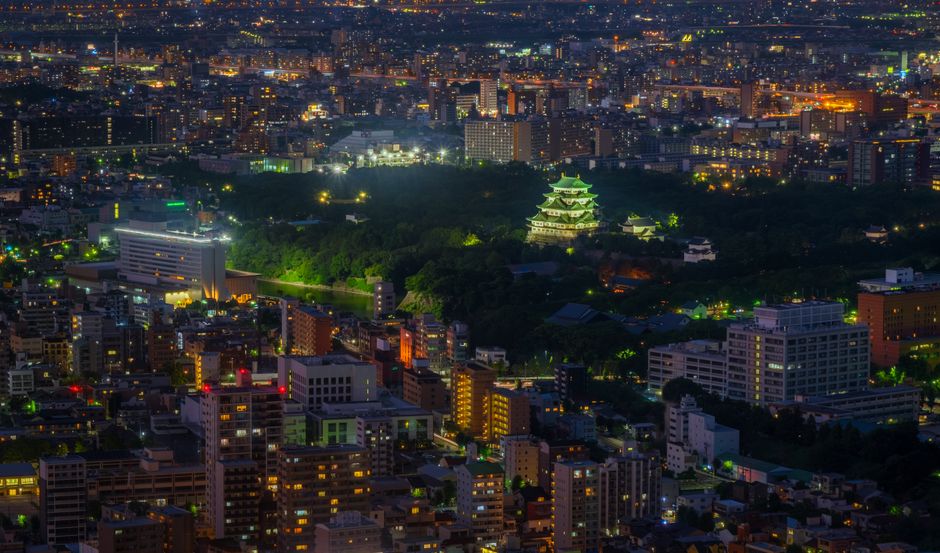
Nagoya is Japan’s fourth-largest city, with about 2.3 million people, the capital of Aichi Prefecture and the industrial heart of central Japan, home of Toyota and of a proud samurai past: the Tokugawa lords who ruled Japan built Nagoya Castle here in the early 1600s. Halfway between Tokyo and Kyoto on the shinkansen, it is often skipped, but it rewards a stop with a rebuilt castle palace of gold and painted screens, one of Japan’s most important shrines at Atsuta, excellent museums of industry and railways, the Ghibli Park nearby, and a hearty local cuisine of miso, eel and chicken wings. Nagoya is also the gateway to Takayama, the Japan Alps, Ise and the old post towns of the Nakasendo. The best months are March to May and October to November; summers are among the hottest in Japan, and the rainy season usually runs from early June to mid-July.
Right now in Nagoya
- Wed 16–24°C 61–76°F 1 mm Clear
- Thu 15–26°C 58–78°F Clear
- Fri 16–25°C 61–78°F Clear
- Mon 12 Oct Sports Day (スポーツの日)
Weather: MET Norway (CC BY 4.0) · Sea temperature: NOAA CoastWatch · Rates: ECB · Holidays: Nager.Date
Top tours in Nagoya
See all tours for Nagoya →
From local operators, with prices and reviews; you check availability and book on Viator, our partner. We may earn a commission at no extra cost to you. How we earn money
Nagoya at a glance
- Best for: castles and samurai history, industry and railway museums, Ghibli Park, local food, shopping, and day trips to Inuyama, Ise and the Japan Alps.
- How long: 1–2 days for the city; 3–4 days with Ghibli Park and day trips.
- Best time: late March to May and October to November, with highs of about 17–25 °C (63–77 °F); avoid the heat of late July and August if you can.
- Getting there: about 1 hour 35 minutes from Tokyo and 35 minutes from Kyoto by Nozomi shinkansen; Chubu Centrair Airport (NGO) is about 30 minutes away by express train.
- Getting around: a simple subway network, JR and Meitetsu trains, and the Me-guru sightseeing bus; pay with an IC card.
- Fees to know: Nagoya Castle’s admission doubled to ¥1,000 for adults on October 1, 2026. Nagoya and Aichi Prefecture do not charge an accommodation tax.
- Before you go: entry rules, rail passes, money and general safety are in our Japan travel guide; see also our Tokyo and Kyoto guides.
Nagoya’s areas and where to stay
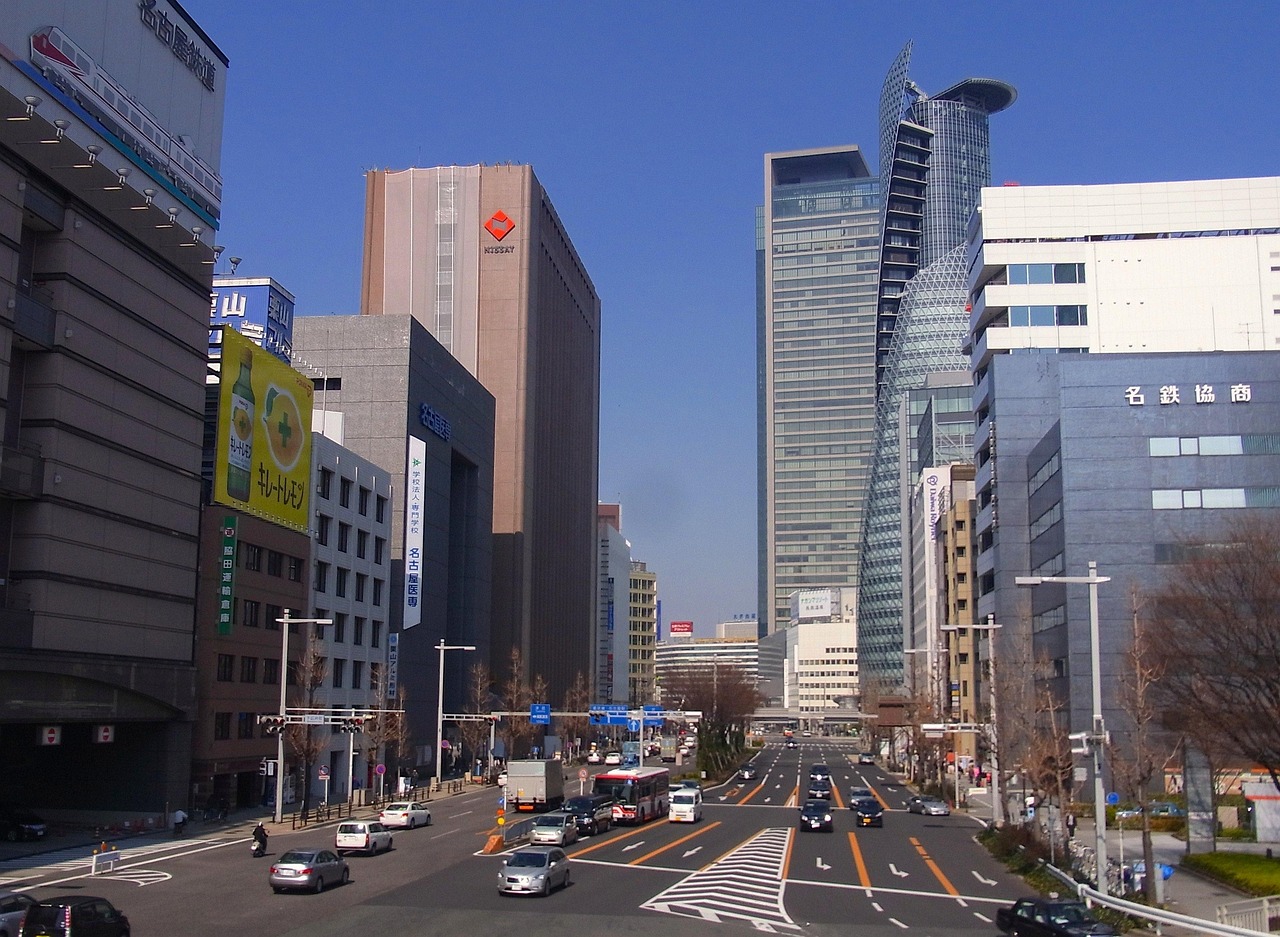
Nagoya was largely rebuilt after World War II on a grid of very wide avenues, which makes it easy to navigate. Most visitors stay around Nagoya Station or Sakae, two subway stops apart.
Nagoya Station (Meieki)
One of the world’s largest station buildings, surrounded by skyscrapers, department stores and underground malls, with trains in every direction. The most practical base, especially for day trips.
Sakae
The downtown shopping and entertainment district, with the TV tower, the Oasis 21 bus terminal and its glass “spaceship” roof, Hisaya-odori Park, department stores, restaurants and nightlife. Lively, and a short subway ride from the castle.
Fushimi and Marunouchi
Between the station and Sakae, a business district with good-value hotels, the Nagoya City Science Museum and the Misono-za theater; Marunouchi leads north to the castle.
Osu
An old temple town turned shopping district around Osu Kannon, with covered arcades of secondhand clothes, electronics, anime shops and street food. Fun to explore, with a few hotels nearby.
Kanayama and Atsuta
South of the center, Kanayama is a transport hub with business hotels, close to Atsuta Jingu and convenient for the airport trains.
Top things to see in Nagoya
Nagoya Castle and the Hommaru Palace
Built by Tokugawa Ieyasu from 1610 as a stronghold for his family, Nagoya Castle was famous for the golden dolphin-like shachihoko on its roof. The keep and palace burned in a 1945 air raid; the concrete keep rebuilt in 1959 has been closed since 2018 for earthquake safety while the city plans a wooden reconstruction, so you can see it only from outside. The highlight is the Hommaru Palace, faithfully rebuilt in cypress wood and opened in full in 2018, with gilded sliding doors and painted ceilings that rival anything in Kyoto. According to the castle’s official site, admission rose from ¥500 to ¥1,000 (about US$6.3) for adults on October 1, 2026 (children of junior high school age and younger free), and the castle is open from 9 a.m. to 4:30 p.m., with last entry at 4 p.m.
Atsuta Jingu
One of Japan’s most important Shinto shrines, in a forest of ancient camphor trees in the south of the city. It is said to keep the sacred sword Kusanagi, one of the three imperial regalia (never shown). Entry to the grounds is free; the treasure hall has swords and other offerings. Try kishimen noodles at the stall inside the precincts.
Toyota Commemorative Museum of Industry and Technology
In a red-brick textile mill where Toyota began as a loom maker, this museum shows the history of weaving machines and cars with working demonstrations; it is near Nagoya Station and excellent even for non-car fans. The Toyota Kaikan Museum and factory tours are in Toyota City, about an hour away.
SCMAGLEV and Railway Park
JR Central’s museum on the waterfront at Kinjofuto, with record-breaking maglev and shinkansen trains, a large model railway and driving simulators; a must for train fans, about 25 minutes from Nagoya Station on the Aonami Line.
Tokugawa Art Museum and Tokugawaen
The treasures of the Owari Tokugawa lords: swords, armor, tea utensils, Noh costumes and scrolls of the Tale of Genji, shown in rotation. Next door, Tokugawaen is a strolling garden with a pond, waterfall and peonies in spring. The castle’s official site sells a combination ticket with Tokugawaen for ¥1,040.
Osu Kannon and Osu shopping streets
A large Buddhist temple with a red main hall, famous for its library of old manuscripts and a flea market on the 18th and 28th of each month. Around it, the Osu arcades mix old shops, vintage clothing, electronics and food stalls.
More classic sights
- Nagoya City Science Museum: home to one of the world’s largest planetariums, in a silver sphere.
- Chubu Electric Power MIRAI TOWER: Japan’s oldest TV tower, in Sakae, with an observation deck and a hotel.
- Noritake Garden: the porcelain maker’s old factory grounds, with a museum and craft center.
- Port of Nagoya Public Aquarium: orcas, belugas and Antarctic penguins at Nagoya Port.
- Shirotori Garden: a large Japanese garden near Atsuta Jingu.
- Legoland Japan: a theme park for children, next to the railway museum.
Castles and forts
- Nagoya Castle
Museums
- Nagoya City Science Museum
- SCMaglev and Railway Park
- Tokugawa Art Museum
- Toyota Commemorative Museum of Industry and Technology
Parks and gardens
- Tokugawa Garden
Churches and cathedrals
- Atsuta Jingū
- Ōsu Kannon Temple
Zoos and aquariums
- Port of Nagoya Public Aquarium
Theme parks
- Legoland Japan Resort
Other things to do in Nagoya
Ghibli Park
The Studio Ghibli theme park opened in 2022 in the Expo 2005 Aichi Commemorative Park in Nagakute, about 40–60 minutes from central Nagoya by subway and the Linimo maglev line. It is not a ride park, but a set of areas recreating places from the films, such as Satsuki and Mei’s house from My Neighbor Totoro and the Valley of Witches. Advance reservations are required. According to Ghibli Park, as of October 2026 the O-Sanpo Day Pass Standard costs ¥3,300 (about US$21) on weekdays and ¥3,800 at weekends for adults, and the Premium pass, covering all five areas, ¥7,300 (about US$46) or ¥7,800; tickets go on sale two months ahead, on the 10th of the month at 2 p.m. Japan time.
Food and drink
Nagoya has one of Japan’s most distinctive local cuisines, called Nagoya-meshi, based on rich red hatcho miso. Try hitsumabushi, grilled eel on rice eaten three ways, the last with broth; miso katsu, pork cutlet with miso sauce; miso nikomi udon, thick noodles simmered in miso in a clay pot; tebasaki, crisp peppery chicken wings, best with beer; kishimen, flat noodles; tenmusu, rice balls with shrimp tempura; and spicy Taiwan ramen, which is actually a Nagoya invention. Locals love the morning service at coffee shops, where a coffee comes with free toast, often ogura toast with sweet red bean paste.
Shopping
The department stores around Nagoya Station and Sakae, the Osu arcades for bargains, and the porcelain of Noritake and nearby Seto and Tokoname. Many shops offer tax-free shopping for visitors on purchases of ¥5,000 or more; from November 1, 2026 you pay the full price and get the tax back after a customs check at the airport (see our Japan travel guide).
Festivals and sports
The Nagoya Festival in October brings parades of samurai and floats through Sakae. Nagoya hosts one of the six annual grand sumo tournaments, in July, at a new arena near the castle, and the Chunichi Dragons play baseball at Vantelin Dome. For more ideas, see our guide to city sightseeing.
Activities and best months
- City sightseeingNagoya Castle's admission rose to ¥1,000 for adults on 1 October 2026 (junior high and younger free); open 9:00-16:30; the concrete keep itself is closed for the planned wooden restoration. · source
Day trips from Nagoya
- Inuyama: a riverside castle town whose 16th-century keep is one of Japan’s few original castles, about 30 minutes by Meitetsu train.
- Gifu: Gifu Castle on a mountaintop and traditional cormorant fishing on the Nagara River in summer evenings, about 20 minutes by JR.
- Ise: Ise Jingu, Japan’s most sacred shrine, and the old streets of Oharai-machi, about 1.5–2 hours by Kintetsu train.
- Magome and Tsumago: two beautifully preserved post towns on the old Nakasendo road, linked by a walking trail of about 8 km (5 miles), about 1.5–2 hours by train and bus.
- Takayama: the old merchant town of the Hida mountains, about 2.5 hours by the JR Hida limited express; see our Takayama guide.
- Kyoto and Osaka: 35 and 50 minutes by Nozomi. See our Kyoto and Osaka guides.
Nearby destinations
- Kyoto105 km
- Takayama112 km
- Nara115 km
- Shirakawa-go121 km
- Osaka139 km
- Kanazawa155 km
- Kobe165 km
- Fuji Five Lakes180 km
Getting there and getting around
By shinkansen and air
Nagoya Station is on the Tokaido Shinkansen: about 1 hour 35 minutes from Tokyo, 35 minutes from Kyoto and 50 minutes from Shin-Osaka by Nozomi. The nationwide Japan Rail Pass (¥50,000 (about US$315) for 7 days on the official site, as of October 2026) covers the Hikari and Kodama; to ride a Nozomi, pass holders need an extra ticket, ¥4,180 (about US$26) between Tokyo and Nagoya. JR’s Hida limited express runs to Takayama and the Shinano to Matsumoto and Nagano. Chubu Centrair International Airport (NGO), on an island in Ise Bay, has flights from across Asia and some long-haul routes; the Meitetsu µSky limited express reaches Nagoya Station in about 30 minutes.
Around the city
Nagoya’s six subway lines cover the center: the Higashiyama Line links Nagoya Station, Fushimi and Sakae, and the Meijo Line loops around the city. The Me-guru sightseeing bus links Nagoya Station, the Toyota museum, Noritake Garden, the castle, the Tokugawa museum and Sakae, and sells a day pass. Pay with an IC card: Suica, PASMO and ICOCA all work, as well as the local manaca. Visitors can buy a Welcome Suica or a Tourist PASMO in Tokyo, valid for 28 days, but money left on a Tourist PASMO is not refunded.
When to go and how long to stay
Nagoya lies on a broad plain, so summers are very hot and winters cold and dry, with the occasional snowfall blown in from the Sea of Japan. The table uses the Japan Meteorological Agency’s (JMA) 1991–2020 normals for its Nagoya station: average daily highs and lows, total rain and days with at least 1 mm of rain.
| Month | Average high / low | Rain (days with 1 mm or more) | What to expect |
|---|---|---|---|
| January | 9 °C (49 °F) / 1 °C (34 °F) | 51 mm (2.0 in), 5 days | Cold, dry and sunny; occasional light snow |
| February | 11 °C (51 °F) / 1 °C (35 °F) | 65 mm (2.5 in), 6 days | Cold; plum blossoms; occasional snow |
| March | 15 °C (58 °F) / 5 °C (40 °F) | 116 mm (4.6 in), 9 days | Cherry blossoms usually open around Mar 24 (JMA normal) |
| April | 20 °C (68 °F) / 10 °C (49 °F) | 128 mm (5.0 in), 9 days | Full bloom around April 2; pleasant and busy |
| May | 25 °C (76 °F) / 15 °C (59 °F) | 150 mm (5.9 in), 10 days | Warm and sunny; Golden Week crowds early in the month |
| June | 28 °C (82 °F) / 19 °C (67 °F) | 187 mm (7.3 in), 12 days | Rainy season usually from about June 6 (JMA normal for Tokai) |
| July | 31 °C (89 °F) / 24 °C (74 °F) | 211 mm (8.3 in), 12 days | Hot and humid; rainy season usually ends around July 19; sumo tournament |
| August | 33 °C (92 °F) / 25 °C (76 °F) | 140 mm (5.5 in), 9 days | The hottest month; highs often above 35 °C (95 °F) |
| September | 29 °C (84 °F) / 21 °C (70 °F) | 232 mm (9.1 in), 11 days | Still hot; the wettest month; typhoons possible |
| October | 23 °C (74 °F) / 15 °C (59 °F) | 165 mm (6.5 in), 9 days | Comfortable; Nagoya Festival; typhoons possible early |
| November | 17 °C (63 °F) / 9 °C (47 °F) | 79 mm (3.1 in), 6 days | Clear and cool; maples late in the month |
| December | 12 °C (53 °F) / 3 °C (38 °F) | 57 mm (2.2 in), 6 days | Cold and dry; maples linger early in the month; illuminations |
Nagoya gets about 1,580 mm (62 in) of rain a year, with the most from June to September. The JMA’s normal rainy season for the Tokai region runs from about June 6 to July 19; in 2026 it ran from about June 2 to July 9. August highs average about 33 °C (92 °F), and heat warnings are common, so plan indoor sights for the afternoon.
Weather month by month
Averages from JMA normals 1991–2020, Nagoya · Last reviewed 5 Oct 2026
Cherry blossoms and fall colors: the JMA’s normal date for the first cherry blossoms in Nagoya is March 24, with full bloom around April 2; in 2026 they opened early, on March 17. The castle grounds, Tsuruma Park and the Yamazaki River are the best spots. The maples at the JMA’s Nagoya station normally turn around November 28; the gorge of Korankei, in Toyota City, is a famous maple spot in mid- to late November.
Crowds: Nagoya rarely feels overcrowded, but Ghibli Park sells out on weekends and holidays, and hotels fill up during big trade fairs and Golden Week.
Two days in Nagoya
Day one, Nagoya Castle and the Hommaru Palace in the morning, the Tokugawa Art Museum and Tokugawaen in the afternoon, and a hitsumabushi dinner in Sakae. Day two, the Toyota museum, then Atsuta Jingu and the Osu shopping streets, with tebasaki and beer in the evening.
Four days with day trips
Add a day at Ghibli Park and a day trip to Inuyama, Ise or the Nakasendo post towns, or continue to Takayama and the Japan Alps.
Where to stay in Nagoya and taxes
- Nagoya Station: chain and luxury hotels, the easiest base for day trips and the shinkansen.
- Sakae: hotels close to restaurants, shopping and nightlife.
- Fushimi: good-value business hotels between the two.
- Kanayama: budget business hotels near Atsuta Jingu and the airport line.
Nagoya’s hotels are usually cheaper than those in Tokyo, Kyoto or Osaka. As of October 2026, neither the City of Nagoya nor Aichi Prefecture charges an accommodation tax; Japan’s 10% consumption tax is usually included in room rates, and hot spring hotels add a small bathing tax.
What a trip to Nagoya costs
Prices are approximate, for October 2026, converted at about ¥158 to the US dollar.
| Item | Typical cost |
|---|---|
| Nagoya Castle (adults, from Oct 1, 2026) | ¥1,000 (about US$6.3) |
| Nagoya Castle and Tokugawaen combination ticket | ¥1,040 (about US$6.6) |
| Ghibli Park O-Sanpo Day Pass Standard, weekday | ¥3,300 (about US$21) |
| Subway ride | ¥210–340 (about US$1.3–2.2) |
| Hitsumabushi | ¥4,000–6,500 (about US$25–41) |
| Miso katsu or miso nikomi udon set | ¥1,200–2,200 (about US$7.6–14) |
| Coffee with morning service | ¥500–700 (about US$3.2–4.4) |
| Business hotel double, per night | ¥9,000–18,000 (about US$57–115) |
| Upscale hotel double, per night | ¥25,000–50,000 (about US$160–315) |
Practical tips for Nagoya
- Ghibli Park: buy tickets the day they go on sale, two months ahead; there are no same-day tickets at the gate.
- The castle keep: it is closed for the planned reconstruction, so budget your time for the Hommaru Palace and grounds.
- Station exits: Nagoya Station is huge; JR is on the east (Sakura-dori) side and the shinkansen on the west (Taiko-dori) side.
- Morning service: go to a local coffee shop before 11 a.m. for the free breakfast with your drink.
- Departure tax: since July 2026, Japan’s International Tourist Tax is ¥3,000 per departure, usually included in your air fare (tickets issued by June 30, 2026 keep the old ¥1,000).
- Visitor hotline: the JNTO’s Japan Visitor Hotline, 050-3816-2787, answers in English 24 hours a day.
Safety
Nagoya is a very safe city. The main risks are natural: intense heat from July to early September, when heatstroke warnings are frequent, typhoons from August to October, which can stop the shinkansen, and earthquakes: central Japan has prepared for a possible large Nankai Trough earthquake for years, and you may see evacuation signs and tsunami routes near the port. If you feel strong shaking, take cover, follow staff instructions, and keep the JNTO’s Safety Tips app on your phone. In an emergency, call 110 for the police or 119 for an ambulance or fire.
What to pack for Nagoya
Light, breathable clothes, a hat and a water bottle for summer; a warm coat in winter, when the wind off the mountains is cold; comfortable shoes and a folding umbrella. Japan uses 100 V and two-pin type A plugs like the US.
What to pack
- City walking shoesLisbon and Porto are steep, with polished limestone cobbles that get slippery, so grippy soles matter.
- Day packs and anti-theft bagsA small zipped or anti-theft bag makes crowded trams and viewpoints less stressful.
- Rain jacketsFrom October to April Porto and Lisbon see rain on roughly a third of days.
- Travel adapters and convertersPortugal uses Type C and F sockets at 230 V, so most visitors from outside Europe need an adapter.
Nagoya travel FAQ
Is Nagoya worth visiting?
Yes, for a day or two: the Hommaru Palace, Atsuta Jingu, superb museums, Ghibli Park and distinctive local food, plus easy day trips to Inuyama, Ise and Takayama.
How much is Nagoya Castle?
¥1,000 for adults from October 1, 2026, up from ¥500; children of junior high school age and younger enter free.
Can I go inside Nagoya Castle’s keep?
No. The 1959 concrete keep has been closed since 2018 for safety while a wooden reconstruction is planned; the Hommaru Palace is open.
How do I get tickets for Ghibli Park?
Tickets must be booked in advance; they go on sale two months ahead, on the 10th of the month at 2 p.m. Japan time.
How do I get from Tokyo to Nagoya?
The Nozomi shinkansen takes about 1 hour 35 minutes. JR Pass holders can take the Hikari or pay ¥4,180 extra for the Nozomi.
What food is Nagoya famous for?
Hitsumabushi eel on rice, miso katsu, miso nikomi udon, tebasaki chicken wings, kishimen noodles and coffee-shop morning service.
How many days do I need in Nagoya?
One or two days for the city; three or four with Ghibli Park and day trips.
Is there an accommodation tax in Nagoya?
No. As of October 2026, neither Nagoya nor Aichi Prefecture charges one.
How do I get from Chubu Airport to Nagoya?
The Meitetsu µSky limited express reaches Nagoya Station in about 30 minutes.
Can I visit Takayama from Nagoya?
Yes, the JR Hida limited express takes about 2.5 hours; it’s better to stay at least one night in Takayama.
Sources
- © OpenStreetMap contributors · ODbL · fetched 5 Oct 2026
- Wikidata · CC0 · fetched 5 Oct 2026
Sources and last review
Researched and last reviewed on 4 October 2026. Nagoya Castle fees, hours and keep closure: Nagoya Castle’s official site (City of Nagoya); Ghibli Park passes: Ghibli Park; climate normals, rainy season and cherry blossom and maple dates: the Japan Meteorological Agency (JMA); JR Pass and Nozomi ticket: the official Japan Rail Pass website; tax-free shopping: the Japan Tourism Agency; visitor hotline: JNTO; exchange rate: the US Federal Reserve. The absence of an accommodation tax, population, history, sight descriptions, journey times, festival dates, other admission prices and typical prices are general references or estimates, flagged for checking. Prices and hours change, so check the official sites before you go. For entry rules, money and general safety, see our Japan travel guide.
Plan your trip
Partner links: TravelerCenter may earn a commission if you book, at no extra cost to you.
🇯🇵 Useful Japanese phrases for Nagoya
All 38 Japanese phrases: restaurant, hotel, emergencies, romance (printable) →