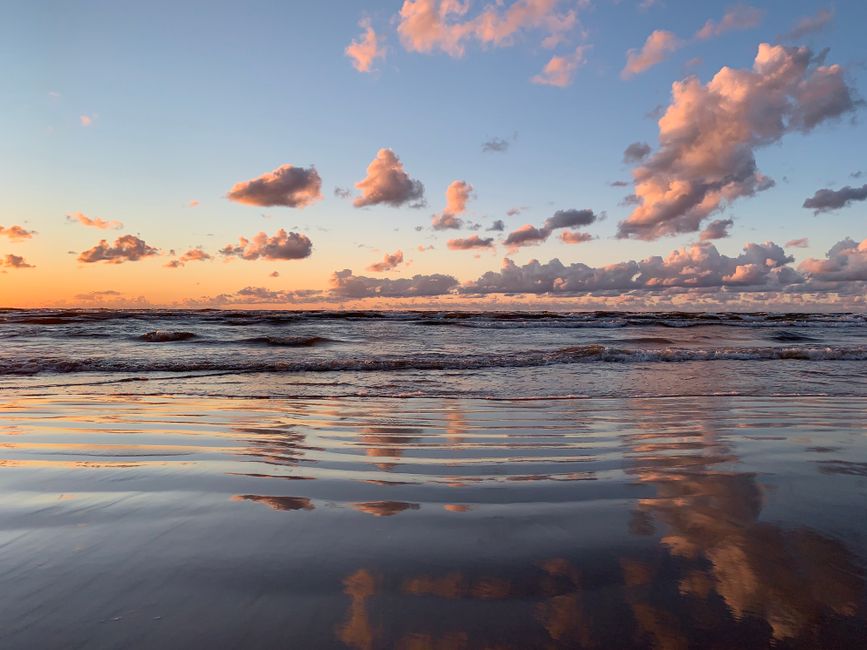
Jūrmala is Latvia’s seaside resort: a 24 km ribbon of fine quartz sand, dunes and pine forest on the Gulf of Riga, half an hour by train from the capital. In the 19th century it became one of the Russian Empire’s favourite places to take the sea air, and it is still lined with carved wooden villas, Art Nouveau summer houses and spa hotels. Majori, the centre, has the pedestrian street Jomas iela, cafés and the liveliest beach; Dzintari has the summer concert hall; and at the western end, Ķemeri offers mud baths and the Great Ķemeri Bog Boardwalk in a national park. Come from late June to August for swimming and concerts, or out of season for long beach walks and spas. Jūrmala works as a day trip from Riga, but two or three nights let you enjoy the sunsets and quiet mornings.
Right now in Jūrmala (Majori)
- Wed 8–16°C 47–61°F Clear
- Thu 8–17°C 47–63°F Partly cloudy
- Fri 10–14°C 49–57°F 5 mm Cloudy
Weather: MET Norway (CC BY 4.0) · Sea temperature: NOAA CoastWatch · Air quality: OpenAQ · Rates: ECB
Top tours in Jūrmala
See all tours for Jūrmala →
From local operators, with prices and reviews; you check availability and book on Viator, our partner. We may earn a commission at no extra cost to you. How we earn money
Jūrmala at a glance
- Best for: a long sandy beach, wooden architecture, spas and mud treatments, summer concerts, cycling and a bog walk in Ķemeri National Park.
- How long: a day trip from Riga for the beach and Majori; 2–3 days to add Ķemeri, cycling and a spa.
- Best time: late June to mid-August for swimming and festivals; May, early June and September for quiet walks; any time for spas.
- Getting in: about 30 minutes by train from Riga to Majori (about €2.30); 15 minutes’ drive from Riga Airport.
- Getting around: trains stop at 14 stations along the resort, and a flat cycle path runs its whole length. Drivers pay a €5 daily entry fee.
- Budget: pricier than Riga in July and August, especially hotels near the beach; cheaper and calmer off-season.
Jūrmala, area by area
Jūrmala is a long, thin city between the sea and the Lielupe River, made up of more than ten former villages. According to the Central Statistical Bureau, it had 52,926 inhabitants at the beginning of 2026, and it was the only one of Latvia’s state cities whose population grew in 2025. From east to west, the main areas are:
- Lielupe and Bulduri: the first stops from Riga, with the Lielupe River, sailing clubs, a water park, the Ragakāpa dunes and quieter beaches. Good for families and nature.
- Dzintari: elegant villas, a forest park with a viewing tower, and the Dzintari Concert Hall by the beach. Good for culture and calm.
- Majori and Dubulti: the centre, with Jomas iela, the tourist information centre, the busiest beach, restaurants and spa hotels. Good for first visits and nightlife.
- Jaundubulti to Kauguri: residential areas with long, uncrowded beaches.
- Ķemeri: the old spa town at the western end, on the edge of Ķemeri National Park, with the resort park, sulphur springs and the bog boardwalk. Good for walkers and wellness.
Top things to see in Jūrmala
Most of Jūrmala’s sights are free: the beach, the streets of villas, the parks and the boardwalk. Check concert and museum hours locally, as many change with the season.
The beach
Jūrmala’s beach runs for about 24 km along the Gulf of Riga, backed by forested dunes. The sea is calm, shallow and only slightly salty (5–7 parts per thousand), and the sand is pale and firm enough for barefoot walks and cycling. According to Visit Jūrmala, the beach is cleaned regularly, water quality at the official bathing sites is tested twice a month in the swimming season, and ten of the eleven sites have excellent long-term water quality. Lifeguards watch the main beaches in summer. Smoking, pets, overnight stays and camping are not allowed on the beaches.
Majori beach, at the end of Jomas iela, is the liveliest, with sun loungers for hire, beach cafés, sports courts and a nearly kilometre-long illuminated beach promenade between Turaidas and Tirgoņu streets, plus the bronze “Turtle” sculpture of 1995. For quiet, walk east towards Dzintari and Bulduri or west beyond Dubulti. In a warm July the water can reach about 20 °C. See our beaches guide.
Jomas iela
Jūrmala’s pedestrian main street runs about a kilometre through Majori, parallel to the beach. It is lined with cafés, restaurants, ice-cream kiosks and old wooden houses, with flower beds and street performers in summer. Side streets lead to the sea in a couple of minutes. The tourist information centre is nearby at Lienes iela 5.
Wooden villas and Art Nouveau architecture
Jūrmala’s greatest treasure is its architecture: hundreds of wooden summer villas from the 19th and early 20th centuries, with verandas, towers, lacy carved eaves and stained glass, set in pine-shaded gardens. Some are beautifully restored, others romantically decaying. The best streets for a walk are in Dzintari, Majori and Dubulti, and the Art Nouveau Lutheran church in Dubulti is a landmark. Visit Jūrmala publishes free walking routes and a digital audio guide.
The Dzintari Concert Hall
The open-air Dzintari Concert Hall, in the pine trees just behind the beach, has hosted summer concerts since the 1930s and was rebuilt and covered with a modern roof in the 2010s. It is the main stage of the Jūrmala Festival, with classical, jazz and popular concerts through the summer; one highlight is a sunrise concert on the beach by the Latvian organist Iveta Apkalna. Check the summer programme and buy tickets in advance.
Ķemeri National Park and the Great Ķemeri Bog Boardwalk
Ķemeri National Park, on Jūrmala’s western edge, protects raised bogs, wetlands, forests and the lakes of the coast. Its most popular walk is the Great Ķemeri Bog Boardwalk (Lielā Ķemeru tīreļa laipa), a wooden path across a vast raised bog dotted with dark pools and stunted pines. There are two loops: a short one of 1.4 km to the first lakes and a long one of 3.4 km with a viewing tower over the bog. It is free and especially beautiful at sunrise and in autumn, when the bog turns red and gold. The car park is a few kilometres from Ķemeri station, so most people come by car or bike. Stay on the boards and bring insect repellent in summer. See our hiking guide.
Ķemeri resort park and the spa tradition
Ķemeri was the heart of Jūrmala’s spa industry, thanks to its sulphurous mineral water and peat mud. According to Visit Jūrmala, the only place in Latvia where therapeutic peat mud is still extracted is the Slokas Lake bog, inside the national park, and mud and mineral baths are still given at the Ķemeri rehabilitation centre. The landscaped Ķemeri resort park has bridges, pavilions and springs, and the white 1930s Ķemeri Hotel, nicknamed the “White Ship”, stands nearby.
Other sights
- Dzintari Concert Hall
- Jomas iela
Parks and gardens
- Ķemeri Resort Park
Nature
- Great Ķemeri Bog Boardwalk
Protected areas
- Ķemeri National Park
Spas, cycling and more experiences
- Spas: many hotels along the beach offer pools, saunas, massages and mud treatments, with day passes for non-guests. Visit Jūrmala lists spas, sanatoriums and rehabilitation centres on its health pages.
- Cycling: the flat beach and a cycle path along the whole resort make Jūrmala ideal by bike. You can rent bikes in Majori, or ride the 20 km EuroVelo 10 route from Riga’s Vanšu bridge. See our cycling guide.
- On the water: summer boats cruise the Lielupe River, and there are paddleboard and kayak rentals on the river and the sea. See our boat trips guide.
- Dunes and forests: walk the Ragakāpa dunes at Lielupe or the forest park in Dzintari, with a viewing tower over the pines.
- Families: playgrounds on the beach, a water park in Lielupe and the shallow, calm sea make Jūrmala easy with children.
Activities and best months
- Beaches and swimmingJunJulAugJūrmala's 24 km beach on the Gulf of Riga has eleven official bathing sites; the Jūrmala Beach Rescue Service has stations at Bulduri, Majori and Kauguri in the swimming season, seaweed is cleared every morning by 8:00 and rubbish collected twice a day, water quality is monitored with the Health Inspectorate, and lifeguards hand out wristbands for children with parents' contact details. · source
- CyclingThe EuroVelo 10 cycle route runs 20 km from Riga's Vanšu bridge to Jūrmala along Daugavgrīvas, Kliņģeru, Kuldīgas, Slokas and Kandavas streets and Jūrmalas gatve, parallel to the railway; bicycles go on the trains with a ticket. · source
- HikingThe Great Ķemeri Bog Boardwalk in Ķemeri National Park, at Jūrmala's western end, is free and open all year: a short loop of 1.5 km (about 1 hour) to the first bog lakes and a long loop of 3.5 km (about 1.5 hours) to an observation tower. From Ķemeri station, cross the railway and walk 1 km to the Ventspils road, then follow the signs; in June-August express bus No. 5 runs to the 'Ķemeri Boardwalk' stop. · source
Seasons and festivals in Jūrmala
Summer is the high season, from Midsummer (Līgo and Jāņi on 23–24 June) to the end of August, with concerts at the Dzintari Concert Hall, the Jūrmala Festival, open-air art exhibitions and sand sculptures on the Dzintari and Majori beaches, and the busiest weekends in July. September is calmer and still mild, and the forests and bog turn golden in October. Winter brings empty, sometimes snowy beaches, frozen edges on the sea in cold years, and spa breaks. Check visitjurmala.lv for the 2027 programme.
Day trips and nearby places
- Riga: the Latvian capital’s Old Town and Art Nouveau district are 30 minutes away by train.
- Ķemeri National Park: the bog boardwalk, Lake Kaņieris with its bird tower, and forest trails, at Jūrmala’s western end.
- Tukums and the Courland coast: continue west by train to Tukums, or drive on to Kuldīga and the coast at Cape Kolka.
- Rundāle Palace and Sigulda: easier from Riga, but reachable by car from Jūrmala in about 1–1.5 hours.
Getting to Jūrmala and getting around
By train. The easiest way. Vivi trains towards Tukums, Ķemeri or Sloka leave Riga Central Station from platform 4 and stop at 14 stations in Jūrmala, from Priedaine to Ķemeri. According to Visit Jūrmala, the ride takes 20–50 minutes and costs €2.30–2.80, depending on the stop: Riga to Majori takes about 30 minutes and costs €2.30. Buy tickets at the station or in the Vivi app; tickets bought from the conductor cost a little more. Bicycles need a separate ticket. For the beach, get off at Majori or Dzintari; for the bog boardwalk, Ķemeri.
By minibus. Minibuses leave from Riga International Coach Terminal and take about 30 minutes to Majori.
By car: the Jūrmala entry fee. Jūrmala is about 20 km west of Riga on the A10/E22 highway and 15 minutes from Riga Airport. From 1 January 2026, every car entering Jūrmala’s special regime zone, marked “Paid zone” (Maksas zona), pays an entry fee of €5 a day, all year round. Pay at the machines at Priedaine (coming from Riga) or Vaivari (coming from the west), by card or contactless, or online, by app or at the tourist information centre. Longer permits cost €20 for 7 days and €60 for 30 days. Electric cars and vehicles adapted for disabled drivers are exempt. Public parking in Jūrmala is free all year, including at the Majori car park by the tourist information centre. Visit Jūrmala does not list any separate per-person resort fee for visitors.
By bike. The EuroVelo 10 route runs 20 km from Riga’s Vanšu bridge to Jūrmala, mostly alongside the railway.
When to go and how long to stay
Jūrmala shares Riga’s climate, with a little more wind and slightly cooler summer afternoons by the water. There is no official WMO climate station in Jūrmala itself, so the table uses LVĢMC’s official 1991–2020 normals for the Rīga (University of Latvia) station, about 20 km to the east, submitted to the World Meteorological Organization.
| Season | Average daily high | Average nightly low | Rain per month | What it’s like |
|---|---|---|---|---|
| Winter (Dec–Feb) | 0–1 °C | −5 to −2 °C | 40–50 mm | Empty, windy beaches and spa breaks; snow possible |
| Spring (Mar–May) | 5 °C rising to 18 °C | −2 to 8 °C | 34–48 mm | The driest season; cool sea, fresh forests |
| Summer (Jun–Aug) | 21–24 °C | 12–15 °C | 65–80 mm | Beach season, concerts and long evenings; showers |
| Autumn (Sep–Nov) | 17 °C falling to 5 °C | 10 °C falling to 1 °C | 56–76 mm | Mild September, golden bogs in October, then dark |
The station records about 675 mm of rain a year. July is the warmest month, with highs of about 24 °C. Swimming season usually runs from late June to mid-August.
Jūrmala in 1 day
Take a morning train from Riga to Dzintari and walk along the beach to Majori, about 2 km. Have lunch on Jomas iela, explore the wooden villas of Majori and Dubulti, then swim or rest on the beach and watch the sunset before the train back.
Jūrmala in 3 days
Day 1 as above. Day 2: rent a bike and ride west to Ķemeri for the resort park and the Great Ķemeri Bog Boardwalk, with lunch in Ķemeri. Day 3: a spa morning, the Lielupe River and the Ragakāpa dunes, and a concert at Dzintari in summer.
Weather month by month
Averages from LVĢMC normals 1991–2020, Rīga LU · Last reviewed 4 Oct 2026
Where to stay in Jūrmala
- Majori: spa hotels on the beach and guesthouses near Jomas iela; the most convenient, and busiest in July.
- Dzintari and Bulduri: quieter villas, apartments and boutique hotels among the pines.
- Ķemeri and Jaunķemeri: spa and rehabilitation hotels and campsites close to the national park.
Book early for summer weekends, Midsummer and festival dates. Off-season spa packages are good value.
Practical tips for Jūrmala
- Take the train: it is cheap, frequent and avoids the €5 car entry fee and summer traffic.
- Know the beach rules: no smoking, pets, camping or overnight stays on the beaches; follow the lifeguards’ flags.
- Buy drinks early: shops sell alcohol only from 10:00 to 20:00 (18:00 on Sundays), and drinking on the beach is not allowed.
- Ticks and mosquitoes: use repellent in Ķemeri and the forests, and check for ticks after walks.
- Bring a layer: evenings by the sea are cool, even in July.
What to pack for Jūrmala
Swimwear, a towel, sun cream, sunglasses and a hat for the beach; a fleece or light jacket for windy evenings; and comfortable shoes or hiking shoes for the bog boardwalk, with insect repellent. A light rain jacket helps in any season, and water shoes are useful for children in the shallows. In winter, bring warm layers for beach walks and a swimsuit for the spa.
What to pack
- Day packs and anti-theft bagsCarries water, towel and sunscreen down the long stairways to Algarve coves.
- Dry bags and phone pouchesProtects phones and cameras from sand and spray on beaches reached by ferry or steep paths.
- Fleeces and warm layersSummits like Pico do Areeiro averaged about 11 °C over 2024, so a fleece is needed even in summer.
- HeadlampsLevada routes such as PR1 and PR9 pass through long, dark, wet tunnels.
- Hiking shoes and bootsMadeira's levadas and the Azores' crater rims are wet, rocky and slippery, so grippy shoes matter more than anywhere else in Portugal.
- Quick-dry beach towelsA sand-shedding quick-dry towel packs small for beach days and lido visits.
- Rain jacketsA packable shell covers showers and wind on coastal routes outside summer.
- Reef-friendly sunscreenSummer UV is strong on Portuguese beaches and there is little shade below the cliffs.
- Trekking polesLong stone staircases and steep descents on Madeira's peaks and the Azores' crater rims are easier on the knees with poles.
- Water bottles and hydration packsRiding in the Algarve and Alentejo heat needs more water than you expect.
- Water shoesRocky coves, lava pools and weever fish in shallow sand make water shoes useful.
- WetsuitsOn the west and north coasts the sea stays around 16–18 °C even in summer, so a thin suit helps for long swims.
Jūrmala travel FAQ
How do I get from Riga to Jūrmala?
By train from Riga Central Station towards Tukums, Ķemeri or Sloka: Majori is about 30 minutes away and costs €2.30, according to Visit Jūrmala. Minibuses also run from the coach terminal in about 30 minutes.
How much is the Jūrmala entry fee?
From 1 January 2026, cars entering Jūrmala’s paid zone pay €5 a day, all year. Pay at the machines at Priedaine or Vaivari, online or by app. Electric cars are exempt, and train passengers pay nothing extra.
Is there a resort or tourist tax in Jūrmala?
Visitors arriving by car pay the €5 daily entry fee. Visit Jūrmala does not list a separate per-person resort fee for visitors as of October 2026; check your hotel booking for any local charges.
Which station is best for the beach in Jūrmala?
Majori, for Jomas iela and the liveliest beach, or Dzintari for the concert hall and a quieter stretch. The beach is a few minutes’ walk from both.
How long is the Great Ķemeri Bog Boardwalk?
There are two loops: a short one of 1.4 km and a long one of 3.4 km with a viewing tower. It is free. Allow one to two hours, and come by car or bike, as it is a few kilometres from Ķemeri station.
Can you swim at Jūrmala?
Yes, from late June to mid-August. The sea is shallow and calm and can reach about 20 °C in a warm spell. Water quality is tested twice a month in season, and ten of the eleven official bathing sites have excellent long-term quality.
Is Jūrmala worth visiting outside summer?
Yes, for long beach walks, the wooden villas, autumn colours on the bog and spa breaks. Many beach cafés close, but hotels and restaurants on Jomas iela stay open and prices are lower.
How many days do you need in Jūrmala?
One day from Riga for the beach and Majori; two or three days to add Ķemeri National Park, cycling and a spa.
Is parking free in Jūrmala?
According to Visit Jūrmala, public parking is free all year, including at the Majori car park next to the tourist information centre, once you have paid the €5 entry fee.
Sources
- © OpenStreetMap contributors · ODbL · fetched 4 Oct 2026
- Wikidata · CC0 · fetched 4 Oct 2026
Sources and last review
Researched and last reviewed on 4 October 2026. Population from the Central Statistical Bureau of Latvia; the entry fee, long-term permits and exemptions, train times and fares, parking, minibuses, the cycle route, beach rules and water quality, the bog boardwalk and peat mud from Visit Jūrmala, the official tourism site; climate from LVĢMC’s official 1991–2020 normals for the Rīga (University of Latvia) station (WMO collection). Building dates for the Dzintari Concert Hall and Ķemeri Hotel, the distance from Ķemeri station to the boardwalk, sea temperatures and summer event details are from general or secondary sources and are flagged for checking. Prices, timetables and rules change, so check the official links before you go.
Plan your trip
Partner links: TravelerCenter may earn a commission if you book, at no extra cost to you.
🇱🇻 Useful Latvian phrases for Jūrmala
All 38 Latvian phrases: restaurant, hotel, emergencies, romance (printable) →