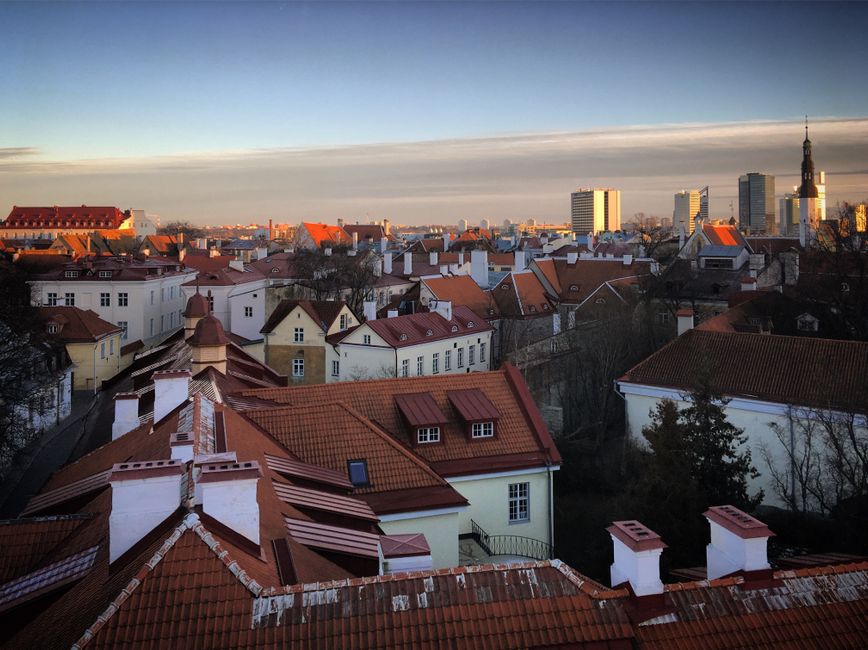
Tallinn, Estonia’s capital, has one of the best-preserved medieval old towns in Europe: a walled Hanseatic port of church spires, merchants’ houses and cobbled lanes, with a castle hill above it and the Baltic Sea at its feet. The Old Town is a UNESCO World Heritage Site, and you can walk across it in 20 minutes. Around it, Tallinn is a modern, digital city of creative quarters in old factories, a baroque palace and park at Kadriorg, the Kumu art museum, the Seaplane Harbour museum and long sandy beaches. It is two hours by ferry from Helsinki and a short flight from much of Europe. Come in summer for white nights and terraces, or from late November for the Christmas market. Give it two or three days, and a fourth for Lahemaa National Park or Helsinki.
Right now in Tallinn
- Wed 10–15°C 49–58°F Clear
- Thu 8–14°C 46–57°F 3 mm Cloudy
- Fri 9–12°C 48–54°F 7 mm Rain
Weather: MET Norway (CC BY 4.0) · Sea temperature: NOAA CoastWatch · Air quality: OpenAQ · Rates: ECB
Top tours in Tallinn
See all tours for Tallinn →
From local operators, with prices and reviews; you check availability and book on Viator, our partner. We may earn a commission at no extra cost to you. How we earn money
Tallinn at a glance
- Best for: a medieval old town, towers and city walls, museums of art, history and the sea, creative districts, food and saunas, and an easy base for Estonian nature.
- How long: 2 days for the Old Town and Kadriorg; 3–4 days to add the Seaplane Harbour, Telliskivi, a beach and a day trip to Lahemaa or Helsinki.
- Best time: late May to early September for long, light days and outdoor life; late November to early January for the Christmas market and snow.
- Getting in: Tallinn Airport is 4 km from the centre, with trams 2 and 4 into town; ferries from Helsinki take about two to two and a half hours and arrive a short walk from the Old Town.
- Getting around: walk in the centre, and use trams and buses elsewhere. As of October 2026, a one-hour ticket costs €2: just tap a contactless bank card on board.
- Budget: cheaper than Helsinki or Stockholm, though Old Town restaurants and hotels are not cheap in summer. Weekday lunch menus, markets and free viewpoints help.
Tallinn, area by area
According to Statistics Estonia, 452,563 people lived in Tallinn on 1 January 2026, a third of the country. The sights are concentrated in and around the Old Town, and most areas are within a 30-minute walk or a short tram ride of each other.
The Old Town: Lower Town and Toompea
The Old Town (Vanalinn) has two halves. The Lower Town was the home of merchants and craftsmen, centred on Town Hall Square; Toompea, the limestone hill above, was the seat of the nobility and the bishop, and is still home to the parliament and government. Steep lanes called Long Leg and Short Leg (Pikk jalg and Lühike jalg) link the two. Best for: first visits and atmosphere; busiest at summer middays when cruise passengers arrive.
Kalamaja, Telliskivi and the harbour
Just north-west of the Old Town, Kalamaja is an old fishing and workers’ district of colourful wooden houses, now full of cafés. Next door, Telliskivi Creative City fills former factory buildings with studios, shops, restaurants and the Fotografiska photography gallery, and the Balti jaam market sits by the main railway station. Along the seafront are the Seaplane Harbour museum, the former Patarei sea fortress prison and the Noblessner shipyard quarter with restaurants and a sea sauna. Best for: food, design and a local feel.
Kadriorg and Pirita
Two kilometres east of the centre, Kadriorg is a green park laid out by Peter the Great around his baroque palace, now an art museum, with the Kumu art museum, the presidential palace and quiet wooden villas around it. Further along the coast, the Song Festival Grounds look down on the bay, and Pirita has a long sandy beach, a ruined convent and the river where Olympic sailing events were held in 1980. Best for: art, parks and seaside walks.
City Centre and Rotermann
Outside the walls to the east, the modern centre around Viru Square has shopping centres, big hotels and the Rotermann Quarter, where old industrial buildings have been rebuilt with bold modern architecture. It is handy for the ferry terminals and the airport tram. Best for: practical stays and shopping.
Top things to see in Tallinn
Prices and hours below were checked on the official sites in October 2026 unless noted. They change, so check before you go. Many museums are closed on Mondays outside summer.
Town Hall Square and the Town Hall
The heart of the Lower Town has been a market place since the Middle Ages. Tallinn Town Hall, finished in the early 1400s, is the only surviving Gothic town hall in northern Europe; the weather vane on its spire, Old Thomas, has watched over the city since 1530. Across the square is the Town Hall Pharmacy, one of the oldest pharmacies in Europe still working on the same spot. In summer the square fills with café terraces, and in winter with the Christmas market.
Tickets and hours. The Town Hall is open to all visitors only from 1 June to 31 August (Monday to Thursday 11:00–18:00, Friday to Sunday 11:00–16:00), when tickets cost €7 for adults, €5 for students and seniors and €15 for a family. From September to May it can be visited only by appointment on weekdays, at a special price of €14, apart from 28–30 December, when it opens 11:00–16:00. The Town Hall tower is open only from 1 June to 31 August, daily 11:00–18:00, for €6 (€4 for students and children); it is 115 steep, narrow steps to the top, and it is closed on 23–24 June and 20 August. The tower is closed in October.
Toompea: the castle, cathedrals and viewpoints
Climb Pikk jalg to Toompea, where Toompea Castle, with its pink baroque façade and the medieval Tall Hermann tower, houses the Estonian parliament. Opposite stands the Russian Orthodox Alexander Nevsky Cathedral, built in 1900 when Estonia was part of the Russian Empire. A few steps away, St Mary’s Cathedral (the Dome Church) is full of the coats of arms of Baltic German nobles. The classic views over the Lower Town’s red roofs are from the free Kohtuotsa and Patkuli viewing platforms, best early in the morning or at sunset.
The city walls, Kiek in de Kök and the bastion tunnels
Almost 2 km of Tallinn’s medieval wall survives, with more than 20 towers. You can walk a short stretch of the wall near the Nunne, Sauna and Kuldjala towers, and admire the Viru Gate from outside. The six-storey cannon tower Kiek in de Kök (“peep into the kitchen”) on the slope of Toompea is a museum of fortifications, linked to the Maiden Tower and to the 17th- and 18th-century tunnels dug under the bastions. Secondary sources list a combined ticket of about €16 for adults as of 2026, with opening from Tuesday to Sunday, 11:00–18:00, from October to April; the City Museum’s own website could not be read, so check before you go.
St Olaf’s Church and St Nicholas’ Church
The spire of St Olaf’s Church (Oleviste) was, in the 16th century, among the tallest in the world. Today you can climb a long, narrow staircase to a viewing platform halfway up, open in the warmer months, usually from April to October; check the current price and hours on site. The Gothic Niguliste Museum, in the former St Nicholas’ Church, is part of the Art Museum of Estonia and holds medieval church art, including a fragment of Bernt Notke’s Danse Macabre; it is open Tuesday to Sunday, 10:00–18:00.
Kadriorg Palace and Kumu
Peter the Great built Kadriorg Palace for his wife Catherine after conquering Estonia in the Great Northern War. Today the baroque palace is the Kadriorg Art Museum, with Western European and Russian art, and its formal garden, swan pond and Japanese garden are lovely in every season. At the top of the park, Kumu, the main building of the Art Museum of Estonia, opened in 2006 in a striking curved building cut into the limestone bank. It tells the story of Estonian art from the 18th century to Soviet-era and contemporary work.
Tickets and hours. As of October 2026, Kumu costs €16 for adults, €11 for students and seniors and €32 for a family (two adults and their children). A combined ticket for three museums in Kadriorg costs €28, and one for five Art Museum of Estonia museums €40. Kumu is open Tuesday, Wednesday and Friday to Sunday 10:00–18:00, Thursday 10:00–20:00, and is closed on Mondays. Take tram 1 or 3 to Kadriorg.
The Seaplane Harbour (Lennusadam)
The Estonian Maritime Museum’s biggest site fills three huge concrete-domed seaplane hangars built in 1916–1917 for the Russian Empire’s navy. Inside you can walk through the 1930s submarine Lembit, see a replica of a 1930s seaplane and an old wreck, and try the flight and ship simulators; outside, the icebreaker Suur Tõll and minehunter Valvas are moored at the quay. Allow at least two hours. It is a 20-minute walk from the Old Town along the seafront.
Tickets and hours. As of October 2026, the combined Seaplane Harbour ticket (the hangar, temporary exhibition and the two museum ships) costs €22 for adults, €11 for children aged 9–18 and students, and €40 for a family. A ticket that adds Fat Margaret, the museum’s tower at the Old Town’s sea gate, costs €30. From October to April it is open Tuesday to Sunday, 10:00–18:00; from May to September every day, 10:00–19:00. It is closed on 24 December and 1 January.
Telliskivi Creative City and Kalamaja
Telliskivi is the place to see modern Tallinn: a former railway factory turned into a district of studios, design shops, street art, bars and restaurants, with a flea market on Saturday mornings and the Fotografiska gallery. Walk on through Kalamaja’s wooden streets to the seafront, or to the Balti jaam market, which sells farm food, street food and Soviet-era bric-a-brac. Entry to the area is free.
More museums: history, the Soviet years and the open-air museum
- Vabamu Museum of Occupations and Freedom: a clear, moving account of the Soviet and Nazi occupations and Estonia’s return to independence.
- KGB Museum in the Hotel Viru: the secret radio room on the hotel’s top floor, seen on a guided tour.
- Estonian Open Air Museum (Rocca al Mare): farmhouses, windmills and a village church moved from all over the country to a seaside forest west of the centre.
- Tallinn TV Tower: an observation deck at 170 m in the Pirita forest, with the 1980 Olympic sailing story and an edge walk for the brave.
- The Song Festival Grounds: the open-air arena where crowds sang for freedom in the “Singing Revolution”; walk up for the views and the history.
Monuments
- Tallinn Town Hall
Historic centres
- Tallinn Old Town
Other sights
- Kiek in de Kök
Castles and forts
- Toompea Castle
Churches and cathedrals
- St Olaf's Church
Museums
- Kadriorg Palace
- Seaplane Harbour (Lennusadam)
More experiences in Tallinn
- Walking tours: free tip-based walking tours leave from the Old Town every day, and guided tours explore the Soviet era and Kalamaja. See our city sightseeing guide.
- Sauna: try a public sauna, a sea sauna at Noblessner or Kalaranna, or a cold dip in the Baltic between rounds.
- Beaches: Pirita is the main city beach, with a 2 km stretch of sand and pine woods, and Stroomi is a quieter family beach west of Kalamaja. The water is usually warm enough to swim only in July and August; see our beaches guide.
- Food: try black bread, sprats, smoked fish and creative new Estonian cooking, and the Telliskivi and Balti jaam markets for cheap eats.
- By bike and boat: cycle the seafront promenade from the harbour to Pirita, or take a summer boat to the island of Naissaar or Prangli; see our cycling and boat trips guides.
Activities and best months
- Beaches and swimmingJunJulAugTallinn has five city beaches: Pirita, the longest and most popular, a 2 km Blue Flag beach with Old Town views about 20 minutes by bus from the centre; Stroomi, a family beach with playgrounds and a 2.5 km promenade; shallow, quiet Kakumäe; Pikakari, a Blue Flag beach by the Katariina pier; and freshwater Harku lake. Visit Tallinn gives water temperatures of 18-22 °C. · source
- Boat tripsMayJunJulAugSepBoats run from Tallinn to the islands of the bay: Sunlines' Vigtund to Aegna (30 minutes, May-September) from Linnahall quay; Sunlines, Monica and Nicesaar to Naissaar (30 minutes to 1 h 15 min) from Linnahall, Pirita and the Seaplane Harbour, an island of sandy beaches, hiking trails, a narrow-gauge railway and military heritage; and the ferry Wrangö from Leppneeme in Viimsi to Prangli (1 hour) all year, several times a day from April to October. · source
- City sightseeingVisit Tallinn's top sights start with the UNESCO-listed Old Town, with its well-preserved street network and city walls, Town Hall Square and the Gothic Town Hall, and Toompea Castle, seat of the parliament, with viewing platforms and St Mary's Cathedral; then the Niguliste Museum, Kadriorg Palace and park with Kumu, the Seaplane Harbour maritime museum, the Noblessner, Telliskivi and Rotermann quarters and the 314 m TV Tower. · source
Festivals and seasons in Tallinn
The Christmas market 2026
The Tallinn Christmas Market fills Town Hall Square from 20 November 2026 to 6 January 2027, open every day 10:00–20:00, with hot drinks served until 22:00 (23:00 on Fridays and Saturdays). It opens at 18:00 on 20 November with the lighting of the tree, which Tallinn claims continues the world’s first public Christmas tree, put up in 1441. Expect wooden huts selling woollens and crafts, blood sausage, sauerkraut and mulled wine (glögi), carousels for children and weekend concerts. Advent is proclaimed on 29 November. Drinks come in reusable cups with a €2 deposit.
Summer: white nights, Midsummer and Old Town Days
From late May to late July the nights hardly get dark, and life moves outdoors to terraces, beaches and parks. Midsummer Eve (23 June) and St John’s Day (24 June) are public holidays, when many locals leave for the countryside and the Estonian Open Air Museum holds traditional celebrations with a bonfire. Tallinn Old Town Days, a medieval festival, takes place in early summer, and the Black Nights Film Festival lights up November.
Day trips from Tallinn
- Lahemaa National Park: about an hour’s drive east. See Palmse Manor and its park, the captains’ village of Käsmu with its boulder-strewn shore, the fishing village of Altja and the Viru bog boardwalk, a 3.5 km wooden path across a raised bog with a viewing tower. Buses are infrequent, so hire a car or book a tour. See our hiking guide.
- Helsinki: two to two and a half hours by ferry, with many sailings a day. Leave early and come back on an evening boat for a full day in the Finnish capital.
- Keila-Joa and the north coast: a waterfall and manor park west of the city, with limestone cliffs at Türisalu, and the flooded Rummu quarry with its underwater prison ruins, popular with divers and swimmers.
- Tartu: Estonia’s university city, about two hours by Elron train, for the Estonian National Museum and student life.
- Pärnu: the summer resort, about two hours by bus, for a beach day or a spa break.
Getting to Tallinn
By air. Tallinn Airport (Lennart Meri, TLL) is one of the closest airports to a city centre in Europe, about 4 km away. As of October 2026, the options into town are:
- Tram: tram 4 runs from the airport to Tondi via the city centre, and tram 2 runs to the Old City Harbour and Kopli. They leave from the public transport centre at the city end of the terminal and take about 15–20 minutes to the centre. Tap a contactless bank card on the validator on board, or buy a €2 one-hour QR ticket from the machine by the stop.
- Bus: city bus 2 runs from Tartu highway, a short walk from the terminal, to the centre and the harbour.
- Taxi or app: taxis wait outside arrivals, and Bolt and other ride apps pick up at the airport. The ride to the Old Town takes about 10 minutes.
By ferry. Ferries from Helsinki arrive at the Old City Harbour (Vanasadam), a 10–15-minute walk from the Old Town; Tallink uses Terminal D and Viking Line and Eckerö Line use Terminal A. The fast ships take about two to two and a half hours. Overnight ferries come from Stockholm, and many Baltic cruise ships call in summer. Tram 2 links the harbour with the airport.
By bus and train. Coaches from Riga (about four and a half hours, via Pärnu) and Vilnius arrive at the Tallinn Bus Station, east of the centre. Elron trains from Tartu, Narva, Viljandi and Valga use Balti jaam, next to the Old Town; Elron also runs a direct train between Riga and Tallinn via Tartu, and other trains connect at Valga.
Getting around Tallinn, tickets and the Tallinn Card
The Old Town is for walking (in comfortable shoes: the cobbles are uneven and steep). Elsewhere, Tallinn has trams, buses and trolleybuses running from about 5:00 to midnight, with night buses on Friday and Saturday nights. Public transport is free for registered residents of Tallinn, but not for visitors.
- Fares as of October 2026: €2 for a one-hour ticket, €5.50 for 1 day, €9 for 3 days, €11 for 5 days and €30 for 30 days. Children under 7 travel free.
- Tap and go: the simplest option is to tap a contactless bank card on a validator inside the vehicle each time you board. Each tap buys a one-hour ticket, and once you have spent the price of a day ticket, further rides that day are free.
- Ühiskaart: for longer stays, buy the public transport card at a kiosk or the tourist information centre and load a 3- or 5-day ticket. Validate on every boarding; QR tickets must be scanned at the front of the vehicle.
- Tallinn Card: a 24-, 48- or 72-hour card with free public transport and free entry to many museums and sights, including the Seaplane Harbour, Kumu and, in summer, the Town Hall. It is sold online, in the app and at the tourist information centre. Secondary sources list prices of roughly €43–45 for 24 hours, €63–65 for 48 hours and €76–78 for 72 hours in 2026, with a small discount online; check the official price before buying. It pays off if you visit three or four paid sights a day.
Bolt, founded in Tallinn, is the main ride-hailing app, and its electric scooters and bikes are everywhere in summer. Only take taxis from ranks or by app, and check the price on the window sticker before getting in.
When to go and how long to stay
Tallinn has a cool coastal climate: mild, light summers and cold, dark winters with some snow. The table uses the Estonian Environment Agency’s official 1991–2020 normals for the Tallinn-Harku station, on the western edge of the city, submitted to the World Meteorological Organization.
| Season | Average daily high | Average nightly low | Rain per month | What it’s like |
|---|---|---|---|---|
| Winter (Dec–Feb) | −1 to 1 °C | −6 to −3 °C | 40–59 mm | Short days, snow on and off, slippery cobbles; Christmas market until 6 January |
| Spring (Mar–May) | 3 °C rising to 15 °C | −4 to 5 °C | 35–37 mm | The driest season; cold March, fresh green May |
| Summer (Jun–Aug) | 19–22 °C | 10–13 °C | 68–85 mm | White nights, terraces and beaches; Midsummer; showers |
| Autumn (Sep–Nov) | 16 °C falling to 4 °C | 8 °C falling to 0 °C | 58–78 mm | Golden September, then wet, windy and dark |
Tallinn gets about 700 mm of rain a year, on about 124 days. July is the warmest month, with highs of about 22 °C; February is the coldest, with nights around −6 °C. Late May, June and early September are often the best balance of weather and crowds. In October expect highs of about 10 °C and frequent rain.
Tallinn in 2 days
Day 1: the Lower Town in the morning, from the Viru Gate to Town Hall Square and St Olaf’s; climb to Toompea for the cathedrals and viewpoints; afternoon at Kiek in de Kök and the bastion tunnels, or the Niguliste Museum; dinner in the Old Town. Day 2: tram to Kadriorg for the palace park and Kumu; lunch at the Rotermann Quarter; then the Seaplane Harbour and an evening in Telliskivi.
Tallinn in 4 days
Add a day trip to Lahemaa National Park on day 3 (manors, fishing villages and the Viru bog). On day 4, take the ferry to Helsinki, or stay in town for Vabamu, the Open Air Museum, the TV Tower and a sauna and swim at Pirita or Noblessner.
Weather month by month
Averages from Estonian Environment Agency normals 1991–2020, Tallinn-Harku · Last reviewed 4 Oct 2026
Where to stay in Tallinn
- The Old Town: historic hotels in medieval houses, steps from everything; atmospheric, but cars are restricted and summer nights can be noisy.
- City Centre and Rotermann: big modern hotels by Viru Square, a short walk from the Old Town and handy for the ferries and the airport tram.
- Kalamaja and Telliskivi: apartments, design hotels and hostels in a lively local area, near Balti jaam station.
- Kadriorg and Pirita: quiet stays near the park and the sea, 10–20 minutes by tram or bus from the centre.
Rooms are dearest in summer, at Midsummer and around New Year, and cheapest from January to March. Many hotels include breakfast and a sauna.
Practical tips for Tallinn
- Beat the cruise crowds: the Old Town is busiest from about 10:00 to 16:00 on summer days when several ships are in port. Explore early in the morning and in the evening.
- Check museum days: Kumu and many other museums are closed on Mondays, and the Seaplane Harbour closes on Mondays from October to April.
- Watch your bill: some Old Town restaurants add a service charge, and the UK government warns about pickpockets in Old Town bars and clubs. Use official taxis or an app.
- Pay by card: almost everything takes contactless cards. Shops sell alcohol only between 10:00 and 22:00.
- Plan for the light: in June the sun sets after 22:30; in December it sets around 15:20, so start sightseeing early.
What to pack for Tallinn
Comfortable shoes with a good grip for the steep, uneven cobbles are the most important thing. Bring layers and a light waterproof rain jacket in every season, a warm layer for ferry decks and the wind off the sea, and swimwear for the beaches and saunas in summer. From November to March, add a warm coat, hat, gloves and ice grips for your shoes. A contactless card and a type C/F plug adapter complete the list.
What to pack
- City walking shoesLisbon and Porto are steep, with polished limestone cobbles that get slippery, so grippy soles matter.
- Day packs and anti-theft bagsCarries water, towel and sunscreen down the long stairways to Algarve coves.
- Dry bags and phone pouchesProtects phones and cameras from sand and spray on beaches reached by ferry or steep paths.
- Fleeces and warm layersIt is cooler at sea than on land, especially on morning whale-watching trips.
- Quick-dry beach towelsA sand-shedding quick-dry towel packs small for beach days and lido visits.
- Rain jacketsA windproof, waterproof shell keeps you warm on open boats, where wind and spray cool you quickly.
- Reef-friendly sunscreenSummer UV is strong on Portuguese beaches and there is little shade below the cliffs.
- Travel adapters and convertersPortugal uses Type C and F sockets at 230 V, so most visitors from outside Europe need an adapter.
- Water shoesRocky coves, lava pools and weever fish in shallow sand make water shoes useful.
- WetsuitsOn the west and north coasts the sea stays around 16–18 °C even in summer, so a thin suit helps for long swims.
Tallinn travel FAQ
Is public transport free in Tallinn for tourists?
No. It is free only for registered residents. As of October 2026, visitors pay €2 for a one-hour ticket, €5.50 for a day, €9 for three days and €11 for five days. The easiest way is to tap a contactless bank card on the validator each time you board.
How do I get from Tallinn Airport to the Old Town?
Take tram 4 (to Tondi via the centre) or tram 2 (to the Old City Harbour) from the transport centre at the city end of the terminal, paying €2 by contactless card or QR ticket. It takes about 15–20 minutes. A taxi or Bolt takes about 10 minutes.
How long is the ferry from Helsinki to Tallinn?
About two to two and a half hours on the fast ships of Tallink, Viking Line and Eckerö Line, with many sailings a day all year. Ferries arrive at the Old City Harbour, a 10–15-minute walk from the Old Town.
Can you climb the Town Hall tower in Tallinn?
Only from 1 June to 31 August, daily 11:00–18:00, for €6 (€4 for students and children), and not on 23–24 June or 20 August. It is 115 steep steps. Outside summer, the free Kohtuotsa and Patkuli viewing platforms on Toompea give the classic views.
How much does Kumu cost?
As of October 2026, €16 for adults, €11 reduced and €32 for a family. It is closed on Mondays and open until 20:00 on Thursdays. A combined ticket for three Kadriorg museums costs €28.
How much is the Seaplane Harbour museum?
As of October 2026, the combined ticket costs €22 for adults, €11 for children aged 9–18 and €40 for a family, or €30 with Fat Margaret. From October to April it opens Tuesday to Sunday, 10:00–18:00.
Is the Tallinn Card worth it?
It can be if you visit three or more paid museums a day and use public transport. It includes free transport and entry to many sights, such as Kumu and the Seaplane Harbour. Compare the official price with the tickets you plan to buy; if you mostly walk the Old Town, single tickets are cheaper.
When is the Tallinn Christmas Market in 2026?
From 20 November 2026 to 6 January 2027 on Town Hall Square, every day from 10:00 to 20:00, with hot drinks until 22:00 (23:00 on Fridays and Saturdays).
How many days do you need in Tallinn?
Two days cover the Old Town, Kadriorg and the Seaplane Harbour. Three or four days let you add Telliskivi, a beach or sauna, and a day trip to Lahemaa or Helsinki.
Can you visit Lahemaa National Park from Tallinn?
Yes, as a day trip: it is about an hour’s drive east. Buses are infrequent, so hire a car or join a guided tour to see Palmse Manor, Käsmu, Altja and the Viru bog boardwalk in one day.
Sources
- © OpenStreetMap contributors · ODbL · fetched 4 Oct 2026
- Wikidata · CC0 · fetched 4 Oct 2026
Sources and last review
Researched and last reviewed on 4 October 2026. Population from Statistics Estonia; public transport fares and ticket rules from Visit Tallinn; airport trams and buses from Tallinn Airport; Town Hall and tower prices and hours from Tallinn Town Hall (raekoda.tallinn.ee); Kumu and Niguliste from the Art Museum of Estonia; the Seaplane Harbour from the Estonian Maritime Museum; the Christmas market from its organisers; climate from the Estonian Environment Agency’s official 1991–2020 normals for Tallinn-Harku (WMO collection); safety from the UK Foreign Office. Tallinn Card prices, Kiek in de Kök prices and hours, St Olaf’s tower, ferry crossing times and the Viru bog trail length come from secondary sources and are flagged for checking. Prices, timetables and rules change, so check the official links before you go. For another northern capital, see our Stockholm guide.
Plan your trip
Partner links: TravelerCenter may earn a commission if you book, at no extra cost to you.
🇪🇪 Useful Estonian phrases for Tallinn
All 38 Estonian phrases: restaurant, hotel, emergencies, romance (printable) →